Log In


Tsumeb Mine (Ongopolo Mine), Tsumeb, Oshikoto Region, Namibiai
| Regional Level Types | |
|---|---|
| Tsumeb Mine (Ongopolo Mine) | Mine (Inactive) |
| Tsumeb | Constituency |
| Oshikoto Region | Region |
| Namibia | Country |

This page kindly sponsored by Marcus J. Origlieri, Ph.D.


Latitude & Longitude (WGS84):
19° 13' 37'' South , 17° 43' 39'' East
Latitude & Longitude (decimal):
Type:
Mine (Inactive) - last checked 2018
Deposit first discovered:
1893
Age:
1000 to 541 ± 1.0 Ma
Geologic Time:
Köppen climate type:
Nearest Settlements:
| Place | Population | Distance |
|---|---|---|
| Tsumeb | 12,190 (2013) | 1.3km |
| Grootfontein | 24,099 (2014) | 55.6km |
| Otavi | 4,562 (2012) | 62.6km |
Other/historical names associated with this locality:
Tsumcorp Mine
Other Languages:
Afrikaans:
Tsumeb, Tsumeb, Osjikoto, Namibië
French:
Tsumeb, Tsumeb, Oshikoto, Namibie
German:
Tsumeb Mine, Tsumeb, Oshikoto, Namibia
Italian:
Tsumeb, Tsumeb, Regione di Oshikoto, Namibia
Russian:
Цумеб, Цумеб, Ошикото, Намибия
Simplified Chinese:
楚梅布, 楚梅布, 奧希科托區, 纳米比亚
Spanish:
Tsumeb, Tsumeb, Región de Oshikoto, Namibia
Belarusian:
Цумеб, Намібія
Bulgarian:
Цумеб, Цумеб, Ошикото, Намибия
Catalan:
Tsumeb, Tsumeb, Namíbia
Cebuano:
Tsumeb, Tsumeb, Oshikoto, Namibya
Danish:
Tsumeb, Tsumeb, Namibia
Dutch:
Tsumeb, Tsumeb, Oshikoto, Namibië
Esperanto:
Cumebo, Cumebo, Namibio
Finnish:
Tsumeb, Tsumeb, Oshikoto, Namibia
Greek:
Τσουμέμπ, Τσουμέμπ, Ναμίμπια
Hebrew:
צואמב, צואמב, נמיביה
Japanese:
ツメブ, ツメブ, オシコト州, ナミビア
Korean:
추메브, 추메브, 오시코토 주, 나미비아
Norwegian:
Tsumeb, Oshikoto (region), Namibia
Polish:
Tsumeb, Tsumeb, Oshikoto, Namibia
Romanian:
Tsumeb, Tsumeb, Namibia
Shona:
Tsumeb, Tsumeb, Namibia
Swedish:
Tsumeb, Tsumeb, Namibia
Traditional Chinese:
楚梅布, 納米比亞
Turkish:
Tsumeb, Tsumeb, Oshikoto Bölgesi, Namibya
Ukrainian:
Цумеб, Цумеб, Ошикото, Намібія
Zulu:
Tsumeb, INamibhiya
A world-famous Cu-Pb-Zn-Ag-Ge-Cd mine, renowned for a wealth of rare and unusual minerals. On January 21, 1893, Matthew Rogers discovered the "green hill," and the site started operating in 1907 and closed in 1996 for economic reasons.
However, even before the "official" discovery, the deposit had been known for ages by local Bushmen and exploited by them artisanally to recover copper.
Mineralisation is hosted in Neoproterozoic Otavi dolomite. The orebody is an ore pipe. It is about 120 by 15 meters in cross-section, steeply dipping and extending from the surface to at least 1,000 meters in depth. Controls for ore emplacement include interrupted circular fracturing, core breccia, and an internal mass of pseudo-aplite (Tsumeb Pipe). Local rocks include mainly Late Proterozoic sedimentary terrane.
Workings include extensive underground openings to a depth of 1,000 meters.
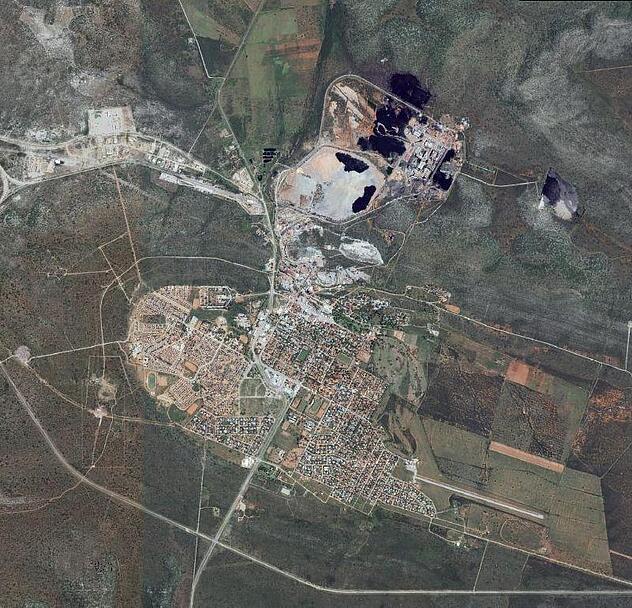
The De Wet shaft is on Main Street.
The Mindat icon shows the surface plant.
Please look for the other icons to see the location of the former "green hill" and exploitation of the early days and also where the De Wet and Friedrich-Wilhelm shafts are situated.
However, even before the "official" discovery, the deposit had been known for ages by local Bushmen and exploited by them artisanally to recover copper.
Mineralisation is hosted in Neoproterozoic Otavi dolomite. The orebody is an ore pipe. It is about 120 by 15 meters in cross-section, steeply dipping and extending from the surface to at least 1,000 meters in depth. Controls for ore emplacement include interrupted circular fracturing, core breccia, and an internal mass of pseudo-aplite (Tsumeb Pipe). Local rocks include mainly Late Proterozoic sedimentary terrane.
Workings include extensive underground openings to a depth of 1,000 meters.
The De Wet shaft is on Main Street.
The Mindat icon shows the surface plant.
Please look for the other icons to see the location of the former "green hill" and exploitation of the early days and also where the De Wet and Friedrich-Wilhelm shafts are situated.
Select Mineral List Type
Standard Detailed Gallery Strunz Chemical ElementsCommodity List
This is a list of exploitable or exploited mineral commodities recorded from this region.Mineral List
Mineral list contains entries from the region specified including sub-localities350 valid minerals. 76 (TL) - type locality of valid minerals. 1 (FRL) - first recorded locality of unapproved mineral/variety/etc. 2 erroneous literature entries.
Rock Types Recorded
Rock list contains entries from the region specified including sub-localities
Select Rock List Type
Alphabetical List Tree DiagramDetailed Mineral List:
| ⓘ Abellaite Formula: NaPb2(CO3)2(OH) References: Desor, J. (10/2023) SEM-EDS & Raman spectroscopyIdentified by Joy Desor: SEM-EDS, Raman Spectroscopy |
| ⓘ Acanthite Formula: Ag2S |
| ✪ Adamite Formula: Zn2(AsO4)(OH) Description: https://youtu.be/3qgo9po-bT8 A very interesting presentation on the Adamite-Zincolvinite-Olivenite series. References: |
| ⓘ Formula: Zn2(AsO4)(OH) Description: Analysis shows less than 0.1% Cobalt, consequently cannot be regarded as 'cobaltoan' |
| ⓘ Formula: (Zn,Cu)2AsO4OH Description: "Cuprian adamite" is primarily Zincolivenite or close to end-member Adamite. References: |
| ⓘ Agardite-(Ce) Formula: CeCu6(AsO4)3(OH)6 · 3H2O |
| ✪ Alamosite Formula: PbSiO3 Habit: divergent sprays Colour: clear / white Description: “Until the nineteen seventies the presence of lead silicates was unknown at Tsumeb. The first lead silicate specimen, alamosite, was discovered during a photographic session at the collection of W.R. Kahn. A piece of aragonite was to be featured, but the specimen that was photographed was slightly too heavy for aragonite. It was composed of radiating 8 cm spray of bundles of elongated, terminated white crystals up to 4 cm. The luster was also different to the known luster of the carbonate. Further examination gave the surprising result that this aragonite was in fact alamosite. This particular specimen is the best alamosite yet found anywhere. Another great specimen belongs to the collection of the Houston Museum. Tsumeb is the only locality from which crystals of alamosite have been reported, and a total of about 20 specimens have been found. Alamosite is often associated with small green-black spheres of melanotekite.”1
Georg Gebhard, Tsumeb, 1999, p163. References: |
| ⓘ Albite Formula: Na(AlSi3O8) |
| ⓘ Almandine Formula: Fe2+3Al2(SiO4)3 |
| ⓘ Anatase Formula: TiO2 |
| ⓘ Andyrobertsite (TL) Formula: KCdCu5(AsO4)4(H2AsO4) · 2H2O Type Locality: Habit: na Colour: Blue |
Tsumeb Mine, Tsumeb, Oshikoto Region, Namibia