Log In


Digenite
A valid IMA mineral species - grandfathered
This page is currently not sponsored. Click here to sponsor this page.


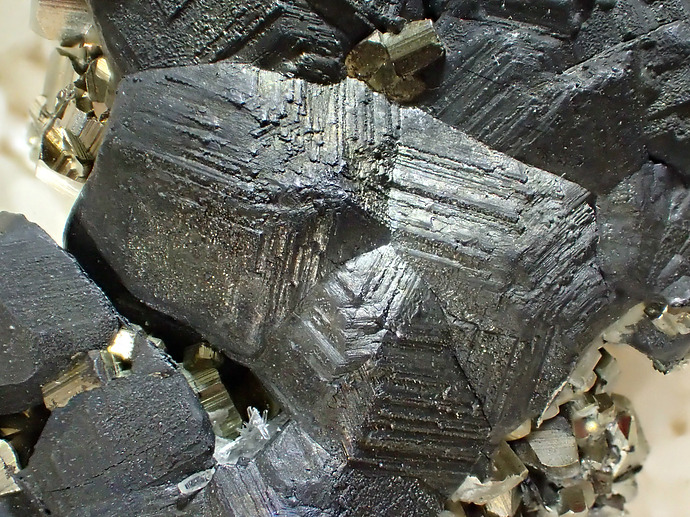

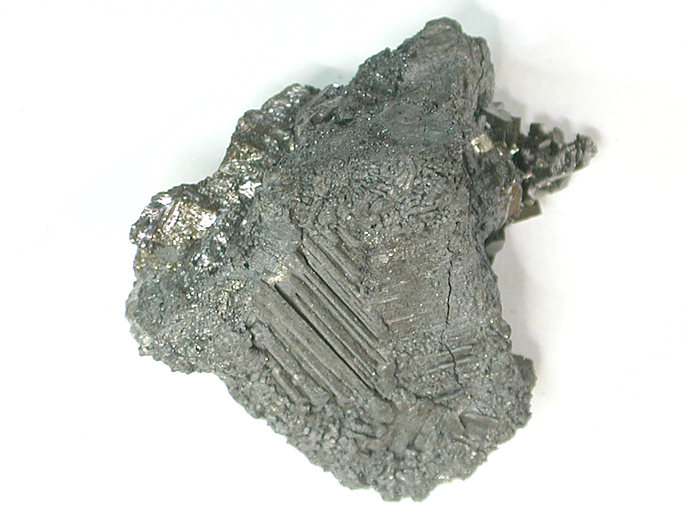

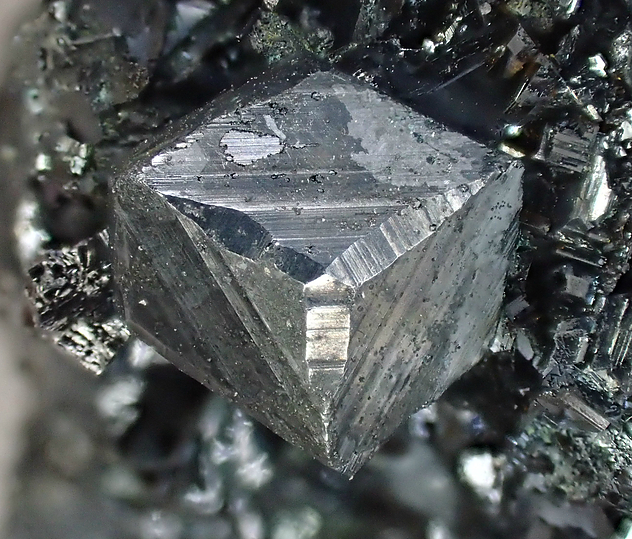
About Digenite
Formula:
Cu9S5
Colour:
Grey to greyish black, turning bluish on exposure to air
Lustre:
Metallic
Hardness:
2½ - 3
Specific Gravity:
5.546
Crystal System:
Trigonal
Member of:
Name:
Named in 1844 by August Breithaupt from Greek διγενηζ digenus = of two origins, because it is related to chalcocite and covellite
Note: Many of the reported associations of digenite and djurleite, identified by powder diffraction, could be anilite and djurleite, as anilite transforms to digenite during grinding.
A recent study showed the existence of a complete solid-solution series between high digenite [cubic, high-temperature digenite] and berzelianite (Pirard & Hatert, 2008).
A recent study showed the existence of a complete solid-solution series between high digenite [cubic, high-temperature digenite] and berzelianite (Pirard & Hatert, 2008).
Unique Identifiers
Mindat ID:
1291
Long-form identifier:
mindat:1:1:1291:7
Similar Names
| Diogenite | A synonym of 'Diogenite meteorite' | |
| Dixenite | A valid IMA mineral species - grandfathered | CuMn142+Fe2+(SiO4)2(As5+O4)(As3+O3)5(OH)6 |
| Dudgeonite | A synonym of 'Calcium-bearing Annabergite' | |
| Dugganite | A valid IMA mineral species | Pb3Zn3(AsO4)2(TeO6) |
IMA Classification of Digenite
Approved, 'Grandfathered' (first described prior to 1959)
IMA Formula:
Cu1.8S
Classification of Digenite
2.BA.10
2 : SULFIDES and SULFOSALTS (sulfides, selenides, tellurides; arsenides, antimonides, bismuthides; sulfarsenites, sulfantimonites, sulfbismuthites, etc.)
B : Metal Sulfides, M: S > 1: 1 (mainly 2: 1)
A : With Cu, Ag, Au
2 : SULFIDES and SULFOSALTS (sulfides, selenides, tellurides; arsenides, antimonides, bismuthides; sulfarsenites, sulfantimonites, sulfbismuthites, etc.)
B : Metal Sulfides, M: S > 1: 1 (mainly 2: 1)
A : With Cu, Ag, Au
2.4.7.3
2 : SULFIDES
4 : AmBnXp, with (m+n):p = 2:1
2 : SULFIDES
4 : AmBnXp, with (m+n):p = 2:1
3.1.3
3 : Sulphides, Selenides, Tellurides, Arsenides and Bismuthides (except the arsenides, antimonides and bismuthides of Cu, Ag and Au, which are included in Section 1)
1 : Sulphides etc. of Cu
3 : Sulphides, Selenides, Tellurides, Arsenides and Bismuthides (except the arsenides, antimonides and bismuthides of Cu, Ag and Au, which are included in Section 1)
1 : Sulphides etc. of Cu
Mineral Symbols
As of 2021 there are now IMA–CNMNC approved mineral symbols (abbreviations) for each mineral species, useful for tables and diagrams.
Please only use the official IMA–CNMNC symbol. Older variants are listed for historical use only.
Please only use the official IMA–CNMNC symbol. Older variants are listed for historical use only.
| Symbol | Source | Reference for Standard |
|---|---|---|
| Dg | IMA–CNMNC | Warr, L.N. (2021). IMA–CNMNC approved mineral symbols. Mineralogical Magazine, 85(3), 291-320. doi:10.1180/mgm.2021.43 |
| Dg | Kretz (1983) | Kretz, R. (1983) Symbols of rock-forming minerals. American Mineralogist, 68, 277–279. |
| Dg | Siivolam & Schmid (2007) | Siivolam, J. and Schmid, R. (2007) Recommendations by the IUGS Subcommission on the Systematics of Metamorphic Rocks: List of mineral abbreviations. Web-version 01.02.07. IUGS Commission on the Systematics in Petrology. download |
| Dg | Whitney & Evans (2010) | Whitney, D.L. and Evans, B.W. (2010) Abbreviations for names of rock-forming minerals. American Mineralogist, 95, 185–187 doi:10.2138/am.2010.3371 |
| Dg | The Canadian Mineralogist (2019) | The Canadian Mineralogist (2019) The Canadian Mineralogist list of symbols for rock- and ore-forming minerals (December 30, 2019). download |
Physical Properties of Digenite
Metallic
Transparency:
Opaque
Colour:
Grey to greyish black, turning bluish on exposure to air
Streak:
Greyish black
Hardness:
2½ - 3 on Mohs scale
Hardness:
VHN100=86 - 106 kg/mm2 - Vickers
Tenacity:
Brittle
Cleavage:
Distinct/Good
{111} on synthetic material
{111} on synthetic material
Fracture:
Conchoidal
Density:
5.546 g/cm3 (Measured) 5.706 g/cm3 (Calculated)
Optical Data of Digenite
Anisotropism:
Mostly isotropic.
Reflectivity:
| Wavelength | R1 (%) |
|---|---|
| 400nm | 29.6% |
| 420nm | 28.8% |
| 440nm | 28.0% |
| 460nm | 27.0% |
| 480nm | 25.9% |
| 500nm | 24.8% |
| 520nm | 23.5% |
| 540nm | 22.2% |
| 560nm | 21.0% |
| 580nm | 19.9% |
| 600nm | 18.9% |
| 620nm | 18.0% |
| 640nm | 17.2% |
| 660nm | 16.3% |
| 680nm | 15.5% |
| 700nm | 14.8% |
Graph shows reflectance levels at different wavelengths (in nm). Peak reflectance is 29.6%.
Colour in reflected light:
Bluish grey
Chemistry of Digenite
Mindat Formula:
Cu9S5
Elements listed:
Common Impurities:
Fe
Crystallography of Digenite
Crystal System:
Trigonal
Class (H-M):
3m(32/m) - Hexagonal Scalenohedral
Space Group:
R3m
Setting:
R32/m
Cell Parameters:
a = 3.919 Å, c = 48.00 Å
Ratio:
a:c = 1 : 12.248
Unit Cell V:
638.44 ų (Calculated from Unit Cell)
Z:
3
Morphology:
Pseudocubic crystals (rare) to 3 cm, usually as intergrowths with other copper sulphides. At temperatures below 81°C, digenite is trigonal R3m; above that temperature, digenite is isometric.
Comment:
Above 73°C, cubic with space group Fm-3m, a = 5.57 Å, Z = 4.
Crystal Structure
Load
Unit Cell | Unit Cell Packed
2x2x2 | 3x3x3 | 4x4x4
Unit Cell | Unit Cell Packed
2x2x2 | 3x3x3 | 4x4x4
Show
Big Balls | Small Balls | Just Balls | Spacefill
Polyhedra Off | Si Polyhedra | All Polyhedra
Remove metal-metal sticks
Big Balls | Small Balls | Just Balls | Spacefill
Polyhedra Off | Si Polyhedra | All Polyhedra
Remove metal-metal sticks
Display Options
Black Background | White Background
Perspective On | Perspective Off
2D | Stereo | Red-Blue | Red-Cyan
Black Background | White Background
Perspective On | Perspective Off
2D | Stereo | Red-Blue | Red-Cyan
View
CIF File Best | x | y | z | a | b | c
CIF File Best | x | y | z | a | b | c
Rotation
Stop | Start
Stop | Start
Labels
Console Off | On | Grey | Yellow
Console Off | On | Grey | Yellow
Data courtesy of the American Mineralogist Crystal Structure Database. Click on an AMCSD ID to view structure
| ID | Species | Reference | Link | Year | Locality | Pressure (GPa) | Temp (K) |
|---|---|---|---|---|---|---|---|
| 0006940 | Digenite | Will G, Hinze E, Abdelrahman A R M (2002) Crystal structure analysis and refinement of digenite, Cu1.8S, in the temperature range 20 to 500 C under controlled sulfur partial pressure European Journal of Mineralogy 14 591-598 | 2002 | synthetic | 0 | 293 | |
| 0006939 | Digenite | Will G, Hinze E, Abdelrahman A R M (2002) Crystal structure analysis and refinement of digenite, Cu1.8S, in the temperature range 20 to 500 C under controlled sulfur partial pressure European Journal of Mineralogy 14 591-598 | 2002 | synthetic | 0 | 293 | |
| 0006937 | Digenite | Will G, Hinze E, Abdelrahman A R M (2002) Crystal structure analysis and refinement of digenite, Cu1.8S, in the temperature range 20 to 500 C under controlled sulfur partial pressure European Journal of Mineralogy 14 591-598 | 2002 | synthetic | 0 | 293 | |
| 0019150 | Digenite | Yamamoto K, Kashida S (1991) X-ray study of the average structures of Cu2Se and Cu1.8S in the room temperature and the high temperature phases Journal of Solid State Chemistry 93 202-211 | 1991 | synthetic | 0 | 300 | |
| 0019151 | Digenite | Yamamoto K, Kashida S (1991) X-ray study of the average structures of Cu2Se and Cu1.8S in the room temperature and the high temperature phases Journal of Solid State Chemistry 93 202-211 | 1991 | synthetic | 0 | 393 | |
| 0000082 | Digenite | Donnay G, Donnay J D H, Kullerud G (1958) Crystal and twin structure of digenite, Cu9S5 American Mineralogist 43 228-242 |  | 1958 | 0 | 293 | |
| 0000121 | Digenite | Morimoto N, Kullerud G (1963) Polymorphism in digenite American Mineralogist 48 110-123 | | 1963 | 0 | 353 |
CIF Raw Data - click here to close
X-Ray Powder Diffraction
Powder Diffraction Data:
| d-spacing | Intensity |
|---|---|
| 5.333 Å | (6) |
| 4.000 Å | (5) |
| 3.385 Å | (4) |
| 3.200 Å | (30) |
| 3.042 Å | (24) |
| 2.954 Å | (31) |
| 2.771 Å | (22) |
| 2.697 Å | (16) |
| 2.499 Å | (12) |
| 2.412 Å | (12) |
| 2.248 Å | (23) |
| 2.171 Å | (7) |
| 2.027 Å | (6) |
| 1.9594 Å | (100) |
| 1.7778 Å | (5) |
| 1.7597 Å | (2) |
| 1.6710 Å | (14) |
| 1.6472 Å | (2) |
| 1.6329 Å | (3) |
| 1.6217 Å | (3) |
| 1.5999 Å | (3) |
| 1.5815 Å | (2) |
| 1.5790 Å | (2) |
| 1.5419 Å | (2) |
| 1.5208 Å | (2) |
| 1.4770 Å | (4) |
| 1.4086 Å | (2) |
| 1.3856 Å | (5) |
| 1.3720 Å | (3) |
| 1.3166 Å | (6) |
| 1.2544 Å | (2) |
| 1.2393 Å | (2) |
| 1.1795 Å | (2) |
| 1.1313 Å | (9) |
Comments:
ICDD 26-476 (synthetic). See also ICDD 23-962 (isometric) 3.35 (4), 3.21 (35), 3.01 (14), 2.779 (45), 2.553 (4), 2.141 (10), 1.967 (100), 1.814 (2), 1.752 (6), 1.678 (20), 1.607 (4), 1.392 (10). See also ICDD 24-61 (isometric) 3.216 (40), 3.05 (10), 2.785 (68), 1.9693 (100), 1.6794 (14), 1.3925 (3), 1.1370 (2), 1.0719 (2), 0.9415 (2).
Geological Environment
Paragenetic Mode(s):
| Paragenetic Mode | Earliest Age (Ga) |
|---|---|
| Stage 3a: Earth’s earliest Hadean crust | >4.50 |
| 8 : Mafic igneous rocks | |
| 11 : Volcanic fumarole minerals; reduced phases (see also #45) | |
| Stage 3b: Earth’s earliest hydrosphere | >4.45 |
| 12 : Hadean hydrothermal subsurface sulfide deposits (see also #33) | |
| 15 : Black/white smoker minerals and other seafloor hydrothermal minerals | |
| Near-surface Processes | |
| 28 : Photo-alteration, pre-biotic | |
| High-𝑇 alteration and/or metamorphism | |
| 33 : Minerals deposited by hydrothermal metal-rich fluids (see also [#12]) | |
| Stage 4b: Highly evolved igneous rocks | >3.0 |
| 34 : Complex granite pegmatites | |
| Stage 7: Great Oxidation Event | <2.4 |
| 47h : [Near-surface oxidized, dehydrated minerals] | |
| Stage 10b: Anthropogenic minerals | <10 Ka |
| 57 : Other minerals formed by human processes |
Geological Setting:
Hydrothermal copper deposits - both as primary and secondary mineral, mafic intrusives, exhalation product, pegmatites.
Type Occurrence of Digenite
Place of Conservation of Type Material:
Technische Universität, Bergakademie Freiberg, Germany, number 1893 (holotype).
Synonyms of Digenite
Other Language Names for Digenite
Relationship of Digenite to other Species
Member of:
Other Members of Chalcocite-Digenite Group:
| Chalcocite | Cu2S | Mon. 2/m : P21/c |
| Djurleite | Cu31S16 | Mon. 2/m : P21/c |
| Roxbyite | Cu58S32 | Tric. 1 : P1 |
| Yarrowite | Cu9S8 | Trig. 3m(32/m) : P3m1 |
Structurally related to group(s):
Common Associates
Associations Based on Photo Data:
| 129 photos of Digenite associated with Malachite | Cu2(CO3)(OH)2 |
| 112 photos of Digenite associated with Chalcopyrite | CuFeS2 |
| 80 photos of Digenite associated with Bornite | Cu5FeS4 |
| 76 photos of Digenite associated with Chalcocite | Cu2S |
Leonard Mine, Butte Mining District, Silver Bow County, Montana, USA