Log In


Hemimorphite
A valid IMA mineral species - grandfathered
This page kindly sponsored by Zhen Yang



About Hemimorphite

Formula:
Zn4Si2O7(OH)2 · H2O
Colour:
Colorless, white, pale blue, pale green, gray, brown
Lustre:
Sub-Adamantine, Vitreous, Sub-Vitreous, Greasy, Silky, Pearly
Hardness:
4½ - 5
Specific Gravity:
3.475
Crystal System:
Orthorhombic
Name:
Named in 1853 by Adolph Kenngott in allusion to the hemimorphic morphology of the crystals. Many names were previously assigned to this species, including calamine. Hemimorphite was chosen by the International Mineralogical Association, over calamine, in 1962.
Type Locality:
Fake Blue Hemimorphite Crystals
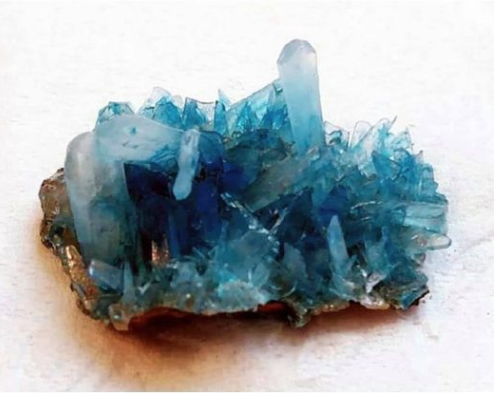
Coated hemimorphite
In 2020 a number of electric-blue crystals of hemimorphite crystals came to market, from the Ojuela mine, Mapimi, Mexico. These have been proven to be deceptively stained using the artificial compound Phthalocyanine Blue BN. See discussion: https://www.mindat.org/mesg-537289.html#538010
 Visit gemdat.org for gemological information about Hemimorphite.
Unique Identifiers
Mindat ID:
1860
Long-form identifier:
mindat:1:1:1860:5
IMA Classification of Hemimorphite
Approved, 'Grandfathered' (first described prior to 1959)
IMA Formula:
Zn2+4Si2O7(OH)2·H2O
Classification of Hemimorphite
9.BD.10
9 : SILICATES (Germanates)
B : Sorosilicates
D : Si2O7 groups, with additional anions; cations in tetrahedral [4] and greater coordination
9 : SILICATES (Germanates)
B : Sorosilicates
D : Si2O7 groups, with additional anions; cations in tetrahedral [4] and greater coordination
56.1.2.1
56 : SOROSILICATES Si2O7 Groups, With Additional O, OH, F and H2O
1 : Si2O7 Groups and O, OH, F, and H2O with cations in [4] coordination
56 : SOROSILICATES Si2O7 Groups, With Additional O, OH, F and H2O
1 : Si2O7 Groups and O, OH, F, and H2O with cations in [4] coordination
14.7.12
14 : Silicates not Containing Aluminum
7 : Silicates of Ba, Sr and Zn
14 : Silicates not Containing Aluminum
7 : Silicates of Ba, Sr and Zn
Mineral Symbols
As of 2021 there are now IMA–CNMNC approved mineral symbols (abbreviations) for each mineral species, useful for tables and diagrams.
| Symbol | Source | Reference for Standard |
|---|---|---|
| Hmp | IMA–CNMNC | Warr, L.N. (2021). IMA–CNMNC approved mineral symbols. Mineralogical Magazine, 85(3), 291-320. doi:10.1180/mgm.2021.43 |
Physical Properties of Hemimorphite
Sub-Adamantine, Vitreous, Sub-Vitreous, Greasy, Silky, Pearly
Transparency:
Transparent, Translucent
Colour:
Colorless, white, pale blue, pale green, gray, brown
Streak:
White
Hardness:
4½ - 5 on Mohs scale
Tenacity:
Brittle
Cleavage:
Perfect
Perfect on {110}, poor on {101}, {001} rare
Perfect on {110}, poor on {101}, {001} rare
Fracture:
Irregular/Uneven, Sub-Conchoidal
Density:
3.475 g/cm3 (Measured) 3.484 g/cm3 (Calculated)
Optical Data of Hemimorphite
Type:
Biaxial (+)
RI values:
nα = 1.614 nβ = 1.617 nγ = 1.636
2V:
Measured: 46° , Calculated: 44°
Birefringence:
0.022
Max. Birefringence:
δ = 0.022
Based on recorded range of RI values above.
Based on recorded range of RI values above.
Interference Colours:
The colours simulate birefringence patterns seen in thin section under crossed polars. They do not take into account mineral colouration or opacity.
Michel-Levy Bar The default colours simulate the birefringence range for a 30 µm thin-section thickness. Adjust the slider to simulate a different thickness.
Grain Simulation You can rotate the grain simulation to show how this range might look as you rotated a sample under crossed polars. Each grain retains its interference colour (retardation) while its brightness falls to black at extinction and reaches a maximum between extinction positions.
The colours simulate birefringence patterns seen in thin section under crossed polars. They do not take into account mineral colouration or opacity.
Michel-Levy Bar The default colours simulate the birefringence range for a 30 µm thin-section thickness. Adjust the slider to simulate a different thickness.
Grain Simulation You can rotate the grain simulation to show how this range might look as you rotated a sample under crossed polars. Each grain retains its interference colour (retardation) while its brightness falls to black at extinction and reaches a maximum between extinction positions.
Surface Relief:
High (positive)
Relative to Canada balsam mounting medium (n ≈ 1.537).
Relative to Canada balsam mounting medium (n ≈ 1.537).
This shows the grain boundary and Becke line effect under plane-polarised
light, based on the contrast between this mineral's average refractive
index and the mounting medium. It does not take into account mineral
colouration.
In focus
Interference Figure:
This shows the idealized biaxial acute bisectrix (Bxa) interference figure
- the conoscopic view for a grain cut perpendicular to the acute bisectrix, using
this mineral's 2V. The two small white dots mark the melatopes - the points
where the two optic axes emerge - and are shown only when they fall within the
field of view. The coloured bands are isochromatics, and the dark bands are
isogyres.
Rotate the stage: at 0°/90° the isogyres form a cross through the melatopes; at 45° they pull apart into curved hyperbolas. That splitting on rotation - absent in a uniaxial figure - is the standard diagnostic test for telling biaxial minerals from uniaxial ones. If 2V is large, the melatopes may fall outside the field of view, as they often do at the microscope too.
Rotate the stage: at 0°/90° the isogyres form a cross through the melatopes; at 45° they pull apart into curved hyperbolas. That splitting on rotation - absent in a uniaxial figure - is the standard diagnostic test for telling biaxial minerals from uniaxial ones. If 2V is large, the melatopes may fall outside the field of view, as they often do at the microscope too.
Dispersion:
strong r > v
Optical Extinction:
X = b; Y = a; Z = c.
Chemistry of Hemimorphite
Mindat Formula:
Zn4Si2O7(OH)2 · H2O
Element Weights:
Elements listed:
Common Impurities:
Cu,Fe
Crystallography of Hemimorphite
Crystal System:
Orthorhombic
Class (H-M):
mm2 - Pyramidal
Space Group:
Imm2
Setting:
Imm2
Cell Parameters:
a = 8.367(5) Å, b = 10.730 Å, c = 5.155(3) Å
Ratio:
a:b:c = 0.78 : 1 : 0.48
Unit Cell V:
462.81 ų (Calculated from Unit Cell)
Z:
2
Morphology:
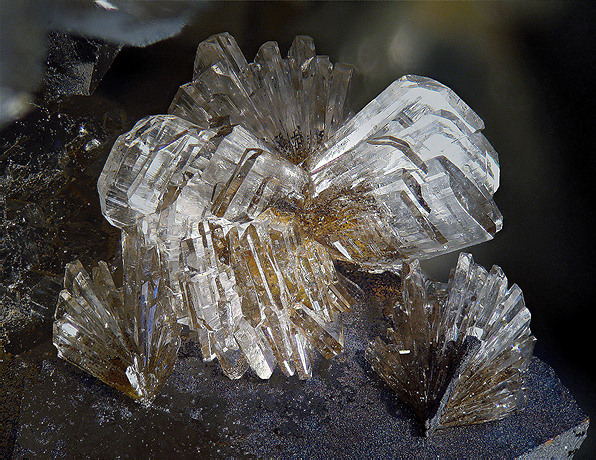
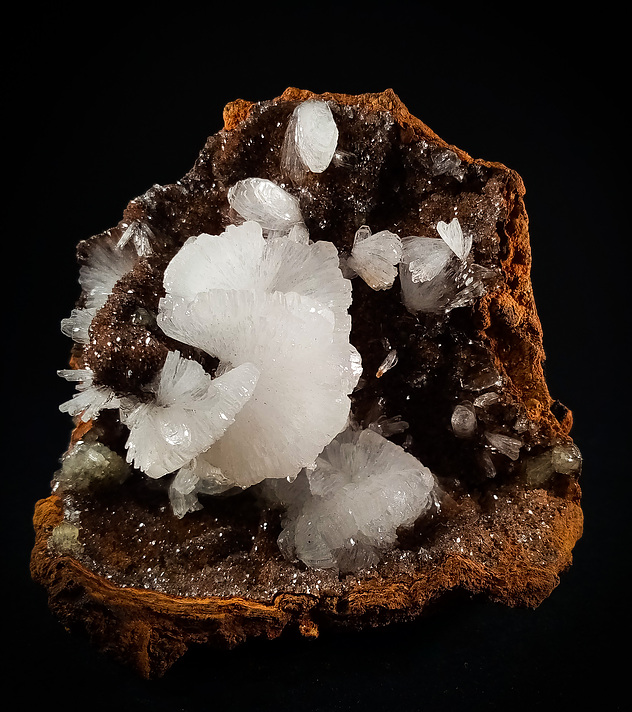
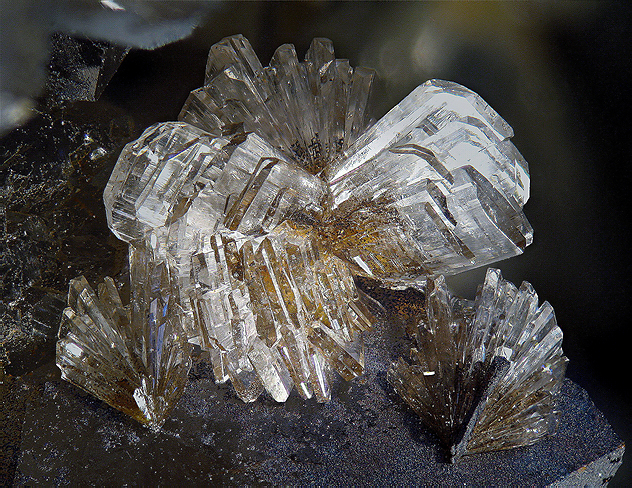
Thin tabular crystals, sheaf-like or fan-like aggregates, stalactitic, mammillary, botryoidal.
Twinning:
On {101} rare
Crystallographic forms of Hemimorphite
Crystal Atlas:
Image Loading
Click on an icon to view

Hemimorphite no.2 - {010} - Goldschmidt (1913-1926)
Hemimorphite no.33 - {001} - Goldschmidt (1913-1926)
Hemimorphite no.91 - {010} - Goldschmidt (1913-1926)
3d models and HTML5 code kindly provided by
www.smorf.nl.
Toggle
Edge Lines | Miller Indices | Axes
Transparency
Opaque | Translucent | Transparent
View
Along a-axis | Along b-axis | Along c-axis | Start rotation | Stop rotation
Edge Lines | Miller Indices | Axes
Transparency
Opaque | Translucent | Transparent
View
Along a-axis | Along b-axis | Along c-axis | Start rotation | Stop rotation
Crystal Structure
Load
Unit Cell | Unit Cell Packed
2x2x2 | 3x3x3 | 4x4x4
Unit Cell | Unit Cell Packed
2x2x2 | 3x3x3 | 4x4x4
Show
Big Balls | Small Balls | Just Balls | Spacefill
Polyhedra Off | Si Polyhedra | All Polyhedra
Remove metal-metal sticks
Big Balls | Small Balls | Just Balls | Spacefill
Polyhedra Off | Si Polyhedra | All Polyhedra
Remove metal-metal sticks
Display Options
Black Background | White Background
Perspective On | Perspective Off
2D | Stereo | Red-Blue | Red-Cyan
Black Background | White Background
Perspective On | Perspective Off
2D | Stereo | Red-Blue | Red-Cyan
View
CIF File Best | x | y | z | a | b | c
CIF File Best | x | y | z | a | b | c
Rotation
Stop | Start
Stop | Start
Labels
Console Off | On | Grey | Yellow
Console Off | On | Grey | Yellow
Data courtesy of the American Mineralogist Crystal Structure Database. Click on an AMCSD ID to view structure
| ID | Species | Reference | Link | Year | Locality | Pressure (GPa) | Temp (K) |
|---|---|---|---|---|---|---|---|
| 0010636 | Hemimorphite | McDonald W S, Cruickshank D W J (1967) Refinement of the structure of hemimorphite Barclay and Cox (1960) Zeitschrift fur Kristallographie 124 180-191 |
Ojuela Mine, Mapimí, Mapimí Municipality, Durango, Mexico