Log In


Bornite
A valid IMA mineral species - grandfathered
This page kindly sponsored by Mark Kucera


About Bornite

Ignaz von Born
Formula:
Cu5FeS4
Colour:
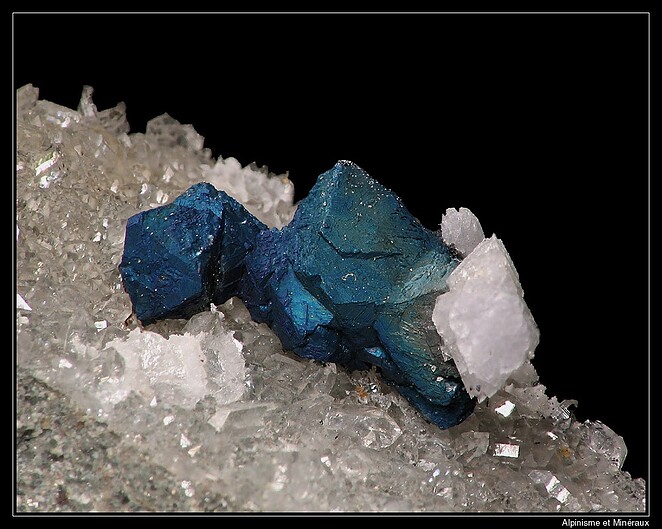
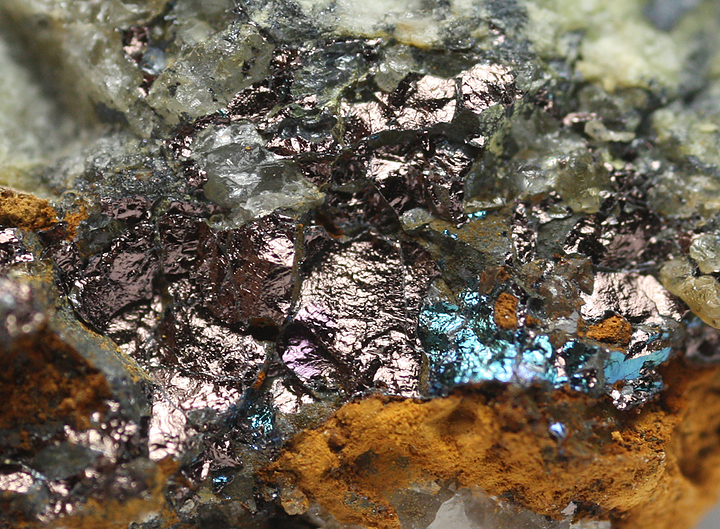
Copper-red to pinchbeck-brown, quickly tarnishing to an iridescent purplish surface.
Lustre:
Metallic
Hardness:
3
Specific Gravity:
5.06 - 5.09
Crystal System:
Orthorhombic
Name:
Originally included with kupferkies in 1725 by Johann Friedrich Henckel. Later assigned various multi-word Latin names by Johan Gottschalk Wallerius in 1747 and variously further translated including "purple copper ore" and "variegated copper ore" in 1802 by Rene Just Haüy. Also called as buntkupfererz by Abraham Gottlieb Werner in 1791. Named "phillipsite" in 1832 by Wilhelm Sulpice Beudant. Renamed as bornite in 1845 by Wilhelm Karl von Haidinger in honor of Ignaz von Born (1742-1791), Austrian mineralogist and invertebrate zoologist.
An important copper ore, typically found as massive or disseminated metallic grains and patches in sulphide ore deposits; relatively rare as good euhedral crystals.
It has a copper-reddish colour on fresh exposures which quickly tarnishes to a pinkish grey, through to an iridescent purple, crimson or blue and eventually black, after exposure to air and moisture, due to formation of very thin coatings of more oxidised minerals.
It may be confused with other iridescent minerals, especially iridescently tarnished chalcopyrite, both often termed “peacock ore” when exhibiting such a tarnish.
Bornite is a copper(I) iron sulphide, with Fe likely predominantly being trivalent, although with some charge transfer likely possible (Goh et al. 2006). Substantial variation in the relative amounts of copper and iron occurs and solid solution extends towards chalcopyrite (CuFeS2) and digenite (Cu9S5). In the Zechstein deposits of Poland there are two copper-deficient varieties defined: half-bornite and quatr-bornite, about 50 and 75% deficient in iron, respectively.
A decomposition product of bornite is idaite.
In terms of crystallochemistry, at temperatures above 228 °C, the crystal structure of bornite is isometric with copper and iron atoms randomly distributed but with cooling, the Fe and Cu become ordered, and symmetry is reduced to orthorhombic. The Fe:Cu:S ratio of high-temperature solid-solutions is variable, and cooling leads to various exsolutions (Morimoto and Kullerud, 1961).
Chemically and structurally related to juxingite.
It has a copper-reddish colour on fresh exposures which quickly tarnishes to a pinkish grey, through to an iridescent purple, crimson or blue and eventually black, after exposure to air and moisture, due to formation of very thin coatings of more oxidised minerals.
It may be confused with other iridescent minerals, especially iridescently tarnished chalcopyrite, both often termed “peacock ore” when exhibiting such a tarnish.
Bornite is a copper(I) iron sulphide, with Fe likely predominantly being trivalent, although with some charge transfer likely possible (Goh et al. 2006). Substantial variation in the relative amounts of copper and iron occurs and solid solution extends towards chalcopyrite (CuFeS2) and digenite (Cu9S5). In the Zechstein deposits of Poland there are two copper-deficient varieties defined: half-bornite and quatr-bornite, about 50 and 75% deficient in iron, respectively.
A decomposition product of bornite is idaite.
In terms of crystallochemistry, at temperatures above 228 °C, the crystal structure of bornite is isometric with copper and iron atoms randomly distributed but with cooling, the Fe and Cu become ordered, and symmetry is reduced to orthorhombic. The Fe:Cu:S ratio of high-temperature solid-solutions is variable, and cooling leads to various exsolutions (Morimoto and Kullerud, 1961).
Chemically and structurally related to juxingite.
Unique Identifiers
Mindat ID:
727
Long-form identifier:
mindat:1:1:727:6
Similar Names
| Barneite | A rock subtype | |
| Barronite | A valid IMA mineral species | (◻0.5Ba0.5)(UO2)2Si5O12(OH) · 2H2O |
| Beraunite | A valid IMA mineral species - grandfathered | Fe63+(PO4)4O(OH)4 · 6H2O |
| Birunite | A valid IMA mineral species - grandfathered - questionable | Ca18(SiO3)8.5(CO3)8.5SO4 · 15H2O(?) |
| Bordite | A synonym of Okenite | |
| Bornite (of Pinkerton) | A rock subtype | |
| Braunite | A valid IMA mineral species - grandfathered | Mn2+Mn63+(SiO4)O8 |
| Brianite | A valid IMA mineral species | Na2CaMg(PO4)2 |
| Browneite | A valid IMA mineral species | MnS |
| Cornite | A synonym of 'Petrosilex' | |
| Kornite | A synonym of Potassic-mangani-leakeite | |
| Kornite (of Frenzel) | A rock subtype |
IMA Classification of Bornite
Approved, 'Grandfathered' (first described prior to 1959)
IMA Formula:
Cu1+5Fe3+S2-4
Approval year:
1962
Classification of Bornite
2.BA.15
2 : SULFIDES and SULFOSALTS (sulfides, selenides, tellurides; arsenides, antimonides, bismuthides; sulfarsenites, sulfantimonites, sulfbismuthites, etc.)
B : Metal Sulfides, M: S > 1: 1 (mainly 2: 1)
A : With Cu, Ag, Au
2 : SULFIDES and SULFOSALTS (sulfides, selenides, tellurides; arsenides, antimonides, bismuthides; sulfarsenites, sulfantimonites, sulfbismuthites, etc.)
B : Metal Sulfides, M: S > 1: 1 (mainly 2: 1)
A : With Cu, Ag, Au
Dana 7th ed.:
2.5.2.1
2.5.2.1
2 : SULFIDES
5 : AmBnXp, with (m+n):p = 3:2
2 : SULFIDES
5 : AmBnXp, with (m+n):p = 3:2
3.1.23
3 : Sulphides, Selenides, Tellurides, Arsenides and Bismuthides (except the arsenides, antimonides and bismuthides of Cu, Ag and Au, which are included in Section 1)
1 : Sulphides etc. of Cu
3 : Sulphides, Selenides, Tellurides, Arsenides and Bismuthides (except the arsenides, antimonides and bismuthides of Cu, Ag and Au, which are included in Section 1)
1 : Sulphides etc. of Cu
Mineral Symbols
As of 2021 there are now IMA–CNMNC approved mineral symbols (abbreviations) for each mineral species, useful for tables and diagrams.
Please only use the official IMA–CNMNC symbol. Older variants are listed for historical use only.
Please only use the official IMA–CNMNC symbol. Older variants are listed for historical use only.
| Symbol | Source | Reference for Standard |
|---|---|---|
| Bn | IMA–CNMNC | Warr, L.N. (2021). IMA–CNMNC approved mineral symbols. Mineralogical Magazine, 85(3), 291-320. doi:10.1180/mgm.2021.43 |
| Bn | Kretz (1983) | Kretz, R. (1983) Symbols of rock-forming minerals. American Mineralogist, 68, 277–279. |
| Bn | Siivolam & Schmid (2007) | Siivolam, J. and Schmid, R. (2007) Recommendations by the IUGS Subcommission on the Systematics of Metamorphic Rocks: List of mineral abbreviations. Web-version 01.02.07. IUGS Commission on the Systematics in Petrology. download |
| Bn | Whitney & Evans (2010) | Whitney, D.L. and Evans, B.W. (2010) Abbreviations for names of rock-forming minerals. American Mineralogist, 95, 185–187 doi:10.2138/am.2010.3371 |
| Bn | The Canadian Mineralogist (2019) | The Canadian Mineralogist (2019) The Canadian Mineralogist list of symbols for rock- and ore-forming minerals (December 30, 2019). download |
Physical Properties of Bornite
Metallic
Transparency:
Opaque
Colour:
Copper-red to pinchbeck-brown, quickly tarnishing to an iridescent purplish surface.
Streak:
Grey-Black
Hardness:
3 on Mohs scale
Hardness:
VHN100=92 kg/mm2 - Vickers
Hardness Data:
Measured
Tenacity:
Brittle
Cleavage:
Poor/Indistinct
In traces on {111}.
In traces on {111}.
Parting:
None.
Fracture:
Irregular/Uneven
Density:
5.06 - 5.09 g/cm3 (Measured) 5.09 g/cm3 (Calculated)
Optical Data of Bornite
Anisotropism:
Weak
Reflectivity:
| Wavelength | R1 (%) |
|---|---|
| 400nm | 19.9% |
| 420nm | 18.8% |
| 440nm | 17.9% |
| 460nm | 17.6% |
| 480nm | 18.0% |
| 500nm | 18.8% |
| 520nm | 20.0% |
| 540nm | 21.3% |
| 560nm | 22.9% |
| 580nm | 24.4% |
| 600nm | 26.0% |
| 620nm | 27.5% |
| 640nm | 28.8% |
| 660nm | 30.2% |
| 680nm | 31.6% |
| 700nm | 32.7% |
Graph shows reflectance levels at different wavelengths (in nm). Peak reflectance is 32.7%.
Colour in reflected light:
Copper-red.
Internal Reflections:
Purplish iridescence.
Pleochroism:
Weak
Chemistry of Bornite
Mindat Formula:
Cu5FeS4
Element Weights:
Elements listed:
Common Impurities:
Ag,Ge,Bi,In,Pb
Chemical Analysis
wt%
| 1 | |
|---|---|
| Cu | 63.42 % |
| Fe | 11.57 % |
| S | 24.66 % |
| SiO2 | 0.21 % |
| Total: | 99.86 % |
Sample references:
Crystallography of Bornite
Crystal System:
Orthorhombic
Class (H-M):
mmm(2/m2/m2/m) - Dipyramidal
Space Group:
Pbca
Cell Parameters:
a = 10.97016(18) Å, b = 21.8803(4) Å, c = 10.9637(2) Å
Ratio:
a:b:c = 0.501 : 1 : 0.501
Unit Cell V:
2631.61 ų
Z:
16
Morphology:
Crystals rare, usually blocky with rough curved faces, pseudo-cubic, pseudo-dodecohedral and rarely pseudo-octahedral. Forms noted: {001}, {011}, {111}, {112}, {223} and {335}.
Bornite is orthorhombic at 10 degrees K up to 275 degrees K (~ 2 degrees Celsius).
Bornite is orthorhombic at 10 degrees K up to 275 degrees K (~ 2 degrees Celsius).
Twinning:
On {111}, often as penetration twins.
Comment:
Various, mostly temperature-dependent supercells are known. Cell parameters are from Shu et al. (2021). Koto & Morimoto (1975) give Pbca, and a = 10.950, b = 21.862, c = 10.950 Å. High-temperature forms are cubic.
Crystallographic forms of Bornite
Crystal Atlas:
Image Loading
Click on an icon to view

Bornite no.1 - {100} - Goldschmidt (1913-1926)
Bornite no.5 - {111} - Goldschmidt (1913-1926)
Bornite no.7 - Goldschmidt (1913-1926)
Bornite no.10 - {110} - Goldschmidt (1913-1926)
3d models and HTML5 code kindly provided by
www.smorf.nl.
Toggle
Edge Lines | Miller Indices | Axes
Transparency
Opaque | Translucent | Transparent
View
Along a-axis | Along b-axis | Along c-axis | Start rotation | Stop rotation
Edge Lines | Miller Indices | Axes
Transparency
Opaque | Translucent | Transparent
View
Along a-axis | Along b-axis | Along c-axis | Start rotation | Stop rotation
Crystal Structure
Load
Unit Cell | Unit Cell Packed
2x2x2 | 3x3x3 | 4x4x4
Unit Cell | Unit Cell Packed
2x2x2 | 3x3x3 | 4x4x4
Show
Big Balls | Small Balls | Just Balls | Spacefill
Polyhedra Off | Si Polyhedra | All Polyhedra
Remove metal-metal sticks
Big Balls | Small Balls | Just Balls | Spacefill
Polyhedra Off | Si Polyhedra | All Polyhedra
Remove metal-metal sticks
Display Options
Black Background | White Background
Perspective On | Perspective Off
2D | Stereo | Red-Blue | Red-Cyan
Black Background | White Background
Perspective On | Perspective Off
2D | Stereo | Red-Blue | Red-Cyan
View
CIF File Best | x | y | z | a | b | c
CIF File Best | x | y | z | a | b | c
Rotation
Stop | Start
Stop | Start
Labels
Console Off | On | Grey | Yellow
Console Off | On | Grey | Yellow
Data courtesy of the American Mineralogist Crystal Structure Database. Click on an AMCSD ID to view structure
| ID | Species | Reference | Link | Year | Locality | Pressure (GPa) | Temp (K) |
|---|---|---|---|---|---|---|---|
| 0009542 | Bornite | Koto K, Morimoto N (1975) Superstructure investigation of bornite, Cu5FeS4, by the modified partial Patterson function Acta Crystallographica B31 2268-2273 |  | 1975 | Cornwall, England | 0 | 293 |
| 0009281 | Bornite | Morimoto N (1964) Structures of two polymorphic forms of Cu5FeS4 Acta Crystallographica 17 351-360 | | 1964 | synthetic | 0 | 293 |
| 0003825 | Bornite | Ding Y, Veblen D R, Prewitt C T (2005) Possible Fe/Cu ordering schemes in the 2a superstructure of bornite (Cu5FeS4) American Mineralogist 90 1265-1269 |  | 2005 | 0 | 293 | |
| 0003824 | Bornite | Ding Y, Veblen D R, Prewitt C T (2005) Possible Fe/Cu ordering schemes in the 2a superstructure of bornite (Cu5FeS4) American Mineralogist 90 1265-1269 | | 2005 | 0 | 293 | |
| 0003823 | Bornite | Ding Y, Veblen D R, Prewitt C T (2005) Possible Fe/Cu ordering schemes in the 2a superstructure of bornite (Cu5FeS4) American Mineralogist 90 1265-1269 | | 2005 | 0 | 293 | |
| 0003822 | Bornite | Ding Y, Veblen D R, Prewitt C T (2005) Possible Fe/Cu ordering schemes in the 2a superstructure of bornite (Cu5FeS4) American Mineralogist 90 1265-1269 | | 2005 | 0 | 293 | |
| 0003821 | Bornite | Ding Y, Veblen D R, Prewitt C T (2005) High-resolution transmission electron microscopy (HRTEM) study of the 4a and 6a superstructure of bornite Cu5FeS4 American Mineralogist 90 1256-1264 | | 2005 | 0 | 293 | |
| 0005156 | Bornite | Kanazawa Y, Koto K, Morimoto N (1978) Bornite (Cu5FeS4): Stability and crystal structure of the intermediate form The Canadian Mineralogist 16 397-404 | | 1978 | 0 | 293 | |
| 0000048 | Bornite | Tunell G, Adams C E (1949) On the symmetry and crystal structure of bornite American Mineralogist 34 824-829 | | 1949 | 0 | 293 |
CIF Raw Data - click here to close
X-Ray Powder Diffraction
Loading XRD data...
Data courtesy of RRUFF project at University of Arizona, used with permission.
Powder Diffraction Data:
| d-spacing | Intensity |
|---|---|
| 3.31 Å | (40) |
| 3.18 Å | (60) |
| 2.74 Å | (50) |
| 2.50 Å | (40) |
| 1.94 Å | (100) |
| 1.65 Å | (30) |
| 1.26 Å | (50) |
| 1.12 Å | (5) |
Geological Environment
Paragenetic Mode(s):
| Paragenetic Mode | Earliest Age (Ga) |
|---|---|
| Stage 2: Planetesimal differentiation and alteration | 4.566-4.550 |
| 6 : Secondary asteroid phases | 4.566-4.560 |
| Stage 3a: Earth’s earliest Hadean crust | >4.50 |
| 8 : Mafic igneous rocks | |
| Stage 3b: Earth’s earliest hydrosphere | >4.45 |
| 12 : Hadean hydrothermal subsurface sulfide deposits (see also #33) | |
| 15 : Black/white smoker minerals and other seafloor hydrothermal minerals | |
| High-𝑇 alteration and/or metamorphism | |
| 31 : Thermally altered carbonate, phosphate, and iron formations | |
| Stage 4b: Highly evolved igneous rocks | >3.0 |
| 37 : Layered igneous intrusions and related PGE minerals | |
| Stage 10a: Neoproterozoic oxygenation/terrestrial biosphere | <0.6 |
| 50 : Coal and/or oil shale minerals | <0.36 |
| 53 : Other minerals with taphonomic origins | <0.4 |
| Stage 10b: Anthropogenic minerals | <10 Ka |
| 54 : Coal and other mine fire minerals (see also #51 and #56) |
Geological Setting:
Common and widespread in copper ore deposits. It also occurs in basic intrusives, in dikes, in contact metamorphic deposits, in quartz veins, and in pegmatites.
Type Occurrence of Bornite
Place of Conservation of Type Material:
No designated type material.
Dzhezkazgan mining district, Karaganda Region, Kazakhstan