Log In


Wulfenite
A valid IMA mineral species - grandfathered
This page kindly sponsored by Chris Whitney-Smith



About Wulfenite

Franz Xaver von Wulfen
Formula:
Pb(MoO4)
Colour:
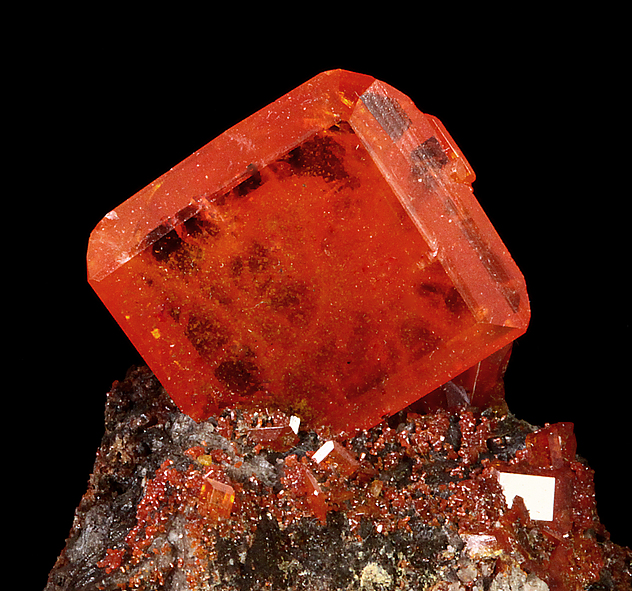
Orange-yellow, yellow, honey-yellow, reddish-orange, rarely colourless, grey, brown, olive-green and even black.
Lustre:
Adamantine, Sub-Adamantine, Resinous
Hardness:
2½ - 3
Specific Gravity:
6.5 - 7.5
Crystal System:
Tetragonal
Member of:
Name:
Renamed in 1845 by Wilhelm Karl von Haidinger in honor of Franz Xaver Freiherr von Wulfen [November 5, 1728, Belgrade, Serbia - March 16, 1805, Klagenfurt, Austria], botanist, mineralogist, alpinist and a member of the Order of the Society of Jesus (Jesuit). Wulfen authored a monograph on the lead ores of Bleiberg, Austria. This mineral was originally named "plumbum spatosum flavo-rubrum, ex Annaberg, Austria" in 1772 by Ignaz von Born. In 1781, Joseph Franz Edler von Jacquin called the mineral "Kärntherischer bleispath". Other names were later proposed.
Type Locality:
Stolzite-Wulfenite Series.
A secondary mineral typically found as thin tabular crystals with a bright orange-red, yellow-orange, yellow or yellowish grey colour in the oxidised zones of hydrothermal lead deposits.
In unique situations, it may precipitate from volcanic fumarole gas, in temperatures from 400 to 550°C (Africano et al., 2002).
 Visit gemdat.org for gemological information about Wulfenite.
A secondary mineral typically found as thin tabular crystals with a bright orange-red, yellow-orange, yellow or yellowish grey colour in the oxidised zones of hydrothermal lead deposits.
In unique situations, it may precipitate from volcanic fumarole gas, in temperatures from 400 to 550°C (Africano et al., 2002).
Visit gemdat.org for gemological information about Wulfenite.Unique Identifiers
Mindat ID:
4322
Long-form identifier:
mindat:1:1:4322:5
Similar Names
| Wulffite | A valid IMA mineral species | K3NaCu4O2(SO4)4 |
| Wülfingite | A valid IMA mineral species | Zn(OH)2 |
IMA Classification of Wulfenite
Approved, 'Grandfathered' (first described prior to 1959)
IMA Formula:
Pb2+Mo6+O4
Classification of Wulfenite
7.GA.05
7 : SULFATES (selenates, tellurates, chromates, molybdates, wolframates)
G : Molybdates, Wolframates and Niobates
A : Without additional anions or H2O
7 : SULFATES (selenates, tellurates, chromates, molybdates, wolframates)
G : Molybdates, Wolframates and Niobates
A : Without additional anions or H2O
Dana 7th ed.:
48.1.3.1
48.1.3.1
48 : ANHYDROUS MOLYBDATES AND TUNGSTATES
1 : AXO4
48 : ANHYDROUS MOLYBDATES AND TUNGSTATES
1 : AXO4
27.3.3
27 : Sulphites, Chromates, Molybdates and Tungstates
3 : Molybdates
27 : Sulphites, Chromates, Molybdates and Tungstates
3 : Molybdates
Mineral Symbols
As of 2021 there are now IMA–CNMNC approved mineral symbols (abbreviations) for each mineral species, useful for tables and diagrams.
Please only use the official IMA–CNMNC symbol. Older variants are listed for historical use only.
Please only use the official IMA–CNMNC symbol. Older variants are listed for historical use only.
| Symbol | Source | Reference for Standard |
|---|---|---|
| Wul | IMA–CNMNC | Warr, L.N. (2021). IMA–CNMNC approved mineral symbols. Mineralogical Magazine, 85(3), 291-320. doi:10.1180/mgm.2021.43 |
| Wul | The Canadian Mineralogist (2019) | The Canadian Mineralogist (2019) The Canadian Mineralogist list of symbols for rock- and ore-forming minerals (December 30, 2019). download |
Pronunciation of Wulfenite
Pronunciation:
| Play | Recorded by | Country |
|---|---|---|
| Jolyon Ralph | United Kingdom |
Physical Properties of Wulfenite
Adamantine, Sub-Adamantine, Resinous
Transparency:
Transparent, Translucent, Opaque
Colour:
Orange-yellow, yellow, honey-yellow, reddish-orange, rarely colourless, grey, brown, olive-green and even black.
Streak:
White
Hardness:
2½ - 3 on Mohs scale
Hardness Data:
Measured
Tenacity:
Brittle
Cleavage:
Distinct/Good
Distinct on {011}; indistinct on {001}, {013}.
Distinct on {011}; indistinct on {001}, {013}.
Fracture:
Irregular/Uneven, Sub-Conchoidal
Density:
6.5 - 7.5 g/cm3 (Measured) 6.88 g/cm3 (Calculated)
Optical Data of Wulfenite
Type:
Uniaxial (-)
RI values:
nω = 2.405 nε = 2.283
2V:
Measured: 8°
Birefringence:
0.122
Max. Birefringence:
δ = 0.122
Based on recorded range of RI values above.
Based on recorded range of RI values above.
Interference Colours:
The colours simulate birefringence patterns seen in thin section under crossed polars. They do not take into account mineral colouration or opacity.
Michel-Levy Bar The default colours simulate the birefringence range for a 30 µm thin-section thickness. Adjust the slider to simulate a different thickness.
Grain Simulation You can rotate the grain simulation to show how this range might look as you rotated a sample under crossed polars. Each grain retains its interference colour (retardation) while its brightness falls to black at extinction and reaches a maximum between extinction positions.
The colours simulate birefringence patterns seen in thin section under crossed polars. They do not take into account mineral colouration or opacity.
Michel-Levy Bar The default colours simulate the birefringence range for a 30 µm thin-section thickness. Adjust the slider to simulate a different thickness.
Grain Simulation You can rotate the grain simulation to show how this range might look as you rotated a sample under crossed polars. Each grain retains its interference colour (retardation) while its brightness falls to black at extinction and reaches a maximum between extinction positions.
Surface Relief:
Very High (positive)
Relative to Canada balsam mounting medium (n ≈ 1.537).
Relative to Canada balsam mounting medium (n ≈ 1.537).
This shows the grain boundary and Becke line effect under plane-polarised
light, based on the contrast between this mineral's average refractive
index and the mounting medium. It does not take into account mineral
colouration.
In focus
Interference Figure:
This shows the idealized uniaxial interference figure - the conoscopic
(convergent-light, Bertrand-lens-in) view, for a grain cut with the optic axis
centred and vertical. The coloured rings are isochromatics, computed with the
same physics as the Michel-Lévy bar above; the dark cross is the isogyre.
For a genuinely uniaxial mineral viewed this way, that cross stays perfectly stationary if you rotate the stage - unlike a biaxial mineral, where it splits apart on rotation. That invariance is itself the standard diagnostic test for telling uniaxial and biaxial minerals apart at the microscope.
For a genuinely uniaxial mineral viewed this way, that cross stays perfectly stationary if you rotate the stage - unlike a biaxial mineral, where it splits apart on rotation. That invariance is itself the standard diagnostic test for telling uniaxial and biaxial minerals apart at the microscope.
Optical Extinction:
Parallel
Pleochroism:
Weak
Comments:
Orange and yellow
Comments:
May be anomalously biaxial.
Chemistry of Wulfenite
Mindat Formula:
Pb(MoO4)
Element Weights:
Elements listed:
Common Impurities:
W,Ca,V,As,Cr,W,Ti
Crystallography of Wulfenite
Crystal System:
Tetragonal
Class (H-M):
4/m - Dipyramidal
Space Group:
I41/a
Setting:
I41/a
Cell Parameters:
a = 5.433 Å, c = 12.110 Å
Ratio:
a:c = 1 : 2.229
Unit Cell V:
357.46 ų (Calculated from Unit Cell)
Z:
4
Morphology:
Crystals commonly thin tabular {001}, square, exhibiting {001}, with flat or rounded vicinal faces, {010}; may be elongated [001], or pyramidal {011}, with the pyramid truncating or replacing {001}; more rarely pseudo-octahedral; and very rarely either cubic or short prismatic pyramidal. Commonly exhibits additional forms, some exhibiting pyramidal hemihedrism; granular, massive.
Twinning:
Twinning on {001} as contact twins; common but rarely seen due to the typical {001} morphology.
Comment:
Class may be 4/m or -4; space Group may be I41/a or I-4. Cell parameters for space group I-4: a = 5.441, c = 12.068 A.
Crystallographic forms of Wulfenite
Crystal Atlas:
Image Loading
Click on an icon to view

Wulfenite no.10 - {001} - Goldschmidt (1913-1926)
Wulfenite no.39 - {201} - Goldschmidt (1913-1926)
Wulfenite no.44 - {001} - Goldschmidt (1913-1926)
Wulfenite no.54 - {001} - Goldschmidt (1913-1926)
Wulfenite no.68 - {001} - Goldschmidt (1913-1926)
Wulfenite no.81 - {112} - Goldschmidt (1913-1926)
Wulfenite - {110}, {001}, {00-1}, overgrown with small pyramidal crystals
Wulfenite - Contact twin on {00-1}
3d models and HTML5 code kindly provided by
www.smorf.nl.
Toggle
Edge Lines | Miller Indices | Axes
Transparency
Opaque | Translucent | Transparent
View
Along a-axis | Along b-axis | Along c-axis | Start rotation | Stop rotation
Edge Lines | Miller Indices | Axes
Transparency
Opaque | Translucent | Transparent
View
Along a-axis | Along b-axis | Along c-axis | Start rotation | Stop rotation
Crystal Structure
Load
Unit Cell | Unit Cell Packed
2x2x2 | 3x3x3 | 4x4x4
Unit Cell | Unit Cell Packed
2x2x2 | 3x3x3 | 4x4x4
Show
Big Balls | Small Balls | Just Balls | Spacefill
Polyhedra Off | Si Polyhedra | All Polyhedra
Remove metal-metal sticks
Big Balls | Small Balls | Just Balls | Spacefill
Polyhedra Off | Si Polyhedra | All Polyhedra
Remove metal-metal sticks
Display Options
Black Background | White Background
Perspective On | Perspective Off
2D | Stereo | Red-Blue | Red-Cyan
Black Background | White Background
Perspective On | Perspective Off
2D | Stereo | Red-Blue | Red-Cyan
View
CIF File Best | x | y | z | a | b | c
CIF File Best | x | y | z | a | b | c
Rotation
Stop | Start
Stop | Start
Labels
Console Off | On | Grey | Yellow
Console Off | On | Grey | Yellow
Data courtesy of the American Mineralogist Crystal Structure Database. Click on an AMCSD ID to view structure
| ID | Species | Reference | Link | Year | Locality | Pressure (GPa) | Temp (K) |
|---|---|---|---|---|---|---|---|
| 0014900 | Wulfenite | Lugli C, Medici L, Saccardo D (1999) Natural wulfenite: structural refinement by single-crystal X-ray diffraction Neues Jahrbuch fur Mineralogie, Monatshefte 1999 281-288 | 1999 | Monte Cengio, Vicenza, Italy | 0 | 293 | |
| 0010618 | Wulfenite | Leciejewicz J (1965) A neutron crystallographic investigation of lead molybdenum oxide, PbMoO4 Zeitschrift fur Kristallographie 121 158-164 |  | 1965 | Los Lamentos, Mexico | 0 | 293 |
CIF Raw Data - click here to close
X-Ray Powder Diffraction
Loading XRD data...
Data courtesy of RRUFF project at University of Arizona, used with permission.
Powder Diffraction Data:
| d-spacing | Intensity |
|---|---|
| 4.96 Å | (10) |
| 3.24 Å | (100) |
| 3.03 Å | (20) |
| 2.72 Å | (25) |
| 2.02 Å | (30) |
| 1.921 Å | (10) |
| 1.787 Å | (18) |
| 1.653 Å | (25) |
Geological Environment
Paragenetic Mode(s):
| Paragenetic Mode | Earliest Age (Ga) |
|---|---|
| Stage 7: Great Oxidation Event | <2.4 |
| 47h : [Near-surface oxidized, dehydrated minerals] |
Geological Setting:
Secondary mineral in weathering zone of lead deposits.
Red Cloud Mine, Silver Mining District, La Paz County, Arizona, USA