Log In


Armalcolite
A valid IMA mineral species
This page is currently not sponsored. Click here to sponsor this page.

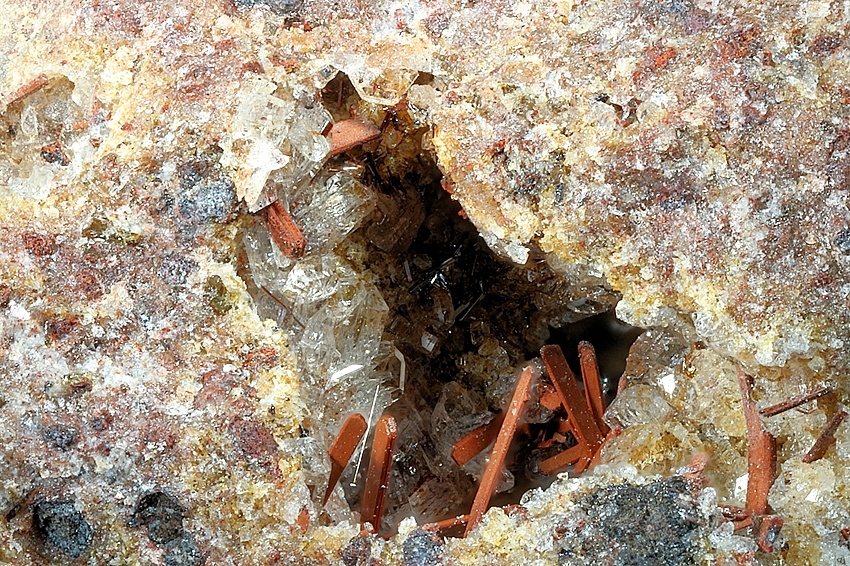
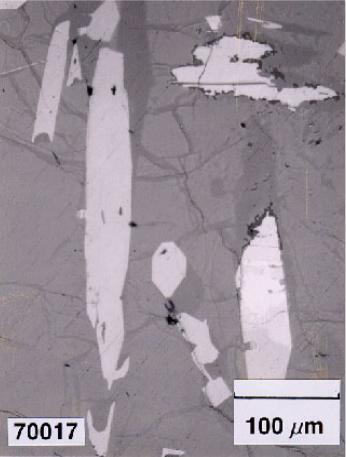
About Armalcolite

Armstong, Aldrin & Collins
Formula:
MgTi4+2O5
Colour:
Grey
Lustre:
Metallic
Hardness:
5
Specific Gravity:
4.94
Crystal System:
Orthorhombic
Member of:
Name:
Named in 1970 by A. T. Andersen, T. E. Bunch, Eugene N. Cameron, S. E. Haggery, F. R. Boyd, O. B. James, K. Keil, Marun Prinz, Paul Ramdohr, and A. El Goresy. This name is in honor of the first three astronauts who traveled to Earth's Moon. The name is an acronym derived from the last names of Neil Alden ARMstrong (1930-2012), Edwin Eugene ALdrin (1930-) and Michael COLlins (1930-2021), the Apollo 11 astronauts who collected the type samples.
Type Locality:
Unique Identifiers
Mindat ID:
341
Long-form identifier:
mindat:1:1:341:0
IMA Classification of Armalcolite
Approved
IMA status notes:
Redefined by the IMA
First published:
1970
Approval history:
IMA 25-A –Ferropseudobrookite (approval), armalcolite (redefinition), pseudobrookite group (establishment)
The original description of armalcolite by Anderson et al. (1970) did not formally establish any individual holotype or cotype specimens as recommended subsequently by Dunn and Mandarino (1987). Type material (unspecified by Anderson et al. 1970) was deposited at what is now the Lunar and Planetary Institute (Houston, Texas, USA). Unit cell dimensions were derived from powder XRD data for sample 10071,28 and ten sets of compositional data were presented from at least six lunar specimens (Anderson et al. 1970). Note that "100 Grain a" and "100 Grain b" reported in Table 2 of Anderson et al. (1970) appear to be from rock fragments found in lunar regolith, sample 10084 (Cameron 1970a,b).
The original description of armalcolite by Anderson et al. (1970) did not formally establish any individual holotype or cotype specimens as recommended subsequently by Dunn and Mandarino (1987). Type material (unspecified by Anderson et al. 1970) was deposited at what is now the Lunar and Planetary Institute (Houston, Texas, USA). Unit cell dimensions were derived from powder XRD data for sample 10071,28 and ten sets of compositional data were presented from at least six lunar specimens (Anderson et al. 1970). Note that "100 Grain a" and "100 Grain b" reported in Table 2 of Anderson et al. (1970) appear to be from rock fragments found in lunar regolith, sample 10084 (Cameron 1970a,b).
Classification of Armalcolite
4.CB.15
4 : OXIDES (Hydroxides, V[5,6] vanadates, arsenites, antimonites, bismuthites, sulfites, selenites, tellurites, iodates)
C : Metal: Oxygen = 2: 3,3: 5, and similar
B : With medium-sized cations
4 : OXIDES (Hydroxides, V[5,6] vanadates, arsenites, antimonites, bismuthites, sulfites, selenites, tellurites, iodates)
C : Metal: Oxygen = 2: 3,3: 5, and similar
B : With medium-sized cations
7.7.1.2
7 : MULTIPLE OXIDES
7 : AB2X5
7 : MULTIPLE OXIDES
7 : AB2X5
7.9.21
7 : Oxides and Hydroxides
9 : Oxides of Ti
7 : Oxides and Hydroxides
9 : Oxides of Ti
Mineral Symbols
As of 2021 there are now IMA–CNMNC approved mineral symbols (abbreviations) for each mineral species, useful for tables and diagrams.
Please only use the official IMA–CNMNC symbol. Older variants are listed for historical use only.
Please only use the official IMA–CNMNC symbol. Older variants are listed for historical use only.
| Symbol | Source | Reference for Standard |
|---|---|---|
| Arm | IMA–CNMNC | Warr, L.N. (2021). IMA–CNMNC approved mineral symbols. Mineralogical Magazine, 85(3), 291-320. doi:10.1180/mgm.2021.43 |
| Arm | Whitney & Evans (2010) | Whitney, D.L. and Evans, B.W. (2010) Abbreviations for names of rock-forming minerals. American Mineralogist, 95, 185–187 doi:10.2138/am.2010.3371 |
Physical Properties of Armalcolite
Metallic
Transparency:
Opaque
Colour:
Grey
Hardness:
5 on Mohs scale
Density:
4.94 g/cm3 (Measured) 4.64 g/cm3 (Calculated)
Optical Data of Armalcolite
Type:
Biaxial
Anisotropism:
Strong, pale grey to dark bluish gray
Reflectivity:
| Wavelength | R1 (%) | R2 (%) |
|---|---|---|
| 450nm | 14.1% | 15.2% |
| 470nm | 14.0% | 15.0% |
| 500nm | 13.8% | 14.7% |
| 520nm | 13.7% | 14.5% |
| 546nm | 13.4% | 14.4% |
| 586nm | 13.3% | 14.3% |
| 620nm | 13.2% | 14.2% |
| 640nm | 13.0% | 14.1% |
Graph shows reflectance levels at different wavelengths (in nm). Peak reflectance is 15.2%.
R1 shown in black, R2 shown in red
Colour in reflected light:
Grey to tan
Pleochroism:
Visible
Chemistry of Armalcolite
Mindat Formula:
MgTi4+2O5
Element Weights:
Elements listed:
Crystallography of Armalcolite
Crystal System:
Orthorhombic
Class (H-M):
mmm(2/m2/m2/m) - Dipyramidal
Cell Parameters:
a = 9.743 Å, b = 10.023 Å, c = 3.738 Å
Ratio:
a:b:c = 0.972 : 1 : 0.373
Unit Cell V:
365.03 ų (Calculated from Unit Cell)
Z:
2
Comment:
Space Group: Bbmm
Crystal Structure
Load
Unit Cell | Unit Cell Packed
2x2x2 | 3x3x3 | 4x4x4
Unit Cell | Unit Cell Packed
2x2x2 | 3x3x3 | 4x4x4
Show
Big Balls | Small Balls | Just Balls | Spacefill
Polyhedra Off | Si Polyhedra | All Polyhedra
Remove metal-metal sticks
Big Balls | Small Balls | Just Balls | Spacefill
Polyhedra Off | Si Polyhedra | All Polyhedra
Remove metal-metal sticks
Display Options
Black Background | White Background
Perspective On | Perspective Off
2D | Stereo | Red-Blue | Red-Cyan
Black Background | White Background
Perspective On | Perspective Off
2D | Stereo | Red-Blue | Red-Cyan
View
CIF File Best | x | y | z | a | b | c
CIF File Best | x | y | z | a | b | c
Rotation
Stop | Start
Stop | Start
Labels
Console Off | On | Grey | Yellow
Console Off | On | Grey | Yellow
Data courtesy of the American Mineralogist Crystal Structure Database. Click on an AMCSD ID to view structure
| ID | Species | Reference | Link | Year | Locality | Pressure (GPa) | Temp (K) |
|---|---|---|---|---|---|---|---|
| 0009836 | Armalcolite | Wechsler B A, Von Dreele R B (1989) Structure refinements of Mg2TiO4, MgTiO3 and MgTi2O5 by time-of-flight neutron powder diffraction Acta Crystallographica B45 542-549 |  | 1989 | synthetic | 0 | 293 |
| 0009835 | Armalcolite | Wechsler B A, Von Dreele R B (1989) Structure refinements of Mg2TiO4, MgTiO3 and MgTi2O5 by time-of-flight neutron powder diffraction Acta Crystallographica B45 542-549 | | 1989 | synthetic | 0 | 293 |
| 0000593 | Armalcolite | Wechsler B A (1977) Cation distribution and high-temperature crystal chemistry of armalcolite American Mineralogist 62 913-920 |  | 1977 | 0 | 297 | |
| 0000591 | Armalcolite | Wechsler B A (1977) Cation distribution and high-temperature crystal chemistry of armalcolite American Mineralogist 62 913-920 | | 1977 | 0 | 297 | |
| 0000590 | Armalcolite | Wechsler B A (1977) Cation distribution and high-temperature crystal chemistry of armalcolite American Mineralogist 62 913-920 | | 1977 | 0 | 297 | |
| 0000594 | Armalcolite | Wechsler B A (1977) Cation distribution and high-temperature crystal chemistry of armalcolite American Mineralogist 62 913-920 | | 1977 | 0 | 673 | |
| 0000592 | Armalcolite | Wechsler B A (1977) Cation distribution and high-temperature crystal chemistry of armalcolite American Mineralogist 62 913-920 | | 1977 | 0 | 1373 |
CIF Raw Data - click here to close
X-Ray Powder Diffraction
Powder Diffraction Data:
| d-spacing | Intensity |
|---|---|
| 3.468 Å | (100) |
| 1.958 Å | (80) |
| 2.763 Å | (25) |
| 2.454 Å | (25) |
| 2.235 Å | (15) |
| 2.199 Å | (15) |
| 2.414 Å | (10) |
Locality:
Comments:
Recorded on type material
Geological Environment
Paragenetic Mode(s):
| Paragenetic Mode | Earliest Age (Ga) |
|---|---|
| Stage 1: Primary nebular phases | 4.567-4.561 |
| 4 : Primary chondrule phases | 4.566–4.561 |
| Stage 3a: Earth’s earliest Hadean crust | >4.50 |
| 7 : Ultramafic igneous rocks | |
| Near-surface Processes | |
| 30 : Terrestrial impact minerals | |
| High-? alteration and/or metamorphism | |
| 31 : Thermally altered carbonate, phosphate, and iron formations | |
| Stage 4b: Highly evolved igneous rocks | >3.0 |
| 35 : Ultra-alkali and agpaitic igneous rocks | |
| Stage 5: Initiation of plate tectonics | <3.5-2.5 |
| 41 : Mantle metasomatism |
Geological Setting:
in salic volcanics; in ultramafic rocks, lamproites and kimberlites; in terrestrial impact craters; in inclusions in carbonaceous chondrites; rarely in granite pegmatites
Type Occurrence of Armalcolite
General Appearance of Type Material:
subhedral to anhedral grains to 300 µm across
Place of Conservation of Type Material:
As no consistently Mg-dominant lunar specimen was investigated in the current work, a lunar neotype for armalcolite cannot be proposed here.
Lunar Science Institute, Houston, Texas, USA
neotype from Disko Island, Greenland, sample 176411, Natural History Museum of Denmark
Lunar Science Institute, Houston, Texas, USA
neotype from Disko Island, Greenland, sample 176411, Natural History Museum of Denmark
Geological Setting of Type Material:
in Ti-rich basalt and microbreccias of lunar samples, formed at low pressures and high temperatures
Other Language Names for Armalcolite
Dutch:Armalcoliet
French:Armalcolite
German:Armalcolit
Norwegian:Armalcolitt
Russian:Армолколит
Spanish:Armalcolita
Relationship of Armalcolite to other Species
Member of:
Other Members of Pseudobrookite Group:
| Ferropseudobrookite | Fe2+Ti4+2O5 | Orth. mmm(2/m2/m2/m) : Cmcm |
| Griffinite | Al2Ti4+O5 | Orth. mmm(2/m2/m2/m) : Cmcm |
| Pseudobrookite | Fe3+2Ti4+O5 | Orth. mmm(2/m2/m2/m) : Cmcm |
| Sassite | Ti3+2Ti4+O5 | Orth. mmm(2/m2/m2/m) : Cmcm |
Forms a series with:
Common Associates
Associations Based on Photo Data:
| 2 photos of Armalcolite associated with Tetraferriphlogopite | KMg3(Si3Fe3+)O10(OH)2 |
| 2 photos of Armalcolite associated with Sanidine | K(AlSi3O8) |
| 1 photo of Armalcolite associated with Pseudobrookite | Fe3+2Ti4+O5 |
Related Minerals - Strunz-mindat Grouping
| 4.CB. | Magnesiohögbomite-6N12S | Mg5Al11TiO23(OH) |
| 4.CB. | Kidodite | BaMg2Fe16O27 |
| 4.CB. | Ferrohögbomite-2N2S | [(Fe2+,Mg,Zn,Al)3(Al,Ti,Fe3+)8O15(OH)]2 |
| 4.CB. | Zhenruite | (MoO3)2 · H2O |
| 4.CB. | Fuyuanite | Mg7Nb6O18(OH)8 |
| 4.CB. | Virgilluethite | MoO3 · H2O |
| 4.CB. | Pengite | (Pb8Sb3+3)Σ11Sb5+9O35 |
| 4.CB.05 | Brizziite | NaSb5+O3 |
| 4.CB.05 | Tistarite | Ti3+2O3 |
| 4.CB.05 | Hematite | Fe2O3 |
| 4.CB.05 | Ecandrewsite | ZnTiO3 |
| 4.CB.05 | Melanostibite | Mn2+2Fe3+Sb5+O6 |
| 4.CB.05 | 'UM1998-11-O-AuHSb' | Au+2Sb3+O2(OH) |
| 4.CB.05 | Karelianite | V3+2O3 |
| 4.CB.05 | Corundum | Al2O3 |
| 4.CB.05 | Eskolaite | Cr2O3 |
| 4.CB.05 | Geikielite | MgTiO3 |
| 4.CB.05 | Akimotoite | MgSiO3 |
| 4.CB.05 | 'Unnamed (Fe-Cr Oxide)' | FeCrO3 |
| 4.CB.05 | 'Auroantimonate' | AuSbO3 |
| 4.CB.05 | Hemleyite | Fe2+SiO3 |
| 4.CB.05 | Ilmenite | Fe2+TiO3 |
| 4.CB.05 | Pyrophanite | Mn2+TiO3 |
| 4.CB.10 | Bixbyite-(Fe) | (Fe,Mn)2O3 |
| 4.CB.10 | Bixbyite-(Mn) | Mn3+2O3 |
| 4.CB.10 | Avicennite | Tl3+2O3 |
| 4.CB.15 | Ferropseudobrookite | Fe2+Ti4+2O5 |
| 4.CB.15 | Griffinite | Al2Ti4+O5 |
| 4.CB.15 | Pseudobrookite Group | |
| 4.CB.15 | Sassite | Ti3+2Ti4+O5 |
| 4.CB.15 | Pseudobrookite | Fe3+2Ti4+O5 |
| 4.CB.20 | Zincovelesite-6N6S | Zn3(Fe3+,Mn3+,Al,Ti)8O15(OH) |
| 4.CB.20 | Magnesiohögbomite-2N4S | (Mg8.43Fe2+1.57)Σ=10Al22Ti4+2O46(OH)2 |
| 4.CB.20 | Magnesiobeltrandoite-2N3S | (Mg6Al2)(Al18Fe3+2)O38(OH)2 |
| 4.CB.20 | Zincohögbomite-2N6S | [(Zn,Mg)7(Al,Fe3+,Ti)16O31(OH)]2 |
| 4.CB.20 | Magnesiohögbomite-6N6S | [(Mg,Fe2+)3(Al,Ti,Fe3+)8O15(OH)]6 |
| 4.CB.20 | Magnesiohögbomite-2N3S | [(Mg,Fe2+,Zn)4(Al,Ti,Fe3+)10O19(OH)]2 |
| 4.CB.20 | Magnesiohögbomite-2N2S | [(Mg,Fe2+)3[Al7(Ti,Fe3+)]O15(OH)]2 |
| 4.CB.20 | 'Ferrohögbomite-6N12S' | [(Fe2+,Mg,Zn)5(Al,Ti,Fe3+)12O23(OH)]6 |
| 4.CB.20 | Zincohögbomite-2N2S | [(Zn,Al,Fe2+)3(Al,Fe3+,Ti)8O15(OH)]2 |
| 4.CB.25 | Kleberite | FeTi6O11(OH)5 |
| 4.CB.25 | Pseudorutile | Fe3+2Ti4+3O9 |
| 4.CB.30 | Oxyvanite | V3+2V4+O5 |
| 4.CB.30 | Berdesinskiite | V3+2TiO5 |
| 4.CB.30 | Kaitianite | Ti3+2Ti4+O5 |
| 4.CB.35 | Machiite | Al2Ti3O9 |
| 4.CB.35 | Vestaite | (Ti4+Fe2+)Ti4+3O9 |
| 4.CB.35 | Olkhonskite | (Cr,V)2Ti3O9 |
| 4.CB.35 | Schreyerite | V3+2Ti4+3O9 |
| 4.CB.40 | Zincorinmanite-(Zn) | Zn2Sb2(Fe3+4Zn2)O14(OH)2 |
| 4.CB.40 | Majindeite | Mg2Mo3O8 |
| 4.CB.40 | Almagreraite | CuZnMn4+3O8 |
| 4.CB.40 | Kamiokite | Fe2Mo3O8 |
| 4.CB.40 | Nolanite | V3+8Fe3+2O14(OH)2 |
| 4.CB.40 | Iseite | Mn2Mo3O8 |
| 4.CB.40 | Rinmanite | Zn2Sb2Mg2Fe4O14(OH)2 |
| 4.CB.45 | Stibioclaudetite | AsSbO3 |
| 4.CB.45 | Claudetite | As2O3 |
| 4.CB.50 | Senarmontite | Sb2O3 |
| 4.CB.50 | Arsenolite | As2O3 |
| 4.CB.55 | Valentinite | Sb2O3 |
| 4.CB.60 | Bismite | Bi2O3 |
| 4.CB.65 | Sphaerobismoite | Bi2O3 |
| 4.CB.70 | Sillénite | Bi12SiO20 |
| 4.CB.75 | Kyzylkumite | V3+Ti2O5(OH) |
| 4.CB.80 | 'Tietaiyangite' | Fe3+4Fe2+TiO9 |
| 4.CB.85 | Liuite | FeTiO3 |
| 4.CB.90 | Luogufengite | Fe2O3 |
| 4.CB.95 | Wangdaodeite | FeTiO3 |
Other Information
Health Risks:
No information on health risks for this material has been entered into the database. You should always treat mineral specimens with care.
Armalcolite in petrology
An essential component of rock names highlighted in red, an accessory component in rock names highlighted in green.
Internet Links for Armalcolite
mindat.org URL:
https://www.mindat.org/min-341.html
Please feel free to link to this page.
Please feel free to link to this page.
Search Engines:
External Links:
Mineral Dealers:
References for Armalcolite
Reference List:
Ophite outcrop, Casterner de les Olles, Tremp, Pallars Jussà, Lleida, Catalonia, Spain