Log In


Magnesiohögbomite-2N2S
A valid IMA mineral species
This page is currently not sponsored. Click here to sponsor this page.


About Magnesiohögbomite-2N2S
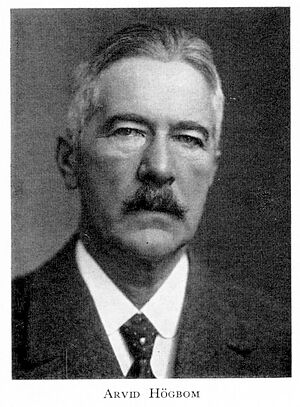
Arvid G. Högbom
Formula:
[(Mg,Fe2+)3[Al7(Ti,Fe3+)]O15(OH)]2
Colour:
Yellowish, brownish, black
Lustre:
Adamantine
Hardness:
6½
Specific Gravity:
3.81
Crystal System:
Hexagonal
Member of:
Name:
Originally described as högbomite, after Arvid Gustav Högbom (11 January 1857, Vännäs, Västerbotten, Sweden - 19 January 1940, Uppsala, Sweden), University of Uppsala, Sweden. Renamed according to the new högbomite group nomenclature (Armbruster 2002).
Type Locality:
This page provides mineralogical data about Magnesiohögbomite-2N2S.
Name Encoding
Formatted:
magnesiohögbomite-2N2S
HTML:
magnesiohögbomite-2<i>N</i>2<i>S</i>
LaTeX:
magnesiohögbomite-2\textit{N}2\textit{S}
ASCII-7:
Magnesiohogbomite-2N2S
Unique Identifiers
Mindat ID:
11450
Long-form identifier:
mindat:1:1:11450:3
Similar Names
| Magnesiohögbomite-2N3S | A valid IMA mineral species | [(Mg,Fe2+,Zn)4(Al,Ti,Fe3+)10O19(OH)]2 |
| Magnesiohögbomite-2N4S | A valid IMA mineral species | (Mg8.43Fe2+1.57)Σ=10Al22Ti24+O46(OH)2 |
| Magnesiohögbomite-6N12S | A valid IMA mineral species | Mg5Al11TiO23(OH) |
| Magnesiohögbomite-6N6S | A valid IMA mineral species | [(Mg,Fe2+)3(Al,Ti,Fe3+)8O15(OH)]6 |
IMA Classification of Magnesiohögbomite-2N2S
Approved
IMA status notes:
Renamed by the IMA
IMA Formula:
(Mg,Fe,Al,Ti)22(O,OH)32
First published:
1916
Approval history:
Renamed as magnesiohögbomite-2N2S by IMA 2001 (special procedure, IMA Case 01–A).
Classification of Magnesiohögbomite-2N2S
4.CB.20
4 : OXIDES (Hydroxides, V[5,6] vanadates, arsenites, antimonites, bismuthites, sulfites, selenites, tellurites, iodates)
C : Metal: Oxygen = 2: 3,3: 5, and similar
B : With medium-sized cations
4 : OXIDES (Hydroxides, V[5,6] vanadates, arsenites, antimonites, bismuthites, sulfites, selenites, tellurites, iodates)
C : Metal: Oxygen = 2: 3,3: 5, and similar
B : With medium-sized cations
Mineral Symbols
As of 2021 there are now IMA–CNMNC approved mineral symbols (abbreviations) for each mineral species, useful for tables and diagrams.
| Symbol | Source | Reference for Standard |
|---|---|---|
| Mhög-2N2S | IMA–CNMNC | Warr, L.N. (2021). IMA–CNMNC approved mineral symbols. Mineralogical Magazine, 85(3), 291-320. doi:10.1180/mgm.2021.43 |
Physical Properties of Magnesiohögbomite-2N2S
Adamantine
Colour:
Yellowish, brownish, black
Comment:
Brown in thin sections.
Hardness:
6½ on Mohs scale
Hardness:
VHN100=1064 - 1216 kg/mm2 - Vickers
Tenacity:
Brittle
Fracture:
Conchoidal
Density:
3.81 g/cm3 (Measured) 3.85 g/cm3 (Calculated)
Optical Data of Magnesiohögbomite-2N2S
Type:
Uniaxial (-)
RI values:
nω = 1.848 - 1.853 nε = 1.803 - 1.823
Max. Birefringence:
δ = 0.030 - 0.045
Based on recorded range of RI values above.
Based on recorded range of RI values above.
Interference Colours:
The colours simulate birefringence patterns seen in thin section under crossed polars. They do not take into account mineral colouration or opacity.
Michel-Levy Bar The default colours simulate the birefringence range for a 30 µm thin-section thickness. Adjust the slider to simulate a different thickness.
Grain Simulation You can rotate the grain simulation to show how this range might look as you rotated a sample under crossed polars. Each grain retains its interference colour (retardation) while its brightness falls to black at extinction and reaches a maximum between extinction positions.
The colours simulate birefringence patterns seen in thin section under crossed polars. They do not take into account mineral colouration or opacity.
Michel-Levy Bar The default colours simulate the birefringence range for a 30 µm thin-section thickness. Adjust the slider to simulate a different thickness.
Grain Simulation You can rotate the grain simulation to show how this range might look as you rotated a sample under crossed polars. Each grain retains its interference colour (retardation) while its brightness falls to black at extinction and reaches a maximum between extinction positions.
Surface Relief:
Very High (positive)
Relative to Canada balsam mounting medium (n ≈ 1.537).
Relative to Canada balsam mounting medium (n ≈ 1.537).
This shows the grain boundary and Becke line effect under plane-polarised
light, based on the contrast between this mineral's average refractive
index and the mounting medium. It does not take into account mineral
colouration.
In focus
Interference Figure:
This shows the idealized uniaxial interference figure - the conoscopic
(convergent-light, Bertrand-lens-in) view, for a grain cut with the optic axis
centred and vertical. The coloured rings are isochromatics, computed with the
same physics as the Michel-Lévy bar above; the dark cross is the isogyre.
For a genuinely uniaxial mineral viewed this way, that cross stays perfectly stationary if you rotate the stage - unlike a biaxial mineral, where it splits apart on rotation. That invariance is itself the standard diagnostic test for telling uniaxial and biaxial minerals apart at the microscope.
For a genuinely uniaxial mineral viewed this way, that cross stays perfectly stationary if you rotate the stage - unlike a biaxial mineral, where it splits apart on rotation. That invariance is itself the standard diagnostic test for telling uniaxial and biaxial minerals apart at the microscope.
Anisotropism:
Distinct
Reflectivity:
| Wavelength | R1 (%) | R2 (%) |
|---|---|---|
| 400nm | 9.74% | 10.2% |
| 420nm | 9.28% | 9.79% |
| 440nm | 8.91% | 9.37% |
| 460nm | 8.55% | 9.08% |
| 480nm | 8.40% | 8.91% |
| 500nm | 8.31% | 8.88% |
| 520nm | 8.27% | 8.80% |
| 540nm | 8.21% | 8.75% |
| 560nm | 8.16% | 8.70% |
| 580nm | 8.15% | 8.70% |
| 600nm | 8.17% | 8.70% |
| 620nm | 8.20% | 8.71% |
| 640nm | 8.24% | 8.73% |
| 660nm | 8.31% | 8.74% |
| 680nm | 8.30% | 8.75% |
| 700nm | 8.37% | 8.77% |
Graph shows reflectance levels at different wavelengths (in nm). Peak reflectance is 10.2%.
R1 shown in black, R2 shown in red
Pleochroism:
Strong
Comments:
O = dark but still yellowish brown; E = bright yellow brown.
Comments:
Absorption, O > E.
Chemistry of Magnesiohögbomite-2N2S
Mindat Formula:
[(Mg,Fe2+)3[Al7(Ti,Fe3+)]O15(OH)]2
Element Weights:
Crystallography of Magnesiohögbomite-2N2S
Crystal System:
Hexagonal
Class (H-M):
6mm - Dihexagonal Pyramidal
Space Group:
P63mc
Cell Parameters:
a = 5.73 Å, c = 18.39 Å
Ratio:
a:c = 1 : 3.209
Unit Cell V:
522.90 ų (Calculated from Unit Cell)
Z:
2
Geological Environment
Paragenetic Mode(s):
| Paragenetic Mode | Earliest Age (Ga) |
|---|---|
| Near-surface Processes | |
| 26 : Hadean detrital minerals | |
| High-? alteration and/or metamorphism | |
| 31 : Thermally altered carbonate, phosphate, and iron formations | |
| Stage 5: Initiation of plate tectonics | <3.5-2.5 |
| 40 : Regional metamorphism (greenschist, amphibolite, granulite facies) |
Type Occurrence of Magnesiohögbomite-2N2S
Place of Conservation of Type Material:
No designated type specimen.
Geological Setting of Type Material:
Rock-making mineral in iron ores.
Associated Minerals at Type Locality:
Synonyms of Magnesiohögbomite-2N2S
Other Language Names for Magnesiohögbomite-2N2S
Dutch:Magnesiohögbomiet-2N2S
German:Magnesiohögbomit-2N2S
Relationship of Magnesiohögbomite-2N2S to other Species
Member of:
Other Members of Magnesiohögbomite subgroup:
| Magnesiohögbomite-2N3S | [(Mg,Fe2+,Zn)4(Al,Ti,Fe3+)10O19(OH)]2 | Trig. 3m(32/m) : P31m |
| Magnesiohögbomite-2N4S | (Mg8.43Fe2+1.57)Σ=10Al22Ti4+2O46(OH)2 | Hex. 6mm : P63mc |
| Magnesiohögbomite-6N12S | Mg5Al11TiO23(OH) | Trig. 3m(32/m) : R3m |
Common Associates
Associations Based on Photo Data:
Related Minerals - Strunz-mindat Grouping
| 4.CB. | Magnesiohögbomite-6N12S | Mg5Al11TiO23(OH) |
| 4.CB. | Kidodite | BaMg2Fe16O27 |
| 4.CB. | Ferrohögbomite-2N2S | [(Fe2+,Mg,Zn,Al)3(Al,Ti,Fe3+)8O15(OH)]2 |
| 4.CB. | Zhenruite | (MoO3)2 · H2O |
| 4.CB. | Fuyuanite | Mg7Nb6O18(OH)8 |
| 4.CB. | Virgilluethite | MoO3 · H2O |
| 4.CB. | Pengite | (Pb8Sb3+3)Σ11Sb5+9O35 |
| 4.CB.05 | Brizziite | NaSb5+O3 |
| 4.CB.05 | Tistarite | Ti3+2O3 |
| 4.CB.05 | Hematite | Fe2O3 |
| 4.CB.05 | Ecandrewsite | ZnTiO3 |
| 4.CB.05 | Melanostibite | Mn2+2Fe3+Sb5+O6 |
| 4.CB.05 | 'UM1998-11-O-AuHSb' | Au+2Sb3+O2(OH) |
| 4.CB.05 | Karelianite | V3+2O3 |
| 4.CB.05 | Corundum | Al2O3 |
| 4.CB.05 | Eskolaite | Cr2O3 |
| 4.CB.05 | Geikielite | MgTiO3 |
| 4.CB.05 | Akimotoite | MgSiO3 |
| 4.CB.05 | 'Unnamed (Fe-Cr Oxide)' | FeCrO3 |
| 4.CB.05 | 'Auroantimonate' | AuSbO3 |
| 4.CB.05 | Hemleyite | Fe2+SiO3 |
| 4.CB.05 | Ilmenite | Fe2+TiO3 |
| 4.CB.05 | Pyrophanite | Mn2+TiO3 |
| 4.CB.10 | Bixbyite-(Fe) | (Fe,Mn)2O3 |
| 4.CB.10 | Bixbyite-(Mn) | Mn3+2O3 |
| 4.CB.10 | Avicennite | Tl3+2O3 |
| 4.CB.15 | Armalcolite | MgTi4+2O5 |
| 4.CB.15 | Ferropseudobrookite | Fe2+Ti4+2O5 |
| 4.CB.15 | Griffinite | Al2Ti4+O5 |
| 4.CB.15 | Pseudobrookite Group | |
| 4.CB.15 | Sassite | Ti3+2Ti4+O5 |
| 4.CB.15 | Pseudobrookite | Fe3+2Ti4+O5 |
| 4.CB.20 | Zincovelesite-6N6S | Zn3(Fe3+,Mn3+,Al,Ti)8O15(OH) |
| 4.CB.20 | Magnesiohögbomite-2N4S | (Mg8.43Fe2+1.57)Σ=10Al22Ti4+2O46(OH)2 |
| 4.CB.20 | Magnesiobeltrandoite-2N3S | (Mg6Al2)(Al18Fe3+2)O38(OH)2 |
| 4.CB.20 | Zincohögbomite-2N6S | [(Zn,Mg)7(Al,Fe3+,Ti)16O31(OH)]2 |
| 4.CB.20 | Magnesiohögbomite-6N6S | [(Mg,Fe2+)3(Al,Ti,Fe3+)8O15(OH)]6 |
| 4.CB.20 | Magnesiohögbomite-2N3S | [(Mg,Fe2+,Zn)4(Al,Ti,Fe3+)10O19(OH)]2 |
| 4.CB.20 | 'Ferrohögbomite-6N12S' | [(Fe2+,Mg,Zn)5(Al,Ti,Fe3+)12O23(OH)]6 |
| 4.CB.20 | Zincohögbomite-2N2S | [(Zn,Al,Fe2+)3(Al,Fe3+,Ti)8O15(OH)]2 |
| 4.CB.25 | Kleberite | FeTi6O11(OH)5 |
| 4.CB.25 | Pseudorutile | Fe3+2Ti4+3O9 |
| 4.CB.30 | Oxyvanite | V3+2V4+O5 |
| 4.CB.30 | Berdesinskiite | V3+2TiO5 |
| 4.CB.30 | Kaitianite | Ti3+2Ti4+O5 |
| 4.CB.35 | Machiite | Al2Ti3O9 |
| 4.CB.35 | Vestaite | (Ti4+Fe2+)Ti4+3O9 |
| 4.CB.35 | Olkhonskite | (Cr,V)2Ti3O9 |
| 4.CB.35 | Schreyerite | V3+2Ti4+3O9 |
| 4.CB.40 | Zincorinmanite-(Zn) | Zn2Sb2(Fe3+4Zn2)O14(OH)2 |
| 4.CB.40 | Majindeite | Mg2Mo3O8 |
| 4.CB.40 | Almagreraite | CuZnMn4+3O8 |
| 4.CB.40 | Kamiokite | Fe2Mo3O8 |
| 4.CB.40 | Nolanite | V3+8Fe3+2O14(OH)2 |
| 4.CB.40 | Iseite | Mn2Mo3O8 |
| 4.CB.40 | Rinmanite | Zn2Sb2Mg2Fe4O14(OH)2 |
| 4.CB.45 | Stibioclaudetite | AsSbO3 |
| 4.CB.45 | Claudetite | As2O3 |
| 4.CB.50 | Senarmontite | Sb2O3 |
| 4.CB.50 | Arsenolite | As2O3 |
| 4.CB.55 | Valentinite | Sb2O3 |
| 4.CB.60 | Bismite | Bi2O3 |
| 4.CB.65 | Sphaerobismoite | Bi2O3 |
| 4.CB.70 | Sillénite | Bi12SiO20 |
| 4.CB.75 | Kyzylkumite | V3+Ti2O5(OH) |
| 4.CB.80 | 'Tietaiyangite' | Fe3+4Fe2+TiO9 |
| 4.CB.85 | Liuite | FeTiO3 |
| 4.CB.90 | Luogufengite | Fe2O3 |
| 4.CB.95 | Wangdaodeite | FeTiO3 |
Other Information
Health Risks:
No information on health risks for this material has been entered into the database. You should always treat mineral specimens with care.
Internet Links for Magnesiohögbomite-2N2S
mindat.org URL:
https://www.mindat.org/min-11450.html
Please feel free to link to this page.
Please feel free to link to this page.
Search Engines:
External Links:
Mineral Dealers:
References for Magnesiohögbomite-2N2S
Reference List:
Armbruster, Thomas (2002) Revised nomenclature of högbomite, nigerite, and taaffeite minerals. European Journal of Mineralogy, 14 (2) 389-395 doi:10.1127/0935-1221/2002/0014-0389
Localities for Magnesiohögbomite-2N2S
Showing 1 localities.
 symbol to view information about a locality.
The
symbol to view information about a locality.
The Locality List
 - This locality has map coordinates listed.
- This locality has estimated coordinates.
ⓘ - Click for references and further information on this occurrence.
? - Indicates mineral may be doubtful at this locality.
- This locality has map coordinates listed.
- This locality has estimated coordinates.
ⓘ - Click for references and further information on this occurrence.
? - Indicates mineral may be doubtful at this locality.
 - Good crystals or important locality for species.
 - World class for species or very significant.
(TL) - Type Locality for a valid mineral species.
(FRL) - First Recorded Locality for everything else (eg varieties).
- World class for species or very significant.
(TL) - Type Locality for a valid mineral species.
(FRL) - First Recorded Locality for everything else (eg varieties).
All localities listed without proper references should be considered as questionable.
Sweden (TL) | |
| Gavelin (1916) +2 other references |
Ruoutevare, Kvikkjokk, Jokkmokk, Norrbotten County, Sweden