Log In


Zincohögbomite-2N2S
A valid IMA mineral species
This page is currently not sponsored. Click here to sponsor this page.


About Zincohögbomite-2N2S
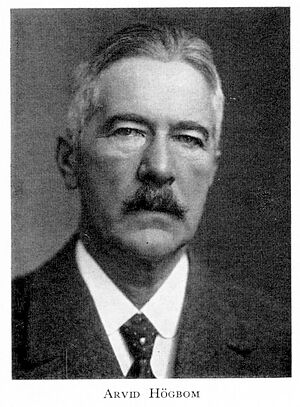
Arvid G. Högbom
Formula:
[(Zn,Al,Fe2+)3(Al,Fe3+,Ti)8O15(OH)]2
Colour:
Deep brown to black
Lustre:
Adamantine
Hardness:
7
Specific Gravity:
4.36 (Calculated)
Crystal System:
Hexagonal
Member of:
Name:
Named as the zinc dominant mineral and 2N2S member of polysomatic series of the Högbomite Group (originally described as Zincohögbomite-8H). The root name is for Arvid Gustaf Högbom (11 January 1857, Vännäs, Västerbotten, Sweden - 19 January 1940, Uppsala, Sweden), Professor of Mineralogy and Geology at Uppsala University.
Name Encoding
Formatted:
zincohögbomite-2N2S
HTML:
zincohögbomite-2<i>N</i>2<i>S</i>
LaTeX:
zincohögbomite-2\textit{N}2\textit{S}
ASCII-7:
Zincohogbomite-2N2S
Unique Identifiers
Mindat ID:
7386
Long-form identifier:
mindat:1:1:7386:4
Similar Names
| Zincohögbomite-2N6S | A valid IMA mineral species - grandfathered | [(Zn,Mg)7(Al,Fe3+,Ti)16O31(OH)]2 |
IMA Classification of Zincohögbomite-2N2S
Classification of Zincohögbomite-2N2S
4.CB.20
4 : OXIDES (Hydroxides, V[5,6] vanadates, arsenites, antimonites, bismuthites, sulfites, selenites, tellurites, iodates)
C : Metal: Oxygen = 2: 3,3: 5, and similar
B : With medium-sized cations
4 : OXIDES (Hydroxides, V[5,6] vanadates, arsenites, antimonites, bismuthites, sulfites, selenites, tellurites, iodates)
C : Metal: Oxygen = 2: 3,3: 5, and similar
B : With medium-sized cations
Mineral Symbols
As of 2021 there are now IMA–CNMNC approved mineral symbols (abbreviations) for each mineral species, useful for tables and diagrams.
| Symbol | Source | Reference for Standard |
|---|---|---|
| Zhög-2N2S | IMA–CNMNC | Warr, L.N. (2021). IMA–CNMNC approved mineral symbols. Mineralogical Magazine, 85(3), 291-320. doi:10.1180/mgm.2021.43 |
Physical Properties of Zincohögbomite-2N2S
Adamantine
Transparency:
Translucent
Colour:
Deep brown to black
Comment:
Transparent in thin section.
Streak:
Brownish
Hardness:
7 on Mohs scale
Hardness:
VHN100=1200 - 1400 kg/mm2 - Vickers
Tenacity:
Brittle
Cleavage:
None Observed
Fracture:
Conchoidal
Density:
4.36 g/cm3 (Calculated)
Optical Data of Zincohögbomite-2N2S
Type:
Uniaxial (-)
RI values:
nω = 1.878(2) nε = 1.832(2)
Max. Birefringence:
δ = 0.046
Based on recorded range of RI values above.
Based on recorded range of RI values above.
Interference Colours:
The colours simulate birefringence patterns seen in thin section under crossed polars. They do not take into account mineral colouration or opacity.
Michel-Levy Bar The default colours simulate the birefringence range for a 30 µm thin-section thickness. Adjust the slider to simulate a different thickness.
Grain Simulation You can rotate the grain simulation to show how this range might look as you rotated a sample under crossed polars. Each grain retains its interference colour (retardation) while its brightness falls to black at extinction and reaches a maximum between extinction positions.
The colours simulate birefringence patterns seen in thin section under crossed polars. They do not take into account mineral colouration or opacity.
Michel-Levy Bar The default colours simulate the birefringence range for a 30 µm thin-section thickness. Adjust the slider to simulate a different thickness.
Grain Simulation You can rotate the grain simulation to show how this range might look as you rotated a sample under crossed polars. Each grain retains its interference colour (retardation) while its brightness falls to black at extinction and reaches a maximum between extinction positions.
Surface Relief:
Very High (positive)
Relative to Canada balsam mounting medium (n ≈ 1.537).
Relative to Canada balsam mounting medium (n ≈ 1.537).
This shows the grain boundary and Becke line effect under plane-polarised
light, based on the contrast between this mineral's average refractive
index and the mounting medium. It does not take into account mineral
colouration.
In focus
Interference Figure:
This shows the idealized uniaxial interference figure - the conoscopic
(convergent-light, Bertrand-lens-in) view, for a grain cut with the optic axis
centred and vertical. The coloured rings are isochromatics, computed with the
same physics as the Michel-Lévy bar above; the dark cross is the isogyre.
For a genuinely uniaxial mineral viewed this way, that cross stays perfectly stationary if you rotate the stage - unlike a biaxial mineral, where it splits apart on rotation. That invariance is itself the standard diagnostic test for telling uniaxial and biaxial minerals apart at the microscope.
For a genuinely uniaxial mineral viewed this way, that cross stays perfectly stationary if you rotate the stage - unlike a biaxial mineral, where it splits apart on rotation. That invariance is itself the standard diagnostic test for telling uniaxial and biaxial minerals apart at the microscope.
Pleochroism:
Strong
Comments:
O = dark brown and E = brown.
Chemistry of Zincohögbomite-2N2S
Mindat Formula:
[(Zn,Al,Fe2+)3(Al,Fe3+,Ti)8O15(OH)]2
Element Weights:
Crystallography of Zincohögbomite-2N2S
Crystal System:
Hexagonal
Class (H-M):
6mm - Dihexagonal Pyramidal
Space Group:
P63mc
Cell Parameters:
a = 5.708 Å, c = 18.31 Å
Ratio:
a:c = 1 : 3.208
Unit Cell V:
516.64 ų (Calculated from Unit Cell)
Z:
2
Morphology:
Euhedral pseudotetrahedra with {1014} and {0001}.
Twinning:
None observed.
X-Ray Powder Diffraction
Powder Diffraction Data:
| d-spacing | Intensity |
|---|---|
| 2.94 Å | (30) |
| 2.85 Å | (50) |
| 2.60 Å | (80) |
| 2.42 Å | (100) |
| 1.592 Å | (60) |
| 1.550 Å | (50) |
| 1.470 Å | (70) |
| 1.425 Å | (80) |
| 1.382 Å | (30) |
Comments:
Mikro-Lakka emery deposit, Samos, Greece. The data are from Ockenga et al. 1998.
Geological Environment
Paragenetic Mode(s):
| Paragenetic Mode | Earliest Age (Ga) |
|---|---|
| Stage 5: Initiation of plate tectonics | <3.5-2.5 |
| 40 : Regional metamorphism (greenschist, amphibolite, granulite facies) |
Type Occurrence of Zincohögbomite-2N2S
General Appearance of Type Material:
Thin coatings (< 50 μm) on single crystals of gahnite. Euhedral pseudotetrahedra.
Place of Conservation of Type Material:
Institut für Mineralogie, Ruhr-Universität Bochum, Bochum, Germany (type).
Technische Universität, Braunschweig, Germany (type).
Technische Universität, Bergakademie, Freiburg, Germany (cotype).
Technische Universität, Braunschweig, Germany (type).
Technische Universität, Bergakademie, Freiburg, Germany (cotype).
Geological Setting of Type Material:
Diaspore- or corundum-bearing metabauxites.
Associated Minerals at Type Locality:
Synonyms of Zincohögbomite-2N2S
Other Language Names for Zincohögbomite-2N2S
Relationship of Zincohögbomite-2N2S to other Species
Member of:
Other Members of Zincohögbomite subgroup:
| Zincohögbomite-2N6S | [(Zn,Mg)7(Al,Fe3+,Ti)16O31(OH)]2 | Hex. 6mm : P63mc |
Common Associates
Related Minerals - Strunz-mindat Grouping
| 4.CB. | Magnesiohögbomite-6N12S | Mg5Al11TiO23(OH) |
| 4.CB. | Kidodite | BaMg2Fe16O27 |
| 4.CB. | Ferrohögbomite-2N2S | [(Fe2+,Mg,Zn,Al)3(Al,Ti,Fe3+)8O15(OH)]2 |
| 4.CB. | Zhenruite | (MoO3)2 · H2O |
| 4.CB. | Fuyuanite | Mg7Nb6O18(OH)8 |
| 4.CB. | Virgilluethite | MoO3 · H2O |
| 4.CB. | Pengite | (Pb8Sb3+3)Σ11Sb5+9O35 |
| 4.CB.05 | Brizziite | NaSb5+O3 |
| 4.CB.05 | Tistarite | Ti3+2O3 |
| 4.CB.05 | Hematite | Fe2O3 |
| 4.CB.05 | Ecandrewsite | ZnTiO3 |
| 4.CB.05 | Melanostibite | Mn2+2Fe3+Sb5+O6 |
| 4.CB.05 | 'UM1998-11-O-AuHSb' | Au+2Sb3+O2(OH) |
| 4.CB.05 | Karelianite | V3+2O3 |
| 4.CB.05 | Corundum | Al2O3 |
| 4.CB.05 | Eskolaite | Cr2O3 |
| 4.CB.05 | Geikielite | MgTiO3 |
| 4.CB.05 | Akimotoite | MgSiO3 |
| 4.CB.05 | 'Unnamed (Fe-Cr Oxide)' | FeCrO3 |
| 4.CB.05 | 'Auroantimonate' | AuSbO3 |
| 4.CB.05 | Hemleyite | Fe2+SiO3 |
| 4.CB.05 | Ilmenite | Fe2+TiO3 |
| 4.CB.05 | Pyrophanite | Mn2+TiO3 |
| 4.CB.10 | Bixbyite-(Fe) | (Fe,Mn)2O3 |
| 4.CB.10 | Bixbyite-(Mn) | Mn3+2O3 |
| 4.CB.10 | Avicennite | Tl3+2O3 |
| 4.CB.15 | Armalcolite | MgTi4+2O5 |
| 4.CB.15 | Ferropseudobrookite | Fe2+Ti4+2O5 |
| 4.CB.15 | Griffinite | Al2Ti4+O5 |
| 4.CB.15 | Pseudobrookite Group | |
| 4.CB.15 | Sassite | Ti3+2Ti4+O5 |
| 4.CB.15 | Pseudobrookite | Fe3+2Ti4+O5 |
| 4.CB.20 | Zincovelesite-6N6S | Zn3(Fe3+,Mn3+,Al,Ti)8O15(OH) |
| 4.CB.20 | Magnesiohögbomite-2N4S | (Mg8.43Fe2+1.57)Σ=10Al22Ti4+2O46(OH)2 |
| 4.CB.20 | Magnesiobeltrandoite-2N3S | (Mg6Al2)(Al18Fe3+2)O38(OH)2 |
| 4.CB.20 | Zincohögbomite-2N6S | [(Zn,Mg)7(Al,Fe3+,Ti)16O31(OH)]2 |
| 4.CB.20 | Magnesiohögbomite-6N6S | [(Mg,Fe2+)3(Al,Ti,Fe3+)8O15(OH)]6 |
| 4.CB.20 | Magnesiohögbomite-2N3S | [(Mg,Fe2+,Zn)4(Al,Ti,Fe3+)10O19(OH)]2 |
| 4.CB.20 | Magnesiohögbomite-2N2S | [(Mg,Fe2+)3[Al7(Ti,Fe3+)]O15(OH)]2 |
| 4.CB.20 | 'Ferrohögbomite-6N12S' | [(Fe2+,Mg,Zn)5(Al,Ti,Fe3+)12O23(OH)]6 |
| 4.CB.25 | Kleberite | FeTi6O11(OH)5 |
| 4.CB.25 | Pseudorutile | Fe3+2Ti4+3O9 |
| 4.CB.30 | Oxyvanite | V3+2V4+O5 |
| 4.CB.30 | Berdesinskiite | V3+2TiO5 |
| 4.CB.30 | Kaitianite | Ti3+2Ti4+O5 |
| 4.CB.35 | Machiite | Al2Ti3O9 |
| 4.CB.35 | Vestaite | (Ti4+Fe2+)Ti4+3O9 |
| 4.CB.35 | Olkhonskite | (Cr,V)2Ti3O9 |
| 4.CB.35 | Schreyerite | V3+2Ti4+3O9 |
| 4.CB.40 | Zincorinmanite-(Zn) | Zn2Sb2(Fe3+4Zn2)O14(OH)2 |
| 4.CB.40 | Majindeite | Mg2Mo3O8 |
| 4.CB.40 | Almagreraite | CuZnMn4+3O8 |
| 4.CB.40 | Kamiokite | Fe2Mo3O8 |
| 4.CB.40 | Nolanite | V3+8Fe3+2O14(OH)2 |
| 4.CB.40 | Iseite | Mn2Mo3O8 |
| 4.CB.40 | Rinmanite | Zn2Sb2Mg2Fe4O14(OH)2 |
| 4.CB.45 | Stibioclaudetite | AsSbO3 |
| 4.CB.45 | Claudetite | As2O3 |
| 4.CB.50 | Senarmontite | Sb2O3 |
| 4.CB.50 | Arsenolite | As2O3 |
| 4.CB.55 | Valentinite | Sb2O3 |
| 4.CB.60 | Bismite | Bi2O3 |
| 4.CB.65 | Sphaerobismoite | Bi2O3 |
| 4.CB.70 | Sillénite | Bi12SiO20 |
| 4.CB.75 | Kyzylkumite | V3+Ti2O5(OH) |
| 4.CB.80 | 'Tietaiyangite' | Fe3+4Fe2+TiO9 |
| 4.CB.85 | Liuite | FeTiO3 |
| 4.CB.90 | Luogufengite | Fe2O3 |
| 4.CB.95 | Wangdaodeite | FeTiO3 |
Fluorescence of Zincohögbomite-2N2S
Not fluorescent.
Other Information
Notes:
Not soluble in HC1, H2SO4 or HNO3.
Health Risks:
No information on health risks for this material has been entered into the database. You should always treat mineral specimens with care.
Internet Links for Zincohögbomite-2N2S
mindat.org URL:
https://www.mindat.org/min-7386.html
Please feel free to link to this page.
Please feel free to link to this page.
Search Engines:
External Links:
Mineral Dealers:
References for Zincohögbomite-2N2S
Reference List:
Ockenga, Ewald, Yalçin, Ünsal, Medenbach, Olaf, Schreyer, Werner (1998) Zincohögbomite, a new mineral from eastern Aegean metabauxites. European Journal of Mineralogy, 10 (6) 1361-1366 doi:10.1127/ejm/10/6/1361
Localities for Zincohögbomite-2N2S
Showing 4 localities.
 symbol to view information about a locality.
The
symbol to view information about a locality.
The Locality List
 - This locality has map coordinates listed.
- This locality has estimated coordinates.
ⓘ - Click for references and further information on this occurrence.
? - Indicates mineral may be doubtful at this locality.
- This locality has map coordinates listed.
- This locality has estimated coordinates.
ⓘ - Click for references and further information on this occurrence.
? - Indicates mineral may be doubtful at this locality.
 - Good crystals or important locality for species.
 - World class for species or very significant.
(TL) - Type Locality for a valid mineral species.
(FRL) - First Recorded Locality for everything else (eg varieties).
- World class for species or very significant.
(TL) - Type Locality for a valid mineral species.
(FRL) - First Recorded Locality for everything else (eg varieties).
All localities listed without proper references should be considered as questionable.
Greece | |
| www.gfz-potsdam.de (2004) |
| Ockenga et al. (1998) +2 other references |
North Macedonia | |
| Chukanov et al. (2025) |
Turkey | |
Mikro-Lakka emery deposit, Kerkis mountain, Western Samos, Samos, North Aegean, Greece