Log In


Pyrophanite
A valid IMA mineral species - grandfathered
This page is currently not sponsored. Click here to sponsor this page.
About Pyrophanite
Formula:
Mn2+TiO3
Sb-bearing varieties are known from several metamorphic manganese mineralisations.
Colour:
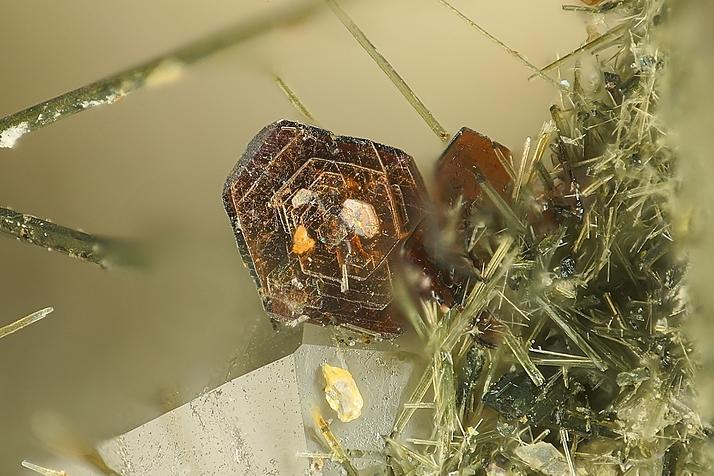
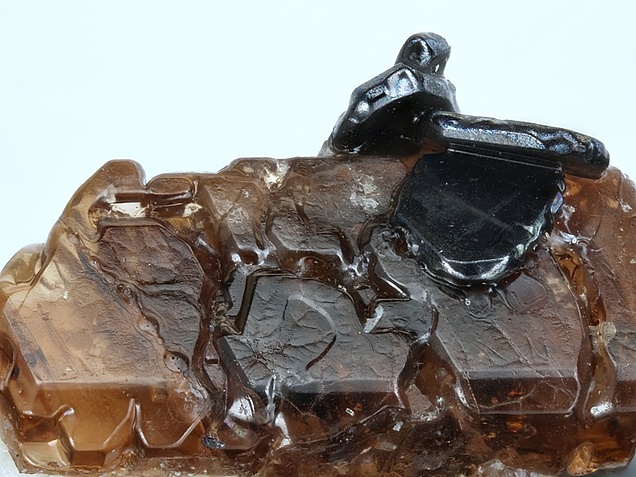
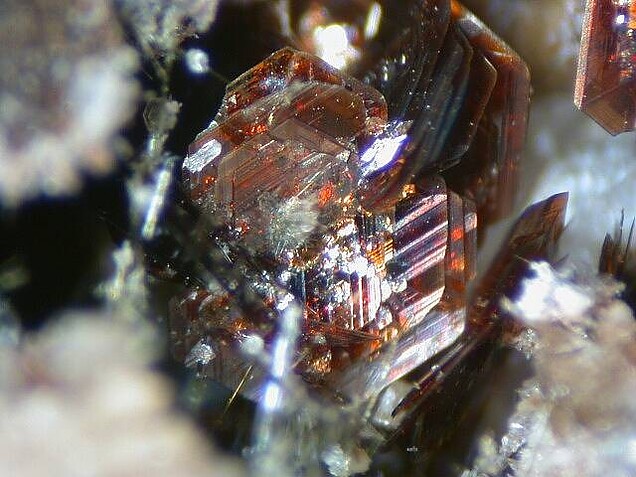
Blood red, greenish yellow, brownish, blackish
Lustre:
Metallic, Sub-Metallic
Hardness:
5 - 6
Specific Gravity:
4.537
Crystal System:
Trigonal
Member of:
Name:
Named in 1890 by Axel Hamberg from the Greek πΰρ, fire, and φαίνεσθαι, to appear, in allusion to its red color.
Unique Identifiers
Mindat ID:
3322
Long-form identifier:
mindat:1:1:3322:6
IMA Classification of Pyrophanite
Approved, 'Grandfathered' (first described prior to 1959)
IMA Formula:
Mn2+Ti4+O3
First published:
1890
Classification of Pyrophanite
4.CB.05
4 : OXIDES (Hydroxides, V[5,6] vanadates, arsenites, antimonites, bismuthites, sulfites, selenites, tellurites, iodates)
C : Metal: Oxygen = 2: 3,3: 5, and similar
B : With medium-sized cations
4 : OXIDES (Hydroxides, V[5,6] vanadates, arsenites, antimonites, bismuthites, sulfites, selenites, tellurites, iodates)
C : Metal: Oxygen = 2: 3,3: 5, and similar
B : With medium-sized cations
4.3.5.3
4 : SIMPLE OXIDES
3 : A2X3
4 : SIMPLE OXIDES
3 : A2X3
7.9.13
7 : Oxides and Hydroxides
9 : Oxides of Ti
7 : Oxides and Hydroxides
9 : Oxides of Ti
Mineral Symbols
As of 2021 there are now IMA–CNMNC approved mineral symbols (abbreviations) for each mineral species, useful for tables and diagrams.
Please only use the official IMA–CNMNC symbol. Older variants are listed for historical use only.
Please only use the official IMA–CNMNC symbol. Older variants are listed for historical use only.
| Symbol | Source | Reference for Standard |
|---|---|---|
| Pph | IMA–CNMNC | Warr, L.N. (2021). IMA–CNMNC approved mineral symbols. Mineralogical Magazine, 85(3), 291-320. doi:10.1180/mgm.2021.43 |
| Pph | Whitney & Evans (2010) | Whitney, D.L. and Evans, B.W. (2010) Abbreviations for names of rock-forming minerals. American Mineralogist, 95, 185–187 doi:10.2138/am.2010.3371 |
| Pyf | The Canadian Mineralogist (2019) | The Canadian Mineralogist (2019) The Canadian Mineralogist list of symbols for rock- and ore-forming minerals (December 30, 2019). download |
Physical Properties of Pyrophanite
Metallic, Sub-Metallic
Transparency:
Opaque
Colour:
Blood red, greenish yellow, brownish, blackish
Comment:
Orange in transmitted light. Greenish yellow colour tentatively attributed to Ce content (Lee, 1955).
Streak:
Ochre yellow with greenish tinge
Hardness:
5 - 6 on Mohs scale
Hardness:
VHN50=435 - 579 kg/mm2 - Vickers
Cleavage:
Perfect
On {0221} perfect; {1012} less perfect.
On {0221} perfect; {1012} less perfect.
Fracture:
Conchoidal, Sub-Conchoidal
Density:
4.537 g/cm3 (Measured) 4.596 g/cm3 (Calculated)
Optical Data of Pyrophanite
Type:
Uniaxial (-)
RI values:
nω = 2.481 nε = 2.21
Max. Birefringence:
δ = 0.271
Based on recorded range of RI values above.
Based on recorded range of RI values above.
Interference Colours:
The colours simulate birefringence patterns seen in thin section under crossed polars. They do not take into account mineral colouration or opacity.
Michel-Levy Bar The default colours simulate the birefringence range for a 30 µm thin-section thickness. Adjust the slider to simulate a different thickness.
Grain Simulation You can rotate the grain simulation to show how this range might look as you rotated a sample under crossed polars. Each grain retains its interference colour (retardation) while its brightness falls to black at extinction and reaches a maximum between extinction positions.
The colours simulate birefringence patterns seen in thin section under crossed polars. They do not take into account mineral colouration or opacity.
Michel-Levy Bar The default colours simulate the birefringence range for a 30 µm thin-section thickness. Adjust the slider to simulate a different thickness.
Grain Simulation You can rotate the grain simulation to show how this range might look as you rotated a sample under crossed polars. Each grain retains its interference colour (retardation) while its brightness falls to black at extinction and reaches a maximum between extinction positions.
Surface Relief:
Very High (positive)
Relative to Canada balsam mounting medium (n ≈ 1.537).
Relative to Canada balsam mounting medium (n ≈ 1.537).
This shows the grain boundary and Becke line effect under plane-polarised
light, based on the contrast between this mineral's average refractive
index and the mounting medium. It does not take into account mineral
colouration.
In focus
Interference Figure:
This shows the idealized uniaxial interference figure - the conoscopic
(convergent-light, Bertrand-lens-in) view, for a grain cut with the optic axis
centred and vertical. The coloured rings are isochromatics, computed with the
same physics as the Michel-Lévy bar above; the dark cross is the isogyre.
For a genuinely uniaxial mineral viewed this way, that cross stays perfectly stationary if you rotate the stage - unlike a biaxial mineral, where it splits apart on rotation. That invariance is itself the standard diagnostic test for telling uniaxial and biaxial minerals apart at the microscope.
For a genuinely uniaxial mineral viewed this way, that cross stays perfectly stationary if you rotate the stage - unlike a biaxial mineral, where it splits apart on rotation. That invariance is itself the standard diagnostic test for telling uniaxial and biaxial minerals apart at the microscope.
Reflectivity:
| Wavelength | R1 (%) | R2 (%) |
|---|---|---|
| 400nm | 23.5% | 19.9% |
| 420nm | 22.7% | 19.6% |
| 440nm | 21.8% | 18.9% |
| 460nm | 21.1% | 18.2% |
| 480nm | 20.4% | 17.6% |
| 500nm | 19.9% | 17.1% |
| 520nm | 19.4% | 16.7% |
| 540nm | 19.0% | 16.3% |
| 560nm | 18.8% | 16.1% |
| 580nm | 18.5% | 15.9% |
| 600nm | 18.3% | 15.7% |
| 620nm | 18.2% | 15.6% |
| 640nm | 18.0% | 15.5% |
| 660nm | 17.8% | 15.4% |
| 680nm | 17.8% | 15.3% |
| 700nm | 17.6% | 15.2% |
Graph shows reflectance levels at different wavelengths (in nm). Peak reflectance is 23.5%.
R1 shown in black, R2 shown in red
Chemistry of Pyrophanite
Mindat Formula:
Mn2+TiO3
Sb-bearing varieties are known from several metamorphic manganese mineralisations.
Sb-bearing varieties are known from several metamorphic manganese mineralisations.
Element Weights:
Elements listed:
Common Impurities:
Fe,Zn
Chemical Analysis
Oxide wt%:
| 1 | 2 | |
|---|---|---|
| TiO2 | 51.75 % | 51.50 % |
| MnO | 35.09 % | 41.00 % |
| FeO | 13.23 % | 6.60 % |
| Total: | 100.07 % | 99.1 % |
Empirical formulas:
| Sample ID | Empirical Formula |
|---|---|
| 3 | (Mn0.76,Fe0.21,Mg0.02)0.99 Ti0.99 O3 |
Sample references:
| ID | Locality | Reference | Notes |
|---|---|---|---|
| 1 | Stokksund, Larvik Commune, Vestfold, Norway | analyzed by B. Bruun | |
| 2 | Stokkøya, Larvik Commune, Vestfold, Norway | X-ray fluorescence analysis | |
| 3 | Gabbro Quarry, Radau valley, Bad Harzburg, Goslar District, Lower Saxony, Germany | Polished grain mount. Fully calibrated quantitative analysis. |
Crystallography of Pyrophanite
Crystal System:
Trigonal
Class (H-M):
3 - Rhombohedral
Space Group:
R3
Cell Parameters:
a = 5.13948(7) Å, c = 14.2829(4) Å
Ratio:
a:c = 1 : 2.779
Unit Cell V:
326.73 ų (Calculated from Unit Cell)
Z:
6
Morphology:
Fine scaly; tabular.
Crystal Structure
Load
Unit Cell | Unit Cell Packed
2x2x2 | 3x3x3 | 4x4x4
Unit Cell | Unit Cell Packed
2x2x2 | 3x3x3 | 4x4x4
Show
Big Balls | Small Balls | Just Balls | Spacefill
Polyhedra Off | Si Polyhedra | All Polyhedra
Remove metal-metal sticks
Big Balls | Small Balls | Just Balls | Spacefill
Polyhedra Off | Si Polyhedra | All Polyhedra
Remove metal-metal sticks
Display Options
Black Background | White Background
Perspective On | Perspective Off
2D | Stereo | Red-Blue | Red-Cyan
Black Background | White Background
Perspective On | Perspective Off
2D | Stereo | Red-Blue | Red-Cyan
View
CIF File Best | x | y | z | a | b | c
CIF File Best | x | y | z | a | b | c
Rotation
Stop | Start
Stop | Start
Labels
Console Off | On | Grey | Yellow
Console Off | On | Grey | Yellow
Data courtesy of the American Mineralogist Crystal Structure Database. Click on an AMCSD ID to view structure
| ID | Species | Reference | Link | Year | Locality | Pressure (GPa) | Temp (K) |
|---|---|---|---|---|---|---|---|
| 0006106 | Pyrophanite | Liferovich R P, Mitchell R H (2006) The pyrophanite-geikielite solid-solution series: crystal structures of the Mn1-xMgxTiO3 series (0 < x < 0.7) The Canadian Mineralogist 44 1099-1107 |  | 2006 | synthetic | 0 | 293 |
| 0006105 | Pyrophanite | Liferovich R P, Mitchell R H (2006) The pyrophanite-geikielite solid-solution series: crystal structures of the Mn1-xMgxTiO3 series (0 < x < 0.7) The Canadian Mineralogist 44 1099-1107 | | 2006 | synthetic | 0 | 293 |
Big Rock Quarry, Granite Mountain area, Little Rock, Pulaski County, Arkansas, USA