

The cheapest Ryzen AI Max+ 395 mini PC with 128GB in Amazon stock on 22 October was the Bosgame M5 at $3,599. The most expensive, the Beelink GTR9 Pro at $4,349, carries the same chip and the same memory. All five machines here run the AMD “Strix Halo” SoC with 16 Zen 5 cores, the Radeon 8060S iGPU and 128GB of LPDDR5X-8000 as unified memory, so the $750 between them buys ports, cooling and a power supply, not speed.
We ranked the five by the price of a 128GB box you can order today. A row gets a Buy button only when its Amazon listing passed two checks on the edit day, Amazon’s Creators API and a US-locale page load from ZIP 10001, and all eight Amazon listings linked on this page passed. The M5 still led on price with 12 units left (Amazon US, checked 22 October 2026). Further down you will find cited tokens/sec figures, the 192GB PRO 495 boxes, and how prices moved since June.
Ryzen AI Max+ 395 mini PC verdict table
Read the price and Ethernet columns first, because they are the only two where the five machines differ in a way that changes how the box gets used. The table is sorted by what a 128GB configuration costs on 22 October 2026, and each name links to the listing the price came from.
| # | Machine | Verdict | 128GB price (22 Oct) | Ethernet | Stock on 22 Oct | Buy |
|---|---|---|---|---|---|---|
| 1 | Bosgame M5 | Cheapest 128GB box in Amazon stock | $3,599 (2TB) | 2.5GbE | Amazon, 12 left | Buy on Amazon |
| 2 | GMKtec EVO-X2 | Cheapest entry with 64GB; 128GB costs $50.99 more than the M5 | $3,649.99 (2TB) | 2.5GbE | Amazon, in stock | Buy on Amazon |
| 3 | Minisforum MS-S1 Max | Best expansion: dual 10GbE, USB4 v2, PCIe x4 slot | $3,879 (2TB) | Dual 10GbE | Amazon, 4 left | Buy on Amazon |
| 4 | Beelink GTR9 Pro | Intel dual 10GbE, vapor chamber, smaller box; $470 over the MS-S1 Max | $4,349 (2TB) | Dual 10GbE | Amazon, 4 left | Buy on Amazon |
| 5 | Framework Desktop | Best for Linux and repairability, if you can get one | $3,449 (DIY, no SSD) | 5GbE | Out of stock at frame.work | Not sold on Amazon |
Our default pick is the Bosgame M5, for one reason: it is the lowest price at which 128GB of Strix Halo memory ships today, and memory is what you are buying this platform for. Its weak spot is the single 2.5GbE port. If you copy 60GB model files across the network every week, the $280 step up to the MS-S1 Max buys dual 10GbE, and that is the only upgrade in this table that changes how the box gets used. The Framework Desktop is cheaper on paper at $3,449, but that price excludes the SSD and every Max+ 395 configuration was out of stock on 22 October.
How this comparison was done
Every Amazon price and stock state on this page comes from two independent reads we took on 22 October 2026. Amazon’s Creators API returned price and availability for each ASIN. A headless browser then loaded each product page with the delivery location set to New York 10001 and recorded the price, the stock line and whether the Add to Cart button was present, plus the seller for every listing that carries a Buy button. A listing that failed either read would have lost its Buy button; none did. Maker-store prices come from the live product data of each store we could read on the same day (Bosgame’s store blocked automated reads), and Framework’s configurator was read directly.
Specs and ports come from each manufacturer’s product page, cross-checked against ServeTheHome’s reviews of every machine here, NAS Compares’ MS-S1 Max review and Tom’s Hardware’s EVO-X2 review. Where the maker page and an older review disagreed, the maker page won: Beelink’s GTR9 Pro page lists a built-in 230W power supply, which corrects the external brick this comparison listed before.
Tokens/sec figures on this page are cited, not measured by us. They come from ServeTheHome, CraftRigs’ EVO-X2 local-LLM run, and public llama.cpp benchmark grids for Strix Halo. Because all five share the same SoC and memory subsystem, inference speed tracks the chip, not the chassis. The chassis decides whether that speed holds under a long generation (thermals) and how the box fits into a homelab (ports, noise). For how these unified-memory boxes line up against discrete GPUs on raw speed, the GPU buyer guide for local LLMs carries the measured 3090/4090/5090/L40S numbers.
How fast the Ryzen AI Max+ 395 runs local LLMs
For local AI the number that matters is addressable memory, and this platform’s answer is roughly 96GB. The Ryzen AI Max+ 395 pairs 16 Zen5 cores with a 40-compute-unit Radeon 8060S iGPU and an XDNA2 NPU, all sharing one 128GB LPDDR5X-8000 pool on a 256-bit bus. Theoretical peak bandwidth is about 256 GB/s. On Linux, GTT kernel parameters (amdgpu.gttsize, and ttm.pages_limit on newer kernels) expose around 96 to 100GB of that pool to the GPU, which is what lets a single box hold a 70B model or a 120B mixture-of-experts model that no consumer discrete GPU can fit. The 96GB figure is the Windows cap; on Linux a larger ttm.pages_limit hands the GPU more, and owners on Framework’s forum report about 120GB, at the cost of memory left for the OS (AMD documents the GTT settings in its ROCm Strix Halo guide).
Cited generation rates on Strix Halo, all at Q4-class quantization:
| Model (Q4) | Memory footprint | Cited tokens/sec | Notes |
|---|---|---|---|
| gpt-oss-120b (MoE) | ~64GB | ~52 to 56 tok/s | Activates ~5B params per token; llama.cpp Vulkan figure, other runtimes are slower, which is why a 120B model runs usably |
| Llama 70B dense | ~40GB | ~4 to 6 tok/s | Fits comfortably, but dense 70B is bandwidth-bound, not capacity-bound |
| Qwen 32B dense | ~20GB | ~8 to 12 tok/s | The practical balance point for interactive use |
| 8B dense | ~5GB | ~25 to 40 tok/s | Fast enough for agent loops and coding assistants |
Runtime choice moves these numbers as much as the chassis does. The gpt-oss-120b figure above comes from llama.cpp’s Vulkan backend, and other runtimes and default settings land lower: ServeTheHome’s out-of-the-box LM Studio run on the GTR9 Pro measured 31.41 tok/s on gpt-oss-120b, while dense Llama 3.3 70B sat at 4.89 tok/s, inside the range above, because bandwidth caps it either way. Pick the runtime before blaming the hardware. The Ollama vs vLLM vs llama.cpp throughput comparison shows how large that gap gets on one GPU, and the llama.cpp setup guide for Linux covers building the Vulkan backend.
Read the pattern in that table. Capacity is the platform’s strength and bandwidth is its ceiling. A dense 70B fits but generates at single-digit tokens/sec because 256 GB/s of shared memory cannot feed it faster. A 120B mixture-of-experts model runs at an order of magnitude higher rate because only about 5B parameters are active per token.
The buying lesson: these machines win when the job is “run a model that does not fit on a 24 or 32GB GPU”, and they lose when the job is “run a small model as fast as possible”, where a discrete GPU is faster. If you are unsure which side of that line your workload sits on, the breakdown of how much VRAM each model size needs sizes it precisely. If dense-model speed is the goal, the Mac Studio M5 Max takes 128GB at 614 GB/s, about 2.4 times this platform’s bandwidth, though at $5,099 for that configuration on 30 September it cost more than any 395 box here.
1. Bosgame M5
Bosgame’s M5 is the cheapest 128GB Strix Halo box in Amazon US stock: $3,599 with a 2TB PCIe 4.0 SSD, sold by Bosgame’s own storefront, with 12 units left on 22 October. That is $50.99 under the equivalent EVO-X2 and $750 under the GTR9 Pro for the same SoC and the same 128GB LPDDR5X-8000. The lead was wider in late September, when the M5 sold for $3,324.04 on 28 September, so its edge over the EVO-X2 depends on the week you buy. At its August price, ServeTheHome’s review put it $500 to $1,000 below AMD’s own Ryzen AI Halo developer box; at $3,599 that gap is smaller.
Its ports are close to the EVO-X2’s: two USB4 ports (one front, one rear), three USB 3.2 Gen2 Type-A, two USB 2.0, HDMI and DisplayPort outputs, and an SD card reader. A second M.2 slot takes more storage. A front button switches between three performance modes, from a quiet low-power profile to the full-power one that brings the fan noise with it; ServeTheHome measured about 38 dBA in the normal mode and 45 dBA in performance mode. The weak spot is networking. The single Realtek 2.5GbE port is the one ServeTheHome called the biggest miss of the system, because a 10GbE port would have put it level with the MS-S1 Max and GTR9 Pro on paper. Power comes from a 240W external brick, so plan desk space for it.

Who it is for: the buyer who wants the most model memory for the least money and is fine on 2.5GbE. Skip it if: you move large model files over the network often, where the 10GbE boxes save real time on every copy, or the box will sit on a desk where an external 240W brick is a nuisance.
2. GMKtec EVO-X2
GMKtec’s EVO-X2 is the cheapest way onto the platform at all: its 64GB and 1TB build is $2,199.99, the same price on Amazon and GMKtec’s own store, and in stock at both on 22 October. At 128GB it costs $3,649.99 with a 2TB SSD on Amazon, $50.99 more than the M5, while GMKtec’s store also sells a 128GB build with a 1TB SSD for $3,499.99 if half the storage is enough. It carries the same 128GB LPDDR5X-8000, two USB4 ports (one front, one rear), dual M.2 2280 slots supporting up to 16TB, HDMI 2.1, DisplayPort, and an SD card reader.
Two compromises pay for that price. First, networking tops out at a single 2.5GbE port (Realtek RTL8125BG), so it is not the box to build a 10G-fed inference node around. Second, cooling is loud. In Tom’s Hardware’s gaming loop the chip averaged 61C with steady frame rates, but the fans became audible across a room under sustained CPU load. Power comes from a 230W external brick. The cooling design (three heat pipes, dual fans, 120W sustained and 140W peak) holds clocks, it just is not quiet doing it.
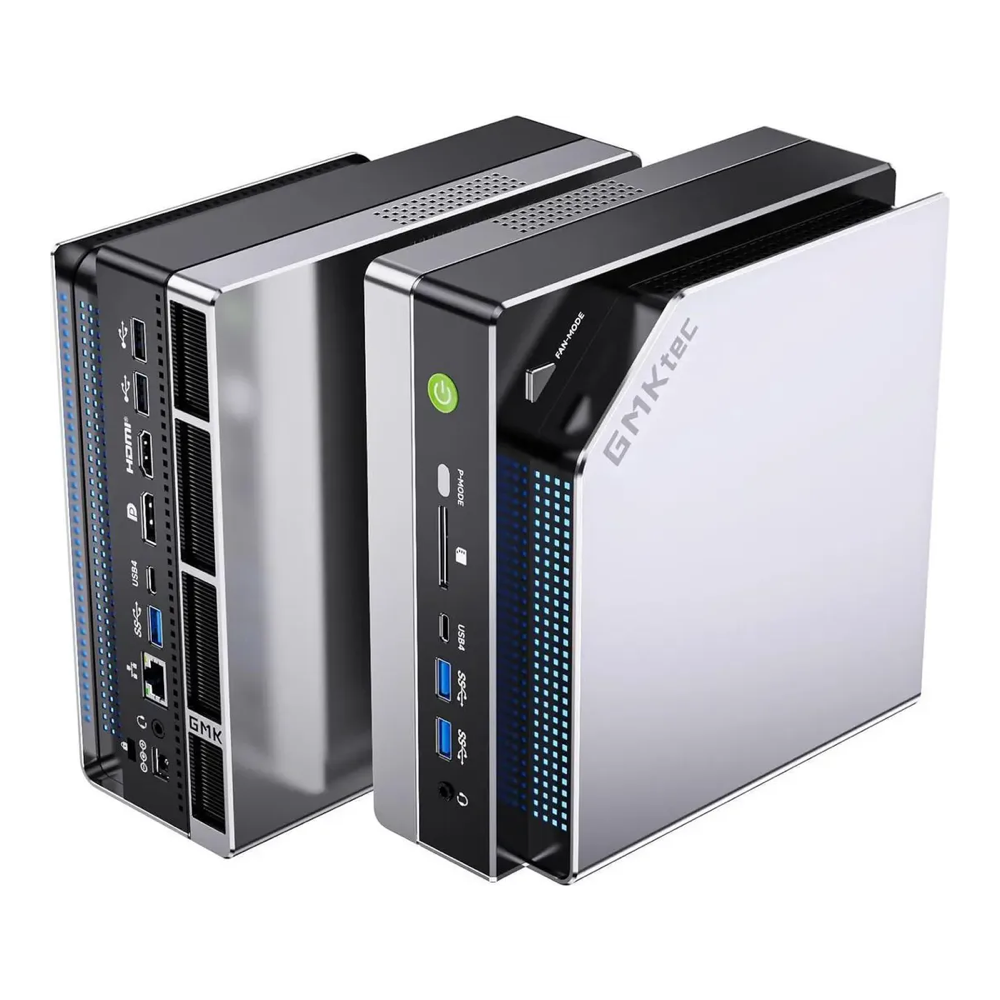
Best fit: the buyer who wants onto the platform for the least money with 64GB, or wants 128GB with Amazon returns and runs it where fan noise does not matter. Skip it if: you need 10GbE, or the machine sits on your desk where the noise under load and the external brick would bother you.
3. Minisforum MS-S1 Max
Minisforum’s MS-S1 Max is the expansion pick and ServeTheHome’s favorite Ryzen AI Max mini PC to date. It pairs the same 128GB Strix Halo platform with dual 10GbE (Realtek RTL8127), two rear USB4 v2 ports at 80Gbps, two front USB4 ports at 40Gbps, HDMI 2.1, and Wi-Fi 7. Inside there is a PCIe slot that is x16 physically but PCIe 4.0 x4 electrically, which in practice takes a half-height card such as a faster NIC or a storage adapter. The power supply is internal (320W), so there is no brick, and the chassis supports 2U rack mounting.
Two details are worth knowing before buying. The second M.2 slot is PCIe 4.0 x1, so treat it as capacity storage rather than a second fast drive. The RTL8127 10GbE controller is new enough that a fresh Linux or Windows install may need Realtek’s driver before the ports come up. Noise is modest at idle and reaches the low 50 dBA range under full load in the Performance mode (130W), with 95W Balanced and 60W Quiet modes to trade speed for silence.
At $3,879 for 128GB and 2TB on Amazon, it costs $280 more than the M5 and $470 less than the GTR9 Pro, for the same dual 10GbE as the Beelink plus faster USB and a PCIe slot. The Amazon listing, sold by Minisforum’s own storefront, had 4 units in stock on 22 October and undercut Minisforum’s store, which asked $3,919 for the same configuration. The 64GB build is $2,599 on Amazon, orderable for a later delivery date rather than from stock, and it is the cheapest way to get 10GbE on this chip.

Who it is for: a homelab or small-team buyer who wants 10GbE, room to add a card, and a box that can go in a rack. Skip it if: you want the smallest footprint; at 2.8 kg and 222 x 206 x 77 mm it is the largest sealed box here.
4. Beelink GTR9 Pro
Beelink’s GTR9 Pro is the other dual-10GbE machine, and with the MS-S1 Max one of only two here that you would reasonably make the center of a model-serving setup. Where the EVO-X2 gives you 2.5GbE, the GTR9 Pro gives you dual 10GbE (Intel E610), alongside two rear USB4 ports, a front USB-C 10Gbps port, two USB 3.2 Type-A, HDMI 2.1, and DisplayPort 2.1. Storage is dual M.2 2280 PCIe 4.0 supporting up to 16TB, shipping with a 2TB drive. Beelink’s spec page lists an integrated 230W power supply, so like the MS-S1 Max there is no external brick. A vapor chamber and dual-turbine fans keep it quieter than the EVO-X2; Beelink rates it at 32 dB, though one reviewer’s reader reported closer to 52 dBA under load, so treat “near-silent” as best-case.
One caveat matters before you deploy it: in ServeTheHome’s review the Intel E610 ports disappeared after a Windows update, and came back only with a later Intel driver and NIC firmware update. Linux owners on Beelink’s and Intel’s forums have also reported the controller hanging or dropping into firmware recovery mode under sustained load, with BIOS and E610 firmware updates fixing it for most. If 10GbE is the reason you are buying this machine, update the BIOS and NIC firmware, run a recent kernel, and test the ports under load before it goes into service. Pair it with a Proxmox-ready mini PC for the rest of the rack and the dual 10GbE makes the GTR9 Pro the obvious node for the GPU-class work.
On pricing, the GTR9 Pro launched at a $1,985 MSRP and now sells for $4,349 both on Amazon and on Beelink’s own store, where orders are pre-orders with a shipping time of about 35 days. The Amazon listing, sold by Beelink’s own storefront, was back in stock on 22 October with 4 units left, which makes Amazon the faster route by about a month. It is still the most expensive machine here, $470 above the MS-S1 Max for the same dual 10GbE and without the PCIe slot.
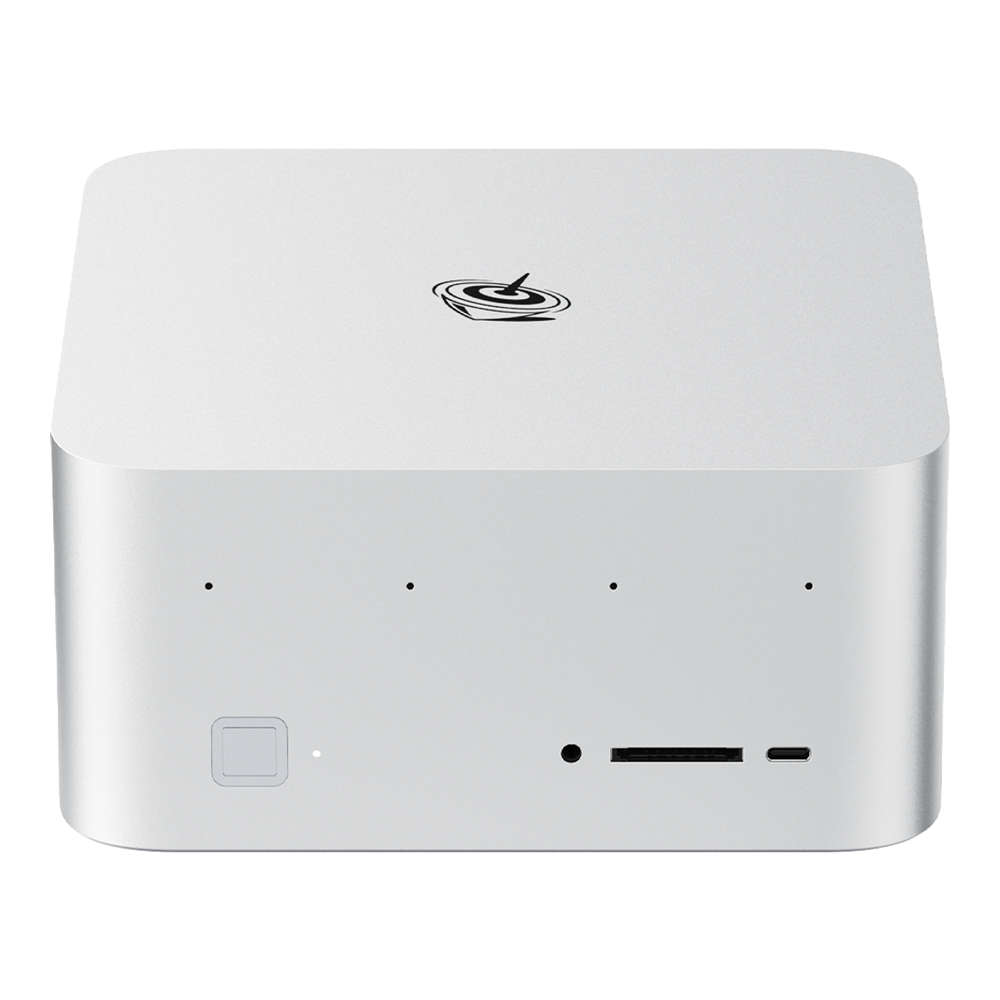
Who it is for: a homelab buyer who wants dual Intel 10GbE and vapor-chamber cooling in a box about 2.9 litres in size, smaller than the 3.5-litre MS-S1 Max. Skip it if: you do not need 10GbE, in which case the M5 or EVO-X2 delivers the same compute for less, or you want 10GbE for less money, which is the MS-S1 Max.
5. Framework Desktop
Framework’s Desktop is the standards-compliant option and the one you cannot buy this week. Framework’s configurator showed the 128GB Max+ 395 system at $3,449 and the 64GB system at $1,959 on 22 October, both out of stock and sold as pre-orders with a $100 deposit. If you can wait, it is the best machine here for a Linux user. The Strix Halo lives on a standard mini-ITX mainboard inside a documented case, the internals are repairable and laid out for it, and there is a PCIe slot on the board for expansion, which only the MS-S1 Max matches. ServeTheHome ranked it their third-favorite Strix Halo machine, and its main knock is that it ships as a kit you assemble. At about 4.5 litres it is also the largest case here.
Memory is 128GB of soldered LPDDR5X, same as the others. Storage uses standard M.2 slots, networking is 5GbE, and front connectivity comes through Framework’s expansion-card system, the same modular USB-C cards used on its laptops, which you populate with USB-A, USB-C, SD, audio, or Ethernet as needed. A Noctua CPU-fan option keeps it quiet. The DIY price excludes the SSD and the OS, so a 128GB build with a 2TB SanDisk SN7100 lands at $3,954 before fan, cable and tiles, which is $355 above the M5.
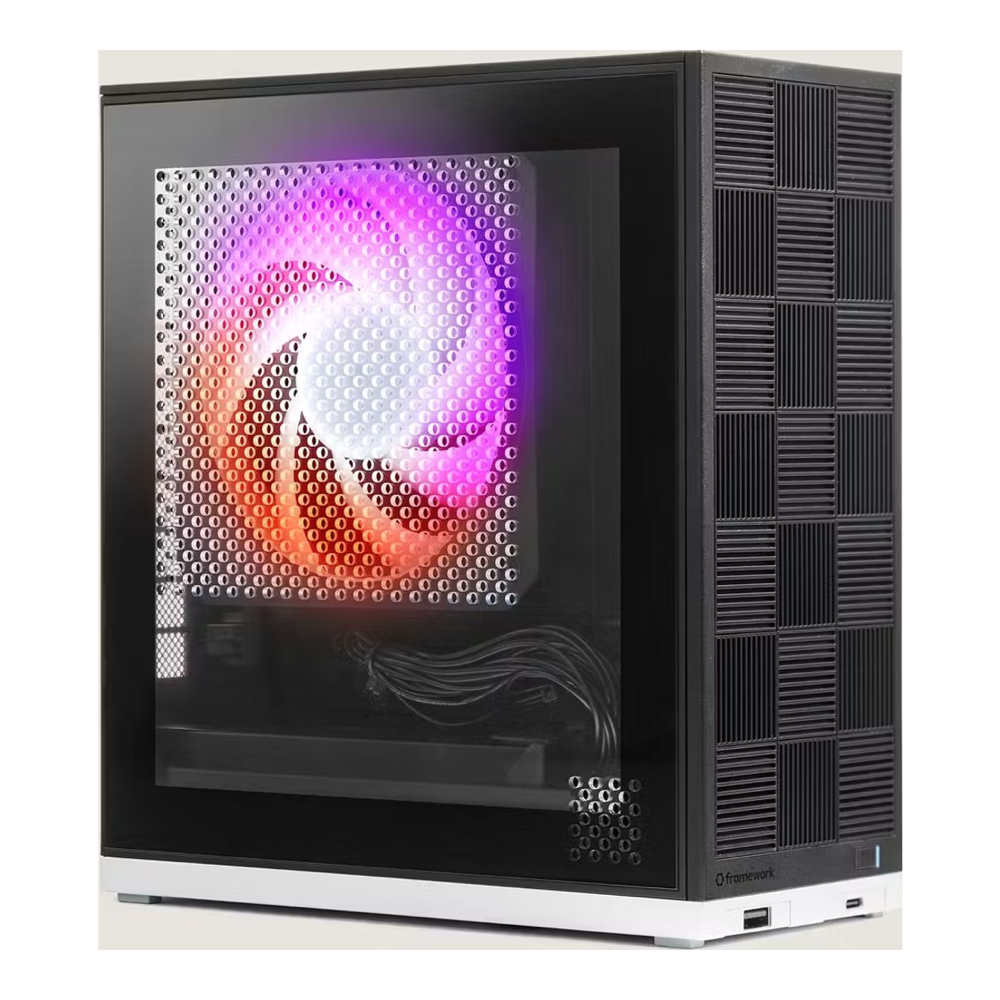
Buy it if: you are a Linux user who values repairability, open documentation, and a PCIe slot, do not mind assembling the machine, and can wait for stock. Skip it if: you want a sealed box that ships now, or you need the smallest possible footprint.
Framework sells the Desktop only direct, so this pick has no Amazon button: check Framework Desktop availability at frame.work.
What a Ryzen AI Max+ 395 mini PC costs now
Every 128GB price in the June version of this comparison has close to doubled. The configuration that anchored this category near $2,000 now costs $3,449 from Framework (without an SSD), $3,599 for the Bosgame M5, $3,649.99 from GMKtec, $3,879 from Minisforum on Amazon, and $4,349 from Beelink. The driver is the DRAM contract market, not vendor margin. These are soldered LPDDR5X parts bought in 128GB blocks, and Framework attributes its increase directly to RAM cost.
| Machine | Config | June 2026 | 11 Aug 2026 | 28 Sep 2026 | 22 Oct 2026 |
|---|---|---|---|---|---|
| Framework Desktop | 128GB | $1,999 | $3,449 | $3,449, out of stock | $3,449, out of stock |
| Bosgame M5 | 128GB + 2TB | not listed | not listed | $3,324.04, in stock | $3,599, 12 left |
| GMKtec EVO-X2 | 128GB + 2TB | $1,800 to $2,000 | $3,649.99 | $3,649.99, in stock | $3,649.99, in stock |
| Minisforum MS-S1 Max | 128GB + 2TB | not listed | not listed | $3,799, 3 left | $3,879, 4 left |
| Beelink GTR9 Pro | 128GB + 2TB | $1,985 | $4,349 | $4,349, Amazon in stock | $4,349, 4 left |
Prices held flat through September and moved up again in October. On Amazon the Bosgame M5 rose $274.96 from its 28 September price and the MS-S1 Max $80, while the EVO-X2 and GTR9 Pro did not move. The GTR9 Pro listing, which showed temporarily out of stock on 10 October, had units again by 22 October. Read the 22 October column as a snapshot: the M5 had 12 units left and both 10GbE boxes had 4, so the cheapest-in-stock answer can change within days, and the Buy buttons above point at the listings rather than at a fixed price. Between manual checks like this one, we track the current AI Max+ 395 mini PC prices across the wider market in our mini PC price tracker, not just these five listings.
Is the Amazon listing a third-party markup?
No. On 22 October the four 128GB pick listings (M5, EVO-X2, MS-S1 Max and GTR9 Pro) were sold by the maker’s own Amazon storefront and shipped from Amazon, and where we could read the maker’s store the Amazon price matched or beat it. The 128GB and 2TB EVO-X2 sells for $3,649.99 on Amazon and $3,649.99 on GMKtec’s store, matching to the cent, the GTR9 Pro is $4,349 in both places, and the MS-S1 Max is $40 cheaper on Amazon than on Minisforum’s store. That is worth stating plainly because the June version of this guide recorded Amazon markups on the GTR9 Pro, and that assumption no longer holds. The number to check before buying is the configuration, not the channel: GMKtec sells 128GB with 1TB at $3,499.99 and 128GB with 2TB at $3,649.99, and a $150 gap between them is easy to misread as a discount.
Which is the cheapest Ryzen AI Max+ 395 mini PC?
In stock, the cheapest one is the GMKtec EVO-X2 with 64GB and a 1TB SSD at $2,199.99, the same price on Amazon and GMKtec’s store. The cheapest 128GB machine in stock is the Bosgame M5 at $3,599. Everything else on 22 October sits between or above those two numbers:
- $2,199.99: GMKtec EVO-X2, 64GB + 1TB. The entry price for the platform.
- $2,399.99: GMKtec EVO-X2, 64GB + 2TB. Worth the $200 only if you would buy a second SSD anyway.
- $2,599: Minisforum MS-S1 Max, 64GB + 2TB. The cheapest route to dual 10GbE on this chip, orderable for a later delivery date.
- $3,599: Bosgame M5, 128GB + 2TB. The cheapest 128GB box in Amazon stock. GMKtec’s store sells a 128GB + 1TB EVO-X2 for $3,499.99 if 1TB is enough.
Framework lists a 64GB build at $1,959, which would be the lowest price on paper, but it is out of stock and the DIY Edition price excludes the SSD and OS.
A 64GB build halves the model space. The GTT split exposes roughly 48GB of a 64GB pool to the GPU against the 96 to 100GB a 128GB machine gives up. A 70B model at 4-bit weights is about 40GB and still fits. A 120B mixture-of-experts model does not, and neither does a 70B at 8-bit. If the reason for buying Strix Halo is holding a model no consumer discrete GPU can fit, 128GB is the configuration that does it, and it now costs what a used workstation GPU costs.
One newer machine is worth knowing about. The GMKtec EVO-X3 pairs the same Ryzen AI Max+ 395 with 128GB and 2TB at $3,799.98 on Amazon, in stock on 22 October, which places it $150 above the EVO-X2 it succeeds rather than at a new tier. It adds the OCuLink port the EVO-X2 lacks, so it is the box to pick if you plan to attach an external GPU.
Ryzen AI Max+ PRO 495 mini PCs: 192GB for about double the price
AMD’s successor chip, the Ryzen AI Max+ PRO 495 (codenamed Gorgon Halo), reached US maker stores at the end of September. On AMD’s spec sheet it is the same 16-core Zen 5 die with four changes: 192GB of LPDDR5X-8533 instead of 128GB of LPDDR5X-8000, a 5.2 GHz boost (100 MHz more), the Radeon 8065S GPU at 3.0 GHz (also 100 MHz more, same 40 compute units), and a 55 TOPS NPU instead of 50. It also loses Precision Boost Overdrive and Curve Optimizer. Peak bandwidth rises about 6.6 percent, from 256 to about 273 GB/s, which is why The Register calls it essentially a factory-overclocked Strix Halo.
GPU memory is the change that matters. AMD rates the 495 at 160GB assignable to the GPU against the 96GB cap on the 395, and The Register reports that 160GB is the Windows limit, with Linux able to hand over nearly all of the 192GB. That puts a new class of model on one box. Qwen3-235B-A22B at Q4_K_M is a 142.2GB download and MiniMax-M2 at Q4_K_M is 138.3GB, and neither fits a 395. Speed does not move with it: bandwidth caps generation on both chips, so a model that already fits a 395, such as gpt-oss-120b at 63.4GB, runs only a few percent faster on a 495.
| Machine | 192GB price (22 Oct) | Ships | Ethernet | Expansion |
|---|---|---|---|---|
| ACEMAGIC F9A | $6,499 (2TB) | Orderable; ship date not stated on the store page | Dual 2.5GbE | OCuLink, USB4 |
| GMKtec EVO-X5 Pro | $6,799 (2TB), $7,099 (4TB) | Orders placed on or after 17 Oct ship in early November | Dual 10GbE | Two USB4 v2, three M.2, 330W external brick |
| Framework Desktop (495) | From $6,799 DIY; $7,449 pre-built (reported) | Pre-order | Not yet confirmed | PCIe x4 slot |
| Minisforum MS-S1 MAX-P495 | $7,399 (2TB) | Sold out; store estimates mid November | Dual 10GbE | Two USB4 v2, PCIe x4 slot, internal 320W PSU |
We found no Amazon US listing for any of them. The three NIMO listings that claimed 495 specs in early October (with 9600MHz memory and a 5.5 GHz boost that AMD’s spec sheet does not support) no longer resolve in Amazon’s catalog. Two other 495 boxes do not change the picture: the Beelink GTR9 Pro 495 is sold only in China and ships with 128GB and the same 96GB GPU cap as a 395, and Bosgame says its 192GB M5 Max arrives in early 2027.
Buy a 495 only if the model you need is a mixture-of-experts that no longer fits a 395’s GPU share, roughly above 96GB on Windows or about 120GB on a tuned Linux box. For everything up to gpt-oss-120b, a 128GB Ryzen AI Max+ 395 box costs about half as much and generates at nearly the same speed. Our Ryzen AI Max+ 495 vs 395 comparison shows which models fit each chip and the expected speed gain.
How the five compare
SoC, memory and inference speed are constants across the five. The table isolates the variables that actually differ, in the same order as the verdict table.
| Spec | Bosgame M5 | GMKtec EVO-X2 | Minisforum MS-S1 Max | Beelink GTR9 Pro | Framework Desktop |
|---|---|---|---|---|---|
| SoC | Ryzen AI Max+ 395 (16 Zen5, Radeon 8060S, XDNA2 NPU), identical | ||||
| Memory | 128GB LPDDR5X-8000, ~256 GB/s, 96GB GPU share on Windows, ~96 to 120GB on Linux via GTT, identical | ||||
| Ethernet | 2.5GbE (Realtek) | 2.5GbE | Dual 10GbE (Realtek RTL8127) | Dual 10GbE (Intel E610) | 5GbE |
| USB4 | 2 (front + rear) | 2 (front + rear) | 2x USB4 v2 80Gbps + 2x USB4 | 2 rear + front USB-C 10G | 2 (rear I/O) |
| Expansion | Dual M.2 | Dual M.2 (to 16TB) | PCIe x4 slot + dual M.2 (x4 and x1) | Dual M.2 (to 16TB) | PCIe slot + M.2 |
| Power supply | External, 240W | External, 230W | Internal, 320W | Internal, 230W | Internal |
| Noise under load | ~38 dBA normal, ~45 dBA performance (STH) | Audible across a room | Low 50 dBA range in Performance mode | 32 dB rated, louder reported under load | Quiet (Noctua option) |
| Form factor | Sealed mini PC | Sealed mini PC | Sealed, 2U rack-mountable | Sealed mini PC | Mini-ITX, self-assembled |
| Linux posture | Works, community-tested | Works, community-tested | Works; RTL8127 may need Realtek’s driver | Works; E610 needs recent kernel and NIC firmware | First-class, open docs |
| Price (128GB, 22 Oct) | $3,599 | $3,649.99 | $3,879 | $4,349 | $3,449 without SSD |
| Where to buy | Amazon | Amazon or GMKtec | Amazon or Minisforum | Amazon (in stock) or Beelink (pre-order) | frame.work (pre-order) |
Which to buy
Compute is the same across all five, so the decision reduces to which constraint you care about most:
- The budget is fixed and the model has to fit: the Bosgame M5. It is the lowest price for 128GB in stock, and 2.5GbE instead of 10GbE is what you give up against the MS-S1 Max and GTR9 Pro.
- You want onto the platform for the least money: the GMKtec EVO-X2 with 64GB at $2,199.99, accepting that a 120B mixture-of-experts model will not fit.
- The box feeds a network or will take a card later: the Minisforum MS-S1 Max. It has the GTR9 Pro’s dual 10GbE for $470 less, plus USB4 v2 and a PCIe slot, and it is the one to rack.
- You want dual 10GbE and vapor-chamber cooling in a smaller box than the Minisforum: the Beelink GTR9 Pro, with time budgeted to update the BIOS and E610 firmware and to test the 10GbE ports under load.
- Linux, repairability and open documentation come first and you can wait: the Framework Desktop, the machine most likely to still be serviceable in three years.
One sizing reality applies to all five. A unified-memory mini PC is the right tool when the model does not fit on a discrete GPU, and the wrong tool when raw speed on a small model is what you need. A 70B dense model at 4 to 6 tokens/sec is patient-batch territory, not interactive chat. If your workload is small models at high speed, the comparison to look at is a used high-VRAM card against a current one, covered in the RTX 3090 versus 5090 breakdown, and the broader mini PC for local AI roundup places these Strix Halo boxes against the Mac and discrete-GPU alternatives.
What to watch in the metrics
When evaluating any Strix Halo box for local AI, three measurements predict whether it will do the job, and none of them is the CPU benchmark the marketing leads with:
- Addressable GPU memory after the GTT setting. The 128GB pool is shared; what the GPU can actually use depends on the kernel parameter. Confirm you can reach at least ~96GB before assuming a 120B model fits.
- Tokens/sec on your real model at your real context length. A 120B MoE at ~52 to 56 tok/s and a 70B dense at ~5 tok/s are both “runs on this box”, but only one is interactive. Benchmark the model you will actually use.
- Sustained clock and acoustics over a long generation. A 30-second benchmark hides the throttle and the fan curve that a 10-minute generation exposes. The chassis, not the chip, decides this, and with the ports it is why these five machines differ.
The silicon is settled. Buy for the ports, the cooling, and the support model, and the Ryzen AI Max+ 395 will deliver the same 96GB or more of model memory regardless of which logo is on the front.


