Model size picks the machine. Budget only decides how fast the model runs. Shop the other way round and it is easy to buy a fast box that cannot hold the model. It is just as easy to buy 128 GB to run an 8B model that a $900 mini PC handles fine.
This guide to the best mini PC for local AI works from the model down. The tiers are 8B, 27B to 32B, dense 70B, 120B mixture-of-experts, and anything past 128 GB. Each one gives the memory needed, the cheapest box that holds it and the fastest one. It also gives the tokens per second that published benchmarks show. Box-by-box comparisons live in their own guides, linked where they apply. Prices were captured on Amazon and the vendor stores on 10 October 2026, and every speed links to its source.
Best mini PC for local AI at each model size
| Biggest model you run | Memory to buy | Best value | Fastest |
|---|---|---|---|
| 7B to 14B (Llama 3.1 8B, Qwen3 14B) | 32 GB | Minisforum UM880 Plus, 32 GB, $829 | Mac Studio M5 Max, 36 GB, $2,299 |
| 27B to 32B dense (Qwen3 32B, Gemma 3 27B) | 48 to 64 GB | GMKtec EVO-X2, 64 GB, $2,199.99 | Mac Studio M5 Max, 48 GB, $3,099 |
| Dense 70B (Llama 3.3 70B) | 128 GB | Bosgame M5, 128 GB, $3,599 | Mac Studio M5 Max, 128 GB, $5,099 |
| 120B mixture-of-experts (gpt-oss-120b) | 128 GB | Bosgame M5, 128 GB, $3,599 | Mac Studio M5 Max, 128 GB, $5,099 |
| Over 128 GB (Qwen3-235B, MiniMax-M2) | 192 GB or more | GMKtec EVO-X5 Pro, 192 GB, $6,799 | Mac Studio M5 Ultra, 256 GB |
Amazon prices are from 10 October 2026. The 128 GB Mac Studio M5 Max is not sold on Amazon. That link goes to Apple, and $5,099 is Apple’s price with a 512 GB SSD. The 40-core, 48 GB model had sold out on Amazon by 24 October, so its links go to Apple too, where it is $3,099 with a 512 GB SSD. Prices on these boxes have kept moving since; the mini PC price tracker follows what the N150, 8845HS and AI Max+ 395 boxes cost now. The NVIDIA DGX Spark has its own section further down. It is a development box first.
How much memory each model size needs
The weights have to fit in the memory the GPU can address. Context needs room too. File sizes below are the GGUF downloads on Hugging Face. Add 8 to 20 GB for the KV cache, and more at long context.
| Model (Q4_K_M unless noted) | Weights | Smallest box that holds it with context |
|---|---|---|
| Llama 3.1 8B | 4.92 GB | 16 GB; 32 GB to keep a second model loaded |
| Gemma 3 27B | 16.55 GB | 36 GB Mac, 32 GB of GPU memory on a PC |
| Qwen3 32B | 19.76 GB (34.82 GB at Q8_0) | 48 GB Mac or 64 GB Strix Halo |
| Llama 3.3 70B | 42.52 GB | 128 GB unified memory |
| gpt-oss-120b (MXFP4) | 63.4 GB | 128 GB unified memory |
| Qwen3-235B-A22B | 142.2 GB | 192 GB Strix Halo on Linux, or 256 GB Mac |
Two defaults shrink what each box can use. macOS wires roughly three quarters of RAM for the GPU. A 48 GB Mac gives a model about 36 GB. A Strix Halo box gives the GPU what the BIOS assigns. That is up to 96 GB on a 128 GB machine, until you raise the limit on Linux (the last section shows how). The LLM VRAM calculator works the full arithmetic for any model, quantization and context length.
Speed is a separate question. Every generated token reads the active weights from memory once. Decode speed follows memory bandwidth. The UM880 Plus’s dual-channel DDR5-5600 gives 89.6 GB/s. Strix Halo has 256 GB/s and the DGX Spark 273 GB/s. The M5 Max has 460 or 614 GB/s, and the M5 Ultra 1.2 TB/s. The unified memory vs VRAM explainer covers why bandwidth, not compute, caps single-user speed.
Run 8B to 14B models for under $1,000
An 8B model at Q4 is under 5 GB. Almost anything with 32 GB of RAM loads it. The Minisforum UM880 Plus is a Ryzen 7 8845HS with the Radeon 780M iGPU. It has 32 GB of DDR5 and a 1 TB SSD. It is $829 on Amazon.
Bandwidth is the limit. At 89.6 GB/s the ceiling for a 4.92 GB file is about 18 tokens a second. Expect low teens in practice. That is our estimate from bandwidth, not a published run. It is fine for chat. It is slow for agent loops that fire hundreds of calls. Do not buy it if 14B is your floor rather than your ceiling. A 32B Q4 file decodes at roughly 3 to 4 tokens a second on the same memory (also an estimate).
The fast way to run the same models is the base Mac Studio M5 Max with 36 GB. It is $2,299 on Amazon, against $2,499 at Apple. The 32-core GPU reads memory at 460 GB/s, five times the UM880 Plus. There is no published 7B run on that exact chip yet. The 40-core M5 Max does 119.9 tokens a second on Llama 2 7B Q4_0 in the llama.cpp Apple Silicon table. By bandwidth alone the 32-core chip should land near three quarters of that, around 90 (our estimate). For the Mac mini end of the range, the Mac mini guide for AI agents covers the cheaper configurations.
Mini PCs sold on their NPU are not the shortcut here. The NPU in a Ryzen AI or Core Ultra chip runs small vendor-tuned models through specific runtimes. llama.cpp and Ollama run on the GPU. The NPU mini PC comparison covers what those chips do well.
Run 27B to 32B models on 48 to 64 GB
This is the tier most people should buy for. A Qwen3 32B or Gemma 3 27B at Q4 is a capable coding and chat model. It needs about 20 GB plus context. Two boxes cover it.
The value pick is the GMKtec EVO-X2 with 64 GB and a 1 TB SSD. It is $2,199.99 on Amazon and at the GMKtec store. The chip is the same Ryzen AI Max+ 395 (Strix Halo) as the 128 GB boxes, with half the memory.
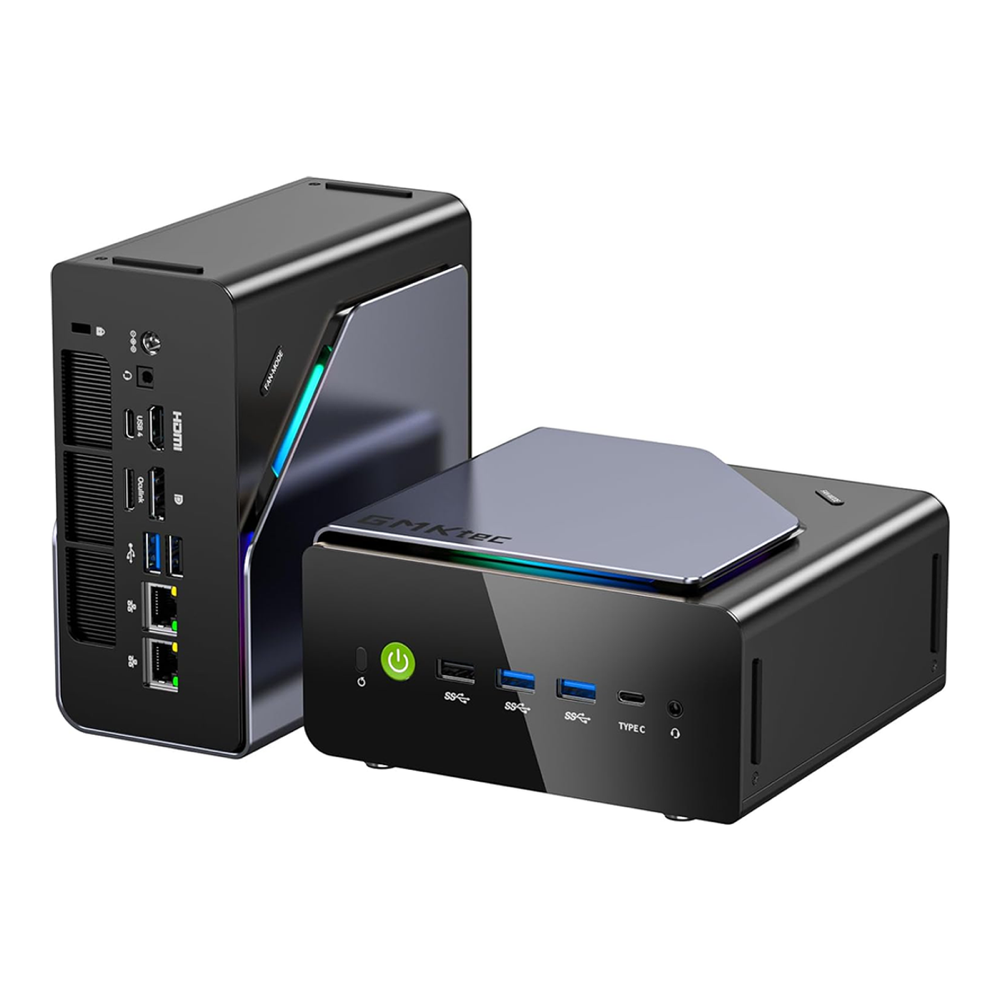
On ROCm, an EVO-X2 decodes Qwen3.8 27B at 11.3 to 11.9 tokens a second at Q4 (llama.cpp run on an EVO-X2). That is comfortable for chat. The catch is the ceiling. Roughly 48 GB is available to the GPU. A 70B Q4 file at 42.5 GB loads with almost no room for context. A 120B model does not load at all. If you expect to want 70B next year, buy 128 GB now. The 128 GB boxes below cost $1,400 more and remove the question.
The speed pick is the Mac Studio M5 Max with the 40-core GPU and 48 GB. It is $3,099 at Apple with a 512 GB SSD, after the 1 TB Amazon listing at $3,399 sold out in October.

At 614 GB/s it has 2.4 times the bandwidth of the EVO-X2. The measured gap is about two to one, on different 27B models. The Mac does 23.6 tokens a second on a Qwen3.5 27B at 6-bit with a 4K context, on MLX (Hardware Corner). The default wired limit leaves about 36 GB for the model. That holds a 32B at Q4 or Q6, but not at Q8. Pass on it if you need Linux, CUDA or a model above 32B. Memory on a Mac cannot be upgraded later. For a laptop at this tier, the laptop guide for local LLMs covers the MacBook Pro and Strix Halo notebooks.
Run a dense 70B: 128 GB and a bandwidth wall
A Llama 3.3 70B at Q4 is 42.5 GB. Every 128 GB box holds it with context to spare. Holding it is not the hard part. Generation is.
| Machine | Price (10 Oct 2026) | Dense 70B-class decode | Source |
|---|---|---|---|
| Strix Halo 395, 128 GB | $3,599 (Bosgame M5) | 4.1 tok/s, Qwen2.5 72B Q5_K_M, ROCm | EVO-X2 llama.cpp run |
| NVIDIA DGX Spark, 128 GB | $6,950 | 4.4 tok/s, Llama 3.1 70B Q4_K_M, Ollama | Ollama |
| Mac Studio M5 Max, 128 GB | $5,099 | about 11 tok/s, our estimate | bandwidth arithmetic below |
Four tokens a second is batch territory. You start a job and come back. There is no published dense 70B run on the M5 Max yet. The estimate comes from its 7B result. 119.9 tokens a second on a 3.83 GB file is about 75 percent of the 614 GB/s ceiling. The same efficiency on a 42.5 GB file gives roughly 11. That makes the 128 GB M5 Max the cheapest box here that runs a dense 70B at a chat pace.
Before paying for that, check whether you need a dense 70B at all. A 120B mixture-of-experts model runs more than ten times faster on the same Strix Halo box. For most work it is the better use of 128 GB.
Run gpt-oss-120b and other MoE models on 128 GB
Mixture-of-experts is why 128 GB mini PCs make sense. gpt-oss-120b stores 117 billion parameters in 63.4 GB. It activates about 5 billion per token. It decodes like a small model and answers like a large one.
| Machine | Price (10 Oct 2026) | gpt-oss-120b decode | Prefill |
|---|---|---|---|
| Bosgame M5 (Strix Halo 395) | $3,599 | 49.0 (llama.cpp ROCm) to 54.5 (llama.cpp Vulkan) | 459 (Vulkan, pp512) |
| NVIDIA DGX Spark | $6,950 | 58.7 (llama.cpp CUDA) | 2,444 (pp2048) |
| Mac Studio M5 Max, 128 GB | $5,099 | 87.9 (MLX, 4K context) | 1,325 at 4K, 2,710 at 16K |
Sources: Strix Halo from the EVO-X2 ROCm run and a Vulkan llama-bench run; DGX Spark from the ggml DGX Spark bench page; M5 Max from Hardware Corner, measured on a MacBook Pro with the same chip and 128 GB.
For most buyers this tier means a Strix Halo box. The Bosgame M5 at $3,599 is the cheapest 128 GB machine on Amazon. The GMKtec store sells a 128 GB EVO-X2 with a 1 TB SSD for $3,499.99. The 2 TB EVO-X2 is $3,649.99 on Amazon. They all decode at the same speed because they share one chip.

Ports, noise and price separate the Strix Halo boxes, not speed. The Minisforum MS-S1 Max at $3,879 adds dual 10GbE and a PCIe slot. On 10 October Amazon was taking orders for a scheduled delivery date rather than shipping from stock. The Bosgame and the EVO-X2 have one 2.5GbE port. The Ryzen AI Max+ 395 mini PC comparison covers five machines box by box, including the Framework Desktop and the Beelink GTR9 Pro.
Pick the Mac instead if one person chats with the model all day. At 87.9 tokens a second it is 1.5 times the DGX Spark on decode. It is 1.6 to 1.8 times Strix Halo, for $1,500 more than the Bosgame. Strix Halo is the wrong box if long prompts or several users are the workload. Its prefill is the slowest of the three by a wide margin.
Run models larger than 128 GB
Qwen3-235B-A22B at Q4_K_M is a 142.2 GB download. MiniMax-M2 at Q4_K_M is 138.3 GB. Neither fits a 128 GB box. There are two routes.
The cheaper route is a Ryzen AI Max+ PRO 495 box with 192 GB. AMD rates it at 160 GB of GPU-assignable memory, against 96 GB on the 395. On 10 October the GMKtec EVO-X5 Pro listed at $6,799 with 2 TB. The Minisforum MS-S1 MAX-P495 listed at $7,399. Both are maker-store prices. Bandwidth rises only about 7 percent. The 495 is a capacity upgrade, not a speed one. The Ryzen AI Max+ 495 vs 395 breakdown lists which models each chip holds.
The fast route is the Mac Studio M5 Ultra. It starts at $5,499 with 96 GB. The 256 GB option requires the 80-core GPU, which pushes the price well past the 495 boxes. In return you get 1.2 TB/s of bandwidth, more than four times a 495 box. Once the model fits, that is what sets decode speed. A 512 GB Ultra is due late in October.
Where the DGX Spark fits
The DGX Spark does not win any tier above on price or single-user speed. NVIDIA raised the 128 GB model to $6,950 on 2 October (The Register). It decodes about as fast as a Strix Halo box at half the price.
Buy it for the work the others cannot do. It runs CUDA, vLLM, SGLang and TensorRT-LLM. It fine-tunes. Its prefill on gpt-oss-120b is roughly five times that of Strix Halo. Under concurrent load it pulls far ahead. StorageReview measured 2 to 4 times the throughput of a Strix Halo box in most vLLM runs (StorageReview). A small team or a set of parallel agents on one box is the case for it. A 64 GB Spark from Acer, ASUS, Dell, Gigabyte, HP and MSI is expected at around $4,999. It keeps the same 273 GB/s and the same software. If CUDA matters and a mini PC does not, a 24 to 32 GB graphics card is faster on anything that fits it. The GPU buyer guide for LLMs covers that path.
Open the full memory pool before you benchmark
Neither Strix Halo nor macOS ships with the memory opened up. The tiers above assume it is. On a Strix Halo Linux box, first set the iGPU memory size (UMA frame buffer) to its 512 MB minimum in the BIOS. Leaving the 96 GB carve-out in place and adding the GTT pool on top starves the operating system. Then add the kernel parameters from AMD’s cluster guide. They hand about 120 GB to the GPU on a 128 GB machine:
ttm.pages_limit=30720000 amdgpu.gttsize=120000On Ubuntu and Debian, open the GRUB defaults file:
sudo vim /etc/default/grubAppend both parameters inside the quotes of the GRUB_CMDLINE_LINUX_DEFAULT line, save, then rebuild the config and reboot:
sudo update-grub && sudo rebootOn Fedora, grubby adds them to every installed kernel in one step:
sudo grubby --update-kernel=ALL --args="ttm.pages_limit=30720000 amdgpu.gttsize=120000"Reboot, then confirm the limit took. The file should read 30720000:
cat /sys/module/ttm/parameters/pages_limitThe kernel docs mark amdgpu.gttsize as deprecated. ttm.pages_limit does the work on current kernels. On a Mac, the equivalent is a sysctl. It lasts until the next reboot. This value allows 120 GB on a 128 GB machine:
sudo sysctl iogpu.wired_limit_mb=122880Leave at least 8 GB for the operating system on either platform. Then load the model you plan to run, at the context length you plan to use, and time it. The llama.cpp setup guide and the Ollama on Linux guide get a model serving. On the DGX Spark, vLLM is the better fit once more than one person uses it.