Sooner or later a homelab box dies in a way SSH can’t fix. The kernel panics before the network comes up, a BIOS update resets the boot order, or a firewall rule you pushed remotely locks you out of the machine that enforces it. Enterprise servers use a BMC such as iLO or iDRAC. The mini PCs and desktop boards most of us run have nothing like it, and an IP-KVM fills that gap: a small box on HDMI and USB that hands you the screen, keyboard and BIOS of a dead machine from anywhere.
The best IP-KVM for a homelab in 2026 comes down to five boxes between about $77 and $400: the GL.iNet Comet, JetKVM, PiKVM V4 Mini, Sipeed NanoKVM and TinyPilot Voyager 3. Most readers arrive weighing JetKVM vs PiKVM, so that pairing gets a straight answer below. We re-checked every vendor store and Amazon listing with a US delivery address in November 2026, and that pass found JetKVM in stock on Amazon from an authorized reseller for the first time, so every pick here now has a working Amazon link.
The verdicts
Best for most homelabs: the GL.iNet Comet (GL-RM1), about $100. It brings 4K capture, Tailscale in the web UI and no subscription, and GL.iNet sells it on Amazon itself with the biggest review base in the group.
Community favorite: JetKVM, $103 direct or about $133 on Amazon. It has the best hardware feel and the busiest open-source development, and the Amazon listing is run by WisdPi, one of the authorized JetKVM resellers, so the extra $30 buys Amazon shipping and returns rather than a scalper margin. The listing is new and has only a handful of reviews so far.
Most capable open-source unit: the PiKVM V4 Mini, $275 direct from PiShop or about $310 on Amazon. The whole stack is GPLv3, the ATX controller is in the box, and IPMI and Redfish emulation let server tooling drive it.
Best budget pick: the Sipeed NanoKVM Full, about $77. You get real IP-KVM work with ATX power control included for well under the other prices here, along with a security history you should read before you order.
Best for business use: the TinyPilot Voyager 3, about $399. It adds role-based access, an advance-replacement warranty and procurement-friendly channels, and the standard model is back in stock on Amazon, sold by TinyPilot itself.
Two of these are cheaper direct, and we’d say so to a friend: JetKVM costs $103 at its authorized resellers, and the PiKVM V4 Mini is $275 at PiShop. The Comet and the Voyager 3 cost the same on Amazon as on the maker store, and the NanoKVM Full only shows up on Amazon through third-party sellers. If you’re kitting out more than one host, the accessories table further down covers the cables, ATX boards, PoE splitters and KVM switch the bundles leave out.
How we picked
Every spec in this guide traces to the vendor pages: the product and docs pages for JetKVM and PiKVM, the Sipeed NanoKVM wiki and GitHub, the GL.iNet Comet pages, and the TinyPilot store. Latency figures are the numbers the vendors state. We cross-checked them against the hands-on roundup Jeff Geerling published this summer covering the whole category, because he put real units on a bench and timed them.
Amazon listings were loaded live with a US delivery address, and we link one only when the seller is the maker, an authorized reseller, or a third party at a fair price. That rule kept JetKVM unlinked for months while resellers with no authorization held its listings at $140 to $180. It changed this month, when the WisdPi Amazon storefront had the standard model in stock. The ranking itself weighs five things:
- Video pipeline: hardware H.264 over WebRTC beats MJPEG on both latency and bandwidth, and it decides how the console feels.
- Power control: an ATX header board that forces a reset with the OS gone, rather than hoping Wake-on-LAN works.
- Virtual media: mounting an ISO so a dead OS becomes a remote reinstall.
- Remote access: a supported VPN path, so the device never faces the internet directly.
- Firmware trust: code you can audit, and a vendor that patched the March 2026 disclosures.
Price matters, but it comes last for a reason. In this category the cheap unit you cannot trust ends up costing more than the expensive one you can, because the device holds BIOS-level access to every machine it is plugged into.
The specs and prices side by side
| Spec | Comet GL-RM1 | JetKVM | PiKVM V4 Mini | NanoKVM Full | Voyager 3 |
|---|---|---|---|---|---|
| Max capture | 4K@30 | 1080p@60 | 1920×1200@60 | 1080p@60 | 1920×1200@60 |
| Encoding | H.264 | H.264 (WebRTC) | H.264 + MJPEG | MJPEG, H.264 in progress | H.264 |
| Vendor latency claim | 30-60 ms | 30-60 ms | 35-50 ms | 90-230 ms | not stated |
| ATX power control | $16 add-on board | $19 add-on board | Included | Included (Full kit) | No header kit |
| Virtual media (ISO mount) | Yes | Yes | Yes, works in BIOS | Yes | Yes |
| Ethernet | Gigabit | 100 Mbps | Gigabit | 100 Mbps | Gigabit |
| Tailscale | Built into UI | Official script | Official package | Supported | Not documented |
| Open source | UI forked from PiKVM | App GPLv2 | Fully, GPLv3 | GPL-3.0 since 2025 | Community MIT + paid Pro |
| Direct price | $99.99 | $103 | $275 | No US store (Sipeed sells via AliExpress) | $399 |
| Amazon seller | GL.iNet | WisdPi (authorized) | PiKVM brand listing | Third party | TinyPilot |
| Buy on Amazon | About $100 | About $133 | About $310 | About $77 | About $399 |
Read the two price rows together before you click. JetKVM and PiKVM carry an Amazon premium of roughly $30 and $35, while the Comet and the Voyager 3 cost the same either way, so for those two the Amazon return window comes free. Amazon prices move daily, so treat the linked figures as a band and check the live price on the listing.
JetKVM vs PiKVM vs NanoKVM vs Comet, head to head
Most people shopping this category are really choosing between two of these four, so here are the pairings we get asked about, each answered before the detail. The per-device sections further down carry the full reasoning, the trade-offs and the rest of the buying links.
JetKVM vs PiKVM
Buy the JetKVM when you want one polished KVM per machine for about $103. Buy the PiKVM V4 Mini when you want the most capable single unit and $275 does not sting. Both stream H.264 over WebRTC with similar latency claims, 30 to 60 ms for JetKVM and 35 to 50 ms for PiKVM. Both mount ISOs as virtual media, and both are open source: the JetKVM app under GPLv2 and the whole PiKVM stack under GPLv3.
The differences sit around the stream. PiKVM captures 1920×1200 with HDMI audio, runs gigabit Ethernet, includes the ATX controller and emulates IPMI and Redfish, so existing server tooling can drive it. JetKVM tops out at 1080p over 100 Mbps and needs its $19 ATX board for real power control. Even with that board, the total stays well under half the PiKVM price. In practice this means JetKVM for a rack of mini PCs, and PiKVM for the one box whose management has to behave like a real BMC.
On Amazon the two sit at about $133 and about $310, so the JetKVM keeps its price lead whichever store you use. Recent JetKVM releases also added H.265, MQTT and Home Assistant integration, which narrows the software gap for anyone who does not need IPMI.
JetKVM vs NanoKVM
JetKVM wins on stream quality and polish, while the NanoKVM Full wins on price, because its $77 kit already includes the ATX control board that JetKVM sells separately. On paper they look alike, both capturing 1080p at 60 fps over 100 Mbps Ethernet. The encoder separates them. JetKVM streams hardware H.264 with a 30 to 60 ms latency claim, and the Sipeed wiki lists the NanoKVM Full as MJPEG, with H.264 still a work in progress and 90 to 230 ms of latency.
Both appeared in the March 2026 coordinated IP-KVM disclosure, and both vendors shipped fixes: JetKVM in firmware 0.5.4 and NanoKVM in application 2.3.1. The NanoKVM also carries its 2025 security history, covered in its own section. We’d reach for JetKVM for anything you’ll sit in front of for more than a few minutes, and the NanoKVM when the job is an occasional BIOS fix on a tight budget.
JetKVM vs GL.iNet Comet
This is the closest fight on the page. The Comet takes it for most buyers on spec and buying convenience, and JetKVM takes it on openness and rack fit. For $99.99 the Comet brings 4K at 30 fps, gigabit Ethernet, 8 GB of eMMC, a quad-core platform and Tailscale as a toggle in its Apps Center. JetKVM costs $103 direct, captures 1080p at 60 fps over 100 Mbps, and answers with a fully open application, a front status display and two screw points that make hard mounting in a rack simple.
Both need an ATX add-on for real power control, about $16 for the Comet and $19 for JetKVM. Both have PoE versions too: the Comet PoE lists at $115.99 and was in stock on Amazon, while the JetKVM PoE ($119 at WisdPi) was sold out at WisdPi and iKoolCore when we checked. The four Comet CVEs from the March 2026 disclosure are addressed in firmware 1.8.2, so update before you deploy one. If you want Wi-Fi, a touchscreen and 4K HDMI passthrough, the Comet Pro (GL-RM10) adds all three plus 32 GB of eMMC for $179.99.
PiKVM vs NanoKVM
These sit at opposite ends of the price range, about $275 against about $77, and the gap buys real capability rather than branding. PiKVM brings H.264 at 35 to 50 ms, gigabit Ethernet, HDMI audio and the most mature virtual media and IPMI support in the category. Almost every Raspberry Pi based KVM is forked from its software. The NanoKVM covers the same core jobs, BIOS access, ISO mounting, ATX power and Tailscale, with a slower MJPEG stream. If it appeals but the stream does not, the Sipeed NanoKVM Pro sits between the two and is covered in the alternatives section.
1. GL.iNet Comet (GL-RM1)
The Comet is the pick we’d hand to most homelab owners, because it lands the best mix of capture spec, access options and buying experience in the group.
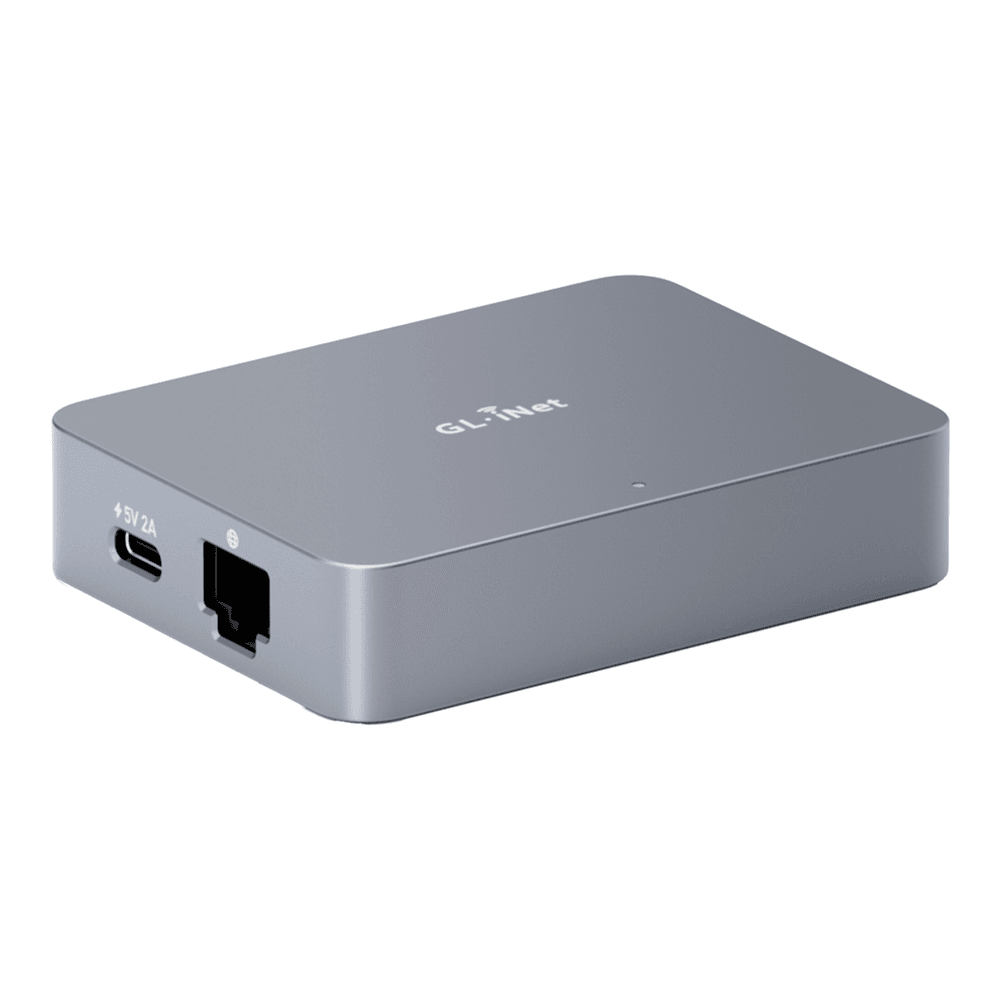
On paper it has the strongest capture pipeline here: 4K at 30 fps with hardware H.264 and a 30 to 60 ms latency claim, on a quad-core ARM platform with 1 GB of RAM, 8 GB of eMMC and gigabit Ethernet. The 4K ceiling matters less than the encoder, since a BIOS screen is not 4K, but it means the Comet never becomes the bottleneck on a modern desktop. GL.iNet ships an Ethernet cable, an HDMI cable and both a USB-A and a USB-C cable in the box, so one host needs nothing extra.
Remote access is where GL.iNet clearly studied the competition. You get local browser access, an optional cloud relay with no subscription, a phone app, a self-hosted server option for fleets, and Tailscale as a toggle in the Apps Center rather than an SSH exercise. The UI is a fork of the PiKVM interface, though GL.iNet does not open the whole platform. The March 2026 disclosure listed four Comet CVEs, including unauthenticated UART root access and weak firmware verification. Firmware 1.8.2 addresses them, so updating is the first job on a new unit.
Power control is honest too. Wake-on-LAN is built in, but GL.iNet itself positions its ATX board, about $16 on Amazon, as the reliable path, because it works at the front-panel header even when the OS is gone. The Comet PoE (GL-RM1PE) adds 802.3af/at power and 32 GB of storage for about $116. That’s the version we’d pick for a rack, fed from a port on a PoE switch so it needs no wall wart, which in a 10-inch mini rack also frees an outlet on the PDU.
Buy it when you want the least friction between unboxing and a working, safely reachable KVM. Skip it if a fully open-source stack is the requirement, because the Comet UI is PiKVM-derived but the platform underneath is not published, so you are trading auditability for convenience. It runs about $100 on Amazon, sold by the GL.iNet storefront at the same price as the GL.iNet web store; check the live price.
2. JetKVM
JetKVM is the device that made this category mainstream, and it is still the one with the most software momentum behind it.
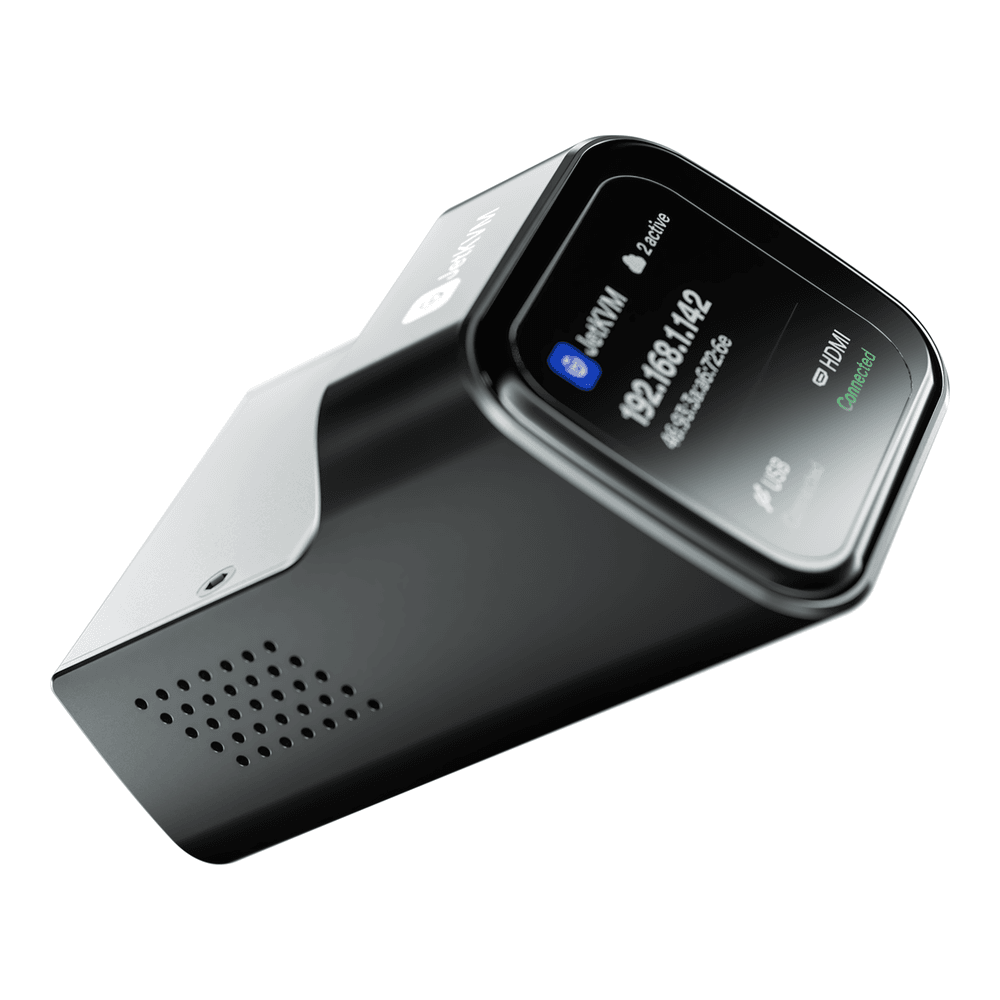
The hardware is a small machined unit with a front status display showing the device IP and connection state. That sounds like a gimmick and turns out to be the feature you appreciate every time you walk past the rack. Capture is 1080p at 60 fps over WebRTC with a 30 to 60 ms latency claim, driven by a Rockchip RV1106G3 with hardware H.264. The 2026 hardware revision swapped mini HDMI for full-size HDMI, moved from soldered eMMC to a 32 GB microSD, and raised the price from $89 to $103.
The application is open source under GPLv2, and the cloud relay is opt-in and open source as well. Tailscale supports JetKVM out of the box with an official install script, so keeping it off the public internet takes one command, though JetKVM itself calls that support partial. The two JetKVM issues from the March 2026 disclosure, weak update verification and missing rate limiting, are fixed in version 0.5.4, and later releases added signed release verification. An ATX extension board, $19 from WisdPi, adds front-panel power control with pass-through headers so the case buttons keep working.
Buying one got easier this month. JetKVM sells through the authorized resellers listed on its product page, WisdPi, iKoolCore and Mini PC Store, and all three had the standard model in stock at $103 in November 2026, with the PoE version sold out at WisdPi and iKoolCore. The WisdPi Amazon storefront now has the standard model in stock at about $133, and that’s the listing we link. The other JetKVM offers on Amazon come from unauthorized sellers at $140 to $160, and the ATX board there only appears from third parties at more than twice the WisdPi price, so buy the board direct.
The honest limits are 100 Mbps Ethernet, fine for a KVM stream and irrelevant for anything else, and a 1080p capture ceiling. Buy it when you want the best hardware feel in the category and the most active open-source development. Skip it if you need more than 1080p, or if the $30 Amazon premium bothers you, in which case order from the resellers listed on jetkvm.com and wait a few days longer.
3. PiKVM V4 Mini
PiKVM is the project everything else here borrows from, and the V4 Mini is its packaged form: a Raspberry Pi CM4 in a proper case with the capture, ATX and power problems already solved.
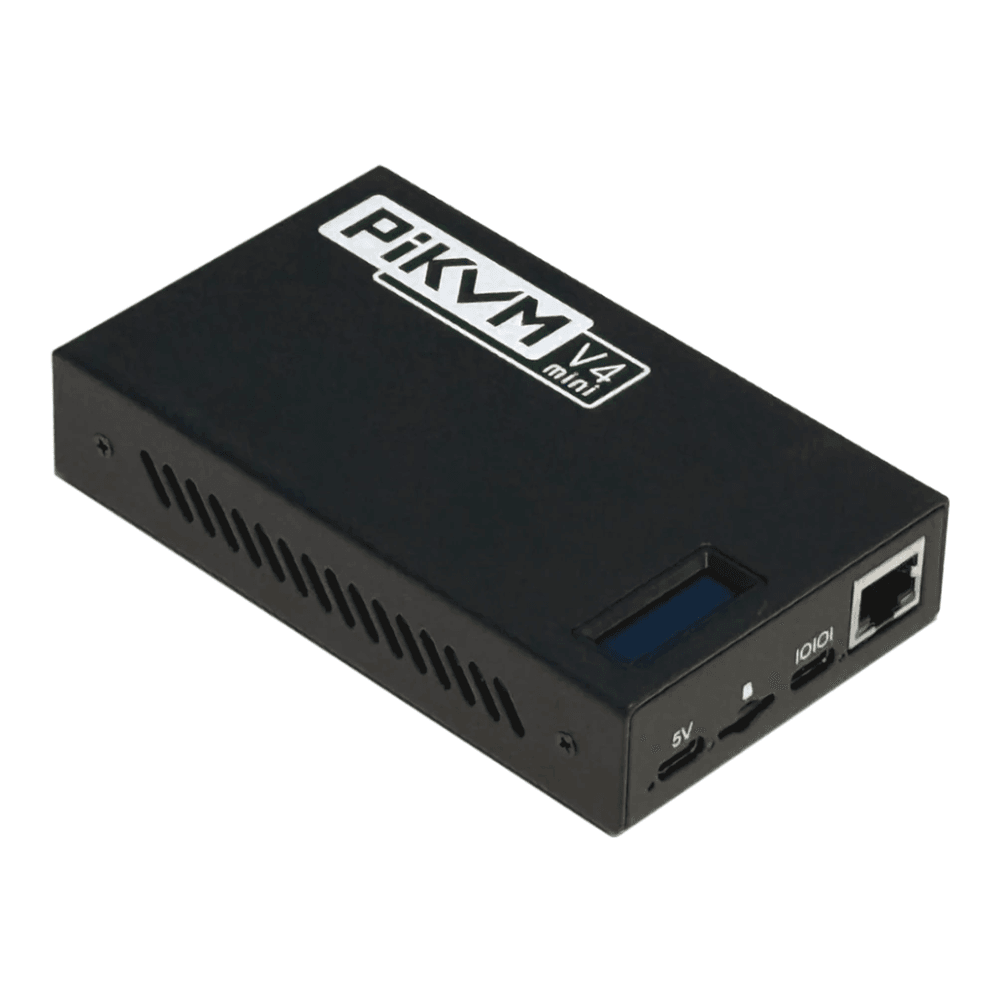
The feature list is the deepest here because the project has been at this the longest. Capture runs to 1920×1200 at 60 Hz with both H.264 and MJPEG pipelines and the tightest latency claim in the group, 35 to 50 ms, which PiKVM itself calls the proven lowest. The ATX controller is included rather than sold as an add-on. Its virtual mass-storage emulation is the most mature of the five and is explicitly designed so a mounted ISO is visible in the BIOS, which is exactly when you need it during a rescue.
It’s also the only unit that documents Redfish emulation, alongside the most mature IPMI support here. Point your existing tooling at those endpoints and a $275 box behaves like the management controller your desktop board never had, so real servers and homelab boxes share one workflow. The whole stack is GPLv3, there is an official Tailscale package, and if the price stings you can build one yourself from a spare Pi. The V4 Plus, $385 direct or about $430 on Amazon from PiShop US, adds HDMI passthrough and an mPCIe slot for an LTE modem.
Buy the Mini when you want maximum capability with nothing closed. Skip it if $275 to $310 for a single-host KVM is out of proportion to the box it will rescue, because at that gap the Comet does most of this for a third of the money. The Amazon listing runs about $310 against $275 on the PiShop web store, so buy direct if the $35 matters more than Amazon’s returns; check the live price.
4. Sipeed NanoKVM Full
The NanoKVM is the budget answer, a RISC-V cube about the size of a large die that does real IP-KVM work for around $77, and it comes with a history you should know before you buy.
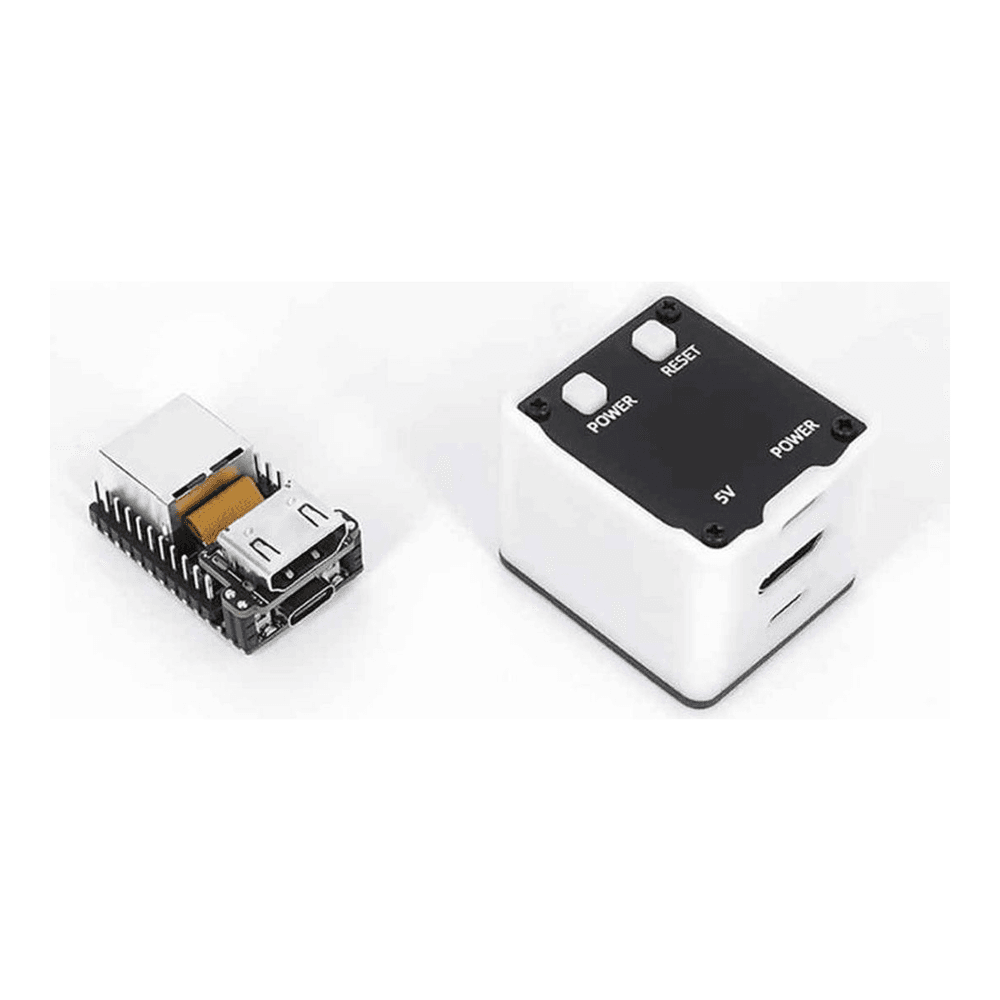
The Full kit gets you the assembled cube with an OLED status display, ATX power control wiring and a pre-flashed card, built around a Sophgo SG2002 RISC-V chip with 256 MB of RAM. Capture is 1080p and streaming is MJPEG, with H.264 still a work in progress. The Sipeed wiki quotes 90 to 230 ms of latency, which is honest and noticeably behind the H.264 units. For watching a boot sequence and changing a BIOS setting that gap barely matters, but for long interactive sessions it does. ISO mounting and Tailscale are supported, and the software is GPL-3.0 on GitHub.
Now the history. In early 2025 a security researcher took the early firmware apart and found default root SSH access, weak default credentials, a hardcoded encryption key and a closed-source binary blob. In a public response on GitHub, Sipeed called these leftovers from a rushed early development phase. Through 2025 the company open-sourced the closed components and shipped fixes for the headline issues. The researcher found no evidence of an intentional backdoor, and the undocumented microphone that made headlines turned out to be a stock part of the dev board underneath.
Our read is that the 2026 NanoKVM is a defensible budget buy for a homelab that keeps it on an isolated VLAN behind Tailscale, which is how every device on this page should run anyway. Whichever channel you buy from, update to NanoKVM application 2.3.1 or later, which fixes the configuration endpoint exposure from the March 2026 disclosure. The Amazon listing we link is the Full kit from a third-party seller rather than Sipeed itself, at about $77, and the shell colour can vary.
Buy it when the budget is the constraint and you’re willing to update firmware promptly. Skip it if the security history rules it out for your environment, or if stream smoothness matters, since the Comet is only about $23 more and better on both counts. Check the live price, because third-party NanoKVM listings come and go faster than the others here.
5. TinyPilot Voyager 3
The Voyager 3 is the pick for the reader whose homelab is drifting toward production, where the questions become who accessed the console and what happens when the unit fails.
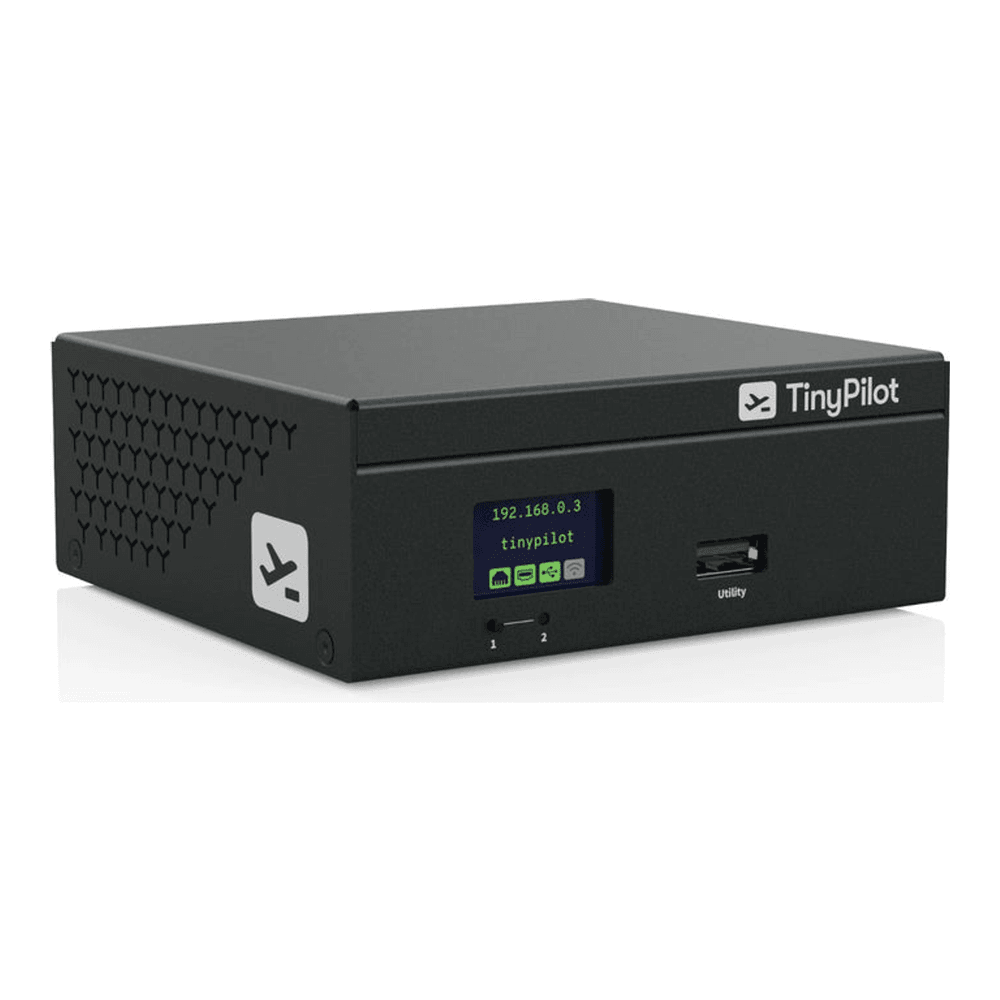
Under the metal case it’s CM4-class hardware, so the raw capability tracks the PiKVM V4: 1920×1200 at 60 Hz capture, virtual media for remote installs, gigabit Ethernet and a front status display. The premium pays for everything around the hardware. You get role-based access control with up to eight simultaneous users and a 12-month advance-replacement warranty with paid extensions. Units ship from North Carolina or Ontario, and the product is stocked through CDW, Insight, SHI and DigiKey, which is the detail that matters if a purchasing department stands between you and the hardware.
Two caveats are worth weighing before the order:
- Ownership: TinyPilot’s founder sold the company in 2024. The store is active and the Voyager 3 is current, but long-term roadmap confidence now rests on the new owner.
- Value: at $399 for capture parity with a $275 PiKVM, you’re buying support and process, not speed.
The community edition of the software is MIT-licensed, with a perpetual per-device Pro license on paid units. The standard Voyager 3 is back in stock on Amazon at about $399, sold by TinyPilot, LLC with only a couple of reviews so far, the same price as the TinyPilot web store. The Voyager 3 Plus, about $549, adds PoE and a second LAN port.
Buy it when audit trails, warranty terms and procurement channels are requirements. Skip it for a personal rack, where the same money buys a Comet for nearly every host you own.
JetKVM alternatives worth a look
If the JetKVM is out of stock, marked up or missing a feature you need, these are the alternatives we’d consider. Each one fixes a different JetKVM limit:
- GL.iNet Comet, Comet PoE or Comet Pro for gigabit Ethernet, 4K capture and an Amazon listing sold by the maker. The Comet is the closest like-for-like swap at $99.99, and the Comet Pro at $179.99 adds dual-band Wi-Fi 6, a 2.22-inch touchscreen, 4K HDMI passthrough and 32 GB of eMMC.
- JetKVM Mini if price per host is the constraint. JetKVM announced it in September 2026 at $39 wired and $42 for the Wi-Fi Mini W. It can be ordered now from the official JetKVM Shop, with the current batches shipping from late November, but it was not on Amazon or at the full-size JetKVM resellers when we checked. It runs on an ESP32-P4X with hardware H.264, captures 1080p at 30 fps or 720p at 60 fps, and keeps the same web UI. ATX and DC extensions are not supported on the Mini yet.
- Luckfox PicoKVM for a cheaper JetKVM-style unit today. It uses the same Rockchip RV1106G3 and a UI forked from the JetKVM one, captures 1080p at 60 fps with H.264 or H.265, and adds a 1.54-inch touchscreen and 8 GB of eMMC for about $70 from Waveshare. The latency figure Luckfox gives is 80 to 200 ms, over 100 Mbps Ethernet.
- Sipeed NanoKVM Pro for 4K and gigabit on a budget. The Pro moves to an Axera AX630C with 1 GB of LPDDR4X, 32 GB of eMMC, gigabit Ethernet, 4K capture with loop-out and H.264, and Sipeed quotes about 60 ms at 2K. The Amazon listings we found had only a handful of reviews and third-party prices around $156 to $160, so we do not link them.
- A DIY PiKVM if you already own a Raspberry Pi 4 and an HDMI capture path. It is the open-source reference build, and PiKVM publishes the parts list and instructions.
Once one is racked, our walkthrough on recovering a headless Proxmox or Linux box with an IP-KVM covers the rescue workflow end to end, from mounting the ISO to fixing boot order.
Accessories that finish the setup
An IP-KVM is only as useful as the cables, power and switching around it, and most of those parts are cheap and stocked on Amazon. The table lists what we’d put in the same cart, with the reason for each.
| Accessory | Amazon pick | Why you’d want it | Approx price |
|---|---|---|---|
| ATX power board (Comet) | GL.iNet GL-ATX board | Front-panel power and reset that work with the OS gone | $16 |
| Button presser (Comet) | GL.iNet Fingerbot FGB-01 | Presses a physical power button on boxes with no header | $30 |
| HDMI cable, 3 ft | Amazon Basics HDMI | 18 Gbps, 4K60, enough for every capture ceiling here | $5 |
| USB-A to USB-C, 3 ft, 2-pack | Anker USB-A to USB-C | Keyboard, mouse and virtual media link to hosts with USB-A only | $9 |
| USB-C to USB-C, 3.3 ft, 2-pack | Anker USB-C to USB-C | The same link for hosts with a USB-C port | $10 |
| PoE splitter, gigabit | YICHTECH USB-C PoE splitter | 802.3af/at in, 5 V 3 A on USB-C out, gigabit pass-through | $14 |
| KVM switch, 8 ports | TESmart 8×1 HDMI KVM | One IP-KVM for up to eight hosts, with LAN and RS-232 control | $229 |
Start with the ATX board, because it’s the part that turns a KVM into a real power button. PiKVM and the NanoKVM Full include one. The Comet board is about $16 on Amazon from GL.iNet, while the JetKVM board is $19 from WisdPi, where it was in stock; on Amazon it only shows up from third parties at more than twice that, so we do not link it. The cables are spares in the right lengths for a rack, since GL.iNet already puts HDMI, Ethernet and both USB cables in the Comet’s box.
Treat the PoE splitter as conditional. Sipeed lists PoE as an expansion accessory for the NanoKVM, and WisdPi sells a Jet PoE Splitter built for JetKVM (5 V, 3 A max, sold out when we checked) that it says also suits NanoKVM and PiKVM. The generic splitter in the table has the same 802.3af/at input and 5 V 3 A output. A non-PoE JetKVM only takes power from the target USB-C port, its extension port, or a Y-cable, and WisdPi no longer ships the Y-cable by default, so check that path before you order. GL.iNet warns that USB PD adapters cannot power the original Comet, which is why the cleaner answer for a PoE rack is the Comet PoE.
The KVM switch is the multi-host play. The PiKVM TESmart integration drives LAN-controlled TESmart switches over the network. PiKVM tested it on a 16-port model and says 4- and 8-port models with a LAN port should work, and the V4 Mini only works with LAN-controlled switches like these. Stock on the 8-port unit was thin and its review base small, so read our KVM switch guide for Linux if you want desk-side options. The JetKVM FAQ lists KVM switches as untested. For a box with no network at all, a USB crash cart adapter is the cheaper tool.
What actually matters in an IP-KVM
If you’re evaluating something outside this list, these are the specs that decide whether the box does its job when a machine is down:
- Encoding beats resolution. H.264 over WebRTC is what makes a remote console feel local. The vendor claims cluster at 30 to 60 ms for the H.264 units against 90 to 230 ms for MJPEG, and you’ll spend your time in BIOS screens and terminals where the encoder, not a 4K ceiling, sets the experience.
- ATX header control is the real power button. Wake-on-LAN depends on a NIC with standby power and firmware in a good mood, which you cannot assume during a failure. A board on the front-panel header forces a hard reset with the OS completely gone.
- Virtual media turns a rescue into a reinstall. All five picks can present an ISO to the target as USB storage. PiKVM is explicit that the emulated drive shows up in the BIOS, and that detail is the whole point.
- Open source is a security feature here. This device sees your disk encryption passphrases and BIOS passwords. The NanoKVM episode showed how closed components plus weak defaults produce a trust crisis, so weight auditable firmware more heavily than you would for a switch.
Exposure is the one that can’t go in a spec sheet. An IP-KVM is BIOS-level access by design, and the March 2026 coordinated disclosure found flaws in devices from four makers, three of them on this page. A runZero internet scan at the time counted a little over 1,300 IP-KVMs reachable from the public internet. The PiKVM docs push strong passwords plus two-factor before any port forward and call a VPN the more secure option.
Four of the five picks support Tailscale in an official form; TinyPilot is the exception, so pair it with WireGuard. A mesh VPN plus an isolated management VLAN carved out on your firewall box is the pattern we run. Our Tailscale on Proxmox guide and the WireGuard setup walkthrough both slot straight into that design.
Lock it down before you rely on it
Whichever unit you pick, the setup that makes it trustworthy is the same. Put the KVM on a management VLAN that client devices cannot reach, and join it to a Tailscale or WireGuard mesh instead of forwarding ports. Change every default credential before the first HDMI cable goes in, and turn on two-factor where the firmware offers it. Then update the firmware on a schedule, because this is the one device on your network whose compromise hands over everything else.
Done that way, a $100 Comet on your Proxmox mini PC quietly removes the last reason to drive to the rack. It will sit unused for months until the night it pays for itself in the first ten minutes. Pair it with the Proxmox post-install checklist and boot-order problems stop being incidents at all.