Log In


Epsomite
A valid IMA mineral species - grandfathered
This page is currently not sponsored. Click here to sponsor this page.



About Epsomite

Formula:
MgSO4 · 7H2O
Colour:
White, grey, colourless, or pink, greenish; colourless in transmitted light.
Lustre:
Vitreous, Silky, Earthy
Hardness:
2 - 2½
Specific Gravity:
1.675 - 1.679
Crystal System:
Orthorhombic
Member of:
Name:
Named in 1806 by Jean-Claude Delamétherie for the type locality at Epsom, Surrey, England.
Type Locality:
Epsomite Group; Epsomite-Morenosite Series; Epsomite-Goslarite Series.
A complete series exists to Morenosite and to Goslarite.
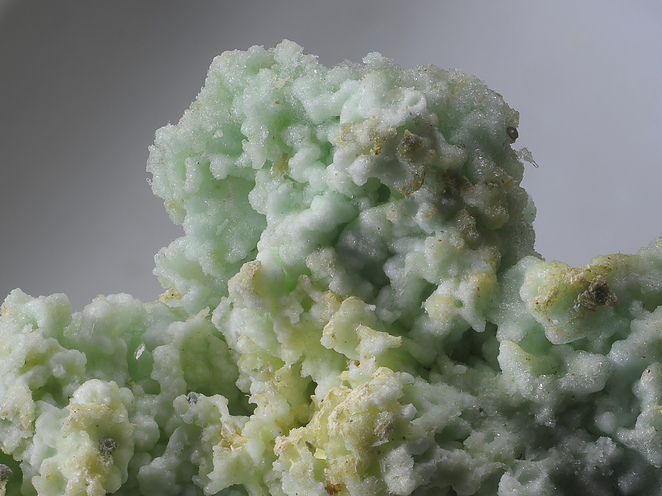
Usually found as crusts, delicate efflorescences, or botryoidal masses of tiny fibrous to acicular crystals, its color is white but it is often stained a variety of pale hues by impurities.
Epsomite is likely to occur in the Martian soils and on the satellites of Jupiter.
A complete series exists to Morenosite and to Goslarite.
Usually found as crusts, delicate efflorescences, or botryoidal masses of tiny fibrous to acicular crystals, its color is white but it is often stained a variety of pale hues by impurities.
Epsomite is likely to occur in the Martian soils and on the satellites of Jupiter.
Unique Identifiers
Mindat ID:
1393
Long-form identifier:
mindat:1:1:1393:8
Similar Names
| Epsomite (of Hobbs) | A synonym of Pentahydrite |
IMA Classification of Epsomite
Approved, 'Grandfathered' (first described prior to 1959)
IMA Formula:
MgS6+O4·7H2O
Classification of Epsomite
7.CB.40
7 : SULFATES (selenates, tellurates, chromates, molybdates, wolframates)
C : Sulfates (selenates, etc.) without additional anions, with H2O
B : With only medium-sized cations
7 : SULFATES (selenates, tellurates, chromates, molybdates, wolframates)
C : Sulfates (selenates, etc.) without additional anions, with H2O
B : With only medium-sized cations
Dana 7th ed.:
29.6.11.1
29.6.11.1
29 : HYDRATED ACID AND NORMAL SULFATES
6 : AXO4·xH2O
29 : HYDRATED ACID AND NORMAL SULFATES
6 : AXO4·xH2O
25.3.6
25 : Sulphates
3 : Sulphates of Mg
25 : Sulphates
3 : Sulphates of Mg
Mineral Symbols
As of 2021 there are now IMA–CNMNC approved mineral symbols (abbreviations) for each mineral species, useful for tables and diagrams.
| Symbol | Source | Reference for Standard |
|---|---|---|
| Esm | IMA–CNMNC | Warr, L.N. (2021). IMA–CNMNC approved mineral symbols. Mineralogical Magazine, 85(3), 291-320. doi:10.1180/mgm.2021.43 |
Pronunciation of Epsomite
Pronunciation:
| Play | Recorded by | Country |
|---|---|---|
| Jolyon Ralph | United Kingdom |
Physical Properties of Epsomite
Vitreous, Silky, Earthy
Transparency:
Transparent, Translucent
Colour:
White, grey, colourless, or pink, greenish; colourless in transmitted light.
Comment:
Pink = cobaltoan; greenish = nickelian.
Streak:
White
Hardness:
2 - 2½ on Mohs scale
Hardness Data:
Measured
Tenacity:
Fragile
Cleavage:
Perfect
Perfect on {010}, distinct on {101}.
Perfect on {010}, distinct on {101}.
Fracture:
Conchoidal
Translation gliding:
T{110}, t[1_10] ?; T{100}, t[0_10] ?; T{011}, t[011] ?; T{101}, t[_101] ?.
Density:
1.675 - 1.679 g/cm3 (Measured) 1.678 g/cm3 (Calculated)
Comment:
Measured on artificial material.
Optical Data of Epsomite
Type:
Biaxial (-)
RI values:
nα = 1.433 nβ = 1.455 nγ = 1.461
2V:
Measured: 52° , Calculated: 54°
Max. Birefringence:
δ = 0.028
Based on recorded range of RI values above.
Based on recorded range of RI values above.
Interference Colours:
The colours simulate birefringence patterns seen in thin section under crossed polars. They do not take into account mineral colouration or opacity.
Michel-Levy Bar The default colours simulate the birefringence range for a 30 µm thin-section thickness. Adjust the slider to simulate a different thickness.
Grain Simulation You can rotate the grain simulation to show how this range might look as you rotated a sample under crossed polars. Each grain retains its interference colour (retardation) while its brightness falls to black at extinction and reaches a maximum between extinction positions.
The colours simulate birefringence patterns seen in thin section under crossed polars. They do not take into account mineral colouration or opacity.
Michel-Levy Bar The default colours simulate the birefringence range for a 30 µm thin-section thickness. Adjust the slider to simulate a different thickness.
Grain Simulation You can rotate the grain simulation to show how this range might look as you rotated a sample under crossed polars. Each grain retains its interference colour (retardation) while its brightness falls to black at extinction and reaches a maximum between extinction positions.
Surface Relief:
High (negative)
Relative to Canada balsam mounting medium (n ≈ 1.537).
Relative to Canada balsam mounting medium (n ≈ 1.537).
This shows the grain boundary and Becke line effect under plane-polarised
light, based on the contrast between this mineral's average refractive
index and the mounting medium. It does not take into account mineral
colouration.
In focus
Interference Figure:
This shows the idealized biaxial acute bisectrix (Bxa) interference figure
- the conoscopic view for a grain cut perpendicular to the acute bisectrix, using
this mineral's 2V. The two small white dots mark the melatopes - the points
where the two optic axes emerge - and are shown only when they fall within the
field of view. The coloured bands are isochromatics, and the dark bands are
isogyres.
Rotate the stage: at 0°/90° the isogyres form a cross through the melatopes; at 45° they pull apart into curved hyperbolas. That splitting on rotation - absent in a uniaxial figure - is the standard diagnostic test for telling biaxial minerals from uniaxial ones. If 2V is large, the melatopes may fall outside the field of view, as they often do at the microscope too.
Rotate the stage: at 0°/90° the isogyres form a cross through the melatopes; at 45° they pull apart into curved hyperbolas. That splitting on rotation - absent in a uniaxial figure - is the standard diagnostic test for telling biaxial minerals from uniaxial ones. If 2V is large, the melatopes may fall outside the field of view, as they often do at the microscope too.
Dispersion:
none
Optical Extinction:
X = a; Y = c; Z = b.
Chemistry of Epsomite
Mindat Formula:
MgSO4 · 7H2O
Element Weights:
Elements listed:
Common Impurities:
Ni,Fe,Co,Mn,Zn
Chemical Analysis
Oxide wt%:
| 1 | |
|---|---|
| SO3 | 32.35 % |
| MgO | 16.20 % |
| FeO | 0.47 % |
| Fe2O3 | 0.78 % |
| H2O | 49.66 % |
| Total: | 99.46 % |
Sample references:
Crystallography of Epsomite
Crystal System:
Orthorhombic
Class (H-M):
222 - Disphenoidal
Space Group:
P212121
Cell Parameters:
a = 11.86 Å, b = 11.99 Å, c = 6.858 Å
Ratio:
a:b:c = 0.989 : 1 : 0.572
Unit Cell V:
975.22 ų (Calculated from Unit Cell)
Z:
4
Morphology:
Crystals rare, usually as fibrous to acicular crusts, fibers elongated [001]; may be in botryoidal masses or stalactic; wooly efflorescences. Artificial crystals short prismatic [001] to equant.
Twinning:
On {110}, rare.
Crystallographic forms of Epsomite
Crystal Atlas:
Image Loading
Click on an icon to view

Epsomite no.23 - {110} - Goldschmidt (1913-1926)
Epsomite no.28 - {110} - Goldschmidt (1913-1926)
3d models and HTML5 code kindly provided by
www.smorf.nl.
Toggle
Edge Lines | Miller Indices | Axes
Transparency
Opaque | Translucent | Transparent
View
Along a-axis | Along b-axis | Along c-axis | Start rotation | Stop rotation
Edge Lines | Miller Indices | Axes
Transparency
Opaque | Translucent | Transparent
View
Along a-axis | Along b-axis | Along c-axis | Start rotation | Stop rotation
Crystal Structure
Load
Unit Cell | Unit Cell Packed
2x2x2 | 3x3x3 | 4x4x4
Unit Cell | Unit Cell Packed
2x2x2 | 3x3x3 | 4x4x4
Show
Big Balls | Small Balls | Just Balls | Spacefill
Polyhedra Off | Si Polyhedra | All Polyhedra
Remove metal-metal sticks
Big Balls | Small Balls | Just Balls | Spacefill
Polyhedra Off | Si Polyhedra | All Polyhedra
Remove metal-metal sticks
Display Options
Black Background | White Background
Perspective On | Perspective Off
2D | Stereo | Red-Blue | Red-Cyan
Black Background | White Background
Perspective On | Perspective Off
2D | Stereo | Red-Blue | Red-Cyan
View
CIF File Best | x | y | z | a | b | c
CIF File Best | x | y | z | a | b | c
Rotation
Stop | Start
Stop | Start
Labels
Console Off | On | Grey | Yellow
Console Off | On | Grey | Yellow
Data courtesy of the American Mineralogist Crystal Structure Database. Click on an AMCSD ID to view structure
| ID | Species | Reference | Link | Year | Locality | Pressure (GPa) | Temp (K) |
|---|---|---|---|---|---|---|---|
| 0007157 | Epsomite | Fortes A D, Wood I G, Alfredsson M, Vocadlo L, Knight K S (2006) The thermoelastic properties of MgSO4*7D2O (epsomite) from powder neutron diffraction and ab initio calculation European Journal of Mineralogy 18 449-462 | 2006 | synthetic | 0 | 293 | |
| 0009290 | Epsomite | Baur W H (1964) On the crystal chemistry of salt hydrates. IV. The refinement of the crystal structure of MgSO4*7H2O (epsomite) Acta Crystallographica 17 1361-1369 |  | 1964 | synthetic | 0 | 293 |
CIF Raw Data - click here to close
Epitaxial Relationships of Epsomite
Epitaxial Minerals:
| 'Goslarite' | ZnSO4 · 7H2O |
| 'Morenosite' | NiSO4 · 7H2O |
| 'Muscovite' | KAl2(AlSi3O10)(OH)2 |
Epitaxy Comments:
Oriented overgrowths with zinc (Goslarite) and nickel (Morenosite) analogues. Also on Muscovite with Epsomite {100} or {110} parallel Muscovite {001} and Epsomite [001] parallel to Muscovite [120], [310], [150], [1_20], [3_10], [1_50].
X-Ray Powder Diffraction
Powder Diffraction Data:
| d-spacing | Intensity |
|---|---|
| 5.98 Å | (30) |
| 5.34 Å | (30) |
| 5.31 Å | (20) |
| 4.22 Å | (100) |
| 4.20 Å | (80) |
| 2.88 Å | (20) |
| 2.67 Å | (20) |
| 2.66 Å | (30) |
Geological Environment
Paragenetic Mode(s):
| Paragenetic Mode | Earliest Age (Ga) |
|---|---|
| Stage 2: Planetesimal differentiation and alteration | 4.566-4.550 |
| 6 : Secondary asteroid phases | 4.566-4.560 |
| Near-surface Processes | |
| 21 : Chemically precipitated carbonate, phosphate, iron formations | |
| 25 : Evaporites (prebiotic) | |
| Stage 7: Great Oxidation Event | <2.4 |
| 45b : [Other oxidized fumarolic minerals] | |
| Stage 10a: Neoproterozoic oxygenation/terrestrial biosphere | <0.6 |
| 49 : Oxic cellular biomineralization (see also #44) | <0.54 |
| 50 : Coal and/or oil shale minerals | <0.36 |
| Stage 10b: Anthropogenic minerals | <10 Ka |
| 54 : Coal and other mine fire minerals (see also #51 and #56) | |
| 55 : Anthropogenic mine minerals |
Geological Setting:
Typically found growing as efflorescences in sheltered spots on outcrops of dolomitic or calcareous rocks; often found growing on the walls of caves and in salt lake deposits; also often found growing on the walls of coal and metal mines, including on wooden supports and abandoned equipment.
Type Occurrence of Epsomite
Synonyms of Epsomite
Other Language Names for Epsomite
Catalan:Epsomita
Dutch:Epsomiet
French:Sel d'Epsom
Hebrew:אפסומיט
Italian:Epsomite
Japanese:エプソマイト
Latin:Epsomensis
Magnesia vitriolata
Sal amarus
Sal Anglicanum
Sal Anglicus
Sal Catartica
Sal catharticum
Sal nativum catharticum
Sal neutrum acidulare
Magnesia vitriolata
Sal amarus
Sal Anglicanum
Sal Anglicus
Sal Catartica
Sal catharticum
Sal nativum catharticum
Sal neutrum acidulare
Polish:Epsomit
Portuguese:Epsomite
Russian:Эпсомит
Spanish:Epsomita
Epsonita
Reichardtita
Epsonita
Reichardtita
Ukrainian:Епсоміт
Varieties of Epsomite
| Aromite (of Darapsky) | Considered a variety of epsomite, but may be a mixture of epsomite and pickeringite. Originally described from Pampa de Aroma, Negreiros, Iquique Province, Tarapacá Region, Chile. |
| Cobalt-bearing Epsomite | A variety of Epsomite containing up to 2.5 wt.% CoO. |
| Copper and Zinc-bearing Epsomite | A variety of Epsomite containing copper and Zinc |
| Iron-bearing Epsomite | An iron-bearing variety of epsomite |
| Manganese-bearing Epsomite | A manganoan epsomite. Originally described from Špania Dolina (Urvölgy; Herrengrund), Špania Dolina ore belt, Starohorské Mts, Banská Bystrica Region, Slovak Republic. See also Fauserite (of Strunz). |
| Zinc-bearing and Manganese-bearing Epsomite |
Relationship of Epsomite to other Species
Member of:
Other Members of Epsomite Group:
| Goslarite | ZnSO4 · 7H2O | Orth. 222 : P212121 |
| Morenosite | NiSO4 · 7H2O | Orth. 222 : P212121 |
Forms a series with:
Common Associates
Associations Based on Photo Data:
| 8 photos of Epsomite associated with Natrojarosite | NaFe3(SO4)2(OH)6 |
| 7 photos of Epsomite associated with Botryogen | MgFe3+(SO4)2(OH) · 7H2O |
| 7 photos of Epsomite associated with Chalcanthite | CuSO4 · 5H2O |
| 7 photos of Epsomite associated with Metahohmannite | Fe3+2(SO4)2O · 4H2O |
| 7 photos of Epsomite associated with Hexahydrite | Mg(H2O)6(SO4) |
| 4 photos of Epsomite associated with Native Sulphur | S8 |
| 3 photos of Epsomite associated with Pickeringite | MgAl2(SO4)4 · 22H2O |
| 3 photos of Epsomite associated with Sideronatrite | Na2Fe(SO4)2(OH) · 3H2O |
| 2 photos of Epsomite associated with Pyrite | FeS2 |
| 2 photos of Epsomite associated with 'Tasmanite' |
Related Minerals - Strunz-mindat Grouping
| 7.CB. | Sarvodaite | Al2(SO4)3 · 5H2O |
| 7.CB.02 | Voudourisite | CdSO4 · H2O |
| 7.CB.05 | Szmikite | MnSO4 · H2O |
| 7.CB.05 | Szomolnokite | FeSO4 · H2O |
| 7.CB.05 | Cobaltkieserite | CoSO4 · H2O |
| 7.CB.05 | Dwornikite | Ni(SO4) · H2O |
| 7.CB.05 | Kieserite | MgSO4 · H2O |
| 7.CB.05 | Poitevinite | (Cu,Fe)SO4 · H2O |
| 7.CB.05 | Gunningite | ZnSO4 · H2O |
| 7.CB.07 | Sanderite | MgSO4 · 2H2O |
| 7.CB.10 | Bonattite | CuSO4 · 3H2O |
| 7.CB.12 | Belogubite | CuZn(SO4)2 · 10H2O |
| 7.CB.15 | Drobecite | CdSO4 · 4H2O |
| 7.CB.15 | Aplowite | CoSO4 · 4H2O |
| 7.CB.15 | Cranswickite | MgSO4 · 4H2O |
| 7.CB.15 | Rozenite | FeSO4 · 4H2O |
| 7.CB.15 | Starkeyite | MgSO4 · 4H2O |
| 7.CB.15 | Ilesite | Mn2+(SO4) · 4H2O |
| 7.CB.15 | Boyleite | ZnSO4 · 4H2O |
| 7.CB.20 | Siderotil | FeSO4 · 5H2O |
| 7.CB.20 | Jôkokuite | MnSO4 · 5H2O |
| 7.CB.20 | Pentahydrite | MgSO4 · 5H2O |
| 7.CB.20 | Chalcanthite | CuSO4 · 5H2O |
| 7.CB.25 | Chvaleticeite | Mn2+(H2O)6(SO4) |
| 7.CB.25 | Nickelhexahydrite | Ni2+(H2O)6(SO4) |
| 7.CB.25 | Hexahydrite | Mg(H2O)6(SO4) |
| 7.CB.25 | Bianchite | Zn(H2O)6(SO4) |
| 7.CB.25 | Moorhouseite | Co2+(H2O)6(SO4) |
| 7.CB.25 | Ferrohexahydrite | Fe2+(H2O)6(SO4) |
| 7.CB.30 | Retgersite | NiSO4 · 6H2O |
| 7.CB.35 | Zincmelanterite | Zn(H2O)6(SO4) · H2O |
| 7.CB.35 | Melanterite | Fe2+(H2O)6(SO4) · H2O |
| 7.CB.35 | Alpersite | (Mg,Cu2+)(H2O)6(SO4) · H2O |
| 7.CB.35 | Bieberite | Co2+(H2O)6(SO4) · H2O |
| 7.CB.35 | Boothite | Cu2+(H2O)6(SO4) · H2O |
| 7.CB.35 | Mallardite | Mn2+(H2O)6(SO4) · H2O |
| 7.CB.40 | Goslarite | ZnSO4 · 7H2O |
| 7.CB.40 | Morenosite | NiSO4 · 7H2O |
| 7.CB.45 | Meta-alunogen | Al2(SO4)3 · 12H2O |
| 7.CB.45 | Alunogen | Al2(SO4)3 · 17H2O |
| 7.CB.50 | Aluminocoquimbite | Al2Fe2(SO4)6(H2O)12 · 6H2O |
| 7.CB.50 | Lazaridisite | Cd3(SO4)3 · 8H2O |
| 7.CB.52 | Pararaisaite | CuMg[Te6+O4(OH)2] · 6H2O |
| 7.CB.55 | Paracoquimbite | Fe4(SO4)6(H2O)12 · 6H2O |
| 7.CB.55 | Rhomboclase | (H5O2)Fe3+(SO4)2 · 2H2O |
| 7.CB.55 | Raisaite | CuMg[Te6+O4(OH)2] · 6H2O |
| 7.CB.55 | Coquimbite | AlFe3(SO4)6(H2O)12 · 6H2O |
| 7.CB.57 | 'Caichengyunite' | Fe2+3Al2(SO4)6 · 30H2O |
| 7.CB.60 | Kornelite | Fe2(SO4)3 · 7H2O |
| 7.CB.65 | Quenstedtite | Fe2(SO4)3 · 11H2O |
| 7.CB.70 | Lausenite | Fe2(SO4)3 · 5H2O |
| 7.CB.75 | Römerite | Fe2+Fe3+2(SO4)4 · 14H2O |
| 7.CB.75 | Lishizhenite | ZnFe2(SO4)4 · 14H2O |
| 7.CB.80 | Ransomite | CuFe2(SO4)4 · 6H2O |
| 7.CB.85 | Dietrichite | ZnAl2(SO4)4 · 22H2O |
| 7.CB.85 | Halotrichite | Fe2+Al2(SO4)4 · 22H2O |
| 7.CB.85 | Apjohnite | Mn2+Al2(SO4)4 · 22H2O |
| 7.CB.85 | Redingtonite | Fe2+Cr3+2(SO4)4 · 22H2O |
| 7.CB.85 | Pickeringite | MgAl2(SO4)4 · 22H2O |
| 7.CB.85 | Bílinite | Fe2+Fe3+2(SO4)4 · 22H2O |
| 7.CB.85 | Wupatkiite | Co2+Al2(SO4)4 · 22H2O |
| 7.CB.90 | Meridianiite | MgSO4 · 11H2O |
Other Information
Magnetism:
Diamagnetic
Health Risks:
No information on health risks for this material has been entered into the database. You should always treat mineral specimens with care.
Internet Links for Epsomite
mindat.org URL:
https://www.mindat.org/min-1393.html
Please feel free to link to this page.
Please feel free to link to this page.
Search Engines:
Hilarion Mine, Kamariza Mines, Agios Konstantinos, Lavreotiki, East Attica, Attica, Greece