

The Prototyping Model is a widely used Software Development Life Cycle Model (SDLC Model) in which an early version of the software, called a prototype, is developed and shared with users for feedback.
- Early prototypes allow users to interact with the system and identify missing functionalities or issues.
- Iterative development ensures the final product is refined, efficient, and meets customer requirements.
- Useful when project requirements are unclear or likely to change, as prototypes can be iteratively refined based on user input.
- Helps create a final product that closely aligns with user expectations and reduces the risk of errors.
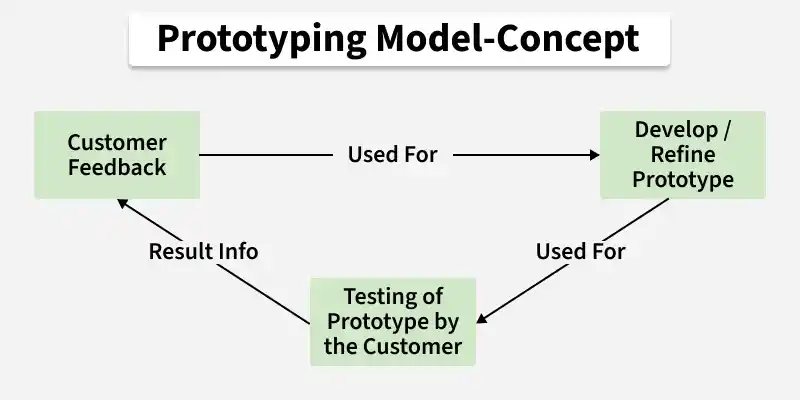
Phases of Prototyping Model
Prototyping Model has six phases as follows:
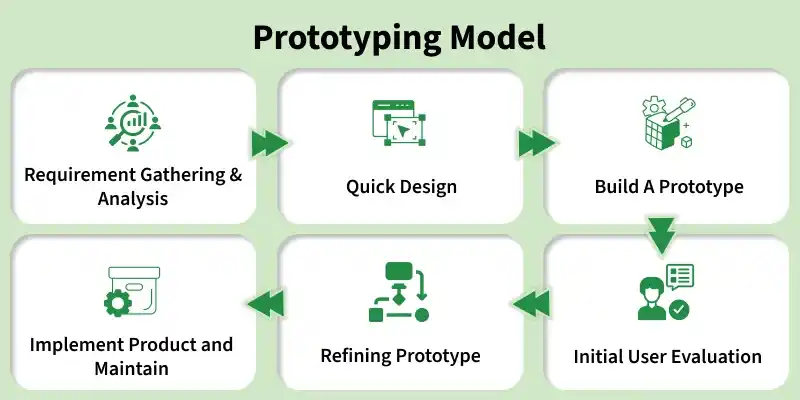
1. Requirements gathering and analysis: Requirement analysis is the first step in developing a prototyping model. During this phase, the system requirements are defined. Users are interviewed to understand their expectations and requirements.
2. Quick design: The second phase could consist of a preliminary design or a quick design. During this stage, the system’s basic design is formed. However, it is not a complete design. It provides the user with a quick overview of the system. The rapid design aids in the development of the prototype.
3. Build a Prototype: During this stage, an actual prototype is intended to support the knowledge gained from quick design. It is a small low-level working model of the desired system.
4. Initial user evaluation: The proposed system is presented to the client for preliminary testing at this stage. It is beneficial to investigate the performance model’s strengths and weaknesses. Customer feedback and suggestions are gathered and forwarded to the developer.
5. Refining prototype: If the user is dissatisfied with the current model, you may want to improve the type that responds to user feedback and suggestions. When the user is satisfied with the upgraded model, a final system based on the approved final type is created.
6. Implement Product and Maintain: The final system was fully tested and distributed to production after it was developed to support the original version. To reduce downtime and prevent major failures, the programmer is run on a regular basis.
Types of Prototyping Models
There are four types of Prototyping Models, which are described below.
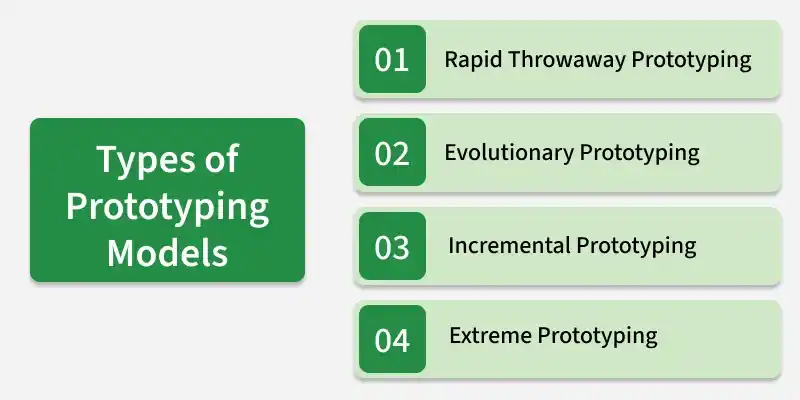
1. Rapid Throwaway Prototyping: This technique offers a useful method of exploring ideas and getting customer feedback for each of them.
- In this method, a developed prototype need not necessarily be a part of the accepted prototype.
- Customer feedback helps prevent unnecessary design faults and hence, the final prototype developed is of better quality.
2. Evolutionary Prototyping: In this method, the prototype developed initially is incrementally refined based on customer feedback till it finally gets accepted.
- In comparison to Rapid Throwaway Prototyping, it offers a better approach that saves time as well as effort.
- This saves time and effort because developers do not need to build a new prototype from scratch for every iteration.
3. Incremental Prototyping: In this type of incremental prototyping, the final expected product is broken into different small pieces of prototypes and developed individually.
- In the end, when all individual pieces are properly developed, then the different prototypes are collectively merged into a single final product in their predefined order.
- It is efficient approach that reduces the complexity of the development process, where the goal is divided into sub-parts and each sub-part is developed individually.
- The time interval between the project's beginning and final delivery is substantially reduced because all parts of the system are prototyped and tested simultaneously.
- However, integration issues may occur if the interfaces and overall system architecture are not carefully planned before development.
4. Extreme Prototyping: This method is mainly used for web development. It consists of three sequential independent phases:
- In this phase, a basic prototype with all the existing static pages is presented in HTML format.
- In the 2nd phase, Functional screens are made with a simulated data process using a prototype services layer.
- This is the final step where all the services are implemented and associated with the final prototype.
This Extreme Prototyping method makes the project cycling and delivery robust and fast and keeps the entire developer team focused and centralized on product deliveries rather than discovering all possible needs and specifications and adding necessitated features.
Applications
- The Prototyping Model should be used when the requirements of the product are not clearly understood or are unstable.
- The prototyping model can also be used if requirements are changing quickly.
- This model can be successfully used for developing user interfaces, high-technology software-intensive systems, and systems with complex algorithms and interfaces.
- The prototyping Model is also a very good choice to demonstrate the technical feasibility of the product.
Advantages
- Customers can see early versions of the product, improving satisfaction and comfort.
- New requirements and missing functionalities can be easily identified and incorporated.
- Early error detection saves effort, cost, and enhances software quality.
- Prototypes can be reused for future projects and offer flexibility in design.
- Facilitates communication, collaboration, and alignment between technical and non-technical stakeholders.
- Reduces project risk by validating design decisions and guiding development iteratively.
Disadvantages
- Can be time-consuming and costly due to repeated iterations.
- Frequent changes in requirements may lead to poor documentation and development challenges.
- Prototypes may not fully represent the final product, causing scalability or functionality issues.
- Risk of sub-optimal solutions if developers rush to build prototypes.
- Focus on prototyping can delay the final product or give a false sense of completion.
- Customers may demand early delivery or lose interest if initial prototypes are unsatisfactory.
