

The Defect Life Cycle involves multiple participants who work together to identify, analyze, fix, verify, and manage software defects. Each participant has specific responsibilities that help ensure defects are resolved efficiently and the software meets quality standards.
- Each participant plays a specific role in defect management.
- Clear responsibilities improve collaboration and reduce delays.
- Effective coordination ensures faster defect resolution and better software quality.
Stages of the Defect Life Cycle
The Defect Life Cycle consists of several stages, each representing the current status of a defect during its resolution process.
- New: A defect is discovered and logged in the defect tracking tool for the first time. It is yet to be reviewed or validated.
- Assigned: The defect is reviewed by the test lead or manager and assigned to a developer for investigation and fixing.
- Open: The developer accepts the defect and starts analyzing it to find the root cause and begin work.
- Fixed: The developer resolves the defect by making the required code changes and updates its status for testing.
- Ready for Retest: The fixed defect is moved to the testing environment and is ready for QA verification.
- Retest: The tester re-tests the defect to check whether the issue has been properly fixed.
- Verified: The tester confirms that the defect has been successfully resolved and is working as expected.
- Closed: The defect is officially closed after successful verification and no further action is required.
- Reopened: If the issue still exists or is not fixed properly, the tester reopens the defect and sends it back to the developer.
- Rejected (Not a Bug / Invalid): The defect is rejected if it is not a valid issue, cannot be reproduced, or is working as designed.
- Deferred: The defect is valid but postponed to a future release due to priority, scheduling, or business decisions.
Participants of the Defect Life Cycle
Different participants are involved in managing defects throughout the defect life cycle.
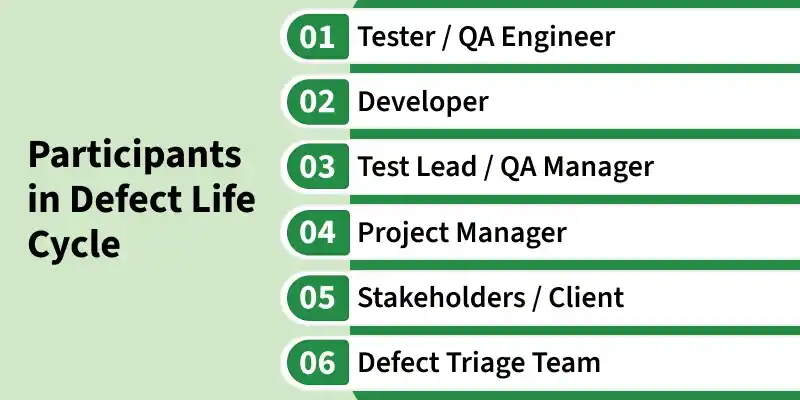
Tester / QA Engineer
The Tester or QA Engineer identifies defects during testing and reports them in the defect tracking system. After the defect is fixed, they verify the fix and close the defect if it works correctly.
- Detect, document, and report defects clearly
- Re-test fixed defects and perform regression testing
- Verify whether the defect has been resolved properly
Developer
The Developer analyzes the defect, identifies the root cause, and fixes the issue in the code. After fixing the defect, the updated build is provided to QA for validation.
- Investigate and reproduce reported defects
- Fix defects and update the code
- Coordinate with QA during verification
Test Lead / QA Manager
The Test Lead or QA Manager oversees the defect management process. They review defects, define severity and priority, and ensure that defect handling is properly tracked.
- Review, classify, and prioritize defects
- Assign defects to developers or team members
- Monitor defect progress and testing quality
Project Manager
The Project Manager monitors how defects affect project schedules, release planning, and overall delivery. They ensure that resources and timelines are managed effectively.
- Track defect impact on project timelines
- Allocate resources for defect resolution
- Communicate progress and risks to stakeholders
Stakeholders / Client
Stakeholders or clients review important defects and often participate in User Acceptance Testing (UAT). They ensure that the software meets business needs and expectations.
- Review critical defects and approvals
- Validate fixes against business requirements
- Provide feedback on overall product quality
Defect Triage Team
The Defect Triage Team usually includes QA members, developers, project managers, and business representatives. They review defects regularly and decide their severity, priority, and action.
- Analyze and classify defects
- Decide whether to fix, defer, or reject a defect
- Ensure defects are properly assigned and tracked
Common Defect Tracking Tools
- Jira: A widely used tool for tracking defects, managing projects, and supporting Agile development workflows.
- Bugzilla: An open-source defect tracking tool used to report, monitor, and manage software bugs.
- Azure DevOps: A Microsoft platform that integrates defect tracking with version control, CI/CD, and project management.
- MantisBT: A lightweight, web-based bug tracking tool that is easy to set up and use.
- Redmine: An open-source project management tool that includes issue and defect tracking capabilities.
- HP ALM / Micro Focus ALM: An enterprise test management solution that supports defect tracking, test planning, and requirements management.
- YouTrack: A flexible issue and defect tracking tool with customizable workflows and Agile project support.
- Zoho Projects: A project management tool that includes built-in issue tracking and defect management features.
