Log In


Chrysotile
A valid IMA mineral species - grandfathered
This page is currently not sponsored. Click here to sponsor this page.
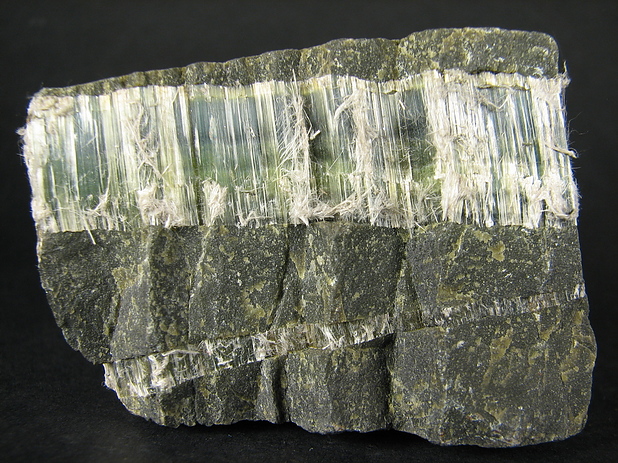

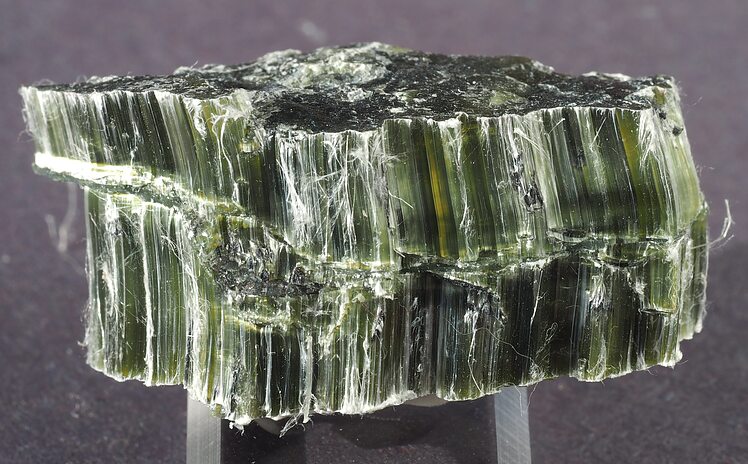


About Chrysotile
Formula:
Mg3(Si2O5)(OH)4
Lustre:
Silky
Hardness:
2½
Crystal System:
Monoclinic
Member of:
Name:
Named in 1843 by Franz von Kobell from the Greek chrysos - "gold" and tilos - "fiber."
Type Locality:
Polymorph of:
Polytypes are clinochrysotile, orthochrysotile, and parachrysotile. Clinochrysotile represents almost all of the known chrysotile specimens. Orthochrysotile is rare, and parachrysotile is very rare.
Lizardite and antigorite are polymorphs, all in the serpentine-subgroup.
Chrysotile and lizardite are the low-temperature serpentine minerals, whereas antigorite is the high-temperature (>250°C) serpentine mineral. According to Evans (2004), chrysotile is metastable.
Coexisting chrysotile and lizardite show slightly different compositions (lizardite is systematically enriched in aluminum and iron with respect to chrysotile) and should no longer be considered as polymorphs (Viti & Mellini, 1997).
Most of the asbestos that was and is mined worldwide consists of chrysotile, but some amphibole varieties were also important, and more hazardous (especially crocidolite and amosite).
A regular interstratification of chrysotile and hydrotalcite is known as UM1995-40-SiO:AlHMg.
 Visit gemdat.org for gemological information about Chrysotile.
Lizardite and antigorite are polymorphs, all in the serpentine-subgroup.
Chrysotile and lizardite are the low-temperature serpentine minerals, whereas antigorite is the high-temperature (>250°C) serpentine mineral. According to Evans (2004), chrysotile is metastable.
Coexisting chrysotile and lizardite show slightly different compositions (lizardite is systematically enriched in aluminum and iron with respect to chrysotile) and should no longer be considered as polymorphs (Viti & Mellini, 1997).
Most of the asbestos that was and is mined worldwide consists of chrysotile, but some amphibole varieties were also important, and more hazardous (especially crocidolite and amosite).
A regular interstratification of chrysotile and hydrotalcite is known as UM1995-40-SiO:AlHMg.
Visit gemdat.org for gemological information about Chrysotile.Unique Identifiers
Mindat ID:
975
Long-form identifier:
mindat:1:1:975:1
IMA Classification of Chrysotile
Approved, 'Grandfathered' (first described prior to 1959)
IMA status notes:
Redefined by the IMA
IMA Formula:
Mg3Si2O5(OH)4
Approval history:
Redefined (special procedure) by the IMA in 2007.
Classification of Chrysotile
9.00.
9 : SILICATES (Germanates)
0 :
0 :
9 : SILICATES (Germanates)
0 :
0 :
71.1.5.1
71 : PHYLLOSILICATES Sheets of Six-Membered Rings
1 : Sheets of 6-membered rings with 1:1 layers
71 : PHYLLOSILICATES Sheets of Six-Membered Rings
1 : Sheets of 6-membered rings with 1:1 layers
14.4.4
14 : Silicates not Containing Aluminum
4 : Silicates of Mg
14 : Silicates not Containing Aluminum
4 : Silicates of Mg
Mineral Symbols
As of 2021 there are now IMA–CNMNC approved mineral symbols (abbreviations) for each mineral species, useful for tables and diagrams.
Please only use the official IMA–CNMNC symbol. Older variants are listed for historical use only.
Please only use the official IMA–CNMNC symbol. Older variants are listed for historical use only.
| Symbol | Source | Reference for Standard |
|---|---|---|
| Ctl | IMA–CNMNC | Warr, L.N. (2021). IMA–CNMNC approved mineral symbols. Mineralogical Magazine, 85(3), 291-320. doi:10.1180/mgm.2021.43 |
| Ctl | Kretz (1983) | Kretz, R. (1983) Symbols of rock-forming minerals. American Mineralogist, 68, 277–279. |
| Ctl | Siivolam & Schmid (2007) | Siivolam, J. and Schmid, R. (2007) Recommendations by the IUGS Subcommission on the Systematics of Metamorphic Rocks: List of mineral abbreviations. Web-version 01.02.07. IUGS Commission on the Systematics in Petrology. download |
| Ctl | Whitney & Evans (2010) | Whitney, D.L. and Evans, B.W. (2010) Abbreviations for names of rock-forming minerals. American Mineralogist, 95, 185–187 doi:10.2138/am.2010.3371 |
| Ctl | The Canadian Mineralogist (2019) | The Canadian Mineralogist (2019) The Canadian Mineralogist list of symbols for rock- and ore-forming minerals (December 30, 2019). download |
| Ctl | Warr (2020) | Warr, L.N. (2020) Recommended abbreviations for the names of clay minerals and associated phases. Clay Minerals, 55, 261–264 doi:10.1180/clm.2020.30 |
Physical Properties of Chrysotile
Silky
Hardness:
2½ on Mohs scale
Optical Data of Chrysotile
Type:
Biaxial
RI values:
nα = 1.569 nγ = 1.57
Max. Birefringence:
δ = 0.001
Based on recorded range of RI values above.
Based on recorded range of RI values above.
Interference Colours:
The colours simulate birefringence patterns seen in thin section under crossed polars. They do not take into account mineral colouration or opacity.
Michel-Levy Bar The default colours simulate the birefringence range for a 30 µm thin-section thickness. Adjust the slider to simulate a different thickness.
Grain Simulation You can rotate the grain simulation to show how this range might look as you rotated a sample under crossed polars. Each grain retains its interference colour (retardation) while its brightness falls to black at extinction and reaches a maximum between extinction positions.
The colours simulate birefringence patterns seen in thin section under crossed polars. They do not take into account mineral colouration or opacity.
Michel-Levy Bar The default colours simulate the birefringence range for a 30 µm thin-section thickness. Adjust the slider to simulate a different thickness.
Grain Simulation You can rotate the grain simulation to show how this range might look as you rotated a sample under crossed polars. Each grain retains its interference colour (retardation) while its brightness falls to black at extinction and reaches a maximum between extinction positions.
Surface Relief:
Moderate (positive)
Relative to Canada balsam mounting medium (n ≈ 1.537).
Relative to Canada balsam mounting medium (n ≈ 1.537).
This shows the grain boundary and Becke line effect under plane-polarised
light, based on the contrast between this mineral's average refractive
index and the mounting medium. It does not take into account mineral
colouration.
In focus
Dispersion:
r > v or r < v
Chemistry of Chrysotile
Mindat Formula:
Mg3(Si2O5)(OH)4
Element Weights:
Elements listed:
Crystallography of Chrysotile
Polytype:
Formula:
Crystal System:
Class (H-M)
Space Group:
Space Group Setting:
Cell Parameters:
Ratio:
Unit Cell Volume (calc):
Z:
Comment:
| Clinochrysotile | Orthochrysotile | Parachrysotile |
|---|---|---|
| Mg3(Si2O5)(OH)4 | Mg3(Si2O5)(OH)4 | Mg3(Si2O5)(OH)4 |
| Monoclinic | Orthorhombic | Orthorhombic |
| 2/m - Prismatic | ||
| a = 5.3 Å, b = 9.19 Å, c = 14.63 Å β = 93° | a = 5.34 Å, b = 9.24 Å, c = 14.2 Å | a = 5.3 Å, b = 9.24 Å, c = 14.71 Å |
| a:b:c = 0.577 : 1 : 1.592 | a:b:c = 0.578 : 1 : 1.537 | a:b:c = 0.574 : 1 : 1.592 |
| V 711.61 ų (Calculated from Unit Cell) | V 700.65 ų (Calculated from Unit Cell) | V 720.38 ų (Calculated from Unit Cell) |
| 4 | 4 | |
| Settings include Cc and C2/m. Falini et al. (2004) give a = 5.340, b = 9.241, c = 14.689 Å, β = 93.66° (space group Cc). |
Crystal Structure
Load
Unit Cell | Unit Cell Packed
2x2x2 | 3x3x3 | 4x4x4
Unit Cell | Unit Cell Packed
2x2x2 | 3x3x3 | 4x4x4
Show
Big Balls | Small Balls | Just Balls | Spacefill
Polyhedra Off | Si Polyhedra | All Polyhedra
Remove metal-metal sticks
Big Balls | Small Balls | Just Balls | Spacefill
Polyhedra Off | Si Polyhedra | All Polyhedra
Remove metal-metal sticks
Display Options
Black Background | White Background
Perspective On | Perspective Off
2D | Stereo | Red-Blue | Red-Cyan
Black Background | White Background
Perspective On | Perspective Off
2D | Stereo | Red-Blue | Red-Cyan
View
CIF File Best | x | y | z | a | b | c
CIF File Best | x | y | z | a | b | c
Rotation
Stop | Start
Stop | Start
Labels
Console Off | On | Grey | Yellow
Console Off | On | Grey | Yellow
Data courtesy of the American Mineralogist Crystal Structure Database. Click on an AMCSD ID to view structure
| ID | Species | Reference | Link | Year | Locality | Pressure (GPa) | Temp (K) |
|---|---|---|---|---|---|---|---|
| 0019917 | Chrysotile | Falini G, Foresti E, Gazzano M, Gualtieri A F, Leoni M, Lesci I G, Roveri N (2004) Tubular-shaped stoichiometric chrysotile nanocrystals Chemistry - A European Journal 10 3043-3049 | 2004 | synthetic | 0 | 293 |
CIF Raw Data - click here to close
Geological Environment
Paragenetic Mode(s):
| Paragenetic Mode | Earliest Age (Ga) |
|---|---|
| Stage 3b: Earth’s earliest hydrosphere | >4.45 |
| 13 : Hadean serpentinization | |
| Near-surface Processes | |
| 23 : Subaerial aqueous alteration by non-redox-sensitive fluids (see also #47) | |
| 24 : Authigenic minerals in terrestrial sediments (see also #17) | |
| Stage 5: Initiation of plate tectonics | <3.5-2.5 |
| 38 : Ophiolites | |
| 40 : Regional metamorphism (greenschist, amphibolite, granulite facies) |
Type Occurrence of Chrysotile
Place of Conservation of Type Material:
No designated type material.
Synonyms of Chrysotile
Other Language Names for Chrysotile
Dutch:Chrysotile
Varieties of Chrysotile
| Aluminian Chrysotile | An aluminium-rich Chrysotile |
| Chrysotilasbest | Asbestiform chrysotile. |
| Chrysotile asbestos | Asbestiform chrysotile. Fairly common in serpentinites. |
| Ishkildite | A variety differing in optical properties and X-ray powder pattern, and containing excess silica. |
Relationship of Chrysotile to other Species
Member of:
Other Members of Serpentine Subgroup:
| Amesite | Mg2Al(AlSiO5)(OH)4 | Tric. 1 : P1 |
| Antigorite | Mg3(Si2O5)(OH)4 | Mon. m : Bm |
| Berthierine | (Fe2+,Fe3+,Al)3(Si,Al)2O5(OH)4 | Mon. m : Bm |
| Brindleyite | (Ni,Al)3(Si,Al)2O5(OH)4 | Mon. |
| Caryopilite | Mn2+3Si2O5(OH)4 | Mon. |
| Cronstedtite | Fe2+2Fe3+((Si,Fe3+)2O5)(OH)4 | Trig. 3m : P31m |
| Fraipontite | (Zn,Al)3((Si,Al)2O5)(OH)4 | Mon. |
| Guidottiite | Mn2Fe3+(Fe3+SiO5)(OH)4 | Hex. 6 : P63 |
| Kellyite | Mn2+2Al(AlSiO5)(OH)4 | Hex. 6 : P63 |
| Lizardite | Mg3(Si2O5)(OH)4 | Trig. 3m : P31m |
| Népouite | Ni3Si2O5(OH)4 | Orth. |
| Pecoraite | Ni3(Si2O5)(OH)4 | Mon. |
Common Associates
Associations Based on Photo Data:
| 66 photos of Chrysotile associated with Serpentine Subgroup | D3[Si2O5](OH)4 |
| 35 photos of Chrysotile associated with Lizardite | Mg3(Si2O5)(OH)4 |
| 31 photos of Chrysotile associated with Magnetite | Fe2+Fe3+2O4 |
| 24 photos of Chrysotile associated with 'Demantoid' | Ca3Fe3+2(SiO4)3 |
| 23 photos of Chrysotile associated with Carlosturanite | (Mg,Fe,Ti)21(Si,Al)12O28(OH)34 · H2O |
| 22 photos of Chrysotile associated with Calcite | CaCO3 |
| 16 photos of Chrysotile associated with Quartz | SiO2 |
| 13 photos of Chrysotile associated with 'Serpentinite' | |
| 13 photos of Chrysotile associated with Antigorite | Mg3(Si2O5)(OH)4 |
| 10 photos of Chrysotile associated with Aragonite | CaCO3 |
Related Minerals - Strunz-mindat Grouping
| 9.00. | Clino-ferri-holmquistite | ◻Li2(Mg3Fe3+2)(Si8O22)(OH)2 |
| 9.00. | Mendigite | Mn2Mn2MnCa(Si3O9)2 |
| 9.00. | Alflarsenite | NaCa2Be3Si4O13(OH) · 2H2O |
| 9.00. | Bridgmanite Subgroup | ABSiO3 |
| 9.00. | Ferroericssonite | BaFe2+2 Fe3+(Si2O7)O(OH) |
| 9.00. | Zvyaginite | NaZnNb2Ti[Si2O7]2(OH,F)3(H2O)4+x (x < 1) |
| 9.00. | Burnettite | CaVAlSiO6 |
| 9.00. | Ferrisepiolite | (Fe3+,Fe2+,Mg)4((Si,Fe3+)6O15)(O,OH)2 · 6H2O |
| 9.00. | Yegorovite | Na4[Si4O8(OH)4] · 7H2O |
| 9.00. | 'Shkatulkalita' | |
| 9.00.15 va | 'Chromoamesite' | Mg2(Al,Cr)(AlSiO5)(OH)4 |
| 9.00.50 | Thornasite | Na12Th4+3(Si8O19)4 · 18H2O |
Other Information
Health Risks:
This mineral is known to be a respirable carcinogen, and is the most common form of asbestos. Exposure to very dusty air or long-term exposure to low level airborne dusts containing fine fibres of chrysotile has been found to cause a high risk of serious lung disease including mesothelioma and lung cancer. Care should be taken working with samples that contain fibrous forms of this mineral, to avoid creating or inhaling dusts. Non-fibrous forms, such as in many serpentinites, are safer to handle, but can still produce potentially carcinogenic respirable fibre when crushed. Appropriate dust masks should be worn if working in areas which have dusts likely to be rich in this mineral. Storage and careful handling of specimens has little or no risk.
Internet Links for Chrysotile
mindat.org URL:
https://www.mindat.org/min-975.html
Please feel free to link to this page.
Please feel free to link to this page.
Search Engines:
External Links:
Mineral Dealers:
References for Chrysotile
Reference List:
Whittaker, E. J. W. (1953) The structure of chrysotile. Acta Crystallographica, 6 (8) 747-748 doi:10.1107/s0365110x53002118
Whittaker, E. J. W. (1956) The structure of chrysotile. II. Clino-chrysotile. Acta Crystallographica, 9 (11) 855-862 doi:10.1107/s0365110x5600245x
Whittaker, E. J. W. (1956) The structure of chrysotile. III. Ortho-chrysotile. Acta Crystallographica, 9 (11) 862-864 doi:10.1107/s0365110x56002461
Whittaker, E. J. W. (1956) The structure of chrysotile. IV. Para-chrysotile. Acta Crystallographica, 9 (11) 865-867 doi:10.1107/s0365110x56002473
Yada, K. (1967) Study of chrysotile asbestos by a high resolution electron microscope. Acta Crystallographica, 23 (5) 704-707 doi:10.1107/s0365110x67003524
Page, Norman J. (1968) Chemical differences among the serpentine "polymorphs". American Mineralogist, 53 (1-2) 201-215
Whittaker, E. J. W., Wicks, F. J. (1970) Chemical differences among the serpentine "polymorphs": A discussion. American Mineralogist, 55 (5-6) 1025-1047
Yada, K. (1971) Study of microstructure of chrysotile asbestos by high-resolution electron microscopy. Acta Crystallographica Section A, 27 (6) 659-664 doi:10.1107/s0567739471001402
Bayliss, Peter (1981) Unit cell data of serpentine group minerals. Mineralogical Magazine, 44 (334) 153-156 doi:10.1180/minmag.1981.044.334.06
MacKenzie, K.J.D., McGavin, D.G. (1994) Thermal and Mössbauer studies of iron-containing hydrous silicates. Part 8. Chrysotile. Thermochimica Acta, 244. 205-221 doi:10.1016/0040-6031(94)80220-3
Viti, Cecilia, Mellini, Marcello (1997) Contrasting chemical compositions in associated lizardite and chrysotile in veins from Elba, Italy. European Journal of Mineralogy, 9 (3) 585-596 doi:10.1127/ejm/9/3/0585
Rinaudo, C., Gastaldi, D., Belluso, E. (2003) Characterization of chrysotile, antigorite and lizardite by FT-Raman spectroscopy. The Canadian Mineralogist, 41 (4). 883-890 doi:10.2113/gscanmin.41.4.883
Evans, Bernard W. (2004) The Serpentinite Multisystem Revisited: Chrysotile Is Metastable. International Geology Review, 46 (6) 479-506 doi:10.2747/0020-6814.46.6.479
Falini, Giuseppe, Foresti, Elisabetta, Gazzano, Massimo, Gualtieri, Alessandro F., Leoni, Matteo, Lesci, Isidoro G., Roveri, Norberto (2004) Tubular-Shaped Stoichiometric Chrysotile Nanocrystals. Chemistry - A European Journal, 10 (12). 3043-3049 doi:10.1002/chem.200305685
Auzende, A.-L., Daniel, I., Reynard, B., Lemaire, C., Guyot, F. (2004) High-pressure behaviour of serpentine minerals: a Raman spectroscopic study. Physics and Chemistry of Minerals, 31 (5) 269-277 doi:10.1007/s00269-004-0384-0
Lesci, I. G., Ferrari, S., Foresti, E., Fracasso, G., Leoni, M., Roveri, N. (2005) Synthetic chrysotile: effect of foreign ions on the hydrothermal synthesis. Acta Crystallographica Section A Foundations of Crystallography, 61. doi:10.1107/s0108767305085107
Burke, Ernst A. J. (2006) A mass discreditation of GQN minerals. The Canadian Mineralogist, 44 (6). p.1557-1560. doi:10.2113/gscanmin.44.6.1557
Hilairet, N., Daniel, I., Reynard, B. (2006) P–V Equations of State and the relative stabilities of serpentine varieties. Physics and Chemistry of Minerals, 33 (8) 629-637 doi:10.1007/s00269-006-0111-0
Viti, C. (2010) Serpentine minerals discrimination by thermal analysis. American Mineralogist, 95 (4) 631-638 doi:10.2138/am.2010.3366
Ristić, Mira, Czakó-Nagy, Ilona, Musić, Svetozar, Vértes, Attila (2011) Spectroscopic characterization of chrysotile asbestos from different regions. Journal of Molecular Structure, 993 (1) 120-126 doi:10.1016/j.molstruc.2010.10.005
SAKAGUCHI, Ilona, KOUKETSU, Yui, MICHIBAYASHI, Katsuyoshi, WALLIS, Simon R. (2020) Attenuated total reflection infrared (ATR–IR) spectroscopy of antigorite, chrysotile, and lizardite. Journal of Mineralogical and Petrological Sciences, 115 (4). 303-312 doi:10.2465/jmps.190807
Localities for Chrysotile
Showing 1,377 localities.
 symbol to view information about a locality.
The
symbol to view information about a locality.
The Locality List
 - This locality has map coordinates listed.
- This locality has estimated coordinates.
ⓘ - Click for references and further information on this occurrence.
? - Indicates mineral may be doubtful at this locality.
- This locality has map coordinates listed.
- This locality has estimated coordinates.
ⓘ - Click for references and further information on this occurrence.
? - Indicates mineral may be doubtful at this locality.
 - Good crystals or important locality for species.
 - World class for species or very significant.
(TL) - Type Locality for a valid mineral species.
(FRL) - First Recorded Locality for everything else (eg varieties).
- World class for species or very significant.
(TL) - Type Locality for a valid mineral species.
(FRL) - First Recorded Locality for everything else (eg varieties).
All localities listed without proper references should be considered as questionable.
Teliatko serpentinite body, Dobšiná, Rožňava District, Košice Region, Slovakia