Log In


Hydroxylborite
A valid IMA mineral species
This page is currently not sponsored. Click here to sponsor this page.


About Hydroxylborite
Formula:
Mg3(BO3)(OH)3
Colour:
Colourless
Lustre:
Vitreous
Hardness:
3½
Specific Gravity:
2.89
Crystal System:
Hexagonal
Name:
In allusion to its composition, being the HYDROXYL dominant member of the series with fluoBORITE.
Type Locality:
Isostructural with:
Unique Identifiers
Mindat ID:
31567
Long-form identifier:
mindat:1:1:31567:0
IMA Classification of Hydroxylborite
Approved
Approval year:
2007
Classification of Hydroxylborite
6.AB.50
6 : BORATES
A : Monoborates
B : BO3, with additional anions; 1(D) + OH, etc.
6 : BORATES
A : Monoborates
B : BO3, with additional anions; 1(D) + OH, etc.
Mineral Symbols
As of 2021 there are now IMA–CNMNC approved mineral symbols (abbreviations) for each mineral species, useful for tables and diagrams.
| Symbol | Source | Reference for Standard |
|---|---|---|
| Hyb | IMA–CNMNC | Warr, L.N. (2021). IMA–CNMNC approved mineral symbols. Mineralogical Magazine, 85(3), 291-320. doi:10.1180/mgm.2021.43 |
Physical Properties of Hydroxylborite
Vitreous
Transparency:
Transparent
Colour:
Colourless
Streak:
White
Hardness:
3½ on Mohs scale
Tenacity:
Brittle
Cleavage:
Imperfect/Fair
On {0001}, imperfect.
On {0001}, imperfect.
Parting:
None.
Fracture:
Conchoidal
Density:
2.89 g/cm3 (Measured) 2.872 g/cm3 (Calculated)
Optical Data of Hydroxylborite
Type:
Uniaxial (-)
RI values:
nω = 1.566 nε = 1.531
Max. Birefringence:
δ = 0.035
Based on recorded range of RI values above.
Based on recorded range of RI values above.
Interference Colours:
The colours simulate birefringence patterns seen in thin section under crossed polars. They do not take into account mineral colouration or opacity.
Michel-Levy Bar The default colours simulate the birefringence range for a 30 µm thin-section thickness. Adjust the slider to simulate a different thickness.
Grain Simulation You can rotate the grain simulation to show how this range might look as you rotated a sample under crossed polars. Each grain retains its interference colour (retardation) while its brightness falls to black at extinction and reaches a maximum between extinction positions.
The colours simulate birefringence patterns seen in thin section under crossed polars. They do not take into account mineral colouration or opacity.
Michel-Levy Bar The default colours simulate the birefringence range for a 30 µm thin-section thickness. Adjust the slider to simulate a different thickness.
Grain Simulation You can rotate the grain simulation to show how this range might look as you rotated a sample under crossed polars. Each grain retains its interference colour (retardation) while its brightness falls to black at extinction and reaches a maximum between extinction positions.
Surface Relief:
Low (positive)
Relative to Canada balsam mounting medium (n ≈ 1.537).
Relative to Canada balsam mounting medium (n ≈ 1.537).
This shows the grain boundary and Becke line effect under plane-polarised
light, based on the contrast between this mineral's average refractive
index and the mounting medium. It does not take into account mineral
colouration.
In focus
Interference Figure:
This shows the idealized uniaxial interference figure - the conoscopic
(convergent-light, Bertrand-lens-in) view, for a grain cut with the optic axis
centred and vertical. The coloured rings are isochromatics, computed with the
same physics as the Michel-Lévy bar above; the dark cross is the isogyre.
For a genuinely uniaxial mineral viewed this way, that cross stays perfectly stationary if you rotate the stage - unlike a biaxial mineral, where it splits apart on rotation. That invariance is itself the standard diagnostic test for telling uniaxial and biaxial minerals apart at the microscope.
For a genuinely uniaxial mineral viewed this way, that cross stays perfectly stationary if you rotate the stage - unlike a biaxial mineral, where it splits apart on rotation. That invariance is itself the standard diagnostic test for telling uniaxial and biaxial minerals apart at the microscope.
Chemistry of Hydroxylborite
Mindat Formula:
Mg3(BO3)(OH)3
Element Weights:
Elements listed:
Crystallography of Hydroxylborite
Crystal System:
Hexagonal
Class (H-M):
6/m - Dipyramidal
Space Group:
P63/m
Cell Parameters:
a = 8.912 Å, c = 3.112 Å
Ratio:
a:c = 1 : 0.349
Unit Cell V:
214.05 ų
Z:
2
Morphology:
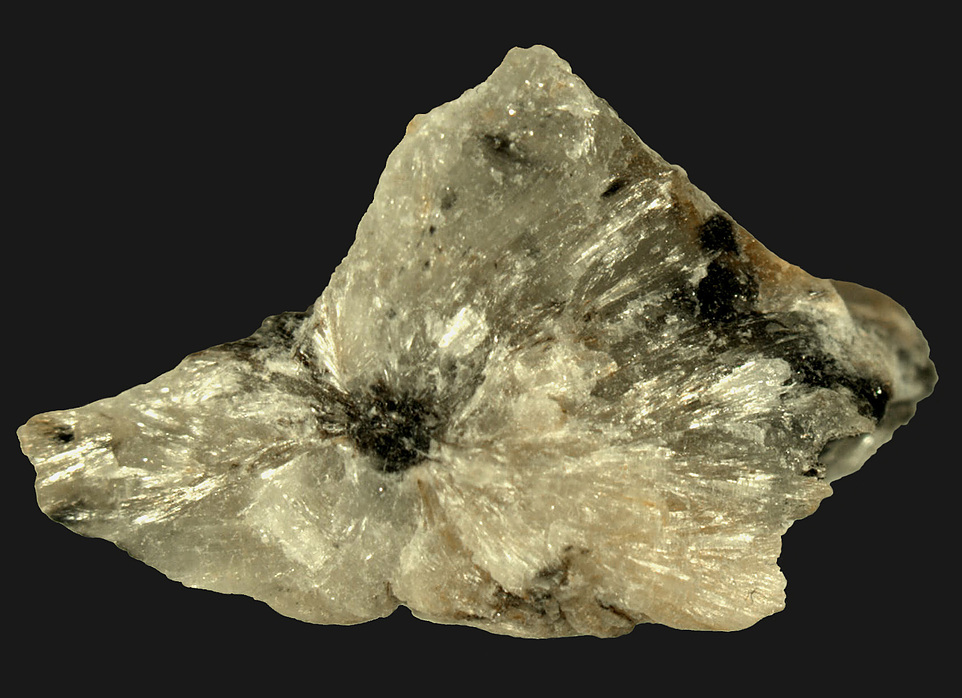
Crystals prismatic with dominant {1010} and without distinct terminal faces; also occurs as radial aggregates.
Crystal Structure
Load
Unit Cell | Unit Cell Packed
2x2x2 | 3x3x3 | 4x4x4
Unit Cell | Unit Cell Packed
2x2x2 | 3x3x3 | 4x4x4
Show
Big Balls | Small Balls | Just Balls | Spacefill
Polyhedra Off | Si Polyhedra | All Polyhedra
Remove metal-metal sticks
Big Balls | Small Balls | Just Balls | Spacefill
Polyhedra Off | Si Polyhedra | All Polyhedra
Remove metal-metal sticks
Display Options
Black Background | White Background
Perspective On | Perspective Off
2D | Stereo | Red-Blue | Red-Cyan
Black Background | White Background
Perspective On | Perspective Off
2D | Stereo | Red-Blue | Red-Cyan
View
CIF File Best | x | y | z | a | b | c
CIF File Best | x | y | z | a | b | c
Rotation
Stop | Start
Stop | Start
Labels
Console Off | On | Grey | Yellow
Console Off | On | Grey | Yellow
Data courtesy of the American Mineralogist Crystal Structure Database. Click on an AMCSD ID to view structure
| ID | Species | Reference | Link | Year | Locality | Pressure (GPa) | Temp (K) |
|---|---|---|---|---|---|---|---|
| 0012664 | Hydroxylborite | Rudnev V V, Chukanov N V, Nechelyustov G N, Yamnova N A (2007) Hydroxylborite, Mg3(BO3)(OH)3, a new mineral species and isomorphous series fluoborite-hydroxylborite series Geology of Ore Deposits 49 710-719 | 2007 | the Titovsky deposit, Sakha-Yakutia Republic, Russia | 0 | 293 | |
| 0009139 | Hydroxylborite | Takeuchi Y (1950) The structure of fluoborite Acta Crystallographica 3 208-210 |  | 1950 | Tallgruvan, Sweden | 0 | 293 |
CIF Raw Data - click here to close
X-Ray Powder Diffraction
Powder Diffraction Data:
| d-spacing | Intensity |
|---|---|
| 2.422 Å | (100) |
| 4.45 Å | (82) |
| 2.573 Å | (65) |
| 2.128 Å | (60) |
| 7.69 Å | (52) |
| 2.551 Å | (49) |
| 2.141 Å | (44) |
Comments:
Visyachy area, Sakha-Yakutia Republic, Russia. Data from the type description.
Geological Environment
Paragenetic Mode(s):
| Paragenetic Mode | Earliest Age (Ga) |
|---|---|
| Near-surface Processes | |
| 23 : Subaerial aqueous alteration by non-redox-sensitive fluids (see also #47) |
Type Occurrence of Hydroxylborite
General Appearance of Type Material:
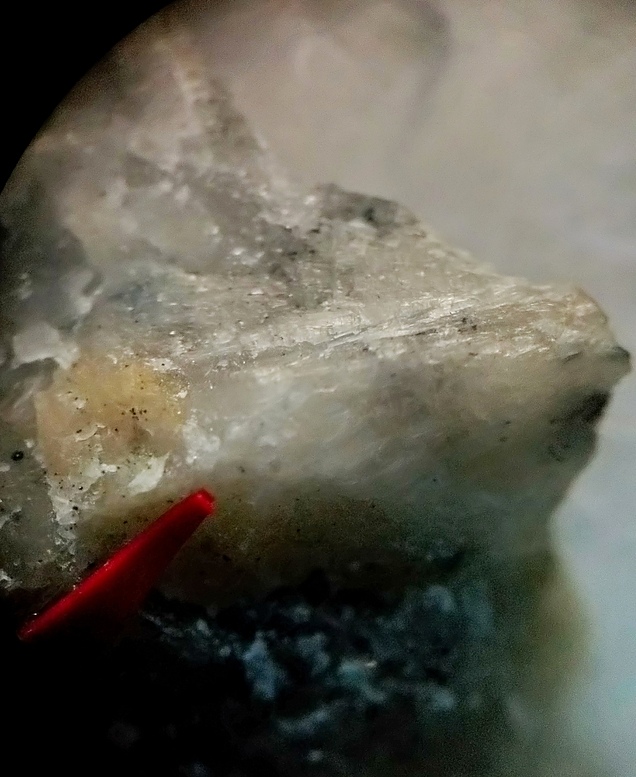
Hexagonal prisms without end faces, about 1-1.5 x 0.1-0.2 mm in size. Commonly as radial and fan-like aggregate.
Place of Conservation of Type Material:
Fersman Mineralogical Museum, Moscow (#91968), and the Geology Museum of the All-Russian Scientific Research Institute of Mineral Resources (#M-1663).
Geological Setting of Type Material:
Mineralized skarn, calciphyre, and marble. Clinohumite calciphyre.
Associated Minerals at Type Locality:
Synonyms of Hydroxylborite
Other Language Names for Hydroxylborite
Dutch:Hydroxylboriet
German:Hydroxylborit
Relationship of Hydroxylborite to other Species
Forms a series with:
Related Minerals - Strunz-mindat Grouping
| 6.AB. | Chubarovite | KZn2(BO3)Cl2 |
| 6.AB. | Rhabdoborite-(Mo) | Mg12Mo6+1.33O6(BO3)6F2 |
| 6.AB.05 | Hambergite | Be2(BO3)(OH) |
| 6.AB.10 | Berborite | Be2(BO3)(OH) · H2O |
| 6.AB.15 | Jeremejevite | Al6(BO3)5(F,OH)3 |
| 6.AB.20 | Yuanfuliite | Mg(Fe3+,Al)O(BO3) |
| 6.AB.20 | Warwickite | (Mg,Ti,Fe,Al)2O(BO3) |
| 6.AB.25 | Karlite | (Mg,Al)6.5(BO3)3(OH)4(◻,Cl)0.5 |
| 6.AB.30 | Marinaite | Cu2Fe3+O2(BO3) |
| 6.AB.30 | Savelievaite | Mg2Cr3+O2(BO3) |
| 6.AB.30 | Fredrikssonite | Mg2Mn3+O2(BO3) |
| 6.AB.30 | Vonsenite | Fe2+2Fe3+(BO3)O2 |
| 6.AB.30 | Ludwigite | Mg2Fe3+(BO3)O2 |
| 6.AB.30 | Azoproite | (Mg,Fe2+)2(Fe3+,Ti,Mg)(BO3)O2 |
| 6.AB.30 | Bonaccordite | Ni2Fe3+(BO3)O2 |
| 6.AB.35 | Folvikite | Sb5+Mn3+(Mg,Mn2+)10O8(BO3)4 |
| 6.AB.35 | Pinakiolite | (Mg,Mn2+)2Mn3+(BO3)O2 |
| 6.AB.40 | Takéuchiite | (Mg,Mn2+)2(Mn3+,Fe3+)(BO3)O2 |
| 6.AB.40 | Blatterite | Sb5+3(Mn3+,Fe3+)9(Mn2+,Mg)35(BO3)16O32 |
| 6.AB.40 | Orthopinakiolite | (Mg,Mn2+)2Mn3+(BO3)O2 |
| 6.AB.40 | Chestermanite | Mg2(Fe3+,Mn3+,Al,Sb3+)(BO3)O2 |
| 6.AB.45 | Aluminomagnesiohulsite | (Mg,Fe2+)2(Al,Mg,Sn)(BO3)O2 |
| 6.AB.45 | Hulsite | Fe2+2Fe3+O2(BO3) |
| 6.AB.45 | Magnesiohulsite | Mg2Fe3+O2(BO3) |
| 6.AB.50 | Fluoborite | Mg3(BO3)(F,OH)3 |
| 6.AB.55 | Shabynite | Mg5(BO3)(OH)5(Cl,OH)2 · 4H2O |
| 6.AB.55 | Wightmanite | Mg5(BO3)O(OH)5 · 2H2O |
| 6.AB.60 | Gaudefroyite | Ca4Mn3+2-3(BO3)3(CO3)(O,OH)3 |
| 6.AB.65 | Sakhaite | Ca48Mg16(BO3)32(CO3)16 · 2(H2O,HCl) |
| 6.AB.70 | Harkerite | Ca48Mg16[AlSi4O15(OH)]4(BO3)16(CO3)16 · 2(H2O,HCl) |
| 6.AB.75 | Pertsevite-(F) | Mg2(BO3)(F,OH) |
| 6.AB.75 | Pertsevite-(OH) | Mg2(BO3)(OH) |
| 6.AB.80 | Jacquesdietrichite | Cu2(H2BO3)(OH)3 |
| 6.AB.85 | Rhabdoborite-(V) | Mg12(V5+,Mo6+,W6+)1.5O6{[BO3]6-x[(P,As)O4]xF2-x} (x < 1) |
| 6.AB.85 | Rhabdoborite-(W) | Mg12(W6+,V5+)1.5O6{[BO3]6-x[(P,As)O4]xF2-x} |
| 6.AB.85 | Painite | CaZrAl9(BO3)O15 |
| 6.AB.90 | Mengxianminite | (Ca,Na)2Sn2(Mg,Fe)3Al8[(BO3)(BeO4)O6]2 |
Fluorescence of Hydroxylborite
Bluish fluorescence under SW UV.
Other Information
Notes:
Dissolves in concentrated H2SO4, readily reacts with quinalizarin, and remains insoluble in water and dilute HCl.
Health Risks:
No information on health risks for this material has been entered into the database. You should always treat mineral specimens with care.
Internet Links for Hydroxylborite
mindat.org URL:
https://www.mindat.org/min-31567.html
Please feel free to link to this page.
Please feel free to link to this page.
Search Engines:
External Links:
Mineral Dealers:
References for Hydroxylborite
Localities for Hydroxylborite
Showing 3 localities.
 symbol to view information about a locality.
The
symbol to view information about a locality.
The Locality List
 - This locality has map coordinates listed.
- This locality has estimated coordinates.
ⓘ - Click for references and further information on this occurrence.
? - Indicates mineral may be doubtful at this locality.
- This locality has map coordinates listed.
- This locality has estimated coordinates.
ⓘ - Click for references and further information on this occurrence.
? - Indicates mineral may be doubtful at this locality.
 - Good crystals or important locality for species.
 - World class for species or very significant.
(TL) - Type Locality for a valid mineral species.
(FRL) - First Recorded Locality for everything else (eg varieties).
- World class for species or very significant.
(TL) - Type Locality for a valid mineral species.
(FRL) - First Recorded Locality for everything else (eg varieties).
All localities listed without proper references should be considered as questionable.
Italy | |
| Mocci et al. (2026) |
Russia | |
| The Chersky Range is within the Saha ... |
| Rudnev et al. (2007) |
Quick NavTopAbout HydroxylboriteUnique IdentifiersIMA Classification Classification Mineral SymbolsPhysical Properties Optical Data Chemistry Crystallography Crystal StructureX-Ray Powder DiffractionGeological EnvironmentType Occurrence SynonymsOther LanguagesRelationshipsStrunz-MindatFluorescence Other InformationInternet Links References Localities Locality List

Titovskoe B deposit, Tas-Khayakhtakh Range, Dogdo River Basin, Polar Yakutia, Sakha, Russia