Log In


Murrawombie Copper Mine, Girilambone, Canbelego Co., New South Wales, Australiai
| Regional Level Types | |
|---|---|
| Murrawombie Copper Mine | Mine (Active) |
| Girilambone | Town |
| Canbelego Co. | County |
| New South Wales | State |
| Australia | Country |
This page is currently not sponsored. Click here to sponsor this page.



Latitude & Longitude (WGS84):
31° 15' 31'' South , 146° 52' 10'' East
Latitude & Longitude (decimal):
Type:
Mine (Active) - last checked 2026
Deposit first discovered:
1875
Köppen climate type:
Other/historical names associated with this locality:
Girilambone Copper Mine; Murrawombie open pit; West Bogan Mine; West Bogan No.5 block
Discovered in 1875, mined from 1993 to 2002 by Straits Resources (heap leaching).
Girilambone is located approximately 46 kilometres north-north-west of the town of Nyngan in central New South Wales.
Stratiform, disseminated.
Aeris Resources website (2017)states that "Triton Mining within the Tritton area in modern times began in 1992 at the Murrawombie open pit and heap leach operation by the Girilambone Copper Company, a Joint Venture between Straits Resources (now Aeris) and Nord Pacific. The Girilambone Copper Company eventually became a wholly owned subsidiary of Straits Resources. Operations at the Girilambone copper project involved the mining of several open pits to recover copper oxide ore that was treated by heap leach, followed by solvent extraction and electrowinning processing to produce copper cathode. The Murrawombie pit was the largest of the mines. Open pit mining at Girilambone ended in 1999, although copper cathode production continued for two more years.
Leaching of residual copper from the Murrawombie heap leach continues today (2026). Approximately 400 tonnes per year of copper is extracted from the leach solution as a copper cement by reaction with scrap iron."
There are 3 satellite deposits, 3 km north of the main pit: Larsens East, Hartmans and Northeast.
Mining was still taking place (2026), with ore being transported by truck to the Tritton processing plant.
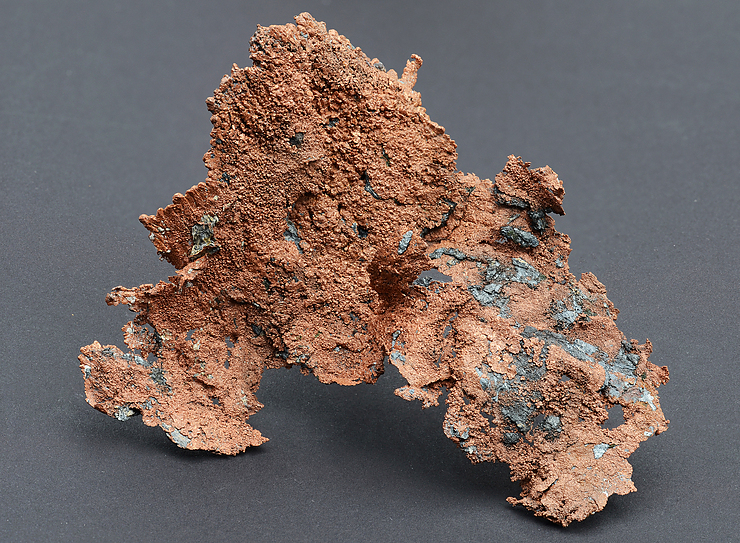
A source of many good native copper, and secondary copper mineral specimens. The deposit caused all sorts of grief to early miners, due to its low iron and high silica content. It was not until 1992, with new technology, the ore could be processed efficiently.
Copper was discovered here by Thomas Hartman 1875, who was also involved with the discovery of the Cobar deposits. Thomas, then William Richardson 1880, Girilambone Copper Mining company 1881-1885, another company by the same name 1896-1902, Girilambone Mining Company 1902-1908, all tried to mine the deposit without success. The Girilambone Copper company was formed 1991 (JV Nord/Straits Resources), and mining took place 1996-1997, and heap leaching till 2003. The Murrawombie pit was developed in 2015.
Aeris Resources Ltd mines the area (2026). The company operation comprises an open pit (Murrawombie Open Pit), a decline portal to the Murrawombie underground, a heap leach copper extraction circuit, and maintenance and
administrative infrastructure and activities. The mine is being progressively rehabilitated.
Copper carbonates and phosphates, supergene chalcocite, and primary chalcopyrite found in steeply dipping shear zones. The main lode forms lenses of massive sulphide largely of chalcocite within pink quartz.
The surface pink quartzite weathered to a siliceous gossan with voids surrounded by massive iron and manganese oxide mineralisation. The voids have been the host to well crystallised secondary copper specimens. This is overprinted by decreasing libethenite and increasing pseudomalachite with depth from weathered phosphate bearing gangue minerals. There is a leached zone to 30m below the surface, then the oxide zone down to 90 metres at the water table. Malachite dominates the upper levels of the oxide zone, then a transition zone of sporadic malachite and pseudomorphs of malachite after azurite, and finally at depth in the oxide zone azurite dominates. Below this is a supergene chalcocite blanket of native copper, and earthy/sooty chalcocite. Chalcopyrite veins are found below this.
Select Mineral List Type
Standard Detailed Gallery Strunz Chemical ElementsMineral List
28 valid minerals.
Rock Types Recorded
Select Rock List Type
Alphabetical List Tree DiagramDetailed Mineral List:
| ⓘ Arsenopyrite Formula: FeAsS |
| ⓘ Atacamite Formula: Cu2(OH)3Cl |
| ⓘ Azurite Formula: Cu3(CO3)2(OH)2 |
| ⓘ Baryte Formula: BaSO4 |
| ⓘ Chalcanthite Formula: CuSO4 · 5H2O |
| ⓘ Chalcocite Formula: Cu2S |
| ⓘ Chalcopyrite Formula: CuFeS2 |
| ⓘ Chalcosiderite Formula: CuFe3+6(PO4)4(OH)8 · 4H2O |
| ⓘ 'Chlorite Group' |
| ⓘ Chrysocolla Formula: Cu2-xAlx(H2-xSi2O5)(OH)4 · nH2O, x < 1 |
| ⓘ Clinochlore Formula: Mg5Al(AlSi3O10)(OH)8 |
| ⓘ Covellite Formula: CuS |
| ⓘ Crandallite Formula: CaAl3(PO4)(PO3OH)(OH)6 |
| ⓘ Cuprite Formula: Cu2O |
| ⓘ Digenite Formula: Cu9S5 |
| ⓘ Galena Formula: PbS |
| ⓘ Goethite Formula: Fe3+O(OH) |
| ⓘ Libethenite Formula: Cu2(PO4)(OH) |
| ⓘ 'Limonite' |
| ⓘ Malachite Formula: Cu2(CO3)(OH)2 |
| ⓘ Marcasite Formula: FeS2 |
| ⓘ Native Copper Formula: Cu |
| ⓘ Pseudomalachite Formula: Cu5(PO4)2(OH)4 |
| ⓘ Pyrite Formula: FeS2 |
| ⓘ Pyrrhotite Formula: Fe1-xS |
| ⓘ Quartz Formula: SiO2 |
| ⓘ Sieleckiite Formula: Cu3Al4(PO4)2(OH)12 · 2H2O |
| ⓘ Sphalerite Formula: ZnS |
| ⓘ Tenorite Formula: CuO |
| ⓘ Turquoise Formula: CuAl6(PO4)4(OH)8 · 4H2O |

Murrawombie Copper Mine, Girilambone, Canbelego Co., New South Wales, Australia