Log In


Prehnite
A valid IMA mineral species - grandfathered
This page is currently not sponsored. Click here to sponsor this page.


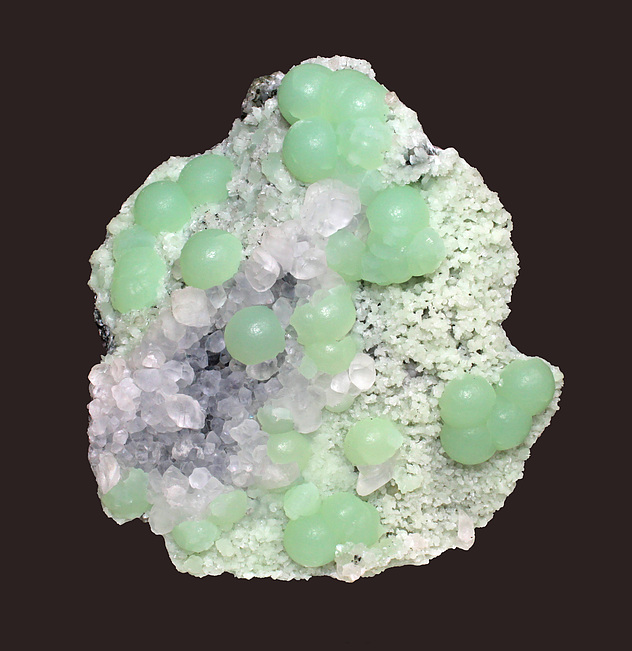
About Prehnite
Formula:
Ca2Al2Si3O10(OH)2
Colour:
Colourless to gray to yellow, yellow-green or white; pale brownish; very rarely pale bluish
Lustre:
Vitreous, Pearly
Hardness:
6 - 6½
Specific Gravity:
2.8 - 2.95
Crystal System:
Orthorhombic
Name:
Named in 1788 by Abraham Gottlieb Werner in honor of the Dutch Colonel, Hendrik von/van Prehn [July 31/August 2, 1733 Cape of Good Hope Colony - August 1785 Heilbronn, Wurttemberg {Germany}], who is credited with discovering the mineral in 1774 at the Cape of Good Hope in South Africa. Von Prehn was a governor of Cape of Good Hope (1779-1780) until he was dismissed. He was a naturalist and mineral collector who brought the first specimens of his namesake mineral to Europe. It is unknown how the mineral came to the attention of Werner. A considerable mystique and folklore have surrounded Prehn and prehnite. The appellation "von" was supposedly bestowed on Prehn for his military service during the Seven Year's War, but there are no printed records available to substantiate the claim. It has been claimed that prehnite was the first mineral named for a person. In 1813, Richard Chenevix wrote a lengthy article (100+ pages) decrying the naming of minerals for people [citation needed - see https://www.mindat.org/mesg-668388.html ].
The Al analogue of ferriprehnite. Both seem to belong to the prehnite group that also likely contains amstallite.
A relatively common calcium alumosilicate occurring in low-temperature hydrothermal environments.
Colourless brick-shaped crystals may be confused with stellerite.
It has a unique crystal structure containing two types of tetrahedral sites: T1 (occupied by only Si) linked with two neighboring T2 tetrahedra and two AlO4(OH)2 octahedra, and T2 (occupied by equal Si and Al) linked to two other T2 tetrahedra in a helical chain and two T1 tetrahedra. Although most X-ray diffraction studies refined the crystal structure in space groups P2cm or P2/n with an ordered alternating Si-Al distribution in the T2 chains, discrepancies have been noted between experimentally determined phase boundaries and those calculated thermodynamically, which have been attributed to Si-Al disorder. First-principles calculations reproduced the observed 1H, 29Si, and 27Al NMR results well, and also revealed that the two ordered structures of prehnite with space groups P2cm and P2/n only differ slightly in enthalpy and NMR parameters. This is consistent with the previously reported coexistence of domains of both space groups in natural prehnite from various localities. The existence of two modifications with the same topology and ordered Si-Al distribution, differing only in how some of the equivalent Si and Al sites are distributed, is unique among silicate minerals.
 Visit gemdat.org for gemological information about Prehnite.
A relatively common calcium alumosilicate occurring in low-temperature hydrothermal environments.
Colourless brick-shaped crystals may be confused with stellerite.
It has a unique crystal structure containing two types of tetrahedral sites: T1 (occupied by only Si) linked with two neighboring T2 tetrahedra and two AlO4(OH)2 octahedra, and T2 (occupied by equal Si and Al) linked to two other T2 tetrahedra in a helical chain and two T1 tetrahedra. Although most X-ray diffraction studies refined the crystal structure in space groups P2cm or P2/n with an ordered alternating Si-Al distribution in the T2 chains, discrepancies have been noted between experimentally determined phase boundaries and those calculated thermodynamically, which have been attributed to Si-Al disorder. First-principles calculations reproduced the observed 1H, 29Si, and 27Al NMR results well, and also revealed that the two ordered structures of prehnite with space groups P2cm and P2/n only differ slightly in enthalpy and NMR parameters. This is consistent with the previously reported coexistence of domains of both space groups in natural prehnite from various localities. The existence of two modifications with the same topology and ordered Si-Al distribution, differing only in how some of the equivalent Si and Al sites are distributed, is unique among silicate minerals.
Visit gemdat.org for gemological information about Prehnite.Unique Identifiers
Mindat ID:
3277
Long-form identifier:
mindat:1:1:3277:9
Similar Names
| Paranite-(Y) | A synonym of Paraniite-(Y) |
| Parianite | A synonym of 'Bitumen' |
| Pyreneite | A synonym of 'Melanite' |
IMA Classification of Prehnite
Approved, 'Grandfathered' (first described prior to 1959)
IMA Formula:
Ca2Al(Si3Al)O10(OH)2
First published:
1788
Classification of Prehnite
9.DP.20
9 : SILICATES (Germanates)
D : Inosilicates
P : Transitional ino-phyllosilicate structures
9 : SILICATES (Germanates)
D : Inosilicates
P : Transitional ino-phyllosilicate structures
72.1.3.1
72 : PHYLLOSILICATES Two-Dimensional Infinite Sheets with Other Than Six-Membered Rings
1 : Two-Dimensional Infinite Sheets with Other Than Six-Membered Rings with 4-membered rings
72 : PHYLLOSILICATES Two-Dimensional Infinite Sheets with Other Than Six-Membered Rings
1 : Two-Dimensional Infinite Sheets with Other Than Six-Membered Rings with 4-membered rings
16.9.10
16 : Silicates Containing Aluminum and other Metals
9 : Aluminosilicates of Ca
16 : Silicates Containing Aluminum and other Metals
9 : Aluminosilicates of Ca
Mineral Symbols
As of 2021 there are now IMA–CNMNC approved mineral symbols (abbreviations) for each mineral species, useful for tables and diagrams.
Please only use the official IMA–CNMNC symbol. Older variants are listed for historical use only.
Please only use the official IMA–CNMNC symbol. Older variants are listed for historical use only.
| Symbol | Source | Reference for Standard |
|---|---|---|
| Prh | IMA–CNMNC | Warr, L.N. (2021). IMA–CNMNC approved mineral symbols. Mineralogical Magazine, 85(3), 291-320. doi:10.1180/mgm.2021.43 |
| Prh | Kretz (1983) | Kretz, R. (1983) Symbols of rock-forming minerals. American Mineralogist, 68, 277–279. |
| Prh | Siivolam & Schmid (2007) | Siivolam, J. and Schmid, R. (2007) Recommendations by the IUGS Subcommission on the Systematics of Metamorphic Rocks: List of mineral abbreviations. Web-version 01.02.07. IUGS Commission on the Systematics in Petrology. download |
| Prh | Whitney & Evans (2010) | Whitney, D.L. and Evans, B.W. (2010) Abbreviations for names of rock-forming minerals. American Mineralogist, 95, 185–187 doi:10.2138/am.2010.3371 |
| Prh | The Canadian Mineralogist (2019) | The Canadian Mineralogist (2019) The Canadian Mineralogist list of symbols for rock- and ore-forming minerals (December 30, 2019). download |
Physical Properties of Prehnite
Vitreous, Pearly
Transparency:
Translucent
Comment:
Pearly on cleavage {001}
Colour:
Colourless to gray to yellow, yellow-green or white; pale brownish; very rarely pale bluish
Streak:
White
Hardness:
6 - 6½ on Mohs scale
Tenacity:
Brittle
Cleavage:
Distinct/Good
Good on {001}, poor on {110}
Good on {001}, poor on {110}
Fracture:
Irregular/Uneven
Density:
2.8 - 2.95 g/cm3 (Measured) 2.9 g/cm3 (Calculated)
Optical Data of Prehnite
Type:
Biaxial (+)
RI values:
nα = 1.611 - 1.632 nβ = 1.615 - 1.642 nγ = 1.632 - 1.665
2V:
Measured: 64° to 70°, Calculated: 58° to 68°
Max. Birefringence:
δ = 0.021 - 0.033
Based on recorded range of RI values above.
Based on recorded range of RI values above.
Interference Colours:
The colours simulate birefringence patterns seen in thin section under crossed polars. They do not take into account mineral colouration or opacity.
Michel-Levy Bar The default colours simulate the birefringence range for a 30 µm thin-section thickness. Adjust the slider to simulate a different thickness.
Grain Simulation You can rotate the grain simulation to show how this range might look as you rotated a sample under crossed polars. Each grain retains its interference colour (retardation) while its brightness falls to black at extinction and reaches a maximum between extinction positions.
The colours simulate birefringence patterns seen in thin section under crossed polars. They do not take into account mineral colouration or opacity.
Michel-Levy Bar The default colours simulate the birefringence range for a 30 µm thin-section thickness. Adjust the slider to simulate a different thickness.
Grain Simulation You can rotate the grain simulation to show how this range might look as you rotated a sample under crossed polars. Each grain retains its interference colour (retardation) while its brightness falls to black at extinction and reaches a maximum between extinction positions.
Surface Relief:
High (positive)
Relative to Canada balsam mounting medium (n ≈ 1.537).
Relative to Canada balsam mounting medium (n ≈ 1.537).
This shows the grain boundary and Becke line effect under plane-polarised
light, based on the contrast between this mineral's average refractive
index and the mounting medium. It does not take into account mineral
colouration.
In focus
Interference Figure:
This shows the idealized biaxial acute bisectrix (Bxa) interference figure
- the conoscopic view for a grain cut perpendicular to the acute bisectrix, using
this mineral's 2V. The two small white dots mark the melatopes - the points
where the two optic axes emerge - and are shown only when they fall within the
field of view. The coloured bands are isochromatics, and the dark bands are
isogyres.
Rotate the stage: at 0°/90° the isogyres form a cross through the melatopes; at 45° they pull apart into curved hyperbolas. That splitting on rotation - absent in a uniaxial figure - is the standard diagnostic test for telling biaxial minerals from uniaxial ones. If 2V is large, the melatopes may fall outside the field of view, as they often do at the microscope too.
Rotate the stage: at 0°/90° the isogyres form a cross through the melatopes; at 45° they pull apart into curved hyperbolas. That splitting on rotation - absent in a uniaxial figure - is the standard diagnostic test for telling biaxial minerals from uniaxial ones. If 2V is large, the melatopes may fall outside the field of view, as they often do at the microscope too.
Dispersion:
weak r > v
Optical Extinction:
X = a; Y = b; Z = c.
Chemistry of Prehnite
Mindat Formula:
Ca2Al2Si3O10(OH)2
Element Weights:
Common Impurities:
Ti,Fe,Mg,Na,K,H2O
Crystallography of Prehnite
Crystal System:
Orthorhombic
Class (H-M):
mm2 - Pyramidal
Cell Parameters:
a = 4.63309(9) Å, b = 5.4839(1) Å, c = 18.5100(3) Å
Ratio:
a:b:c = 0.845 : 1 : 3.375
Unit Cell V:
470.29 ų (Calculated from Unit Cell)
Z:
2
Morphology:
Uncommon crystals (blocky to thin tabular); aggregates are fanlike, reniform, globular, stalactitic, granular, compact.
Twinning:
Fine lamellar
Comment:
Space group P2cn (non-standard setting). Note that prehnite may consist of orthorhombic domains (Pc2m, twinned to simulate Pncm) as well as monoclinic domains (P2/n) (Aumento, 1968; Akizuki, 1987; Detrie et al., 2008). Cell parameters from Sugiyama et al. (2021)
Crystal Structure
Load
Unit Cell | Unit Cell Packed
2x2x2 | 3x3x3 | 4x4x4
Unit Cell | Unit Cell Packed
2x2x2 | 3x3x3 | 4x4x4
Show
Big Balls | Small Balls | Just Balls | Spacefill
Polyhedra Off | Si Polyhedra | All Polyhedra
Remove metal-metal sticks
Big Balls | Small Balls | Just Balls | Spacefill
Polyhedra Off | Si Polyhedra | All Polyhedra
Remove metal-metal sticks
Display Options
Black Background | White Background
Perspective On | Perspective Off
2D | Stereo | Red-Blue | Red-Cyan
Black Background | White Background
Perspective On | Perspective Off
2D | Stereo | Red-Blue | Red-Cyan
View
CIF File Best | x | y | z | a | b | c
CIF File Best | x | y | z | a | b | c
Rotation
Stop | Start
Stop | Start
Labels
Console Off | On | Grey | Yellow
Console Off | On | Grey | Yellow
Data courtesy of the American Mineralogist Crystal Structure Database. Click on an AMCSD ID to view structure
| ID | Species | Reference | Link | Year | Locality | Pressure (GPa) | Temp (K) |
|---|---|---|---|---|---|---|---|
| 0007288 | Prehnite | Detrie T A, Ross N L, Angel R J, Gatta G D (2009) Equation of state and structure of prehnite to 9.8 GPa European Journal of Mineralogy 21 561-570 | 2009 | N'Chwaning II mine, Kuruman, South Africa | 0.0001 | 293 | |
| 0006388 | Prehnite | Balic-Zunic T, Scavnicar S, Molin G (1990) Crystal structure of prehnite from Komiza European Journal of Mineralogy 2 731-734 | 1990 | Komiza | 0 | 293 | |
| 0007289 | Prehnite | Detrie T A, Ross N L, Angel R J, Gatta G D (2009) Equation of state and structure of prehnite to 9.8 GPa European Journal of Mineralogy 21 561-570 | 2009 | N'Chwaning II mine, Kuruman, South Africa | 1.952 | 293 | |
| 0007290 | Prehnite | Detrie T A, Ross N L, Angel R J, Gatta G D (2009) Equation of state and structure of prehnite to 9.8 GPa European Journal of Mineralogy 21 561-570 | 2009 | N'Chwaning II mine, Kuruman, South Africa | 4.279 | 293 | |
| 0007291 | Prehnite | Detrie T A, Ross N L, Angel R J, Gatta G D (2009) Equation of state and structure of prehnite to 9.8 GPa European Journal of Mineralogy 21 561-570 | 2009 | N'Chwaning II mine, Kuruman, South Africa | 5.111 | 293 | |
| 0007292 | Prehnite | Detrie T A, Ross N L, Angel R J, Gatta G D (2009) Equation of state and structure of prehnite to 9.8 GPa European Journal of Mineralogy 21 561-570 | 2009 | N'Chwaning II mine, Kuruman, South Africa | 6.408 | 293 | |
| 0007293 | Prehnite | Detrie T A, Ross N L, Angel R J, Gatta G D (2009) Equation of state and structure of prehnite to 9.8 GPa European Journal of Mineralogy 21 561-570 | 2009 | N'Chwaning II mine, Kuruman, South Africa | 7.818 | 293 | |
| 0007294 | Prehnite | Detrie T A, Ross N L, Angel R J, Gatta G D (2009) Equation of state and structure of prehnite to 9.8 GPa European Journal of Mineralogy 21 561-570 | 2009 | N'Chwaning II mine, Kuruman, South Africa | 8.207 | 293 | |
| 0007295 | Prehnite | Detrie T A, Ross N L, Angel R J, Gatta G D (2009) Equation of state and structure of prehnite to 9.8 GPa European Journal of Mineralogy 21 561-570 | 2009 | N'Chwaning II mine, Kuruman, South Africa | 9.03 | 293 | |
| 0007296 | Prehnite | Detrie T A, Ross N L, Angel R J, Gatta G D (2009) Equation of state and structure of prehnite to 9.8 GPa European Journal of Mineralogy 21 561-570 | 2009 | N'Chwaning II mine, Kuruman, South Africa | 9.345 | 293 | |
| 0007297 | Prehnite | Detrie T A, Ross N L, Angel R J, Gatta G D (2009) Equation of state and structure of prehnite to 9.8 GPa European Journal of Mineralogy 21 561-570 | 2009 | N'Chwaning II mine, Kuruman, South Africa | 9.75 | 293 | |
| 0000157 | Prehnite | Papike J J, Zoltai T (1967) Ordering of tetrahedral aluminium in prehnite, Ca2(Al,Fe)[Si3AlO10](OH)2 American Mineralogist 52 974-984 |  | 1967 | 0 | 293 |
CIF Raw Data - click here to close
X-Ray Powder Diffraction
Loading XRD data...
Data courtesy of RRUFF project at University of Arizona, used with permission.
Powder Diffraction Data:
| d-spacing | Intensity |
|---|---|
| 3.48 Å | (90) |
| 3.28 Å | (60) |
| 3.08 Å | (100) |
| 2.55 Å | (100) |
| 2.37 Å | (40) |
| 2.31 Å | (40) |
| 1.77 Å | (70) |
Geological Environment
Paragenetic Mode(s):
| Paragenetic Mode | Earliest Age (Ga) |
|---|---|
| Stage 3a: Earth’s earliest Hadean crust | >4.50 |
| 8 : Mafic igneous rocks | |
| 10 : Basalt-hosted zeolite minerals | |
| Stage 3b: Earth’s earliest hydrosphere | >4.45 |
| 14 : Hot springs, geysers, and other subaerial geothermal minerals | |
| 16 : Low-𝑇 aqueous alteration of Hadean subaerial lithologies (see also #23) | |
| Near-surface Processes | |
| 23 : Subaerial aqueous alteration by non-redox-sensitive fluids (see also #47) | |
| High-𝑇 alteration and/or metamorphism | |
| 31 : Thermally altered carbonate, phosphate, and iron formations | |
| Stage 5: Initiation of plate tectonics | <3.5-2.5 |
| 39 : High-𝑃 metamorphism (blueschist, eclogite, ultrahigh 𝑃 facies) | |
| 40 : Regional metamorphism (greenschist, amphibolite, granulite facies) |
Geological Setting:
A secondary mineral in mafic volcanic rocks, low-grade metamorphic mineral.
Type Occurrence of Prehnite
Synonyms of Prehnite
Other Language Names for Prehnite
Common Associates
Associations Based on Photo Data:
| 1,533 photos of Prehnite associated with |
Upper New Street Quarry, Paterson, Passaic County, New Jersey, USA