Log In


Palmierite
A valid IMA mineral species - grandfathered
This page is currently not sponsored. Click here to sponsor this page.

About Palmierite

Luigi Palmieri
Formula:
K2Pb(SO4)2
K may be replaced by minor Na.
Colour:
Colourless, white; colourless in transmitted light
Lustre:
Vitreous, Pearly
Hardness:
2
Specific Gravity:
4.363
Crystal System:
Trigonal
Member of:
Name:
Named in honor of Luigi Palmieri (22 April 1807, Faicchio, Benevento, Italy – 9 September 1896, Naples, Italy), physicist and meteorologist, and Director of the Vesuvius Observatory. He was famous for his scientific studies of the eruptions of Mount Vesuvius, for his research on earthquakes and meteorological phenomena and for improving the seismograph.
Isostructural with:
The lead analogue of Kalistrontite. Compare eleomelanite.
In experimental volcanic gas condensation by Africano et al. (2002) it deposited in the range of ca. 600-400oC.
Commonly found as an alteration product in man made pigments and smelting residues.
In experimental volcanic gas condensation by Africano et al. (2002) it deposited in the range of ca. 600-400oC.
Commonly found as an alteration product in man made pigments and smelting residues.
Unique Identifiers
Mindat ID:
3071
Long-form identifier:
mindat:1:1:3071:3
Similar Names
| Palmerite | A synonym of Taranakite | |
| Plimerite | A valid IMA mineral species | ZnFe43+(PO4)3(OH)5 |
| Plombièrite | A valid IMA mineral species | Ca5Si6O16(OH)2 · 7H2O |
IMA Classification of Palmierite
Approved, 'Grandfathered' (first described prior to 1959)
IMA Formula:
K2Pb2+(S6+O4)2
Classification of Palmierite
7.AD.40
7 : SULFATES (selenates, tellurates, chromates, molybdates, wolframates)
A : Sulfates (selenates, etc.) without additional anions, without H2O
D : With only large cations
7 : SULFATES (selenates, tellurates, chromates, molybdates, wolframates)
A : Sulfates (selenates, etc.) without additional anions, without H2O
D : With only large cations
28.4.3.1
28 : ANHYDROUS ACID AND NORMAL SULFATES
4 : Miscellaneous
28 : ANHYDROUS ACID AND NORMAL SULFATES
4 : Miscellaneous
25.7.5
25 : Sulphates
7 : Sulphates of Pb
25 : Sulphates
7 : Sulphates of Pb
Mineral Symbols
As of 2021 there are now IMA–CNMNC approved mineral symbols (abbreviations) for each mineral species, useful for tables and diagrams.
| Symbol | Source | Reference for Standard |
|---|---|---|
| Pmi | IMA–CNMNC | Warr, L.N. (2021). IMA–CNMNC approved mineral symbols. Mineralogical Magazine, 85(3), 291-320. doi:10.1180/mgm.2021.43 |
Physical Properties of Palmierite
Vitreous, Pearly
Transparency:
Translucent
Colour:
Colourless, white; colourless in transmitted light
Hardness:
2 on Mohs scale
Density:
4.363 g/cm3 (Measured) 4.33 g/cm3 (Calculated)
Optical Data of Palmierite
Type:
Uniaxial (-)
Chemistry of Palmierite
Mindat Formula:
K2Pb(SO4)2
K may be replaced by minor Na.
K may be replaced by minor Na.
Element Weights:
Elements listed:
Crystallography of Palmierite
Crystal System:
Trigonal
Class (H-M):
3m(32/m) - Hexagonal Scalenohedral
Space Group:
R3m
Cell Parameters:
a = 5.4950(6) Å, c = 20.849(4) Å
Ratio:
a:c = 1 : 3.794
Unit Cell V:
545.19 ų (Calculated from Unit Cell)
Z:
3
Morphology:
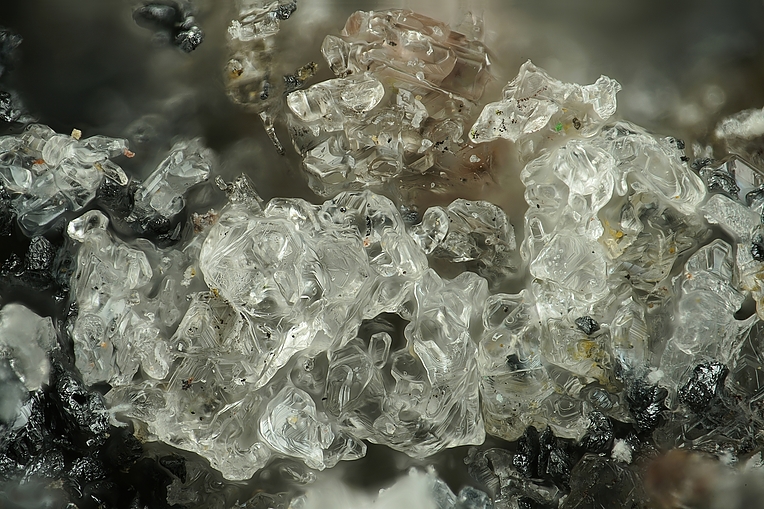
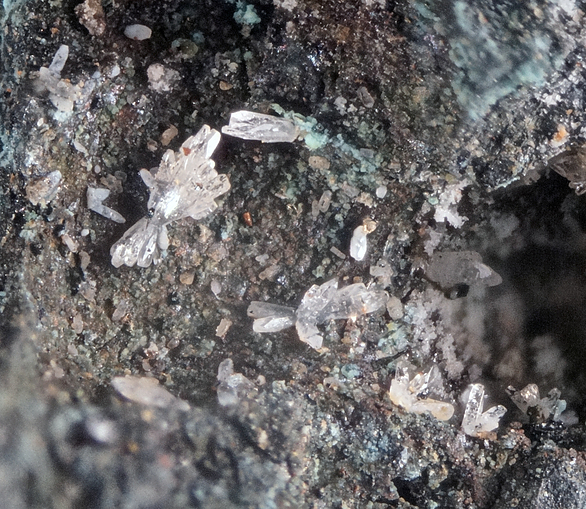
Crystals are microscopic micaceous plates {0001}, with hexagonal outlines.
Crystal Structure
Load
Unit Cell | Unit Cell Packed
2x2x2 | 3x3x3 | 4x4x4
Unit Cell | Unit Cell Packed
2x2x2 | 3x3x3 | 4x4x4
Show
Big Balls | Small Balls | Just Balls | Spacefill
Polyhedra Off | Si Polyhedra | All Polyhedra
Remove metal-metal sticks
Big Balls | Small Balls | Just Balls | Spacefill
Polyhedra Off | Si Polyhedra | All Polyhedra
Remove metal-metal sticks
Display Options
Black Background | White Background
Perspective On | Perspective Off
2D | Stereo | Red-Blue | Red-Cyan
Black Background | White Background
Perspective On | Perspective Off
2D | Stereo | Red-Blue | Red-Cyan
View
CIF File Best | x | y | z | a | b | c
CIF File Best | x | y | z | a | b | c
Rotation
Stop | Start
Stop | Start
Labels
Console Off | On | Grey | Yellow
Console Off | On | Grey | Yellow
Data courtesy of the American Mineralogist Crystal Structure Database. Click on an AMCSD ID to view structure
| ID | Species | Reference | Link | Year | Locality | Pressure (GPa) | Temp (K) |
|---|---|---|---|---|---|---|---|
| 0015320 | Palmierite | Tissot R G, Rodriguez M A, Sipola D L, Voigt J A (2001) X-ray powder diffraction study of synthetic palmierite, K2Pb(SO4)2 Powder Diffraction 16 92-97 | 2001 | synthetic | 0 | 293 |
CIF Raw Data - click here to close
X-Ray Powder Diffraction
Powder Diffraction Data:
| d-spacing | Intensity |
|---|---|
| 6.948 Å | (35) |
| 4.333 Å | (45) |
| 3.138 Å | (100) |
| 2.749 Å | (70) |
| 2.557 Å | (35) |
| 2.156 Å | (30) |
| 2.068 Å | (35) |
Geological Environment
Paragenetic Mode(s):
| Paragenetic Mode | Earliest Age (Ga) |
|---|---|
| Stage 7: Great Oxidation Event | <2.4 |
| 45a : [Sulfates, arsenates, selenates, antimonates] | |
| 47b : [Sulfates and sulfites] | |
| Stage 10b: Anthropogenic minerals | <10 Ka |
| 56 : Slag and smelter minerals (see also #51 and #55) |
Type Occurrence of Palmierite
General Appearance of Type Material:
As minute crytals, platy on {0001} with hexagonal outline
Place of Conservation of Type Material:
University of Naples, Naples, 17516; Natural History Museum, Paris, France, 107.476, 107.477; The Natural History Museum, London, England, 1927,1049.
Geological Setting of Type Material:
Volcanic fumaroles
Associated Minerals at Type Locality:
Arsenatnaya fumarole, Second scoria cone, Northern Breakthrough, Great Fissure eruption, Tolbachik Volcanic field, Milkovsky District, Kamchatka Krai, Russia