Log In


Aqualite
A valid IMA mineral species
This page is currently not sponsored. Click here to sponsor this page.



About Aqualite
Formula:
(H3O)8(Na,K,Sr)5Ca6Zr3Si26O66(OH)9Cl
Colour:
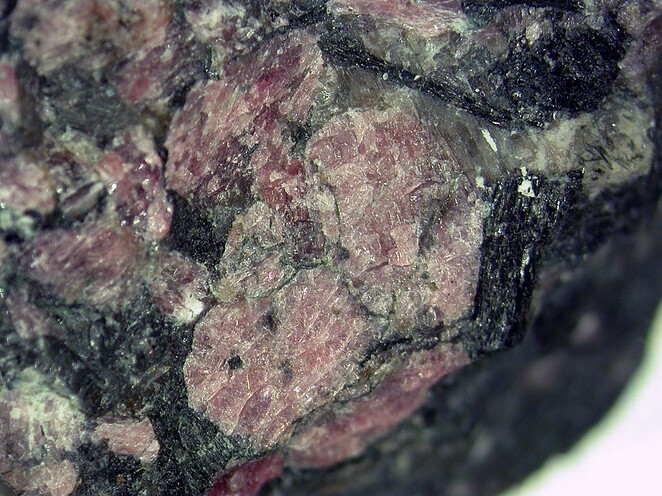
Pink
Lustre:
Vitreous
Hardness:
4 - 5
Specific Gravity:
2.58
Crystal System:
Trigonal
Member of:
Name:
The name alludes to its composition.
Unique Identifiers
Mindat ID:
27558
Long-form identifier:
mindat:1:1:27558:5
Similar Names
| Agalite | A synonym of Talc |
| Aglaite | A synonym of 'Cymatolite' |
| Agolite | A synonym of 'Agalmatolite' |
| Aqualite (of Reed) | A synonym of 'Indicolite' |
IMA Classification of Aqualite
Classification of Aqualite
9.CO.10
9 : SILICATES (Germanates)
C : Cyclosilicates
O : [Si9O27]18- 9-membered rings
9 : SILICATES (Germanates)
C : Cyclosilicates
O : [Si9O27]18- 9-membered rings
64.1.1.3
64 : CYCLOSILICATES Rings with Other Anions and Insular Silicate Groups
1 : Rings with Other Anions and Insular Silicate Groups with mixed ring types
64 : CYCLOSILICATES Rings with Other Anions and Insular Silicate Groups
1 : Rings with Other Anions and Insular Silicate Groups with mixed ring types
Mineral Symbols
As of 2021 there are now IMA–CNMNC approved mineral symbols (abbreviations) for each mineral species, useful for tables and diagrams.
| Symbol | Source | Reference for Standard |
|---|---|---|
| Aq | IMA–CNMNC | Warr, L.N. (2021). IMA–CNMNC approved mineral symbols. Mineralogical Magazine, 85(3), 291-320. doi:10.1180/mgm.2021.43 |
Pronunciation of Aqualite
Pronunciation:
| Play | Recorded by | Country |
|---|---|---|
| Jolyon Ralph | United Kingdom |
Physical Properties of Aqualite
Vitreous
Transparency:
Translucent
Colour:
Pink
Streak:
White
Hardness:
4 - 5 on Mohs scale
Tenacity:
Brittle
Fracture:
Conchoidal
Density:
2.58(2) g/cm3 (Measured) 2.66 g/cm3 (Calculated)
Optical Data of Aqualite
Type:
Uniaxial (+)
RI values:
nω = 1.569 nε = 1.571
Max. Birefringence:
δ = 0.002
Based on recorded range of RI values above.
Based on recorded range of RI values above.
Interference Colours:
The colours simulate birefringence patterns seen in thin section under crossed polars. They do not take into account mineral colouration or opacity.
Michel-Levy Bar The default colours simulate the birefringence range for a 30 µm thin-section thickness. Adjust the slider to simulate a different thickness.
Grain Simulation You can rotate the grain simulation to show how this range might look as you rotated a sample under crossed polars. Each grain retains its interference colour (retardation) while its brightness falls to black at extinction and reaches a maximum between extinction positions.
The colours simulate birefringence patterns seen in thin section under crossed polars. They do not take into account mineral colouration or opacity.
Michel-Levy Bar The default colours simulate the birefringence range for a 30 µm thin-section thickness. Adjust the slider to simulate a different thickness.
Grain Simulation You can rotate the grain simulation to show how this range might look as you rotated a sample under crossed polars. Each grain retains its interference colour (retardation) while its brightness falls to black at extinction and reaches a maximum between extinction positions.
Surface Relief:
Moderate (positive)
Relative to Canada balsam mounting medium (n ≈ 1.537).
Relative to Canada balsam mounting medium (n ≈ 1.537).
This shows the grain boundary and Becke line effect under plane-polarised
light, based on the contrast between this mineral's average refractive
index and the mounting medium. It does not take into account mineral
colouration.
In focus
Interference Figure:
This shows the idealized uniaxial interference figure - the conoscopic
(convergent-light, Bertrand-lens-in) view, for a grain cut with the optic axis
centred and vertical. The coloured rings are isochromatics, computed with the
same physics as the Michel-Lévy bar above; the dark cross is the isogyre.
For a genuinely uniaxial mineral viewed this way, that cross stays perfectly stationary if you rotate the stage - unlike a biaxial mineral, where it splits apart on rotation. That invariance is itself the standard diagnostic test for telling uniaxial and biaxial minerals apart at the microscope.
For a genuinely uniaxial mineral viewed this way, that cross stays perfectly stationary if you rotate the stage - unlike a biaxial mineral, where it splits apart on rotation. That invariance is itself the standard diagnostic test for telling uniaxial and biaxial minerals apart at the microscope.
Pleochroism:
Visible
Comments:
W= colorless to pink
E= pink
E= pink
Chemistry of Aqualite
Mindat Formula:
(H3O)8(Na,K,Sr)5Ca6Zr3Si26O66(OH)9Cl
Element Weights:
Crystallography of Aqualite
Crystal System:
Trigonal
Class (H-M):
3 - Pyramidal
Space Group:
R3
Cell Parameters:
a = 14.1435(4) Å, c = 31.410(1) Å
Ratio:
a:c = 1 : 2.221
Unit Cell V:
5,441.42 ų (Calculated from Unit Cell)
Z:
3
Morphology:
idiomorphic crystals to 3 cm in diameter
X-Ray Powder Diffraction
Powder Diffraction Data:
| d-spacing | Intensity |
|---|---|
| 11.43 Å | (39) |
| 10.50 Å | (44) |
| 7.06 Å | (42) |
| 6.63 Å | (43) |
| 4.39 Å | (100) |
| 3.624 Å | (41) |
| 2.987 Å | (100) |
| 2.850 Å | (79) |
Comments:
From Type Description.
Geological Environment
Paragenetic Mode(s):
| Paragenetic Mode | Earliest Age (Ga) |
|---|---|
| Stage 4b: Highly evolved igneous rocks | >3.0 |
| 35 : Ultra-alkali and agpaitic igneous rocks |
Type Occurrence of Aqualite
Place of Conservation of Type Material:
A.E.Fersman Mineralogical Museum, Russian Academy of Sciences, Moscow, Russia, catalog no. 2668/1.
Geological Setting of Type Material:
alkaline pegmatite
Associated Minerals at Type Locality:
Synonyms of Aqualite
Other Language Names for Aqualite
Relationship of Aqualite to other Species
Member of:
Other Members of Eudialyte Group:
| Alluaivite | Na19(Ca,Mn)6(Ti,Nb)3Si26O74Cl · 2H2O | Trig. 3m(32/m) : R3m |
| Amableite-(Ce) | Na15[(Ce1.5Na1.5)Mn3]Mn2Zr3◻Si[Si24O69(OH)3](OH)2 · H2O | Trig. 3 : R3 |
| Andrianovite | Na12(K,Sr,Ce)3Ca6Mn3Zr3Nb(Si25O73)(O,H2O,OH)5 | Trig. 3m : R3m |
| Carbokentbrooksite | (Na3Na3Na3Na3Na3)Ca6(VMn2+3)Zr3[Si3O9]2[Si9O27SiO][Si9O27Nb(OH)3](CO3)(H2O) | Trig. 3m : R3m |
| Davinciite | Na12K3Ca6Fe2+3Zr3(Si26O73OH)Cl2 | Trig. 3m : R3m |
| Dualite | Na30(Ca,Na,Ce,Sr)12(Na,Mn,Fe,Ti)6Zr3Ti3Mn[Si51O144](OH,H2O,Cl)9 | Trig. 3m : R3m |
| Eudialyte | Na15Ca6Fe3Zr3Si(Si25O73)(O,OH,H2O)3(Cl,OH)2 | Trig. 3m(32/m) : R3m |
| Feklichevite | Na11Ca9(Fe3+,Fe2+)2Zr3Nb[Si25O73](OH,H2O,Cl,O)5 | Trig. 3m : R3m |
| Fengchengite | Na12◻3(Ca,Sr)6Fe3+3 Zr3Si(Si25O73)(H2O,OH)3(OH,Cl)2 | Trig. 3m(32/m) : R3m |
| Ferrokentbrooksite | Na15Ca6(Fe,Mn)3Zr3NbSi25O73(O,OH,H2O)3Cl2 | Trig. 3m : R3m |
| Georgbarsanovite | Na12(Mn,Sr,REE)3Ca6Fe2+3Zr3NbSi25O76Cl2 · H2O | Trig. 3m : R3m |
| Golyshevite | Na10Ca3Ca6Zr3Fe2SiNb(Si3O9)2(Si9O27)2CO3(OH)3 · H2O | Trig. 3m : R3m |
| 'Hydrorastsvetaevite' | (Na11(H3O)11K6(H2O)1.5Sr)Ca12Fe3Na2MnZr6Si52O144(OH)4.5Cl3.5 | Trig. 3m : R3m |
| Ikranite | (Na,H3O)15(Ca,Mn2+)6Fe3+2Zr3[H0-3Si3O9)2(Si9O27)2SiO]Cl · 2-3H2O | Trig. 3m : R3m |
| Ilyukhinite | (H3O,Na)14Ca6Mn2Zr3Si26O72(OH)2 · 3H2O | Trig. 3m : R3m |
| Johnsenite-(Ce) | Na12(Ce2Ca)Ca6Mn3Zr3[Si3O9]2[Si9O27SiO][Si9O27W(O)3](CO3)(OH,Cl)2 | Trig. 3m : R3m |
| Kentbrooksite | (Na,REE)15(Ca,REE)6(Mn2+,Fe2+)3Zr3Nb[Si25O74]F2 · 2H2O | Trig. 3m : R3m |
| Khomyakovite | Na12Sr3Ca6Fe3Zr3W[Si25O73](O,OH,H2O)3(OH,Cl)2 | Trig. 3m : R3m |
| Labyrinthite | (Na,K,Sr)35Ca12Fe3Zr6TiSi51O144(O,OH,H2O)9Cl3 | Trig. 3 : R3 |
| Manganoeudialyte | Na14Ca6Mn3Zr3[Si26O72(OH)2](H2O,Cl,O,OH)6 | Trig. 3m : R3m |
| Manganokhomyakovite | Na12Sr3Ca6Mn3Zr3W[Si25O73](O,OH,H2O)3(OH,Cl)2 | Trig. 3m : R3m |
| Mogovidite | Na9(Ca,Na)12Fe2Zr3Si25O72(CO3) (OH)4 | Trig. 3m : R3m |
| Odikhinchaite | Na9Sr3[(H2O)2Na]Ca6Mn3Zr3NbSi (Si24O72)O(OH)3(CO3) · H2O | Trig. 3m : R3m |
| Oneillite | Na15Ca3Mn3Fe2+3Zr3Nb(Si25O73)(O,OH,H2O)3(OH,Cl)2 | Trig. 3 : R3 |
| Raslakite | Na15Ca3Fe2+3(Na,Zr)3Zr3(Si,Nb)[(Si3O9)2(Si9O27)2SiO](OH,H2O)3(Cl,OH) | Trig. 3 : R3 |
| Rastsvetaevite | Na27K8Ca12Fe3Zr6Si52O144(O,OH,H2O)6Cl2 | Trig. 3m : R3m |
| Selsurtite | (H3O)12Na3(Ca3Mn3)(Na2Fe)Zr3◻{Si(Si3O9)2(Si9O27)Si9O24(OH)3}(OH)Cl(H2O) | Trig. 3 : R3 |
| Sergevanite | Na15(Ca3Mn3)(Na2Fe)Zr3Si26O72(OH)3 · H2O | Trig. 3 : R3 |
| Siudaite | Na8(Mn2+2Na)Ca6(Fe3+,Mn2+)3Zr3NbSi24(Si,◻,Ti)O74(OH)2Cl · 5H2O | Trig. 3m : R3m |
Kovdor Phlogopite mine, Kovdor Massif, Kovdorsky District, Murmansk Oblast, Russia