Log In


Moissanite
A valid IMA mineral species - grandfathered
This page is currently not sponsored. Click here to sponsor this page.


About Moissanite

Portrait of Henri Moissan
Formula:
SiC
Colour:
Green, black, blue, colourless, green yellow, yellow
Lustre:
Vitreous
Hardness:
9½
Specific Gravity:
3.218 - 3.22
Crystal System:
Hexagonal
Name:
Named in 1905 after Ferdinand Frederick Henri Moissan (28 September 1852 – 20 February 1907), a French chemist who, after years of research of high-temperature methods and furnaces for the production of carbides and synthetic diamonds, discovered the natural occurrence in the Canyon Diablo meteorite.
Moissan was the first to isolate elemental fluorine and received the 1906 Nobel Prize in Chemistry for that.
Moissan was the first to isolate elemental fluorine and received the 1906 Nobel Prize in Chemistry for that.
Dimorph of:
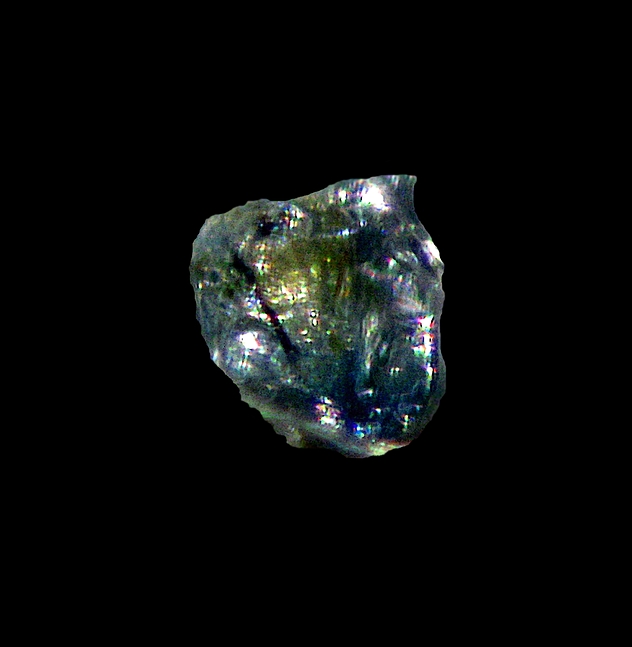
Moissanite, found as tiny crystals in some meteorites (originally formed in star dust) and kimberlites, is a naturally occurring silicon carbide, SiC (in synthetic form a very important high-performance ceramic, more commonly known as abrasive "carborundum").
A large number of polytypes (predominantly hexagonal or rhombohedral) is known.
Most of the natural moissanite grains are 6H and 15R polytypes (Shiryaev et al., 2011).
An unusual example of rock-forming moissanite, also of kimberlitic origin, is known from Turkey (Di Pierro et al., 2003).
Compare 'UM1982-06-C:Si'.
 Visit gemdat.org for gemological information about Moissanite.
A large number of polytypes (predominantly hexagonal or rhombohedral) is known.
Most of the natural moissanite grains are 6H and 15R polytypes (Shiryaev et al., 2011).
An unusual example of rock-forming moissanite, also of kimberlitic origin, is known from Turkey (Di Pierro et al., 2003).
Compare 'UM1982-06-C:Si'.
Visit gemdat.org for gemological information about Moissanite.Unique Identifiers
Mindat ID:
2743
Long-form identifier:
mindat:1:1:2743:0
Similar Names
| Misenite | A valid IMA mineral species - grandfathered | K8H6(SO4)7 |
| β-Moissanite | A synonym of 'Moissanite-3C' |
IMA Classification of Moissanite
Approved, 'Grandfathered' (first described prior to 1959)
IMA Formula:
Si4+C4-
First published:
1905
Classification of Moissanite
1.DA.
1 : ELEMENTS (Metals and intermetallic alloys; metalloids and nonmetals; carbides, silicides, nitrides, phosphides)
D : Nonmetallic Carbides and Nitrides
A : Nonmetallic carbides
1 : ELEMENTS (Metals and intermetallic alloys; metalloids and nonmetals; carbides, silicides, nitrides, phosphides)
D : Nonmetallic Carbides and Nitrides
A : Nonmetallic carbides
Dana 7th ed.:
1.3.7.1
1.3.8.1
1 : NATIVE ELEMENTS AND ALLOYS
3 : Semi-metals and non-metals
1 : NATIVE ELEMENTS AND ALLOYS
3 : Semi-metals and non-metals
2.1
2 : Carbides, Nitrides, Silicides and Phosphides
2 : Carbides, Nitrides, Silicides and Phosphides
Mineral Symbols
As of 2021 there are now IMA–CNMNC approved mineral symbols (abbreviations) for each mineral species, useful for tables and diagrams.
| Symbol | Source | Reference for Standard |
|---|---|---|
| Moi | IMA–CNMNC | Warr, L.N. (2021). IMA–CNMNC approved mineral symbols. Mineralogical Magazine, 85(3), 291-320. doi:10.1180/mgm.2021.43 |
Physical Properties of Moissanite
Vitreous
Transparency:
Transparent
Colour:
Green, black, blue, colourless, green yellow, yellow
Streak:
Greenish grey
Hardness:
9½ on Mohs scale
Cleavage:
Poor/Indistinct
{0001} Indistinct
{0001} Indistinct
Fracture:
Conchoidal
Density:
3.218 - 3.22 g/cm3 (Measured)
Comment:
3.218 - 3.22, Average = 3.21
Optical Data of Moissanite
Type:
Uniaxial (+)
RI values:
nω = 2.616 - 2.757 nε = 2.654 - 2.812
Birefringence:
0.2-0.3
Max. Birefringence:
δ = 0.038 - 0.055
Based on recorded range of RI values above.
Based on recorded range of RI values above.
Interference Colours:
The colours simulate birefringence patterns seen in thin section under crossed polars. They do not take into account mineral colouration or opacity.
Michel-Levy Bar The default colours simulate the birefringence range for a 30 µm thin-section thickness. Adjust the slider to simulate a different thickness.
Grain Simulation You can rotate the grain simulation to show how this range might look as you rotated a sample under crossed polars. Each grain retains its interference colour (retardation) while its brightness falls to black at extinction and reaches a maximum between extinction positions.
The colours simulate birefringence patterns seen in thin section under crossed polars. They do not take into account mineral colouration or opacity.
Michel-Levy Bar The default colours simulate the birefringence range for a 30 µm thin-section thickness. Adjust the slider to simulate a different thickness.
Grain Simulation You can rotate the grain simulation to show how this range might look as you rotated a sample under crossed polars. Each grain retains its interference colour (retardation) while its brightness falls to black at extinction and reaches a maximum between extinction positions.
Surface Relief:
Very High (positive)
Relative to Canada balsam mounting medium (n ≈ 1.537).
Relative to Canada balsam mounting medium (n ≈ 1.537).
This shows the grain boundary and Becke line effect under plane-polarised
light, based on the contrast between this mineral's average refractive
index and the mounting medium. It does not take into account mineral
colouration.
In focus
Interference Figure:
This shows the idealized uniaxial interference figure - the conoscopic
(convergent-light, Bertrand-lens-in) view, for a grain cut with the optic axis
centred and vertical. The coloured rings are isochromatics, computed with the
same physics as the Michel-Lévy bar above; the dark cross is the isogyre.
For a genuinely uniaxial mineral viewed this way, that cross stays perfectly stationary if you rotate the stage - unlike a biaxial mineral, where it splits apart on rotation. That invariance is itself the standard diagnostic test for telling uniaxial and biaxial minerals apart at the microscope.
For a genuinely uniaxial mineral viewed this way, that cross stays perfectly stationary if you rotate the stage - unlike a biaxial mineral, where it splits apart on rotation. That invariance is itself the standard diagnostic test for telling uniaxial and biaxial minerals apart at the microscope.
Colour in reflected light:
Pale grey
Pleochroism:
Weak
Comments:
Pale blue to paler blue
Chemistry of Moissanite
Mindat Formula:
SiC
Elements listed:
Crystallography of Moissanite
Polytype:
Formula:
Crystal System:
Class (H-M)
Space Group:
Space Group Setting:
Cell Parameters:
Ratio:
Unit Cell Volume (calc):
Z:
Comment:
| Moissanite-10R | Moissanite-15R | Moissanite-2H | Moissanite-33R | Moissanite-3C | Moissanite-4H | Moissanite-5H | Moissanite-6H |
|---|---|---|---|---|---|---|---|
| SiC | SiC | SiC | SiC | SiC | SiC | SiC | SiC |
| Trigonal | Hexagonal | ||||||
| 3m - Ditrigonal Pyramidal | 6mm - Dihexagonal Pyramidal | ||||||
| R3m | P63mc | ||||||
| P63mc | |||||||
| a = 3.08 Å, c = 37.85 Å | a = 3.073 Å, c = 15.08 Å | ||||||
| a:c = 1 : 12.289 | a:c = 1 : 4.907 | ||||||
| V 310.96 ų (Calculated from Unit Cell) | V 123.33 ų (Calculated from Unit Cell) | ||||||
| 6 | |||||||
Crystal Structure
Load
Unit Cell | Unit Cell Packed
2x2x2 | 3x3x3 | 4x4x4
Unit Cell | Unit Cell Packed
2x2x2 | 3x3x3 | 4x4x4
Show
Big Balls | Small Balls | Just Balls | Spacefill
Polyhedra Off | Si Polyhedra | All Polyhedra
Remove metal-metal sticks
Big Balls | Small Balls | Just Balls | Spacefill
Polyhedra Off | Si Polyhedra | All Polyhedra
Remove metal-metal sticks
Display Options
Black Background | White Background
Perspective On | Perspective Off
2D | Stereo | Red-Blue | Red-Cyan
Black Background | White Background
Perspective On | Perspective Off
2D | Stereo | Red-Blue | Red-Cyan
View
CIF File Best | x | y | z | a | b | c
CIF File Best | x | y | z | a | b | c
Rotation
Stop | Start
Stop | Start
Labels
Console Off | On | Grey | Yellow
Console Off | On | Grey | Yellow
Data courtesy of the American Mineralogist Crystal Structure Database. Click on an AMCSD ID to view structure
| ID | Species | Reference | Link | Year | Locality | Pressure (GPa) | Temp (K) |
|---|---|---|---|---|---|---|---|
| 0004279 | Moissanite | Capitani G C, Di Pierro S, Tempesta G (2007) The 6H-SiC structure model: Further refinement from SCXRD data from a terrestrial moissanite American Mineralogist 92 403-407 |  | 2007 | 150 km NW from Izmir, Turkey | 0 | 293 |
| 0015175 | Moissanite | Xu Y N, Ching W Y (1993) Electronic, optical, and structural properties of some wurtzite crystals Physical Review B48 4335-4351 | 1993 | 0 | 293 | ||
| 0011553 | Moissanite | Wyckoff R W G (1963) Second edition. Interscience Publishers, New York, New York Crystal Structures 1 85-237 | 1963 | 0 | 293 | ||
| 0017910 | Moissanite | Braekken H (1930) Zur Kristallstruktur des kubischen Karborunds _cod_database_code 1010995 Zeitschrift fur Kristallographie 75 572-573 | 1930 | 0 | 293 | ||
| 0017954 | Moissanite | Ott H (1925) Die Gitterstruktur des Karborunds ( Si C ) I. _cod_database_code 1011053 Zeitschrift fur Kristallographie 61 515-531 | 1925 | 0 | 293 | ||
| 0017937 | Moissanite | Burdick C, Owen E (1918) The Atomic Structure of Carborundum Determined by X-Rays _cod_database_code 1011031 Journal of the American Chemical Society 40 1749-1759 | 1918 | 0 | 293 |
CIF Raw Data - click here to close
X-Ray Powder Diffraction
Powder Diffraction Data:
| d-spacing | Intensity |
|---|---|
| - Å | () |
Comments:
X-ray powder diffraction data are given on the polytype pages.
Geological Environment
Paragenetic Mode(s):
| Paragenetic Mode | Earliest Age (Ga) |
|---|---|
| Pre-terrestrial "Ur-minerals" | >4.57 |
| 1 : Stellar atmosphere condensates | |
| Stage 3a: Earth’s earliest Hadean crust | >4.50 |
| 7 : Ultramafic igneous rocks | |
| Near-surface Processes | |
| 26 : Hadean detrital minerals | |
| 29 : Lightning-generated minerals | |
| Stage 4b: Highly evolved igneous rocks | >3.0 |
| 35 : Ultra-alkali and agpaitic igneous rocks | |
| 36 : Carbonatites, kimberlites, and related igneous rocks | |
| Stage 5: Initiation of plate tectonics | <3.5-2.5 |
| 38 : Ophiolites | |
| 39 : High-𝑃 metamorphism (blueschist, eclogite, ultrahigh 𝑃 facies) |
Type Occurrence of Moissanite
General Appearance of Type Material:
Green hexagonal crystals, isolated by dissolving iron in HCl.
Geological Setting of Type Material:
Iron meteroite
Synonyms of Moissanite
Other Language Names for Moissanite
Dutch:Moissaniet
Italian:Moissanite
Portuguese:Moissanite
Russian:Муассанит
Simplified Chinese:莫桑石
Spanish:Moissanita
Muassanita
Muassanita
Traditional Chinese:碳矽石
Common Associates
Associations Based on Photo Data:
Other Information
Notes:
Concentrated sulfuric, nitric, and hydrochloric acids do not decompose it at their boiling point. Attacked by molten lead chromate. Does not burn in oxygen at 1000 C.
Health Risks:
No information on health risks for this material has been entered into the database. You should always treat mineral specimens with care.
Industrial Uses:
Natural moissanite is too rare to be exploited, but synthetic silicon carbide is produdced as an abrasive, and synthetic moissanite crystals are grown to use as a gemstone and diamond simulant.
Internet Links for Moissanite
mindat.org URL:
https://www.mindat.org/min-2743.html
Please feel free to link to this page.
Please feel free to link to this page.
Search Engines:
External Links:
Mineral Dealers:
References for Moissanite
Reference List:
Bauer, J., Fiala, J., Hrichova, R. (1963) Natural α-silicon carbide. American Mineralogist, 48 (5-6) 620-634
Bauer, Ya., Fiala, Yu., Grzhikhova, R. (1965) Moissanite from middle mountains of Czechoslovakia. International Geology Review, 7 (7) 1194-1206 doi:10.1080/00206816509474771
Shaffer, P. T. B. (1969) A review of the structure of silicon carbide. Acta Crystallographica Section B Structural Crystallography and Crystal Chemistry, 25 (3) 477-488 doi:10.1107/s0567740869002457
Hannam, A. L., Shaffer, P. T. B. (1969) Revised X-ray diffraction line intensities for silicon carbide polytypes. Journal of Applied Crystallography, 2 (2) 45-48 doi:10.1107/s0021889869006510
Gibbon, D. L. (1971) Electron diffraction effects in silicon carbide. I. Pure polytypes. II. whiskers. Journal of Applied Crystallography, 4 (2) 95-103 doi:10.1107/s0021889871006435
Fleischer, Michael, Pabst, Adolf, Cabri, Louis J. (1976) New Mineral Names. American Mineralogist, 61 (9-10) 1053-1056 p.1054
Lyakhovich, V. V. (1980) Origin of accessory moissanite. International Geology Review, 22 (8) 961-970 doi:10.1080/00206818209466961
Ming, Tang, Anders, Edward, Hoppe, Peter, Zinner, Ernst (1989) Meteoritic silicon carbide and its stellar sources; implications for galactic chemical evolution. Nature, 339 (6223). 351-354 doi:10.1038/339351a0
Zinner, Ernst, Ming, Tang, Anders, Edward (1989) Interstellar SiC in the Murchison and Murray meteorites: Isotopic composition of Ne, Xe, Si, C, and N. Geochimica et Cosmochimica Acta, 53 (12) 3273-3290 doi:10.1016/0016-7037(89)90107-5
Leung, Irene, Guo, Wenxiang, Friedman, Irving, Gleason, Jim (1990) Natural occurrence of silicon carbide in a diamondiferous kimberlite from Fuxian. Nature, 346 (6282). 352-354 doi:10.1038/346352a0
Daulton, T. L. (2002) Polytype Distribution in Circumstellar Silicon Carbide. Science, 296 (5574). 1852-1855 doi:10.1126/science.1071136
Di Pierro, Simonpietro, Gnos, Edwin, Grobety, Bernard H., Armbruster, Thomas, Bernasconi, Stefano M., Ulmer, Peter (2003) Rock-forming moissanite (natural α-silicon carbide) American Mineralogist, 88 (11) 1817-1821 doi:10.2138/am-2003-11-1223
Puchezh-Katun astrobleme, Nizhny Novgorod, Nizhny Novgorod Oblast, Russia