Log In


Herbertsmithite
A valid IMA mineral species
This page is currently not sponsored. Click here to sponsor this page.




About Herbertsmithite
Formula:
Cu3Zn(OH)6Cl2
Colour:
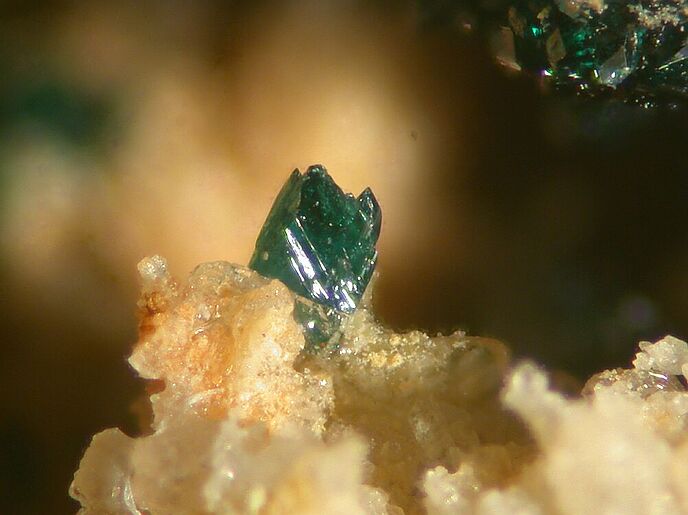
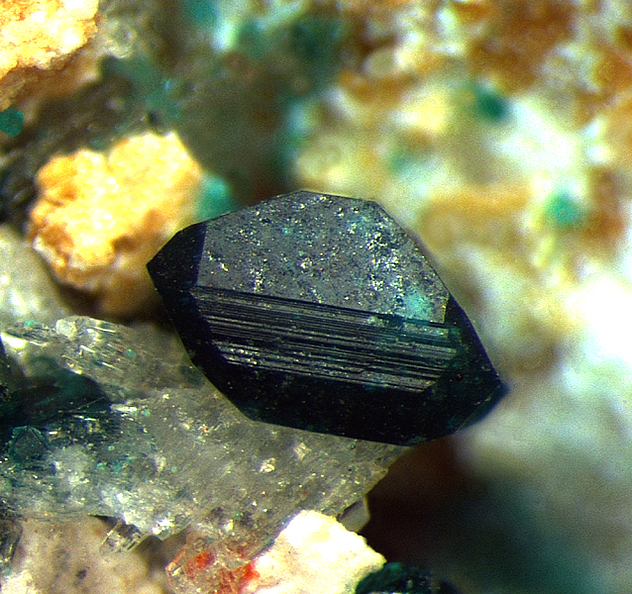
light green, blue-green, emerald green
Lustre:
Vitreous
Hardness:
3 - 3½
Specific Gravity:
3.85 - 3.95
Crystal System:
Trigonal
Member of:
Name:
Named in honor of George Frederick Herbert Smith (26 May 1872, Edgbaston, England, UK - 20 April 1953), crystallographer and curator, British Museum of Natural History, London (England), who discovered the similar mineral paratacamite. The mineral smithite is also named after him.
Type Locality:
Dimorph of:
Isostructural with:
Atacamite Group.
A polymorph of (metastable) kapellasite.
Closely related to paratacamite and easily confused with twinned clinoatacamite.
On heating paratacamite reversibly transforms into herbertsmithite between 353K and 393K (Welch et al., 2014).
The Zn analogue of gillardite and leverettite.
This mineral gained attention in March 2007 when it was reported that it has very specific and unusual physical properties that make it behave as a new type of matter (see references).
A polymorph of (metastable) kapellasite.
Closely related to paratacamite and easily confused with twinned clinoatacamite.
On heating paratacamite reversibly transforms into herbertsmithite between 353K and 393K (Welch et al., 2014).
The Zn analogue of gillardite and leverettite.
This mineral gained attention in March 2007 when it was reported that it has very specific and unusual physical properties that make it behave as a new type of matter (see references).
Unique Identifiers
Mindat ID:
26600
Long-form identifier:
mindat:1:1:26600:0
IMA Classification of Herbertsmithite
Classification of Herbertsmithite
3.DA.10c
3 : HALIDES
D : Oxyhalides, hydroxyhalides and related double halides
A : With Cu, etc., without Pb
3 : HALIDES
D : Oxyhalides, hydroxyhalides and related double halides
A : With Cu, etc., without Pb
Mineral Symbols
As of 2021 there are now IMA–CNMNC approved mineral symbols (abbreviations) for each mineral species, useful for tables and diagrams.
| Symbol | Source | Reference for Standard |
|---|---|---|
| Her | IMA–CNMNC | Warr, L.N. (2021). IMA–CNMNC approved mineral symbols. Mineralogical Magazine, 85(3), 291-320. doi:10.1180/mgm.2021.43 |
Pronunciation of Herbertsmithite
Pronunciation:
| Play | Recorded by | Country |
|---|---|---|
| Jolyon Ralph | United Kingdom |
Physical Properties of Herbertsmithite
Vitreous
Transparency:
Transparent
Colour:
Light green, blue-green, emerald green
Streak:
Light green
Hardness:
3 - 3½ on Mohs scale
Tenacity:
Brittle
Cleavage:
Distinct/Good
on {10_11}
on {10_11}
Density:
3.85 - 3.95 g/cm3 (Measured) 3.76 g/cm3 (Calculated)
Optical Data of Herbertsmithite
Type:
Uniaxial (-)
RI values:
nω = 1.825 - 1.849 nε = 1.815 - 1.842
Max. Birefringence:
δ = 0.007 - 0.010
Based on recorded range of RI values above.
Based on recorded range of RI values above.
Interference Colours:
The colours simulate birefringence patterns seen in thin section under crossed polars. They do not take into account mineral colouration or opacity.
Michel-Levy Bar The default colours simulate the birefringence range for a 30 µm thin-section thickness. Adjust the slider to simulate a different thickness.
Grain Simulation You can rotate the grain simulation to show how this range might look as you rotated a sample under crossed polars. Each grain retains its interference colour (retardation) while its brightness falls to black at extinction and reaches a maximum between extinction positions.
The colours simulate birefringence patterns seen in thin section under crossed polars. They do not take into account mineral colouration or opacity.
Michel-Levy Bar The default colours simulate the birefringence range for a 30 µm thin-section thickness. Adjust the slider to simulate a different thickness.
Grain Simulation You can rotate the grain simulation to show how this range might look as you rotated a sample under crossed polars. Each grain retains its interference colour (retardation) while its brightness falls to black at extinction and reaches a maximum between extinction positions.
Surface Relief:
Very High (positive)
Relative to Canada balsam mounting medium (n ≈ 1.537).
Relative to Canada balsam mounting medium (n ≈ 1.537).
This shows the grain boundary and Becke line effect under plane-polarised
light, based on the contrast between this mineral's average refractive
index and the mounting medium. It does not take into account mineral
colouration.
In focus
Interference Figure:
This shows the idealized uniaxial interference figure - the conoscopic
(convergent-light, Bertrand-lens-in) view, for a grain cut with the optic axis
centred and vertical. The coloured rings are isochromatics, computed with the
same physics as the Michel-Lévy bar above; the dark cross is the isogyre.
For a genuinely uniaxial mineral viewed this way, that cross stays perfectly stationary if you rotate the stage - unlike a biaxial mineral, where it splits apart on rotation. That invariance is itself the standard diagnostic test for telling uniaxial and biaxial minerals apart at the microscope.
For a genuinely uniaxial mineral viewed this way, that cross stays perfectly stationary if you rotate the stage - unlike a biaxial mineral, where it splits apart on rotation. That invariance is itself the standard diagnostic test for telling uniaxial and biaxial minerals apart at the microscope.
Pleochroism:
Weak
Comments:
O > E; green to greenish blue
Comments:
Indices gradually increase with increasing Cu/Zn.
Anomalous birefringence in greenish-blue to dark blue.
Anomalous birefringence in greenish-blue to dark blue.
Chemistry of Herbertsmithite
Mindat Formula:
Cu3Zn(OH)6Cl2
Element Weights:
Crystallography of Herbertsmithite
Crystal System:
Trigonal
Class (H-M):
3m(32/m) - Hexagonal Scalenohedral
Space Group:
R3m
Cell Parameters:
a = 6.834 Å, c = 14.075 Å
Ratio:
a:c = 1 : 2.06
Unit Cell V:
569.28 ų
Z:
3
Morphology:
Platy, pseudohexagonal crystals to 0.5 mm (Iran); rhombohedrons and pseudo-octahedra to 1.5 mm (Chile).
Crystal Structure
Load
Unit Cell | Unit Cell Packed
2x2x2 | 3x3x3 | 4x4x4
Unit Cell | Unit Cell Packed
2x2x2 | 3x3x3 | 4x4x4
Show
Big Balls | Small Balls | Just Balls | Spacefill
Polyhedra Off | Si Polyhedra | All Polyhedra
Remove metal-metal sticks
Big Balls | Small Balls | Just Balls | Spacefill
Polyhedra Off | Si Polyhedra | All Polyhedra
Remove metal-metal sticks
Display Options
Black Background | White Background
Perspective On | Perspective Off
2D | Stereo | Red-Blue | Red-Cyan
Black Background | White Background
Perspective On | Perspective Off
2D | Stereo | Red-Blue | Red-Cyan
View
CIF File Best | x | y | z | a | b | c
CIF File Best | x | y | z | a | b | c
Rotation
Stop | Start
Stop | Start
Labels
Console Off | On | Grey | Yellow
Console Off | On | Grey | Yellow
Data courtesy of the American Mineralogist Crystal Structure Database. Click on an AMCSD ID to view structure
| ID | Species | Reference | Link | Year | Locality | Pressure (GPa) | Temp (K) |
|---|---|---|---|---|---|---|---|
| 0014574 | Herbertsmithite | Braithwaite R S W, Mereiter K, Paar W H, Clark A M (2004) Herbertsmithite, Cu3Zn(OH)6Cl2, a new species and the definition of paratacamite Mineralogical Magazine 68 527-539 |  | 2004 | Mina Los Tres Presidentes, Sierra Gorda, Chile | 0 | 293 |
CIF Raw Data - click here to close
X-Ray Powder Diffraction
Powder Diffraction Data:
| d-spacing | Intensity |
|---|---|
| 5.466 Å | (55) |
| 4.702 Å | (14) |
| 2.899 Å | (11) |
| 2.764 Å | (100) |
| 2.730 Å | (13) |
| 2.266 Å | (36) |
| 1.820 Å | (13) |
| 1.709 Å | (18) |
Comments:
XRD pattern quite similar to those for atacamite, clinoatacamite and paratacamite, but herbertsmithite is readily distinguished from these by infrared spectroscopy and SXRD
Geological Environment
Paragenetic Mode(s):
| Paragenetic Mode | Earliest Age (Ga) |
|---|---|
| Stage 7: Great Oxidation Event | <2.4 |
| 47a : [Near-surface hydration of prior minerals] | |
| 47g : [Halogen-bearing surface weathering minerals] | |
| Stage 10a: Neoproterozoic oxygenation/terrestrial biosphere | <0.6 |
| 50 : Coal and/or oil shale minerals | <0.36 |
Geological Setting:
Copper mineralizations in syenitic porphyries and granites, hosted by triassic dolomites (Anarak, Iran)
Type Occurrence of Herbertsmithite
General Appearance of Type Material:
Rhombohedrons to 1.5 mm across.
Place of Conservation of Type Material:
Natural History Museum, London, United Kingdom, number BM 2003.33.
Synonyms of Herbertsmithite
Other Language Names for Herbertsmithite
Dutch:Herbertsmithiet
German:Herbertsmithit
Anarakit
Anarakit
Italian:Herbertsmithite
Simplified Chinese:氯羟锌铜石
Spanish:Herbertsmithita
Traditional Chinese:氯羥鋅銅石
Relationship of Herbertsmithite to other Species
Member of:
Other Members of Atacamite Group:
| Atacamite | Cu2(OH)3Cl | Orth. mmm(2/m2/m2/m) : Pnma |
| Botallackite | Cu2(OH)3Cl | Mon. 2/m : P21/m |
| Clinoatacamite | Cu2(OH)3Cl | Mon. 2/m : P21/c |
| Gillardite | Cu3Ni(OH)6Cl2 | Trig. 3m(32/m) : R3m |
| Haydeeite | Cu3Mg(OH)6Cl2 | Trig. 3m(32/m) : P3m1 |
| Hibbingite | Fe2+2(OH)3Cl | Orth. mmm(2/m2/m2/m) : Pnma |
| Iyoite | MnCuCl(OH)3 | Mon. 2/m : P21/m |
| Kapellasite | Cu3Zn(OH)6Cl2 | Trig. 3m(32/m) : P3m1 |
| Kempite | Mn2+2(OH)3Cl | Orth. mmm(2/m2/m2/m) : Pnma |
| Kuliginite | Fe3Mg(OH)6Cl2 | Trig. 3 : R3 |
| Leverettite | Cu3Co(OH)6Cl2 | Trig. 3 : R3 |
| Misakiite | Cu3Mn(OH)6Cl2 | Trig. 3m(32/m) : P3m1 |
| Paratacamite | Cu3(Cu,Zn)(OH)6Cl2 | Trig. 3 : R3 |
| Paratacamite-(Mg) | Cu3(Mg,Cu)(OH)6Cl2 | Trig. 3 : R3 |
| Paratacamite-(Ni) | Cu3(Ni,Cu)(OH)6Cl2 | Trig. 3 : R3 |
| Tondiite | Cu3Mg(OH)6Cl2 | Trig. 3m(32/m) : R3m |
| 'Unnamed (Cu-Zn Chloride Hydroxide)' | CuZnCl(OH)3 | Mon. 2/m : P21/m |
Common Associates
Associations Based on Photo Data:
| 30 photos of Herbertsmithite associated with Wulfenite | Pb(MoO4) |
| 22 photos of Herbertsmithite associated with Gordaite | NaZn4(SO4)(OH)6Cl · 6H2O |
| 12 photos of Herbertsmithite associated with Christelite | Cu2Zn3(SO4)2(OH)6 · 4H2O |
| 8 photos of Herbertsmithite associated with Quartz | SiO2 |
| 7 photos of Herbertsmithite associated with Linarite | PbCu(SO4)(OH)2 |
| 7 photos of Herbertsmithite associated with Malachite | Cu2(CO3)(OH)2 |
| 7 photos of Herbertsmithite associated with Chrysocolla | Cu2-xAlx(H2-xSi2O5)(OH)4 · nH2O, x < 1 |
| 7 photos of Herbertsmithite associated with Coronadite | Pb(Mn4+6Mn3+2)O16 |
| 7 photos of Herbertsmithite associated with Cerussite | PbCO3 |
| 5 photos of Herbertsmithite associated with Paratacamite | Cu3(Cu,Zn)(OH)6Cl2 |
Related Minerals - Strunz-mindat Grouping
| 3.DA. | Parahibbingite | Fe2(OH)3Cl |
| 3.DA. | Centennialite | CaCu3Cl2(OH)6 · nH2O (n ~ 0.7) |
| 3.DA. | Bounahasite | Cu+Cu2+2(OH)3Cl2 |
| 3.DA. | Muonionalustaite | Ni3(OH)4Cl2 · 4H2O |
| 3.DA.05 | Melanothallite | Cu2Cl2O |
| 3.DA.10c | Haydeeite | Cu3Mg(OH)6Cl2 |
| 3.DA.10b | Clinoatacamite | Cu2(OH)3Cl |
| 3.DA.10c | Paratacamite | Cu3(Cu,Zn)(OH)6Cl2 |
| 3.DA.10c | Kapellasite | Cu3Zn(OH)6Cl2 |
| 3.DA.10c | Leverettite | Cu3Co(OH)6Cl2 |
| 3.DA.10a | Hibbingite | Fe2+2(OH)3Cl |
| 3.DA.10c | Paratacamite-(Ni) | Cu3(Ni,Cu)(OH)6Cl2 |
| 3.DA.10a | Kempite | Mn2+2(OH)3Cl |
| 3.DA.10c | Tondiite | Cu3Mg(OH)6Cl2 |
| 3.DA.10a | Atacamite | Cu2(OH)3Cl |
| 3.DA.10b | Belloite | Cu(OH)Cl |
| 3.DA.10c | Misakiite | Cu3Mn(OH)6Cl2 |
| 3.DA.10b | Iyoite | MnCuCl(OH)3 |
| 3.DA.10c | Kuliginite | Fe3Mg(OH)6Cl2 |
| 3.DA.10c | Gillardite | Cu3Ni(OH)6Cl2 |
| 3.DA.10b | 'Unnamed (Cu-Zn Chloride Hydroxide)' | CuZnCl(OH)3 |
| 3.DA.10b | Botallackite | Cu2(OH)3Cl |
| 3.DA.15 | Claringbullite | Cu4ClF(OH)6 |
| 3.DA.15 | Barlowite | Cu4BrF(OH)6 |
| 3.DA.20 | Simonkolleite | Zn5Cl2(OH)8 · H2O |
| 3.DA.25 | Buttgenbachite | Cu19(NO3)2(OH)32Cl4 · 2H2O |
| 3.DA.25 | Connellite | Cu19(SO4)(OH)32Cl4 · 3H2O |
| 3.DA.30 | Abhurite | Sn21Cl16(OH)14O6 |
| 3.DA.35 | Ponomarevite | K4Cu4Cl10O |
| 3.DA.40 | Calumetite | CaCu4(OH)8Cl2 · 3.5H2O |
| 3.DA.40 | Anthonyite | Cu(OH,Cl)2 · 3H2O |
| 3.DA.45 | Khaidarkanite | Cu4Al3(OH)14F3 · 2H2O |
| 3.DA.50 | Bobkingite | Cu5Cl2(OH)8 · 2H2O |
| 3.DA.55 | Avdoninite | K2Cu5(OH)4Cl8 · H2O |
| 3.DA.60 | Droninoite | Ni6Fe3+2(OH)16Cl2 · 4H2O |
| 3.DA.70 | Chrysothallite | K6Cu6Tl3+Cl17(OH)4 · H2O |
| 3.DA.70 | Dioskouriite | CaCu4Cl6(OH)4 · 4H2O |
| 3.DA.75 | Feodosiyite | Cu11Mg2Cl18(OH)8 · 16H2O |
| 3.DA.80 | Romanorlovite | K8Cu6Cl17(OH)3 |
Fluorescence of Herbertsmithite
none
Other Information
Health Risks:
No information on health risks for this material has been entered into the database. You should always treat mineral specimens with care.
Internet Links for Herbertsmithite
mindat.org URL:
https://www.mindat.org/min-26600.html
Please feel free to link to this page.
Please feel free to link to this page.
Search Engines:
External Links:
Mineral Dealers:
References for Herbertsmithite
Reference List:
Braithwaite, R. S. W., Mereiter, K., Paar, W. H., Clark, A. M. (2004) Herbertsmithite, Cu3Zn(OH)6Cl2, a new species, and the definition of paratacamite. Mineralogical Magazine, 68 (3) 527-539 doi:10.1180/0026461046830204
Mandarino, Joseph A. (2004) New minerals. The Canadian Mineralogist, 42 (6) 1901-1927 doi:10.2113/gscanmin.42.6.1901
Helton, J. S.; Matan, K.; Shores, M. P.; Nytko, E. A.; Bartlett, B. M.; Yoshida, Y.; Takano, Y.; Suslov, A.; Qiu, Y.; Chung, J.-H.; et al. (2007) Spin Dynamics of the Spin-1/2 Kagome Lattice Antiferromagnet ZnCu3(OH)6Cl2. Physical Review Letters, 98 (10). 107204 doi:10.1103/physrevlett.98.107204
Misguich, G.; Sindzingre, P. (2007) Magnetic susceptibility and specific heat of the spin-1/2 Heisenberg model on the kagome lattice and experimental data on ZnCu3(OH)6Cl2. The European Physical Journal B, 59 (3). 305-309 doi:10.1140/epjb/e2007-00301-6
Bert, F; Olariu, A; Zorko, A; Mendels, P; Trombe, J C; Duc, F; Vries, M A de; Harrison, A; Hillier, A D; Lord, J; et al. (2009) Frustrated magnetism in the quantum Kagome Herbertsmithite ZnCu3(OH)6Cl2 antiferromagnet. Journal of Physics: Conference Series, 145. 012004 doi:10.1088/1742-6596/145/1/012004
Zorko, A; Nellutla, S; Tol, J van; Brunel, L C; Bert, F; Duc, F; Trombe, J-C; Mendels, P (2009) Electron spin resonance investigation of the spin-1/2 kagomé antiferromagnet ZnCu3(OH)6Cl2. Journal of Physics: Conference Series, 145. 012014 doi:10.1088/1742-6596/145/1/012014
Freedman, Danna E., Han, Tianheng H., Prodi, Andrea, Müller, Peter, Huang, Qing-Zhen, Chen, Yu-Sheng, Webb, Samuel M., Lee, Young S., McQueen, Tyrel M., Nocera, Daniel G. (2010) Site Specific X-ray Anomalous Dispersion of the Geometrically Frustrated Kagomé Magnet, Herbertsmithite, ZnCu3(OH)6Cl2. Journal Of The American Chemical Society, 132 (45) 16185-16190 doi:10.1021/ja1070398
Mendels, Philippe; Bert, Fabrice (2010) Quantum Kagome Antiferromagnet ZnCu3(OH)6Cl2. Journal of the Physical Society of Japan, 79 (1). 011001 doi:10.1143/jpsj.79.011001
Helton, J. S.; Matan, K.; Shores, M. P.; Nytko, E. A.; Bartlett, B. M.; Qiu, Y.; Nocera, D. G.; Lee, Y. S. (2010) Dynamic Scaling in the Susceptibility of the Spin-1/2 Kagome Lattice Antiferromagnet Herbertsmithite. Physical Review Letters, 104 (14). 147201 doi:10.1103/physrevlett.104.147201
Mendels, Philippe; Bert, Fabrice (2011) Quantum kagome antiferromagnet : ZnCu3(OH)6Cl2. Journal of Physics: Conference Series, 320. 012004 doi:10.1088/1742-6596/320/1/012004
Ofer, Oren; Keren, Amit; Brewer, Jess H; Han, Tianheng H; Lee, Young S (2011) The Herbertsmithite Hamiltonian: μSR measurements on single crystals. Journal of Physics: Condensed Matter, 23 (16). 164207 doi:10.1088/0953-8984/23/16/164207
Shaginyan, V. R.; Msezane, A. Z.; Popov, K. G.; Japaridze, G. S.; Stephanovich, V. A. (2012) Identification of strongly correlated spin liquid in herbertsmithite. EPL (Europhysics Letters), 97 (5). 56001 doi:10.1209/0295-5075/97/56001
Nilsen, G J; de Vries, M A; Stewart, J R; Harrison, A; Rønnow, H M (2013) Low-energy spin dynamics of the s= 1/2 kagome system herbertsmithite. Journal of Physics: Condensed Matter, 25 (10). 106001 doi:10.1088/0953-8984/25/10/106001
Welch, Mark D., Sciberras, Matthew J., Williams, Peter A., Leverett, Peter, Schlüter, Jochen, Malcherek, Thomas (2014) A temperature-induced reversible transformation between paratacamite and herbertsmithite. Physics and Chemistry of Minerals, 41 (1) 33-48 doi:10.1007/s00269-013-0621-5
Sciberras, Matthew J., Leverett, Peter, Williams, Peter A., Schlüter, Jochen, Malcherek, Thomas, Welch, Mark D., Downes, Peter J., Hibbs, David E., Kampf, Anthony R. (2017) Structural and compositional variations of basic Cu(II) chlorides in the herbertsmithite and gillardite structure field. Mineralogical Magazine, 81 (1) 123-134 doi:10.1180/minmag.2016.080.079
Localities for Herbertsmithite
Showing 35 localities.
 symbol to view information about a locality.
The
symbol to view information about a locality.
The Locality List
 - This locality has map coordinates listed.
- This locality has estimated coordinates.
ⓘ - Click for references and further information on this occurrence.
? - Indicates mineral may be doubtful at this locality.
- This locality has map coordinates listed.
- This locality has estimated coordinates.
ⓘ - Click for references and further information on this occurrence.
? - Indicates mineral may be doubtful at this locality.
 - Good crystals or important locality for species.
 - World class for species or very significant.
(TL) - Type Locality for a valid mineral species.
(FRL) - First Recorded Locality for everything else (eg varieties).
- World class for species or very significant.
(TL) - Type Locality for a valid mineral species.
(FRL) - First Recorded Locality for everything else (eg varieties).
All localities listed without proper references should be considered as questionable.
Quick NavTopAbout HerbertsmithiteUnique IdentifiersIMA Classification Classification Mineral SymbolsPronunciation Physical Properties Optical Data Chemistry Crystallography Crystal StructureX-Ray Powder DiffractionGeological EnvironmentType Occurrence SynonymsOther LanguagesRelationshipsCommon AssociatesStrunz-MindatFluorescence Other InformationInternet Links References Localities Locality List

San Francisco Mine, Caracoles, Caracoles mining district, Sierra Gorda, Antofagasta Province, Antofagasta, Chile