Log In


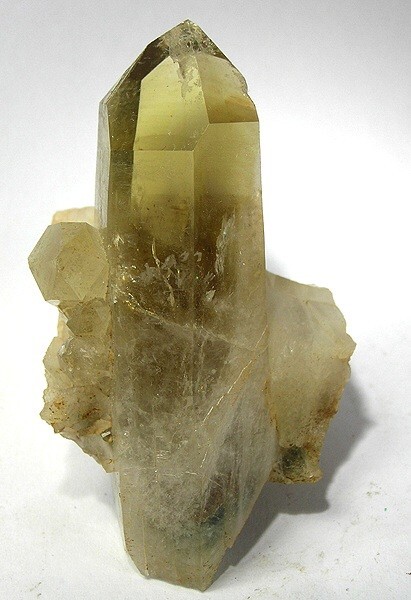
Citrine
A variety of Quartz
This page kindly sponsored in memory of Laszlo Z. Valachi


About Citrine
Formula:
SiO2
Colour:
Yellow, yellow-orange, orange
Lustre:
Vitreous
Hardness:
7
Crystal System:
Trigonal
Name:
From citrina (color as yellow as citron).
A yellow to yellow-orange or yellow-green variety of quartz.
NOTE: Quartz colored by visible inclusions, or coatings, of any kind is not called citrine. Iron-stained quartz should not be mistaken for citrine.. Microscopic to Nano-scale inclusions may be a legitimate cause of colour for citrine.
The cause of the color is still under debate. Like smoky quartz, natural citrines pale when heated above 200-500 °C and turn yellow again when irradiated (Lehmann, 1970), and they also slowly pale in UV light. This indicates the presence of color centers. At least some citrine is colored by aluminum-based and irradiation-induced color centers related to those found in smoky quartz (Lehmann, 1972; Maschmeyer et al., 1980). Accordingly, transitions to smoky quartz ("smoky citrine") exist, many citrines show smoky phantoms. There appear to be at least two types of yellow Al-based color centers with different thermal stability (Schmetzer, 1988). Since the yellow color centers are often more stable than the smoky color centers, some smoky quartz can be turned into citrine by careful heating (Nassau and Prescott, 1977). Natural citrine, as well as citrine produced by heating smoky quartz, is dichroic in polarized light.
Note: Natural citrine is very rare. Large quantities of amethyst, usually of lesser quality, are heated to turn it yellow or orange and sold as "citrine." Because the color is now caused by finely distributed iron minerals (mostly hematite and goethite), heated amethyst is not citrine in the strict sense, and also shows no dichroism in polarized light.
That a crystal shows dichroism does not mean it is a natural citrine, it just means it is not heated amethyst. Certain smoky quartz and rock crystals can be turned yellow by careful heat treatment and/or irradiation, and these crystals will show dichroism.
Thin coatings of iron oxides on colourless quartz, as well as inclusions of yellow iron oxides ("limonite"), may simulate citrine.
 Visit gemdat.org for gemological information about Citrine.
NOTE: Quartz colored by visible inclusions, or coatings, of any kind is not called citrine. Iron-stained quartz should not be mistaken for citrine.. Microscopic to Nano-scale inclusions may be a legitimate cause of colour for citrine.
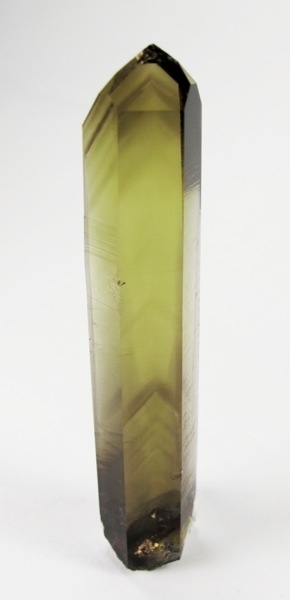

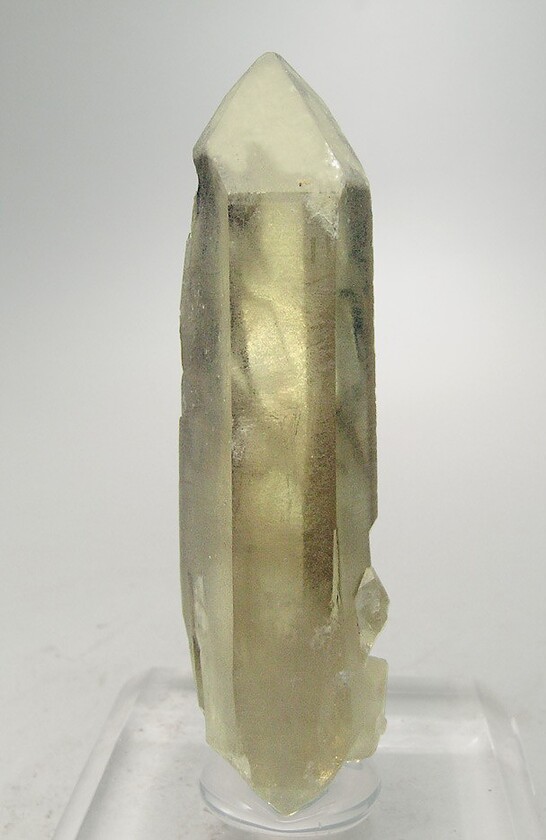
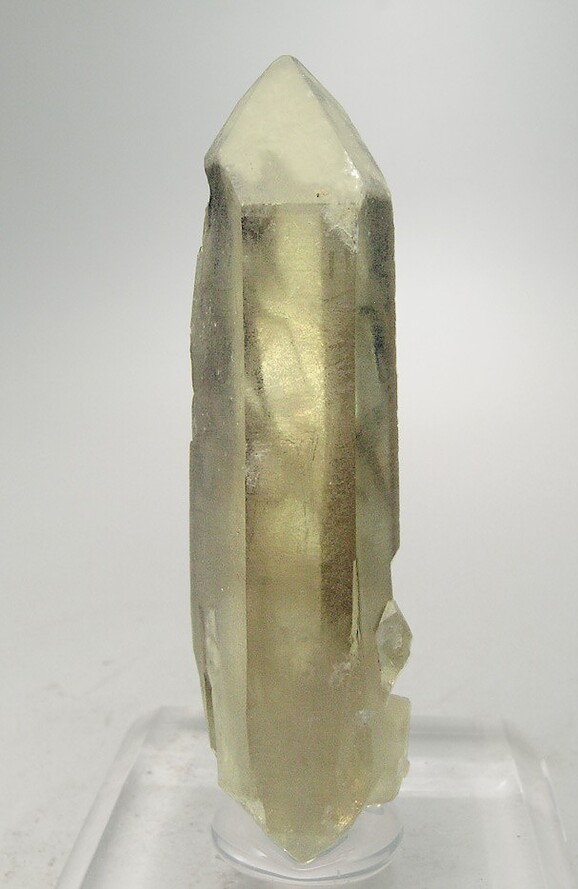
The cause of the color is still under debate. Like smoky quartz, natural citrines pale when heated above 200-500 °C and turn yellow again when irradiated (Lehmann, 1970), and they also slowly pale in UV light. This indicates the presence of color centers. At least some citrine is colored by aluminum-based and irradiation-induced color centers related to those found in smoky quartz (Lehmann, 1972; Maschmeyer et al., 1980). Accordingly, transitions to smoky quartz ("smoky citrine") exist, many citrines show smoky phantoms. There appear to be at least two types of yellow Al-based color centers with different thermal stability (Schmetzer, 1988). Since the yellow color centers are often more stable than the smoky color centers, some smoky quartz can be turned into citrine by careful heating (Nassau and Prescott, 1977). Natural citrine, as well as citrine produced by heating smoky quartz, is dichroic in polarized light.
It has also been suggested that iron is the cause of color, as artificial crystals grown in an iron-bearing solution turn out orange. However, the dichroic behavior of the lab-grown crystals differs from that in natural citrine (Rossmann, 1994), and the UV-sensitivity of natural citrines indicates that the color is not simply caused by incorporated trace elements.
Citrine can be found in the same geological environments as smoky quartz and is often associated and intergrown with it. Contrary to amethyst, citrine crystals may show a macromosaic structure and become very large (meter-size crystals of good quality have been found Minas Gerais, Brazil).

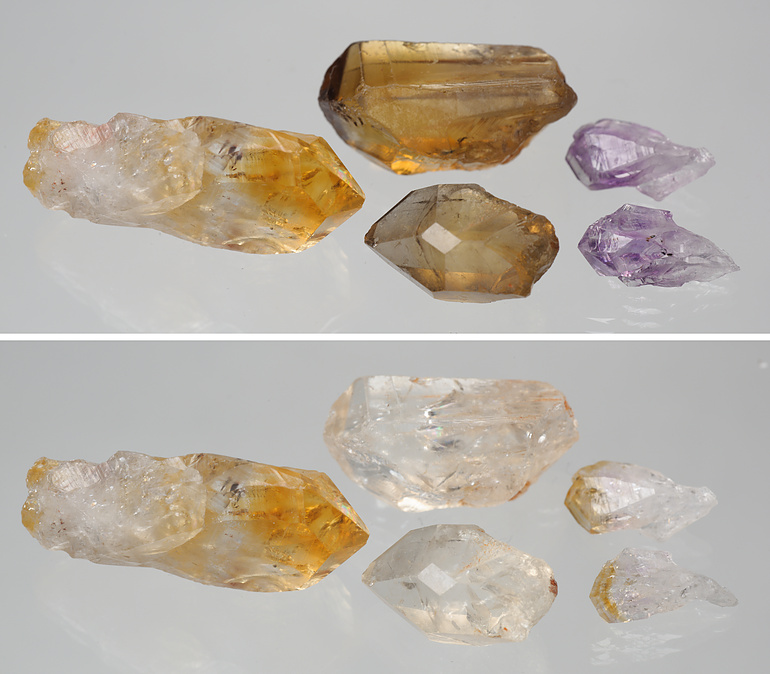


Note: Natural citrine is very rare. Large quantities of amethyst, usually of lesser quality, are heated to turn it yellow or orange and sold as "citrine." Because the color is now caused by finely distributed iron minerals (mostly hematite and goethite), heated amethyst is not citrine in the strict sense, and also shows no dichroism in polarized light.
That a crystal shows dichroism does not mean it is a natural citrine, it just means it is not heated amethyst. Certain smoky quartz and rock crystals can be turned yellow by careful heat treatment and/or irradiation, and these crystals will show dichroism.
Thin coatings of iron oxides on colourless quartz, as well as inclusions of yellow iron oxides ("limonite"), may simulate citrine.
Visit gemdat.org for gemological information about Citrine.Unique Identifiers
Mindat ID:
1054 (as Citrine)
3337 (as Quartz)
3337 (as Quartz)
Long-form identifier:
mindat:1:1:1054:8 (as Citrine)
mindat:1:1:3337:0 (as Quartz)
mindat:1:1:3337:0 (as Quartz)
Physical Properties of Citrine
Vitreous
Transparency:
Transparent, Translucent
Colour:
Yellow, yellow-orange, orange
Comment:
Dichroic.
Hardness:
7 on Mohs scale
Chemistry of Citrine
Mindat Formula:
SiO2
Elements listed:
Crystallography of Citrine
Crystal System:
Trigonal
Synonyms of Citrine
Other Language Names for Citrine
Common Associates
Associations Based on Photo Data:
| 49 photos of Citrine associated with 'Smoky Quartz' | SiO2 |
| 34 photos of Citrine associated with Danburite | CaB2Si2O8 |
| 32 photos of Citrine associated with Quartz | SiO2 |
| 29 photos of Citrine associated with 'Amethyst' | SiO2 |
| 19 photos of Citrine associated with Muscovite | KAl2(AlSi3O10)(OH)2 |
| 15 photos of Citrine associated with Calcite | CaCO3 |
| 11 photos of Citrine associated with Fluorite | CaF2 |
| 8 photos of Citrine associated with Schorl | NaFe2+3Al6(Si6O18)(BO3)3(OH)3(OH) |
| 8 photos of Citrine associated with Microcline | K(AlSi3O8) |
| 8 photos of Citrine associated with Albite | Na(AlSi3O8) |
Other Information
Health Risks:
Citrine is a variety of quartz which is usually quite harmless unless broken or powdered. Broken crystals and masses may have razor-sharp edges that can easily cut skin and flesh. Handle with care. Do not grind dry since long-term exposure to finely ground powder may lead to silicosis.
Internet Links for Citrine
mindat.org URL:
https://www.mindat.org/min-1054.html
Please feel free to link to this page.
Please feel free to link to this page.
Search Engines:
Mineral Dealers:
References for Citrine
Reference List:
Nassau, K., Prescott, B. E. (1977) Smoky, blue, greenish yellow, and other irradiation-related colors in quartz. Mineralogical Magazine, 41 (319) 301-312 doi:10.1180/minmag.1977.041.319.01
Maschmeyer, D., Niemann, K., Hake, H., Lehmann, G., Räuber, A. (1980) Two modified smoky quartz centers in natural citrine. Physics and Chemistry of Minerals, 6 (2) 145-156 doi:10.1007/bf00311051
Olkhovka deposit, Krasnovishersky District, Perm Krai, Russia