Log In


This page is currently not sponsored. Click here to sponsor this page.
Type:
Other Languages:
French:
Utah, États-Unis
German:
Utah, Vereinigte Staaten
Italian:
Utah, Stati Uniti d'America
Russian:
Юта, Соединённые Штаты Америки
Simplified Chinese:
犹他州, 美国
Spanish:
Utah, Estados Unidos
Afrikaans:
Utah, Verenigde State van Amerika
Albanian:
Utah, Shtetet e Bashkuara të Amerikës
Amharic:
ዩታህ, አሜሪካ
Anglo-Saxon:
Utah, Geānedu Rīcu American
Arabic:
يوتا, الولايات المتحدة
Aragonese:
Utah
Armenian:
Յուտա, Ամերիկայի Միացյալ Նահանգներ
Asturian:
Utah, Estaos Xuníos d'América
Aymara:
Utah suyu, Istadus Unidus
Azeri:
Yuta, Amerika Birləşmiş Ştatları
Bashkir:
Юта, Америка Ҡушма Штаттары
Basque:
Utah
Bavarian:
Utah, Vaoanigte Stootn
Belarusian:
Юта, Злучаныя Штаты Амерыкі
Belarusian (Tarashkevitsa):
Юта, Злучаныя Штаты Амэрыкі
Bengali:
ইউটা, মার্কিন যুক্তরাষ্ট্র
Bishnupriya Manipuri:
ইউটা, তিলপারাষ্ট্র
Bislama:
Yuta, Yunaeted Stet blong Amerika
Bosnian:
Utah, Sjedinjene Američke Države
Breton:
Utah, Stadoù-Unanet Amerika
Bulgarian:
Юта, Съединени американски щати
Burmese:
ယူးတားပြည်နယ်, အမေရိကန်ပြည်ထောင်စု
Catalan:
Utah, Estats Units d’Amèrica
Cebuano:
Utah
Central Bikol:
Utah, Estados Unidos
Chechen:
Юта, Америкин Цхьаьнатоьхна Штаташ
Cheyenne:
Utah, United States
Chuvash:
Юта, Пĕрлешнĕ Штатсем
Cornish:
Utah, Statys Unys
Corsican:
Utah, Stati Uniti d'America
Croatian:
Utah, Sjedinjene Američke Države
Czech:
Utah, Spojené státy americké
Danish:
Utah, USA
Dutch:
Utah, Verenigde Staten
Dutch Low Saxon:
Utah, Verienigde Staoten van Amerika
Egyptian Arabic:
يوتا, امريكا
Emilian-Romagnol:
Utah, Stat Unî
Esperanto:
Utaho
Estonian:
Utah, Ameerika Ühendriigid
Extremaduran:
Utah, Estaus Uníus
Faroese:
Utah
Farsi/Persian:
یوتا, ایالات متحده آمریکا
Fiji Hindi:
Utah, United States
Finnish:
Utah, Yhdysvallat
Franco-Provençal:
Utah, Ètats-Unis
Gagauz:
Utah, Amerika Birleşik Devletläri
Galician:
Utah, Estados Unidos de América
Georgian:
იუტა, ამერიკის შეერთებული შტატები
Greek:
Γιούτα, Ηνωμένες Πολιτείες Αμερικής
Guarani:
Utah, Tetãvore Joapykuéra
Haitian:
Youta, Etazini
Hakka:
Utah
Hawaiian:
Uka, ‘Amelika Hui Pū ‘ia
Hebrew:
יוטה, ארצות הברית
Hill Mari:
Юта, Америкын Ушымы Штатвлӓжӹ
Hindi:
यूटा, संयुक्त राज्य
Hungarian:
Utah, Amerikai Egyesült Államok
Icelandic:
Utah, Bandaríkin
Ido:
Utah, Usa
Igbo:
Yútạh, Njikọ̀taọ̀hà
Iloko:
Utah, Estados Unidos iti Amerika
Indonesian:
Utah, Amerika Serikat
Interlingua:
Utah, Statos Unite de America
Irish Gaelic:
Utah, Stáit Aontaithe Mheiriceá
Japanese:
ユタ州, アメリカ合衆国
Javanese:
Utah, Amérika Sarékat
Judaeo-Spanish:
Utah, Estados Unidos de Amerika
Kabiye:
Utaa, Etaazuunii
Kalmyk:
Юта, Америкин Ниицәтә Орн Нутугуд
Kannada:
ಯೂಟ, ಅಮೇರಿಕ ಸಂಯುಕ್ತ ಸಂಸ್ಥಾನ
Kapampangan:
Utah, Estados Unidos
Kazakh (Cyrillic Script):
Юта, Америка Құрама Штаттары
Korean:
유타주, 미국
Kurdish (Latin Script):
Utah, Dewletên Yekbûyî yên Amerîkayê
Latin:
Uta, Civitates Foederatae Americae
Latvian:
Jūta, Amerikas Savienotās Valstis
Ligurian:
Utah, Stati Unïi d'America
Limburgian:
Utah, Vereinegde Staote vaan Amerika
Lithuanian:
Juta, Jungtinės Amerikos Valstijos
Lombard:
Utah, Stat Ünì d'America
Low Saxon/Low German:
Utah, USA
Luri:
یۊتا, ڤولاتچٱیا یٱکاگرتٱ آمریکا
Luxembourgish:
Utah, Vereenegt Staate vun Amerika
Macedonian:
Јута, Соединети Американски Држави
Maithili:
युटा, संयुक्त राज्य अमेरिका
Malagasy:
Utah, Etazonia
Malay:
Utah, Amerika Syarikat
Malayalam:
യൂറ്റാ
Manx:
Utah, Steatyn Unnaneysit America
Maori:
Utah, Hononga-o-Amerika
Marathi:
युटा, अमेरिकेची संयुक्त संस्थाने
Mazanderani:
یوتا
Meadow Mari:
Юта, Ушымо Американ Штат-влак
Min Dong Chinese:
Utah
Mingrelian:
იუტა, ამერიკაშ აკოართაფილი შტატეფი
Mirandese:
Utah, Stados Ounidos de la América
Mongolian:
Юта, Америкийн Нэгдсэн Улс
Nauruan:
Utah, Eben Merika
Navajo:
Áshįįh Biiʼtó Hahoodzo, Wááshindoon Bikéyah Ałhidadiidzooígíí
Nepali:
युटा, संयुक्त राज्य अमेरिका
Newar / Nepal Bhasa:
युताः, संयुक्त राज्य अमेरिका
Northern Frisian:
Utah, Feriind Stoote foon Ameerika
Northern Sami:
Utah, Amerihká ovttastuvvan stáhtat
Norwegian:
Utah, USA
Norwegian (Nynorsk):
Utah, USA
Occitan:
Utah, Estats Units d'America
Ossetian:
Ютæ, Америкæйы Иугонд Штаттæ
Pali:
उटाह, संयुक्त राज्य अमेरिका
Piedmontese:
Utah, Stat Unì d'América
Polish:
Utah, Stany Zjednoczone
Portuguese:
Utah, Estados Unidos
Punjabi:
ਯੂਟਾ, ਸੰਯੁਕਤ ਰਾਜ ਅਮਰੀਕਾ
Quechua:
Utah suyu, Hukllachasqa Amirika Suyukuna
Romanian:
Utah, Statele Unite ale Americii
Romansh:
Utah, Stadis Unids
Russia Buriat:
Юта
Samoan:
Iutā, Iunaite Sitete o Amerika
Samogitian:
Juta, JAV
Sanskrit:
यूटाह, अमेरिकासंयुक्तराज्यम्
Sardinian:
Utah, Istados Unidos de Amèrica
Saterland Frisian:
Utah, Fereende Stoaten fon Amerikoa
Scots:
Utah
Scottish Gaelic:
Utah, Na Stàitean Aonaichte
Serbian:
Јута, Сједињене Америчке Државе
Serbo-Croatian:
Utah, Sjedinjene Američke Države
Sicilian:
Utah, Stati Uniti
Silesian:
Utah, Zjednoczůne Sztaty
Slovak:
Utah, Spojené štáty
Slovenian:
Utah, Združene države Amerike
South Azerbaijani:
یوتا ایالتی, آمریکا بیرلشمیش ایالتلری
Swahili:
Utah, Marekani
Swedish:
Utah, USA
Tagalog:
Utah, Estados Unidos
Tamil:
யூட்டா, அமெரிக்க ஐக்கிய நாடு
Tatar:
Юта (штат), Америка Кушма Штатлары
Telugu:
యూటా, అమెరికా సంయుక్త రాష్ట్రాలు
Thai:
รัฐยูทาห์, ประเทศสหรัฐอเมริกา
Tibetan (Standard):
ཡུ་ཊ།, ཨ་མེ་རི་ཁ་རྒྱལ་ཕྲན་མཉམ་འབྲེལ་རྒྱལ་ཁབ།
Traditional Chinese:
猶他州, 美國
Turkish:
Utah, Amerika Birleşik Devletleri
Ukrainian:
Юта, Сполучені Штати Америки
Urdu:
یوٹاہ, ریاستہائے متحدہ امریکا
Uyghur:
Yuta Shitati, ئامېرىكا قوشما شىتاتلىرى
Uzbek (Latin Script):
Yuta, Amerika Qoʻshma Shtatlari
Venetian:
Utah, Stati Unii de ła Mèrica
Vietnamese:
Utah, Chủng Quốc Hoa Kỳ
Volapük:
Utah, Lamerikän
Waray:
Utah, Estados Unidos
Welsh:
Utah, Unol Daleithiau America
West Frisian:
Utah, Feriene Steaten
Western Punjabi:
یوٹاہ, امریکہ
Yakut:
Юта, Америка Холбоһуктаах Штааттара
Yiddish:
יוטא, פאראייניקטע שטאטן פון אמעריקע
Yoruba:
Utah
Zazaki:
Utah, Dewletê Amerikayê Yewbiyayey
Zulu:
Utah, IMelika
Utah is a state in the western United States, covering approximately 219,900 km². It is bordered by Idaho to the north, Wyoming to the north-east, Colorado to the east, Arizona to the south, Nevada to the west, and touches New Mexico at a single point in the south-east. Salt Lake City is the state capital and largest city, while Provo, Ogden, and St. George are other major population centres.
Geographically, Utah is one of the most topographically diverse states in the USA, encompassing parts of the Rocky Mountains, the Colorado Plateau, and the Basin and Range Province. The Wasatch Range forms a prominent north–south mountain chain along the eastern edge of the Great Basin and defines the Wasatch Front, where most of the population resides. The eastern and southern parts of the state are dominated by the Colorado Plateau, characterised by high plateaus, mesas, deep canyons, and iconic landforms such as those found in Zion, Bryce Canyon, and Arches national parks. The Great Salt Lake, a remnant of Pleistocene Lake Bonneville, is a defining hydrological feature.
Geologically, Utah records an exceptionally long and varied geological history. Precambrian crystalline basement rocks are exposed in several uplifts, while thick sequences of Palaeozoic marine sedimentary rocks form much of the Colorado Plateau. These are overlain by Mesozoic sandstones, shales, and limestones, famous for their spectacular canyon landscapes. The state was affected by Laramide orogeny, which uplifted mountain blocks and created intermontane basins, followed by widespread Cenozoic extension and volcanism in the western part of the state. Volcanic fields, calderas, and lava flows are common, particularly in western and southern Utah.
Utah has a major mineral and mining heritage, spanning metallic, industrial, and energy resources. The state is internationally known for copper mining, particularly at the Bingham Canyon Mine, one of the world’s largest open-pit copper mines, which has also produced significant gold, silver, and molybdenum. Utah has also produced uranium from sandstone-hosted deposits, notably during the mid-20th century, as well as vanadium, lead, and zinc. Industrial minerals are economically important and include potash, salt, gypsum, phosphate, and magnesium compounds derived from brines of the Great Salt Lake. Fossil fuel resources include coal, oil, and natural gas, especially in eastern Utah.
Administratively, Utah is divided into 29 counties. The state’s identity is closely linked to its distinctive geology, arid climate, and dramatic landscapes, which have shaped settlement patterns, resource development, and land use. Utah is a key region for understanding the interaction of plateau tectonics, basin-and-range extension, and large-scale hydrothermal mineral systems in western North America.
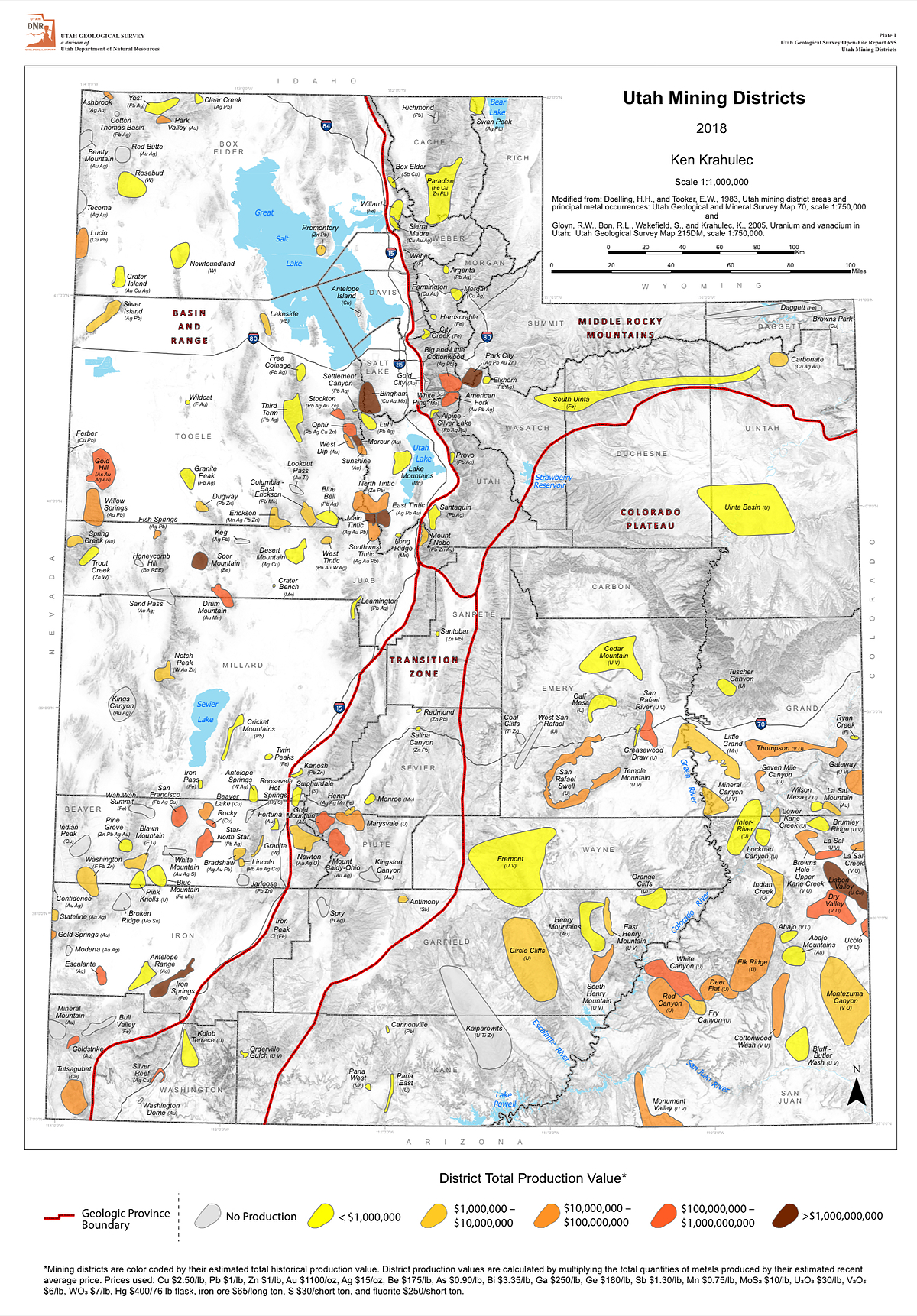
A detailed map of Utah reflecting the mining districts color coded by production value can be found at:
Krahulec, Ken (2018) Utah Mining Districts. Open-File Report 695. Utah Geological Survey
Geographically, Utah is one of the most topographically diverse states in the USA, encompassing parts of the Rocky Mountains, the Colorado Plateau, and the Basin and Range Province. The Wasatch Range forms a prominent north–south mountain chain along the eastern edge of the Great Basin and defines the Wasatch Front, where most of the population resides. The eastern and southern parts of the state are dominated by the Colorado Plateau, characterised by high plateaus, mesas, deep canyons, and iconic landforms such as those found in Zion, Bryce Canyon, and Arches national parks. The Great Salt Lake, a remnant of Pleistocene Lake Bonneville, is a defining hydrological feature.
Geologically, Utah records an exceptionally long and varied geological history. Precambrian crystalline basement rocks are exposed in several uplifts, while thick sequences of Palaeozoic marine sedimentary rocks form much of the Colorado Plateau. These are overlain by Mesozoic sandstones, shales, and limestones, famous for their spectacular canyon landscapes. The state was affected by Laramide orogeny, which uplifted mountain blocks and created intermontane basins, followed by widespread Cenozoic extension and volcanism in the western part of the state. Volcanic fields, calderas, and lava flows are common, particularly in western and southern Utah.
Utah has a major mineral and mining heritage, spanning metallic, industrial, and energy resources. The state is internationally known for copper mining, particularly at the Bingham Canyon Mine, one of the world’s largest open-pit copper mines, which has also produced significant gold, silver, and molybdenum. Utah has also produced uranium from sandstone-hosted deposits, notably during the mid-20th century, as well as vanadium, lead, and zinc. Industrial minerals are economically important and include potash, salt, gypsum, phosphate, and magnesium compounds derived from brines of the Great Salt Lake. Fossil fuel resources include coal, oil, and natural gas, especially in eastern Utah.
Administratively, Utah is divided into 29 counties. The state’s identity is closely linked to its distinctive geology, arid climate, and dramatic landscapes, which have shaped settlement patterns, resource development, and land use. Utah is a key region for understanding the interaction of plateau tectonics, basin-and-range extension, and large-scale hydrothermal mineral systems in western North America.
Early in Utah’s mining history, individual mining districts were organized by the miners and prospectors from the local camp. They elected a recorder, determined regulations for claims, named the district, and defined district boundaries. The U.S. General Mining Act of 1872 formalized a uniform set of claim regulations and the federal government eventually took over the recorder functions. After 1872, the organization of individual mining districts and the definition of their boundaries became somewhat superfluous due to the uniform federal regulations. However, by 1920, 115 mining districts were recognized in Utah along with numerous unorganized camps outside of these district boundaries (Butler and others, 1920). By 1983, Doelling and Tooker (1983) showed 159 districts in Utah. More recently the Utah U-V mining districts were defined by Gloyn and others (2005).
A detailed map of Utah reflecting the mining districts color coded by production value can be found at:
Krahulec, Ken (2018) Utah Mining Districts. Open-File Report 695. Utah Geological Survey
Utah is situated at the intersection of three important geological provinces, the Middle Rocky Mountains in the northeast, the Colorado Plateau in the southeast, and the Basin and Range Province in the west. In addition, a transition zone lies along the boundary between the Basin and Range Province and the Colorado Plateau. These provinces have significantly different geologic histories resulting in the formation of different ore deposit types and the production of unique metal assemblages. For example, the Basin and Range Province has mainly produced Cu, Pb, Zn, Au, and Ag from intrusive-centered mining districts, but the Colorado Plateau is primarily recognized for sandstone-hosted U, V, and Cu deposits.
Utah Mining Districts courtesy UGS