

An ETL pipeline is a data processing workflow that extracts data from multiple sources, transforms it into a clean and usable format, and loads it into a target system like a data warehouse. It helps organizations manage large volumes of data efficiently for analysis and reporting.
- Extracts data from different sources such as databases, APIs, and applications
- Transforms data by cleaning, filtering, and structuring it for consistency
- Loads the processed data into storage systems for analytics and decision-making
Process of ETL
The ETL process is a data integration method used to collect data from multiple sources, convert it into a usable format, and store it in a target system like a data warehouse for analysis and reporting.
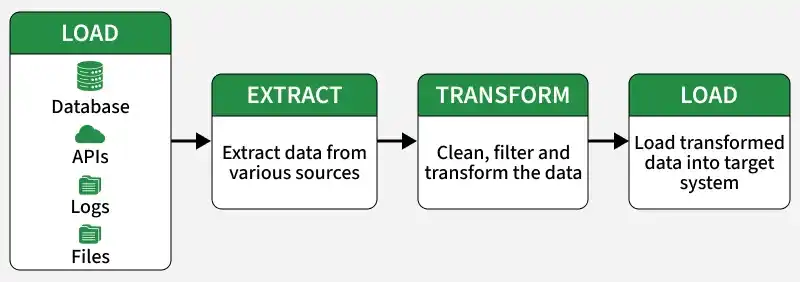
- Extract: Data is collected from different sources such as databases, APIs, logs, and files. The data is usually raw and unprocessed.
- Transform: The extracted data is cleaned, filtered, and converted into a structured format. Business rules are applied to ensure accuracy, consistency, and quality.
- Load: The transformed data is loaded into the target system such as a data warehouse, database, or data lake for analysis and decision-making.
ETL Architecture
ETL Architecture defines how data moves through the Extract, Transform, and Load process from source systems to a target system like a data warehouse.
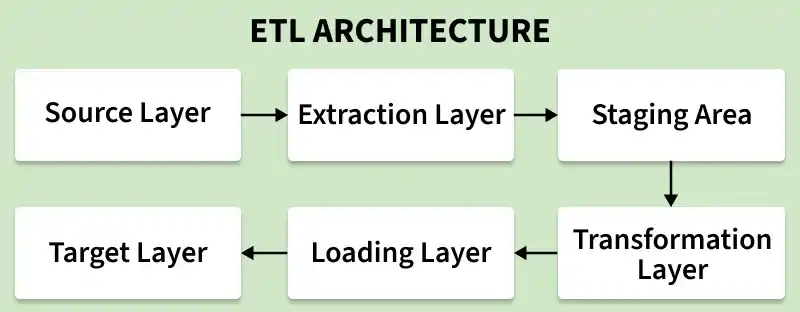
- Source Layer: Data originates from databases, APIs, files, logs, etc.
- Extraction Layer: Data is extracted from source systems into the ETL pipeline.
- Staging Area: A temporary storage area where extracted data is stored before transformation. It helps in data validation and cleaning without affecting source systems.
- Transformation Layer: In this layer, data is cleaned, filtered, joined, and converted into a structured format. Business rules are applied here to ensure data quality and consistency.
- Loading Layer: The transformed data is loaded into the target system such as a data warehouse or data lake.
- Target Layer: This is the final destination where data is stored for analysis, reporting, and decision-making.
Types of ETL Pipelines
ETL pipelines can be classified based on how and when data is processed and moved from source systems to target systems.
- Batch ETL Pipeline: In batch ETL, data is collected and processed at scheduled intervals (hourly, daily, weekly). It is suitable for large volumes of data where real-time processing is not required.
- Real-Time ETL Pipeline: In real-time ETL, data is processed continuously as soon as it is generated. It is used in systems that need instant insights like fraud detection and live monitoring.
- Micro-Batch ETL Pipeline: In micro-batch ETL, data is processed in small batches at very short intervals (seconds or minutes). It provides a balance between batch and real-time processing.
- Cloud-Based ETL Pipeline: In cloud-based ETL, data is processed using cloud platforms and services. It is scalable, flexible, and cost-effective for modern data systems.
- Streaming ETL Pipeline: In streaming ETL, data flows continuously from sources like IoT devices, logs, or social media. It is designed for high-speed and real-time data processing.
Benefits of ETL Pipeline
An ETL pipeline is designed to prepare data for analysis and business insights. To gain valuable insights, data from various sources like CRMs, social media platforms, and web reports need to be moved, combined, and modified to match the destination database's requirements.
An ETL pipeline is useful for:
- Centralizing and standardizing data so it's easily accessible for analysts and decision-makers.
- Allowing developers to focus on important tasks instead of dealing with data movement and maintenance.
- Migrating data from old systems to a new data warehouse.
- Enabling deeper analytics beyond basic data transformations.
In simple terms, an ETL pipeline helps gather and prepare data from different sources to make it ready for analysis, saving time and effort for developers and providing better insights for decision-making.
Characteristics of an ETL Pipeline
ETL pipelines help businesses stay competitive by providing better and faster data for decision-making. To achieve this effectively, ETL pipelines should have the following characteristics:
- Real-time data processing: Ability to continuously process and update data in real time.
- Flexibility and adaptability: Easily adapt to changes in data sources, formats, and business requirements.
- Independent processing resources: Use separate and scalable resources to avoid system overload.
- Improved data accessibility: Make data easily available for analytics and decision-making.
- Ease of setup and maintenance: Simple to configure, manage, and maintain over time.
ETL Pipeline Use Cases
- Data Warehousing: A data warehouse is a central repository of data collected from one or more different sources, used for reporting and data analysis.
- Data Integration Tools: Most data integration tools use the ETL (Extract, Transform, Load) concept to combine data from multiple systems into a unified view.
- Format Conversion: ETL pipelines are commonly used to convert data formats such as CSV files into formats that are compatible with relational databases, with minimal coding effort.
- Quick Import of Large Datasets: ETL pipelines are widely used by students and data professionals to quickly import and process large datasets for analysis and machine learning tasks.
ETL Pipeline vs Data Pipeline
| Feature | ETL Pipeline | Data Pipeline |
|---|---|---|
| Full Form | Extract, Transform, Load | No fixed expansion (general term) |
| Definition | A pipeline that extracts data, transforms it, and loads it into a data warehouse | A broader system that moves data from one system to another |
| Purpose | Mainly used for data warehousing and analytics | Used for real-time or batch data movement and processing |
| Processing Type | Mostly batch processing | Supports batch + real-time processing |
| Transformation | Happens before loading (ETL model) | Can happen at any stage (ETL, ELT, streaming) |
| Data Storage | Usually ends in a data warehouse | Can end in databases, lakes, or applications |
| Flexibility | Less flexible | More flexible and scalable |
| Use Case | Business intelligence, reporting | Streaming apps, real-time analytics, ML pipelines |
