

Agile is an approach to software development that emphasizes iterative development, incremental delivery, customer collaboration, continuous feedback, and responding to changing requirements.
- Supports frequent and incremental delivery of valuable software.
- Encourages collaboration among customers, stakeholders, and development teams.
- Supports adapting development work based on feedback and changing requirements.
Agile Manifesto
The Agile Manifesto values individuals and interactions, working software, customer collaboration, and responding to change more highly than processes and tools, comprehensive documentation, contract negotiation, and following a plan
- Individuals and Interactions over Processes and Tools
- Working Software over Comprehensive Documentation
- Customer Collaboration over Contract Negotiation
- Responding to Change over Following a Plan
- The values on the right are important, but the values on the left are valued more highly.
Principles of Agile Methodology
The Agile Manifesto includes 12 principles that provide guidance for delivering valuable software, collaborating effectively, responding to change, and continuously improving the development process.
- Customer Satisfaction: Satisfy the customer through early and continuous delivery of valuable software.
- Welcome Change: Welcome changing requirements, even late in development, to provide greater value to the customer.
- Frequent Delivery: Deliver working software frequently, with a preference for shorter timescales.
- Collaboration: Business people and developers should work together throughout the project.
- Motivated Teams: Build projects around motivated individuals, provide them with the environment and support they need, and trust them to get the work done.
- Effective Communication: Face-to-face conversation is the most efficient and effective method of conveying information to and within a development team.
- Working Software: Working software is the primary measure of progress.
- Sustainable Development: Maintain a sustainable pace of development that can be continued indefinitely.
- Technical Excellence: Give continuous attention to technical excellence and good design to enhance agility.
- Simplicity: Maximize the amount of work not done by focusing on essential work and avoiding unnecessary complexity.
- Self-Organizing Teams: The best architectures, requirements, and designs emerge from self-organizing teams.
- Continuous Improvement: At regular intervals, the team reflects on how to become more effective and adjusts its behavior accordingly.
Typical Agile Development Cycle
Agile does not prescribe a single fixed development process. Different Agile approaches use different practices and workflows. A typical Agile cycle involves planning, development, testing, delivery, feedback, and adaptation, with these activities repeated as needed.
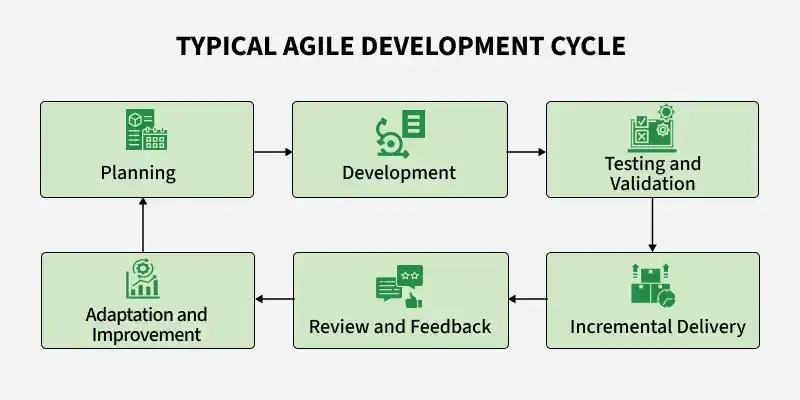
- Planning: Define goals, identify requirements, and prioritize work based on customer and business value.
- Development: Design and develop the selected functionality collaboratively.
- Testing and Validation: Test and validate the software throughout development to identify defects and provide timely feedback.
- Incremental Delivery: Deliver working software or other valuable outcomes incrementally, according to the Agile approach being used.
- Review and Feedback: Evaluate the delivered work, gather feedback, and use it to guide future development.
- Adaptation and Improvement: Adapt requirements, priorities, practices, or plans based on feedback and lessons learned.
Agile Frameworks and Methodologies
Agile encompasses various frameworks, methodologies, and approaches that provide different ways to apply Agile principles in software development and product delivery.
- Scrum: An Agile framework for developing and delivering products through an iterative and incremental approach.
- Kanban: A method for managing and improving the flow of work by visualizing work and limiting work in progress.
- Extreme Programming (XP): An Agile software development methodology that emphasizes practices such as test-driven development, pair programming, continuous integration, and frequent releases.
- Crystal: A family of Agile methodologies that emphasizes communication, teamwork, frequent delivery, and adapting practices to the needs of the project and team.
- Dynamic Systems Development Method (DSDM): An Agile framework that provides a structured approach to project delivery and emphasizes active stakeholder involvement and iterative development.
- Feature-Driven Development (FDD): An iterative and incremental software development methodology that organizes development around client-valued features.
- Adaptive Software Development (ASD): An Agile software development methodology that emphasizes collaboration, learning, and adaptation in changing environments.
Agile Roles and Responsibilities
Agile does not define one universal set of roles for every Agile team. Roles and responsibilities depend on the framework, methodology, and organization being used.
- Product Owner: In Scrum, the Product Owner is accountable for maximizing product value and for effective Product Backlog management.
- Scrum Master: In Scrum, the Scrum Master is accountable for establishing Scrum as defined in the Scrum Guide and for the effectiveness of the Scrum Team.
- Developers: In Scrum, Developers are accountable for creating a usable Increment during each Sprint and for planning and performing the work required to create it.
Agile Testing
Agile Testing integrates testing and quality activities throughout development to provide continuous feedback and support the delivery of valuable, working software.
- Continuous Testing: Testing activities are performed throughout development to provide timely feedback.
- Early Defect Detection: Frequent testing helps identify defects and quality problems early.
- Collaboration: Testers, developers, product representatives, and other relevant stakeholders collaborate to understand and validate requirements.
- Frequent Validation: Developed functionality is regularly validated against applicable requirements and quality expectations.
- Test Automation: Automated tests can provide faster feedback and support regression testing where appropriate.
- Continuous Quality Improvement: Testing results and feedback are used to improve software quality and development practices.
Agile Tools
Agile teams can use various tools to manage work, track progress, communicate, and support development activities. Agile does not require any specific tool.
- Jira: Supports work tracking, backlog management, iteration or Sprint planning, issue tracking, and reporting.
- Trello: Uses boards and cards to visualize and manage work.
- Azure DevOps: Provides services for work tracking, source control, CI/CD, and other software development activities.
- Asana: Supports task management, project planning, and team collaboration.
- ClickUp: Provides task management, project planning, goals, and workflow management.
- Monday.com: Supports project, task, workflow, and team collaboration.
Advantages of Agile Methodology
Agile can help teams deliver value frequently, obtain feedback early, and adapt to changing customer and business needs.
- Enables frequent delivery of valuable software.
- Supports adaptation to changing requirements and priorities.
- Provides frequent opportunities for customer and stakeholder feedback.
- Helps identify and address problems early.
- Encourages collaboration and communication among team members.
- Supports continuous improvement through regular feedback and reflection.
Limitations of Agile Methodology
Agile can present challenges when teams, organizations, or project environments are not well suited to iterative and adaptive development.
- Frequent changes can make scope management challenging.
- Long-term cost, scope, and delivery predictions can be less certain when requirements evolve.
- Requires effective collaboration and communication.
- Requires teams to have appropriate skills and the ability to work collaboratively.
- Large organizations may face additional coordination and communication challenges.
- Agile does not eliminate documentation; documentation should be created when it provides necessary value.
