

Thermodynamics is the branch of physics that studies heat, work, temperature, energy, and the relationships between them in physical systems.
- It also describes how energy is transferred between a system and its surroundings and how these transfers affect the state of the system.
- Real-world systems have parameters called "thermodynamic variables," which help describe their state and predict their behavior.
A system is in thermodynamic equilibrium when its macroscopic properties, such as pressure, temperature, volume, and composition, remain unchanged with time, and there are no unbalanced driving forces causing macroscopic changes within the system.
Example: A gas enclosed in a closed container that has reached uniform temperature and pressure and shows no macroscopic changes with time is in thermodynamic equilibrium.
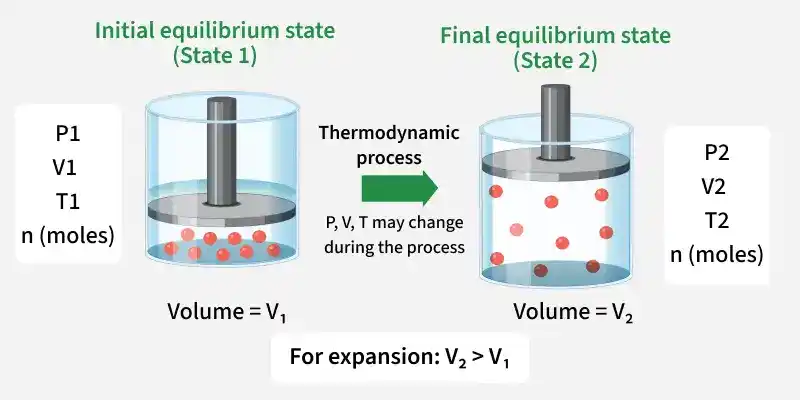
Thermodynamic variables are measurable macroscopic quantities used to describe the state of a thermodynamic system.
These variables can be divided into two types:
1. Extensive Variables
Extensive variables depend on the amount or size of the system. Examples include volume, mass, internal energy, and entropy.
2. Intensive Variables
Intensive variables do not depend on the amount or size of the system. Examples include pressure, temperature, and density.
Equation of State
An equation of state describes the relationship between the state variables of a thermodynamic system. For an ideal gas, the equation of state is:
PV = nRT
where P is pressure, V is volume, n is the number of moles, R is the universal gas constant, and T is the absolute temperature.
For a fixed amount of gas, n and R are constant. Therefore:
\frac{PV}{T}= Constant
For an isothermal process, where temperature remains constant:
P1V1 = P2V2
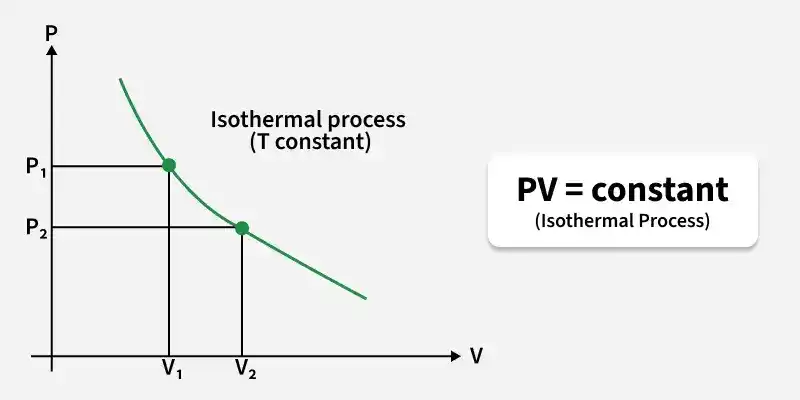
The P-V diagram for an isothermal process shows that pressure decreases as volume increases while temperature remains constant.
For an isochoric process, where volume remains constant:
\frac{P_1}{T_1}=\frac{P_2}{T_2}
For an isobaric process, where pressure remains constant:
\frac{V_1}{T_1}=\frac{V_2}{T_2}
These equations define the behavior of ideal gases under different conditions.
Sample Problems
Question 1: In an isothermal thermodynamic process, the initial pressure and volume are 106 N/m²2 and 3 m,3 respectively. Now, the pressure of the container is doubled. Find the volume.
Solution: In the case of an isothermal process,
P1V1 = P2V2
Given:
P1 = 106, P2 = 2 × 10⁶ and V1 = 3
Plugging the values in the equation,
P1V1 = P2V2
⇒ 106 × 3 = 2 × 10⁶ × V2
⇒ 3 = 2 × V2
⇒ 1.5 m3 = V2
Question 2: In an isothermal thermodynamic process, initial pressure and volume are 5 × 10⁶ N/m2 and 6m3 respectively. Now, the pressure of the container is halved. Find the volume.
Solution: In the case of an isothermal process,
P1V1 = P2V2
Given:
P1 = 5 × 10⁶, P2 = 2.5 × 10⁶ and V1 = 6
Plugging the values in the equation,
P1V1 = P2V2
⇒ 5 × 106 × 6= 2.5 × 10⁶ × V2
⇒ 5 x 6 = 2.5 × V2
⇒ 12m3 = V2
Question 3: In an isochoric process, the volume remains constant. Initial pressure and temperature are 5 × 10⁶ N/m2 and 100K, respectively. Now, the pressure of the container is halved. Find the new temperature.
Solution: In the case of an isochoric process,
P1T2 = P2T1
Given:
P1 = 5 × 10⁶, P2 = 2.5 × 10⁶ and T1 = 100 K
Plugging the values in the equation,
P1T2 = P2T1
⇒ 5 × 10⁶ × T2 = 2.5 × 106 × 100
⇒ T2 = 0.5 × 100
⇒ 50 K = T2
Question 4: In an isochoric process, the volume remains constant. Initial pressure and temperature are 106 N/m2 and 250K, respectively. Now, the pressure of the container is increased four times. Find the new temperature.
Solution: In the case of an isochoric process
P1T2 = P2T1
Given:
P1 = 106, P2 = 4 × 10⁶ and T1 = 250 K
Plugging the values in the equation,
P1T2 = P2T1
⇒ 1 × 10⁶ × T2 = 4 × 106 × 250
⇒ T2 = 4 × 250
⇒ 1000K = T2
Question 5: In a thermodynamic process, the pressure remains constant. Initial volume and temperature are 5 m³ and 250K, respectively. Now, the volume of the container has increased by two times. Find the new temperature.
Solution: In the case of an isobaric process,
V1T2 = V2T1
Given:
V1 = 5 m3, V2 = 10 m3 and T1 = 250 K
Plugging the values in the equation,
V1T2 = V2T1
⇒ 5 × T2 = 10 × 250
⇒ T2 = 500
⇒ 500K = T2
Unsolved Problems
Question 1: In an isothermal process, a gas has an initial volume of 4 m³ and a pressure of 2 × 10⁵ N/m². If the gas is compressed to 2 m³, find the final pressure.
Question 2: In an isochoric process, the pressure of a gas is 3 × 10²5 N/m² at 300 K. If the pressure is increased to 4.5×10⁵ N/m², find the new temperature.
Question 3: A gas in an isobaric process has an initial volume of 2 m³ and a temperature of 200 K. If the volume is increased to 5 m³, calculate the new temperature.
Question 4: In an isothermal process, the volume of a gas decreases from 6 m³ to 3 m³ while the initial pressure is 1.5 × 10⁵ N/m². Find the final pressure.
Question 5: A gas is in an isochoric process at 400 K and a pressure of 5 × 10⁵ N/m². If the temperature is raised to 600 K, calculate the new pressure.
