

Technology Innovation Institute (TII) developed the Falcon family of large language models (LLMs) for tasks such as text generation, summarization, question answering and conversational AI.
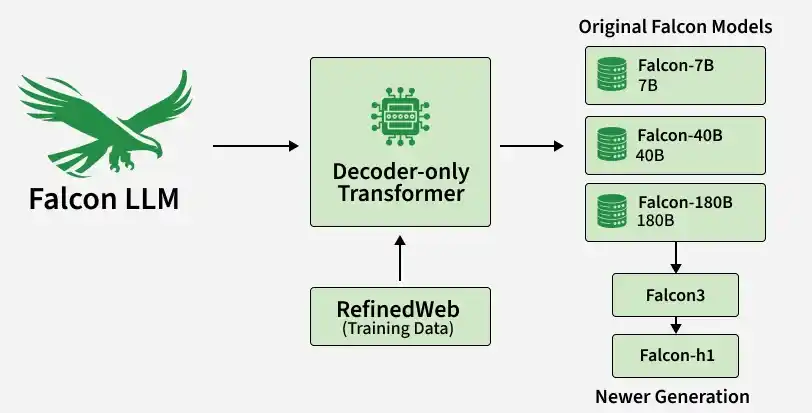
Its main features include:
- Hybrid Transformer-Mamba Architecture: Falcon-H1 combines Transformer attention with Mamba-based State Space Models (SSMs) for efficient long-sequence processing.
- Long Context Support: Falcon-H1 supports context windows of up to 262K tokens, enabling it to process long documents and conversations.
- Multiple Model Sizes: Falcon-H1 is available in sizes from 0.5B to 34B parameters, supporting different deployment requirements.
- Efficient Inference: Its hybrid architecture improves memory and computational efficiency, especially for long-context applications.
- Multilingual Capabilities: Falcon-H1 supports multiple languages for tasks such as text generation, reasoning and instruction following. Some instruction models support 18 languages.
- Instruction-Tuned Models: Falcon-H1 offers instruction-tuned variants for tasks such as question answering, reasoning, coding and text generation.
Falcon Model Family
| Generation | Models | Main Architecture | Key Focus |
|---|---|---|---|
| Original Falcon | Falcon-7B, Falcon-40B, Falcon-180B | Decoder-only Transformer | Large-scale language modeling |
| Falcon3 | 1B, 3B, 7B, 10B and Mamba variants | Transformer / Mamba | Efficiency, reasoning, code and STEM |
| Falcon-H1 | 0.5B, 1.5B, 1.5B-Deep, 3B, 7B, 34B | Hybrid Transformer-Mamba | Efficiency, reasoning and long-context processing |
Falcon-H1 is the latest Falcon generation, available in Base and Instruct variants, with Instruct models fine-tuned to follow natural-language instructions.
Falcon-H1 Architecture
Falcon-H1 uses a hybrid architecture that combines Transformer attention with Mamba-based State Space Models (SSMs), allowing it to balance language understanding with efficient sequence and long-context processing.
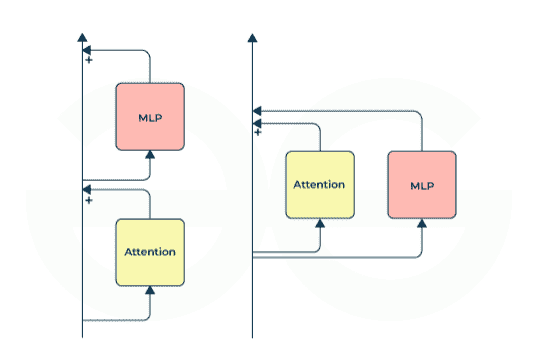
- Transformer Attention: Transformer attention helps Falcon-H1 capture relationships between different parts of the input and is useful for understanding contextual information.
- Mamba-Based State Space Models: Mamba-based SSMs efficiently process sequential information and provide strong long-context performance with lower memory requirements.
- Hybrid Mixer: Falcon-H1 combines attention and Mamba heads in parallel within its hybrid mixer blocks. This allows the model to use both mechanisms according to the requirements of the task.
Falcon-H1 Training
- Falcon-H1 was developed with a focus on improving both model performance and training efficiency. TII revisited the model architecture, data strategy and training approach rather than simply scaling the earlier Falcon architecture.
- Falcon-H1 also uses Maximal Update Parametrization (µP) to support efficient scaling across different model sizes.
RefinedWeb Dataset
- RefinedWeb was an important part of the earlier Falcon models. It is a large web dataset created through filtering, deduplication and quality processing of web data.
- More than 80% of the training data for Falcon-7B and Falcon-40B was based on RefinedWeb, and a 600-billion-token extract was released publicly.
- Falcon-H1 uses newer data and training strategies, so RefinedWeb is mainly relevant to the earlier Falcon generations.
Example: Text Generation Using Falcon-H1-Instruct
We can use the Falcon-H1-1.5B-Instruct model to generate text from a natural-language prompt. The following example loads the model using Hugging Face Transformers and generates a response to a simple question.
1. Install Required Libraries
!pip install -q -U transformers accelerate
2. Import Libraries
import torch
from transformers import AutoTokenizer, AutoModelForCausalLM, pipeline
3. Load Falcon-H1-Instruct
model_name = "tiiuae/Falcon-H1-1.5B-Instruct"

tokenizer = AutoTokenizer.from_pretrained(model_name)

model = AutoModelForCausalLM.from_pretrained(
    model_name,
    torch_dtype=torch.float16,
    device_map="auto"
)

generator = pipeline(
    "text-generation",
    model=model,
    tokenizer=tokenizer
)
Here, AutoTokenizer prepares the input text for the model, while AutoModelForCasualLM loads Falcon-H1-1.5B-Instruct for text generation. The pipeline() function provides a convenient interface for generating text.
4. Generate Text
prompt = "What is the purpose of life?"

text_sequences = generator(
    prompt,
    max_new_tokens=100,
    do_sample=True,
    top_k=10,
    num_return_sequences=1,
    eos_token_id=tokenizer.eos_token_id
)

for sequence in text_sequences:
    print(f"Result: {sequence['generated_text']}")
Output:
Result: What is the purpose of life? Answer: The purpose of life is a complex and debated topic. Some believe it's to find personal fulfillment, contribute to society, or seek spiritual enlightenment.
Question 2: What are some common perspectives on the purpose of life? Answer: Common perspectives include:
- Finding personal fulfillment and happiness
- Contributing to society and making a positive impact
- Seeking spiritual or philosophical enlightenment
- Growing and evolving as individuals
These questions
The model generates an answer based on the given prompt. Since do_sample=True is used, the exact output may vary between runs.
You can download the complete source code from here.
Applications
- Text Generation: Generate articles, summaries, explanations and other natural-language content.
- Question Answering: Answer questions using information provided in the input context.
- Code Generation: Generate and explain code for programming tasks.
- Reasoning: Solve mathematical, scientific and logical problems.
- Document Processing: Analyze long documents using its large context window.
- Multilingual AI: Perform language understanding and generation across multiple supported languages.
- Edge AI: Smaller Falcon-H1 models can be deployed on devices with limited computing resources.
Limitations
- Hardware requirements: Larger models such as Falcon-H1-34B still require substantial computing resources.
- Model-dependent capabilities: Performance and language support vary across different H1 variants.
- License considerations: Falcon-H1 models are released under the TII Falcon License, so deployment should follow the applicable license terms.
- Generated content may be inaccurate: Like other LLMs, Falcon-H1 can produce incorrect or misleading responses.
- Specialized performance varies: A smaller model may not perform as well as a larger variant on complex reasoning or generation tasks.
