

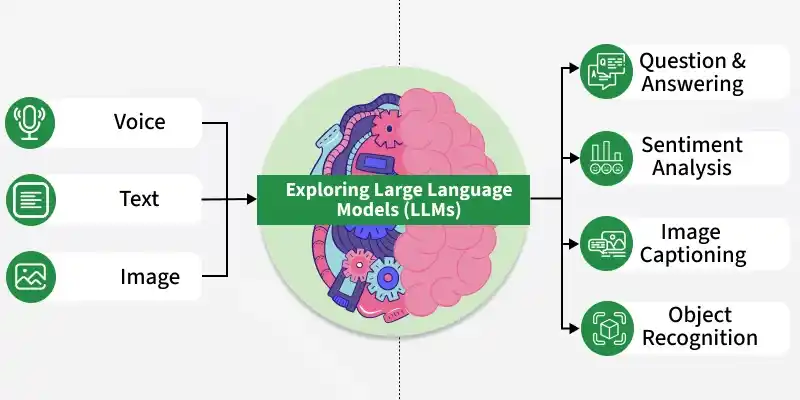
Large Language Models (LLMs) are advanced AI systems built on deep neural networks designed to process, understand and generate human-like text.
- LLMs Learn patterns, grammar and context from text and can answer questions, write content, translate languages and many more.
- By using massive datasets and billions of parameters, LLMs have transformed the way humans interact with technology.
- Modern LLMs include ChatGPT (OpenAI), Google Gemini, Anthropic Claude, etc.
At a basic level, an LLM predicts the next token based on the tokens that came before it.
Example:
The sun rises in the __
The model may assign a high probability to: east
The model does not simply memorize sentences. During training, it learns statistical and semantic patterns that allow it to generate new text based on the given context.
Working of LLM
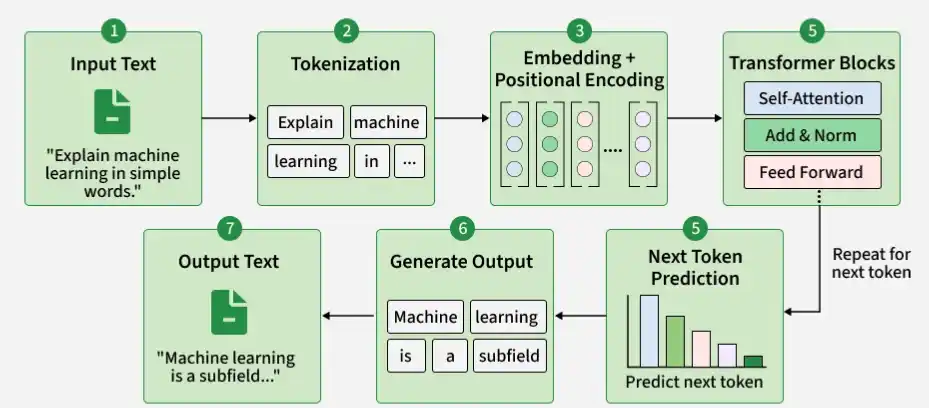
1. Tokenization
The input text is divided into smaller units called tokens.
For example:
Machine learning is useful __
may be split into: ["Machine", " learning", " is", " useful"]
2. Embeddings
Each token is converted into a numerical vector called an embedding, which represents its meaning and relationships with other tokens.
3. Transformer Architecture
The tokens pass through multiple Transformer blocks that process their relationships using self-attention and feed-forward networks.
A simplified flow is: Tokens → Embeddings → Transformer Blocks → Output
4. Self-Attention
Self-attention helps the model understand relationships between tokens by determining which tokens are important to each other.
For example:
It helps connect "it" with the relevant word in: The animal crossed the road because it was tired.
5. Next-Token Prediction
The LLM predicts the next token based on the previous tokens.
For example:
Artificial intelligence is → powerful
The process repeats one token at a time until the complete response is generated.
Popular LLMs
Examples of well-known LLM families include : GPT, Llama, Claude, Gemini, Mistral and Qwen
- GPT-5.4 (OpenAI): Advanced LLM designed for reasoning, coding, tool use and a wide range of language tasks.
- Gemini 3.1 Pro (Google DeepMind): Multimodal LLM capable of processing text, images, audio, video and documents.
- Claude Sonnet 5 and Claude Opus 5 (Anthropic): LLMs designed for reasoning, coding, writing and other complex tasks.
- Llama 4 (Meta): Open-weight multimodal LLM family that includes models such as Llama 4 Scout and Llama 4 Maverick.
- DeepSeek-V4.1-Flash (DeepSeek): Multimodal LLM designed for reasoning, coding and efficient AI applications.
- Mistral Large 3 (Mistral AI): Open-weight multimodal LLM designed for general-purpose language, reasoning and coding tasks.
- Qwen3 (Alibaba): A family of LLMs designed for language, reasoning, coding and multilingual applications, with multimodal variants such as Qwen3-VL.
Applications
- Code Generation: LLMs can generate accurate code based on user instructions for specific tasks.
- Debugging and Documentation: They assist in identifying code errors, suggesting fixes and even automating project documentation.
- Question Answering: Users can ask both casual and complex questions, receiving detailed, context-aware responses.
- Language Translation and Correction: LLMs can translate across many languages (often dozens to 100+).
- Prompt-Based Versatility: By crafting creative prompts, users can unlock endless possibilities, as LLMs excel in one-shot and zero-shot learning scenarios.
Advantages
- Can perform new tasks using zero-shot and few-shot learning without retraining
- Efficiently process and understand large amounts of text data
- Adapt easily to specific domains through fine-tuning
- Automate repetitive language-based tasks, reducing human effort
- Work effectively across multiple domains like healthcare, education and business
Limitations
- Require very high computational resources, making them expensive to train
- Training can take a long time, often weeks or months
- Depend on large amounts of high-quality and unbiased data
- Consume significant energy, contributing to environmental impact
- Can introduce bias and misinformation, raising ethical concerns
For a complete guide on LLMs, refer to this page - Large Language Model (LLM) Tutorial
