

Prerequisites: Generative Adversarial Network
This article will demonstrate how to build an Auxiliary Generative Adversarial Network using the Keras and TensorFlow libraries. The dataset which is used is the MNIST Image dataset pre-loaded into Keras.
Step 1: Setting up the environment
Step 1 : Open Anaconda prompt in Administrator mode.

Step 2 : Create a virtual environment using the command : conda create --name acgan python=3.7

Step 3 : Then, activate the environment using the command : conda activate acgan

Step 4 : Install the following libraries -
         4.1 - Tensorflow --> pip install tensorflow==2.1
         4.2 - Keras      --> pip install keras==2.3.1
Step 2: Importing the required libraries
from keras.datasets import mnist
from keras.layers import Input, Dense, Reshape, Flatten, Dropout, multiply
from keras.layers.convolutional import UpSampling2D, Conv2D
from keras.layers import BatchNormalization, Activation, Embedding, ZeroPadding2D
from keras.models import Sequential, Model
from keras.layers.advanced_activations import LeakyReLU

from tensorflow.keras.optimizers import Adam

import matplotlib.pyplot as plt
import numpy as np
Step 3: Defining parameters to be used in later processes
# Defining the Input shape
image_shape = (28, 28, 1)
classes = 10
latent_dim = 100

# Defining the optimizer and the losses
optimizer = Adam(0.0002, 0.5)
losses = ['binary_crossentropy','sparse_categorical_crossentropy']
Step 4: Defining a utility function to build the Generator
def build_generator():

    model = Sequential()

    # Building the input layer
    model.add(Dense(128 * 7 * 7, activation="relu", input_dim=latent_dim))
    model.add(Reshape((7, 7, 128)))
    model.add(BatchNormalization(momentum=0.82))
    model.add(UpSampling2D())

    model.add(Conv2D(128, (3,3), padding="same"))
    model.add(BatchNormalization(momentum=0.82))
    model.add(Activation("relu"))
    model.add(UpSampling2D())

    model.add(Conv2D(64, (3,3), padding="same"))
    model.add(BatchNormalization(momentum=0.82))
    model.add(Activation("relu"))

    model.add(Conv2D(1, (3,3), padding='same'))
    model.add(Activation("tanh"))

    # Generating the output image
    noise = Input(shape=(latent_dim,))
    label = Input(shape=(1,), dtype='int32')
    z = Flatten()(Embedding(classes, latent_dim)(label))

    model_input = multiply([noise, z])
    image = model(model_input)

    return Model([noise, label], image)
Step 5: Defining a utility function to build the Discriminator
def build_discriminator():

    model = Sequential()

    # Building the input layer
    model.add(Conv2D(16, (3,3), strides=2, input_shape=image_shape, padding="same"))
    model.add(LeakyReLU(alpha=0.2))
    model.add(Dropout(0.25))

    model.add(Conv2D(32, (3,3), strides=2, padding="same"))
    model.add(ZeroPadding2D(padding=((0,1),(0,1))))
    model.add(LeakyReLU(alpha=0.2))
    model.add(Dropout(0.25))

    model.add(BatchNormalization(momentum=0.8))

    model.add(Conv2D(64, (3,3), strides=2, padding="same"))
    model.add(LeakyReLU(alpha=0.2))
    model.add(Dropout(0.25))

    model.add(BatchNormalization(momentum=0.8))

    model.add(Conv2D(128, (3,3), strides=1, padding="same"))
    model.add(LeakyReLU(alpha=0.2))
    model.add(Dropout(0.25))

    model.add(Flatten())

    image = Input(shape=image_shape)

    # Extract features from images
    features = model(image)

    # Building the output layer
    validity = Dense(1, activation="sigmoid")(features)
    label = Dense(classes, activation="softmax")(features)

    return Model(image, [validity, label])
Step 6: Defining a utility function to display the generated images
def display_images():
    r = 10
    c = 10
    noise = np.random.normal(0, 1, (r * c,latent_dim))

    new_labels = np.array([num for _ in range(r) for num in range(c)])
    gen_images = generator.predict([noise, new_labels])

    # Rescale images 0 - 1
    gen_images = 0.5 * gen_images + 0.5

    fig, axs = plt.subplots(r, c)
    count = 0
    for i in range(r):
        for j in range(c):
            axs[i,j].imshow(gen_images[count,:,:,0], cmap='gray')
            axs[i,j].axis('off')
            count += 1
    plt.show()
    plt.close()
Step 7: Building and Training the AC-GAN
def train_acgan(epochs, batch_size=128, sample_interval=50):

    # Load the dataset
    (X, y), (_, _) = mnist.load_data()

    # Configure inputs
    X = X.astype(np.float32)
    X = (X - 127.5) / 127.5
    X = np.expand_dims(X, axis=3)
    y = y.reshape(-1, 1)

    # Adversarial ground truths
    valid = np.ones((batch_size, 1))
    fake = np.zeros((batch_size, 1))

    for epoch in range(epochs):

        # Select a random batch of images
        index = np.random.randint(0, X.shape[0], batch_size)
        images = X[index]

        # Sample noise as generator input
        noise = np.random.normal(0, 1, (batch_size, latent_dim))

        # The labels of the digits that the generator tries to create an
        # image representation of
        new_labels = np.random.randint(0, 10, (batch_size, 1))

        # Generate a half batch of new images
        gen_images = generator.predict([noise, new_labels])

        image_labels = y[index]

        # Training the discriminator
        disc_loss_real = discriminator.train_on_batch(
          images, [valid, image_labels])
        disc_loss_fake = discriminator.train_on_batch(
          gen_images, [fake, new_labels])
        disc_loss = 0.5 * np.add(disc_loss_real, disc_loss_fake)

        # Training the generator
        gen_loss = combined.train_on_batch(
          [noise, new_labels], [valid, new_labels])

        # Print the accuracies
        print ("%d [acc.: %.2f%%, op_acc: %.2f%%]" % (
          epoch, 100 * disc_loss[3], 100 * disc_loss[4]))

        # display at every defined epoch interval
        if epoch % sample_interval == 0:
            display_images()
Step 8: Building the Generative Adversarial Network
# Build and compile the discriminator
discriminator = build_discriminator()
discriminator.compile(loss=losses,
    optimizer=optimizer,
    metrics=['accuracy'])

# Build the generator
generator = build_generator()

# Defining the input for the generator
#and generating the images
noise = Input(shape=(latent_dim,))
label = Input(shape=(1,))
image = generator([noise, label])

# Disable the Discriminator
# For the combined model we will only train the generator
discriminator.trainable = False

# The discriminator takes in the generated image
# as input and determines validity
# and the label of that image
valid, target_label = discriminator(image)

# The combined model (both generator and discriminator)
# Training the generator to fool the discriminator
combined = Model([noise, label], [valid, target_label])
combined.compile(loss=losses, optimizer=optimizer)

train_acgan(epochs=14000, batch_size=32, sample_interval=2000)
Output (At every 2000 epoch interval):
Epoch 0

Epoch 2000

Epoch 4000

Epoch 6000

Epoch 8000

Epoch 10000

Epoch 12000

Epoch 14000
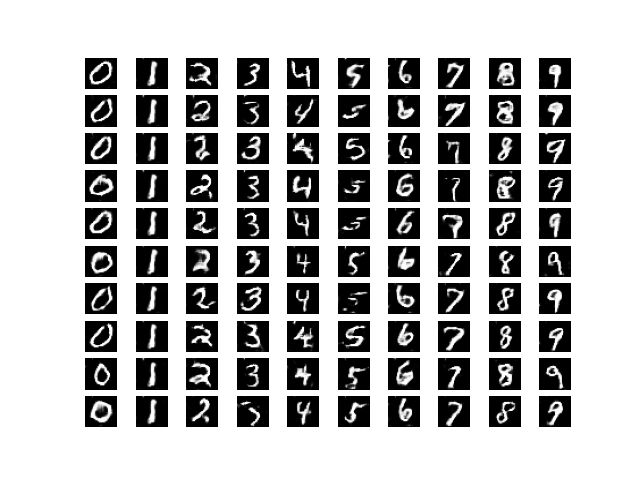
On visually observing the progression of generated images, it can be concluded that the network is working at an acceptable level. The quality of images can be improved by training the network for more time or by tuning the parameters of the network. For any doubts/queries, comment below.
