

Machine Learning Pipeline is a structured workflow that connects the different tasks involved in building and using a machine learning model. It takes data as input, processes it through a series of steps, and produces a trained model that can be used to make predictions.
- Connects the different tasks involved in developing a machine learning model.
- Reduces the need to manually perform the same steps whenever the model is trained or updated.
- Ensures that the same processing steps are followed each time the pipeline runs.
- Minimizes mistakes that can occur when different tasks are performed manually.
- The same pipeline can be run again with new data or when the model needs to be updated.
- Makes complex machine learning workflows easier to build and manage.
Steps for Building
A machine learning pipeline is a step-by-step process that automates data preparation, model training and deployment. Here, we will discuss the key steps:
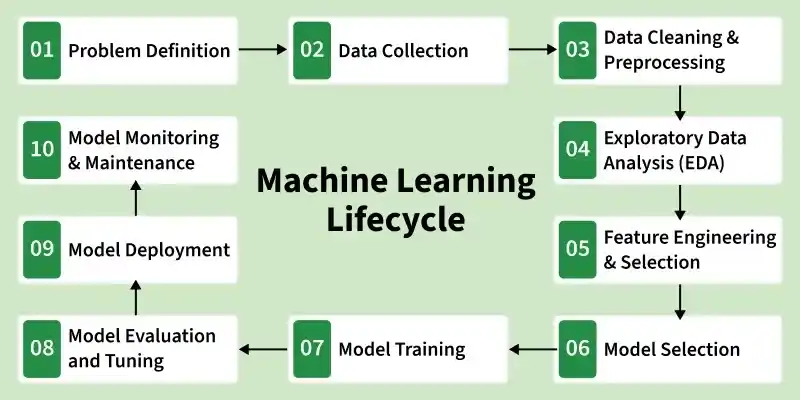
Step 1: Data Collection and Preprocessing
- Gather data from sources like databases, APIs or CSV files.
- Clean the data by handling missing values, duplicates and errors.
- Normalize and standardize numerical values.
- Convert categorical variables into a machine readable format.
Step 2: Feature Engineering
- Select the most important features for better model performance.
- Create new features for feature extraction or transformation.
Step 3: Data Splitting
- Divide the dataset into training, validation and testing sets.
- When dealing with imbalanced datasets, use random sampling.
Step 4: Model Selection & Training
- Choose the best algorithm based on the problem includes classification, regression, Clustering etc.
- Train the model using the training dataset.
Step 5: Model evaluation & Optimization
- Test the model's performance using accuracy, precision, recall and other metrics.
- Tune hyperparameters using Grid Search or Random Search and avoiding overfitting using techniques like cross- validation.
Step 6: Model Deployment
- Deploy the trained model using Flask, FastAPI, TensorFlow and cloud services.
- Save the trained model for real-world applications.
Types
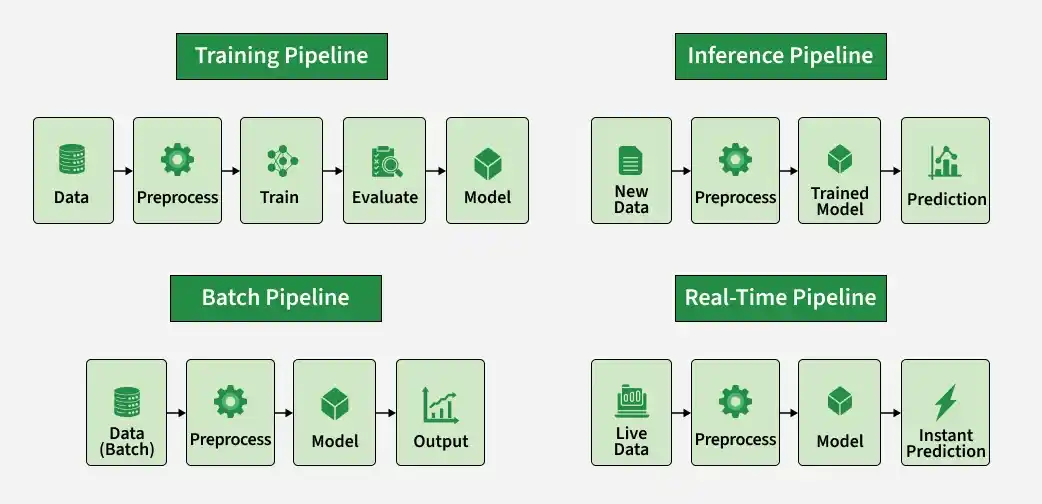
Machine learning pipelines can be classified based on their purpose and how they process data.
1. Training Pipeline
- Automates the process of preparing data and training a machine learning model.
- Includes data preprocessing, feature engineering, model training and evaluation.
- Used when building a new model or updating an existing model.
2. Inference Pipeline
- Processes new or unseen data using a trained model.
- Applies the required preprocessing before generating predictions.
- Used after a model has been trained and deployed.
3. Batch Pipeline
- Processes data in groups at scheduled or predefined intervals.
- Suitable when predictions do not need to be generated immediately.
- Commonly used for periodic data processing and reporting tasks.
4. Real-Time Pipeline
- Processes incoming data continuously or as it arrives.
- Generates predictions with low latency.
- Suitable for applications that require immediate predictions, such as fraud detection.
Implementation for Model Training
Step 1: Import Libraries and Prepare Data
#from sklearn.pipeline import Pipeline
from sklearn.preprocessing import StandardScaler
from sklearn.linear_model import LinearRegression

# Training data
X = [[1], [2], [3], [4], [5]]
y = [2, 4, 6, 8, 10] code
Step 2: Create and Train the Pipeline
pipeline = Pipeline([
    ('scaler', StandardScaler()),
    ('model', LinearRegression())
])

pipeline.fit(X, y)

print("Model trained successfully!")
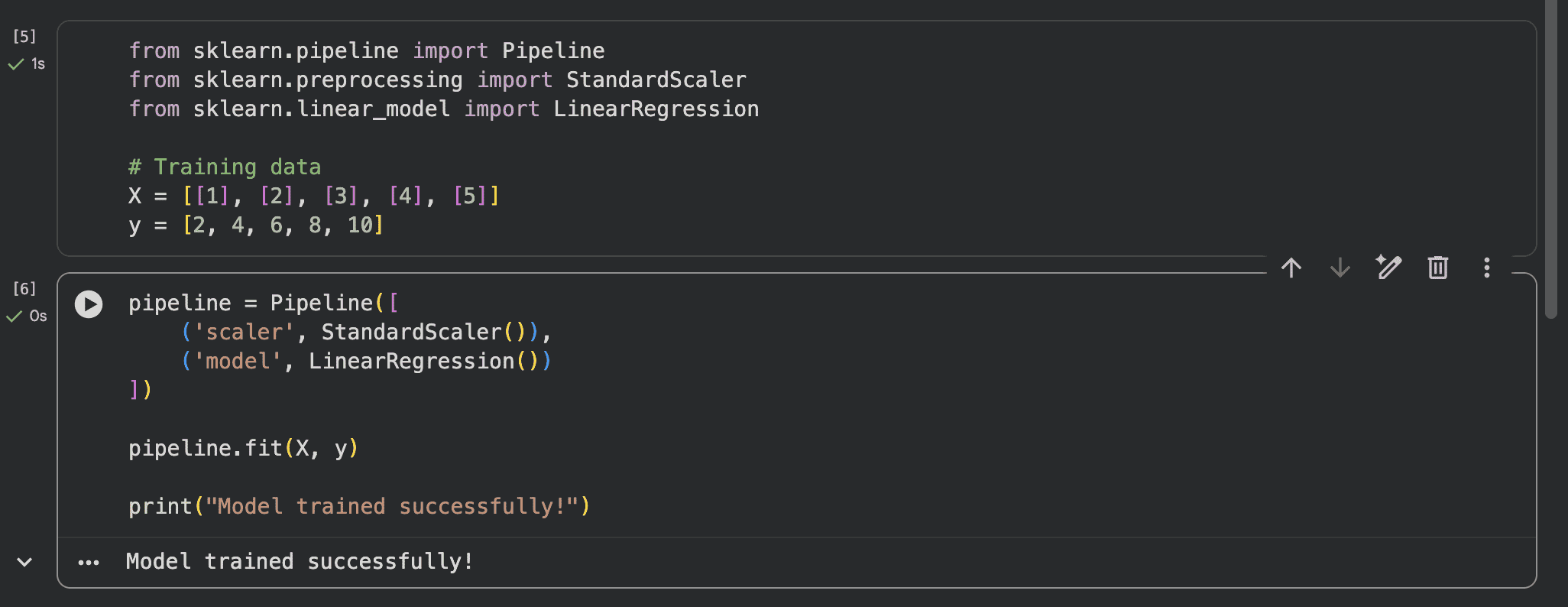
The pipeline combines data preprocessing and model training into a single workflow. The StandardScaler preprocesses the input data, while LinearRegression trains the model using the processed data.
Step 3: Make a Prediction
prediction = pipeline.predict([[6]])

print("Prediction:", prediction[0])

The trained pipeline is used to make a prediction for new input data. The pipeline automatically applies the preprocessing step before passing the data to the trained model.
Difference between ML Pipeline and MLOps
| Aspect | ML Pipeline | MLOps |
|---|---|---|
| Definition | A workflow for building and using ML models | A broader practice for managing ML systems throughout their lifecycle |
| Focus | Data preparation, training, evaluation and deployment | Automation, deployment, monitoring, versioning, testing, retraining and governance |
| Purpose | Defines how individual ML tasks are performed | Defines how ML systems are developed, deployed and maintained reliably |
| Scope | Focuses on a specific ML workflow | Covers the broader ML development and operational lifecycle |
| Relationship | Can be a part of an MLOps workflow | Can include multiple ML pipelines |
