

Java is a widely used programming language for building web, desktop, mobile, and enterprise applications. It is known for its simple syntax, portability, and powerful features that make development easier and more secure.
- Supports object-oriented programming concepts like classes, objects, inheritance, and polymorphism
- Platform independent because of JVM support
- Secure and robust with strong memory management
Features of Java
Java provides several features that make it suitable for developing reliable, portable, and scalable applications.
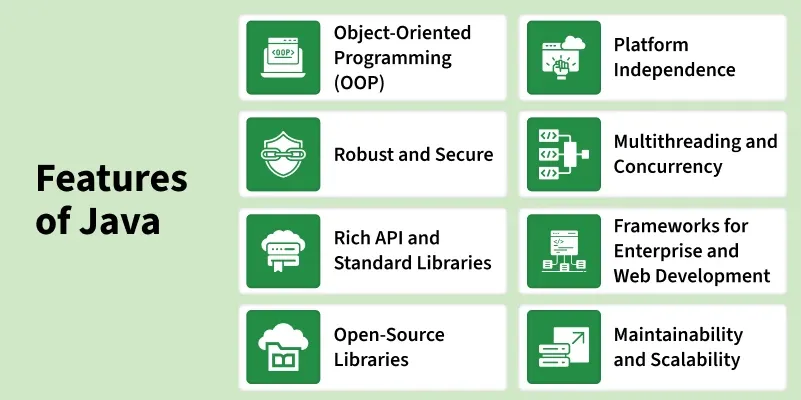
- Object-Oriented Programming: Supports modular and reusable code using classes, objects, inheritance, encapsulation, polymorphism, and abstraction.
- Platform Independence: Java bytecode can run on any platform that provides a compatible JVM.
- Robustness: Provides features such as automatic memory management, exception handling, and type checking.
- Security: Includes built-in mechanisms such as bytecode verification, class loading controls, and Java security APIs.
- Multithreading and Concurrency: Provides APIs for executing and coordinating multiple tasks concurrently.
- Rich Standard Library: Provides built-in APIs for collections, I/O, networking, concurrency, database connectivity, and other common programming tasks.
- Automatic Memory Management: The JVM manages object memory and automatically reclaims unreachable objects through garbage collection.
- High Performance: JVM technologies such as Just-In-Time (JIT) compilation can compile frequently executed bytecode into native machine code at runtime.
Understanding Hello World Program
The first program that developers usually write while learning any programming language is the Hello World program. It helps verify that the Java Development Kit (JDK) is installed correctly and introduces the basic structure of a Java program.
Traditional Hello World Program
This is the standard approach used in Java and works in all Java versions.
public class HelloWorld {
    public static void main(String[] args) {
        System.out.println("Hello World!");
    }
}
Output
Hello World!
Simplified Hello World Program (Java 24+)
Modern Java provides a simplified way to write small programs without explicitly declaring the traditional public static void main(String[] args) method. This capability was available as a preview feature in Java 24 and became permanent in Java 25.
class Geeks{
    void main() {
        System.out.println("Hello, World!");
    }
}
Output
Hello, World!
This simplified syntax reduces boilerplate code and makes it easier for beginners to write their first Java programs.
Note: In Java 24, simple source files and instance main methods were preview features and required preview features to be enabled. The feature was finalized in Java 25.
Structure of a Java Program
The structure of a Java program defines the standard format for writing Java applications and includes essential components required for program execution.
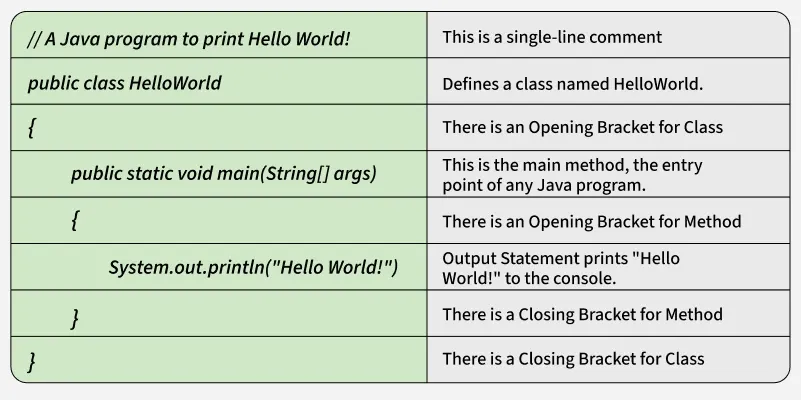
How to run the above code?

- Write code in a file like HelloWorld.java.
- Java Compiler "javac" compiles it into bytecode "HelloWorld.class".
- JVM (Java Virtual Machine) reads the .class file and interprets the bytecode.
- The JVM initially interprets bytecode and uses JIT (Just-In-Time) compilation to convert frequently executed code into native machine code for better performance.
Famous Applications Built Using Java
Java has been used in many well-known applications, platforms, and large-scale software systems. Its portability, mature ecosystem, and support for backend development make it suitable for a wide range of applications.
- Android Applications: Java has historically been one of the primary languages for Android development and remains widely used in existing Android applications.
- Minecraft: Java Edition: The Java Edition of Minecraft is developed using Java.
- Apache Hadoop: Hadoop is largely implemented in Java and is widely used for distributed storage and processing of large datasets.
- Apache Kafka: Kafka is primarily implemented using Java and Scala and is commonly used for distributed event streaming.
- NASA WorldWind: WorldWind is an open-source virtual globe technology with a Java-based SDK.
Companies may use multiple programming languages and technologies, and their technology stacks can change over time.
Uses of Java
- Mobile App Development is widely used for building Android applications using Android Studio.
- Web Development is used to create web applications and REST APIs with frameworks like Spring, Spring Boot, Struts, and Hibernate.
- Desktop GUI Applications are developed using libraries such as JavaFX and Swing.
- Enterprise Applications power banking systems, ERP software, and other large-scale business applications.
- Game Development is supported through frameworks and engines like LibGDX and jMonkeyEngine.
- Big Data Technologies use Java in platforms such as Hadoop and Apache Kafka for processing large datasets.
- Internet of Things (IoT) enables Java to run on embedded systems and smart devices.
- Cloud-Based Applications are built and deployed on platforms like AWS, Azure, and Google Cloud.
- Scientific Applications use Java to develop tools for processing and analyzing large volumes of scientific data.
