

CRUD stands for Create, Read, Update and Delete. These are the four basic operations used to manage data stored in SQL tables.

Create
The INSERT statement is used to add new records to a table.
Example 1: Insert values into all columns
INSERT INTO employees VALUES (1, 'James');This inserts a new employee record into the employees table.
Example 2: Insert values into specific columns
Here, only the specified columns receive values. Any column not specified receives its default value or NULL, depending on the table definition.
INSERT INTO employees (id, name) VALUES (2, 'Mike');Output:
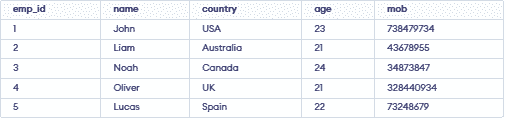
Note: Values must match the column data types and order. Specifying column names is safer and clearer.
Read
The SELECT statement is used to retrieve data from a table.
Example 1: Select all columns
SELECT * FROM employees;This retrieves all columns and rows from the employees table.
Output:
Example 2: Select specific columns
SELECT employee_id, employee_name, salary FROM employees;Output:

Example 3: Read records using a condition
SELECT * FROM employees WHERE age = 24;Output:

Note: SELECT is used to retrieve data from a table, with WHERE for filtering and ORDER BY for sorting results.
Update
The UPDATE statement is used to modify existing records.
Example 1: Update a single record
UPDATE employeesSET age = 25
WHERE emp_id = 3;
This changes Alex's salary from 25000 to 30000.
Example 2: Update multiple columns
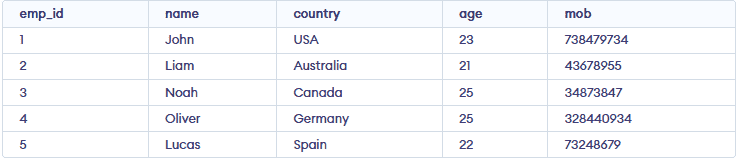
UPDATE employeesSET age = 25,    country = 'Germany'
WHERE emp_id = 3;
Output After Update:
Delete
The DELETE statement is used to remove records from a table.
Example 1: Delete a specific record
DELETE FROM employees WHERE emp_id = 4;Output:
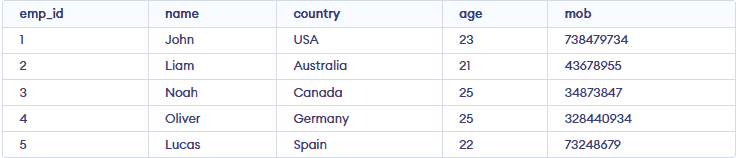
This removed the employee whose employee_id is 4.
