

- Courses
- Tutorials
- Practice
- Jobs
50 DBMS MCQs with Answers
Question 1
Consider the following transactions with data items P and Q initialized to zero:
T1: read (P) ;
    read (Q) ;
    if P = 0 then Q : = Q + 1 ;
    write (Q) ;
T2: read (Q) ;
    read (P) ;
    if Q = 0 then P : = P + 1 ;
    write (P) ;
Any non-serial interleaving of T1 and T2 for concurrent execution leads to
- A
A serializable schedule
- B
A schedule that is not conflict serializable
- C
A conflict serializable schedule
- D
A schedule for which a precedence graph cannot be drawn
Question 2
Table A:
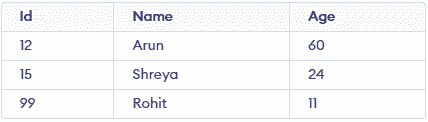
Table B:
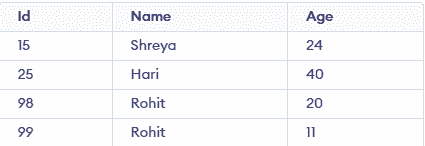
Table C:

Consider the above tables A, B and C. How many tuples does the result of the following SQL query contains?
SELECT A.id
FROM   A
WHERE  A.age > ALL (SELECT B.age
                    FROM   B
                    WHERE  B. name = "arun")
- A
4
- B
3
- C
0
- D
1
Question 3
Database table by name Loan_Records is given below.
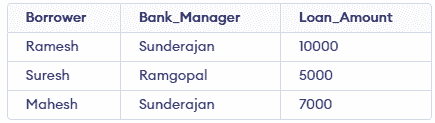
What is the output of the following SQL query?
SELECT Count(*)
FROM  ( ( SELECT Borrower, Bank_Manager
          FROM Loan_Records) AS S
          NATURAL JOIN ( SELECT Bank_Manager, Loan_Amount
FROM Loan_Records) AS T );- A
3
- B
9
- C
5
- D
6
Question 4
Consider the following relational schema:
Suppliers(sid:integer, sname:string, city:string, street:string)
Parts(pid:integer, pname:string, color:string)
Catalog(sid:integer, pid:integer, cost:real)
Consider the following relational query on the above database:
SELECT S.sname
    FROM Suppliers S
        WHERE S.sid NOT IN (SELECT C.sid
                            FROM Catalog C
                            WHERE C.pid NOT IN (SELECT P.pid
                                                FROM Parts P
                                                WHERE P.color<> 'blue'))
Assume that relations corresponding to the above schema are not empty. Which one of the following is the correct interpretation of the above query?
- A
Find the names of all suppliers who have supplied a non-blue part.
- B
Find the names of all suppliers who have not supplied a non-blue part.
- C
Find the names of all suppliers who have supplied only blue parts.
- D
Find the names of all suppliers who have not supplied only blue parts.
Question 5
Let R1 (a, b, c) and R2 (x, y, z) be two relations in which a is the foreign key of R1 that refers to the primary key of R2 . Consider following four options. (a)Insert into R 1 (b)Insert into R 2 (c)Delete from R 1 (d)Delete from R 2 Which of the following is correct about the referential integrity constraint with respect to above?
- AOperations (a) and (b) will cause violation.
- BOperations (b) and (c) will cause violation.
- COperations (c) and (d) will cause violation.
- DOperations (d) and (a) will cause violation.
Question 6
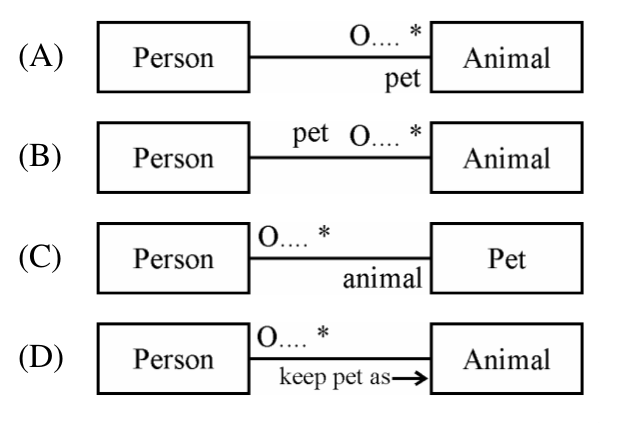
How to express that some person keeps animals as pets?
- A(A)
- B(B)
- C(C)
- D(D)
Question 7
A view of database that appears to an application program is known as
- A
Schema
- B
Subschema
- C
Virtual table
- D
Index Table
Question 8
Which operation is used to extract specified columns from a table?
- A
Project
- B
Join
- C
Extract
- D
Substitute
Question 9
The relation schemas R1 and R2 form a Lossless join decomposition of R if and only if: (a) R1 ∩ R2 ↠ (R1 - R2) (b) R1 → R2 (c) R1 ∩ R2 ↠ (R2 - R1 ) (d)(R2 → R1) ∩ R2
- A(a) and (b) happens
- B(a) and (d) happens
- C(a) and (c) happens
- D(b) and (c) happens
Question 10
In functional dependency Armstrong inference rules refers to
- A
Reflexivity, Augmentation and Decomposition
- B
Transitivity, Augmentation and Reflexivity
- C
Augmentation, Transitivity, Reflexivity and Decomposition
- D
Reflexivity, Transitivity and Decomposition
There are 50 questions to complete.
