

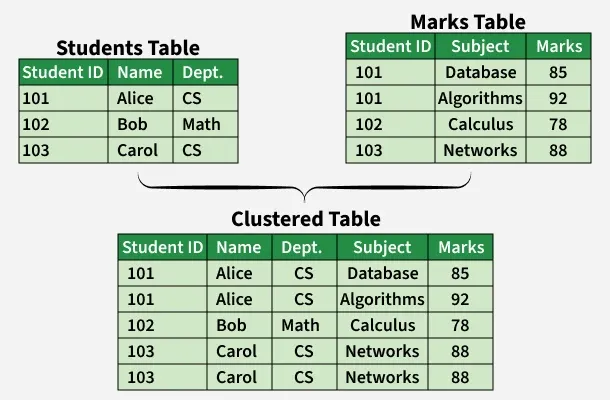
Clustered indexing is a database indexing technique that is used to physically arrange the data in a table based on the values of the clustered index key.
- Rows are stored in the order of the clustered index key.
- Improves query execution speed and overall database performance.
- A table can have only one clustered index because the data can have only one clustered ordering
When to Use Clustered Indexing
Clustered indexing is a useful technique for improving the performance of database queries and data storage.
- When Data is Often Retrieved in a Specific Order: If your queries often retrieve data in a specific order, Clustered indexing can be a great choice. By physically arranging the data in the table according to the clustered index key, the database can quickly locate and retrieve the data it needs.
- When Query Performance is a Concern: If query performance is a concern, Clustered indexing can be a great option. By using the clustered index to quickly locate the data, the database can execute queries faster, particularly for queries that return large amounts of data.
- When Range Queries are Frequent: Suitable when queries frequently retrieve rows within a specific range of clustered index key values.
Note: Clustered indexing may not always be the best choice. Frequent insertions or updates to the clustering key can increase page modifications and index maintenance overhead.
Applications
- Range-Based Queries: Ideal for BETWEEN, <, > queries since ordered records lie in contiguous disk blocks, reducing page accesses.
- Improved performance for grouped data: Tuples sharing the same clustering key (e.g., department or category) are stored together, speeding up group and equality scans.
- Better performance in data warehousing: Improves performance for queries that frequently filter or access data using commonly used dimensions such as date or region.
- Used in file organization: Determines the physical order of records in clustered files, unlike secondary indexes which only store pointers.
- Sequential Data Access: Efficient for retrieving large sets of rows in clustered-key order.
Advantages
- Efficient Range Queries: Makes retrieval of rows within a range of clustered index key values more efficient.
- Improved Query Performance: Reduces the number of page accesses required for suitable queries by storing data according to the clustered index key.
- Efficient Sequential Access: Supports efficient retrieval of rows in clustered-key order.
Disadvantages
- Index Maintenance Overhead: Insert and update operations can require page modifications, splitting, or reorganization, which may affect performance.
- Storage and Maintenance Cost: Creating or rebuilding a clustered index can require additional resources, especially for large tables.
- Limited to One Clustered Index: A table can have only one clustered index, as having multiple clustered indexes would result in conflicting physical orderings of the data.
Read More About: Primary Indexing in Databases
