

Large Language Models (LLMs) process and generate text mainly at the token level, making them effective for tasks such as text generation, translation and question answering. To explore a higher-level approach, Meta introduced Large Concept Models (LCMs), which predict the next concept instead of the next token. In the original LCM architecture, a concept is represented as a sentence-level embedding in the SONAR semantic space.
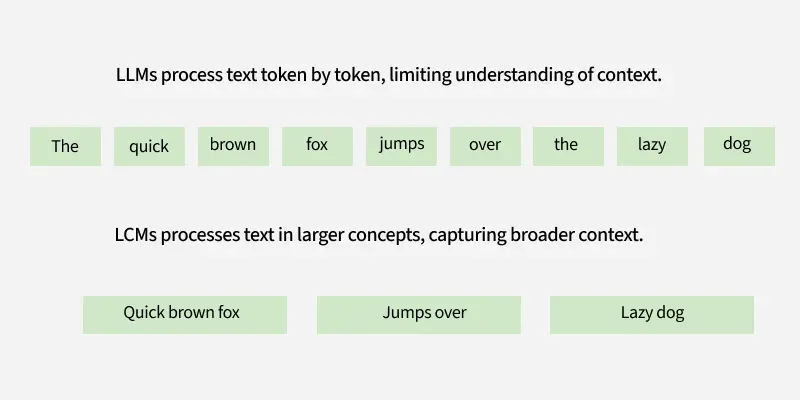
For example
While an LLM predicts the next token in a sentence, an LCM represents the current sentence as an embedding and predicts the embedding of the next sentence. This allows language to be modeled as a sequence of higher-level concepts rather than individual tokens.
Working
The basic working of an LCM can be divided into three steps:
- Convert sentences into embeddings: Input sentences are represented as semantic embeddings using the SONAR embedding space.
- Predict the next concept: The LCM predicts the embedding corresponding to the next sentence or concept.
- Generate text: The predicted embedding is decoded into text.
Therefore, instead of directly learning:
Token -> Token -> Token
LCM models a higher-level sequence:
Concept -> Concept -> Concept
The original LCM research explored different approaches for predicting these concept embeddings, including regression, diffusion-based generation and quantized representations.
Features
1. Concept-Level Processing
- LCMs model language using higher-level semantic representations instead of directly predicting individual tokens. In the original LCM implementation, each concept corresponds to a sentence embedding.
- This allows the model to learn relationships between sentence-level ideas while reducing the number of prediction steps compared with token-level modeling.
2. Multilingual Representation
- The original LCM uses SONAR, a multilingual and multimodal sentence-embedding space. The original SONAR system supported text in 200 languages and provided a shared representation space for text and speech.
- This shared space allows related meanings to be represented across languages, making it useful for multilingual modeling and zero-shot generalization.
3. Higher-Level Sequence Modeling
- LCMs model sequences using sentence-level representations, reducing the number of autoregressive prediction steps compared with token-level modeling.
- Meta reported that this approach becomes more computationally efficient as input context grows.
Advantages over LLMs
| Feature | LLM | LCM |
|---|---|---|
| Basic Unit | Token | Concept or sentence |
| Prediction | Next token | Next concept embedding |
| Representation | Token-level | Sentence-level semantic embedding |
| Generation | Token by token | Concept by concept |
| Multilingual Support | Through language-specific token representations | Through a shared semantic space |
| Research Stage | Mature and widely used | Emerging research direction |
Current Developments
- 2024: Meta introduced LCMs as an experimental approach to language modeling in a sentence representation space.
- 2026: Meta introduced v-Sonar and v-LCM, extending concept-space modeling to vision-language tasks such as image/video captioning and question answering.
- 2026: OmniSONAR extended the shared semantic representation approach to text, speech, code and mathematical expressions across thousands of languages.
- OmniSONAR: Extended the shared semantic representation approach to broader multilingual and multimodal applications.
Applications
- Text Summarization: Generate summaries using sentence-level concepts.
- Summary Expansion: Expand summaries into detailed text.
- Multilingual Generation: Model concepts across languages.
- Multimodal Tasks: Extend concept-level modeling to vision-language tasks.
Limitations
- Information Loss: Sentence embeddings may lose fine-grained details.
- Additional Decoding: Concept embeddings must be decoded into text.
- Limited Evaluation: Research has focused on selected tasks rather than the broad range of LLM applications.
- Emerging Technology: LCMs are still experimental and are not a general replacement for LLMs.
