Melba Liston was active as a trombonist from 1942 in big bands such as those led by Gerald Wilson and Dizzy Gillespie, performed with Dexter Gordon and Billie Holiday, arranged music for Randy Weston, appeared in supporting roles in various Hollywood films, and worked as an educator. Yet her name remains known to few, perhaps because the trombone long was not considered an instrument for women. A reevaluation of her work is ongoing.

This is the full version of an article that appeared, in much shorter form, in *Jazz Podium* (February/March 2026).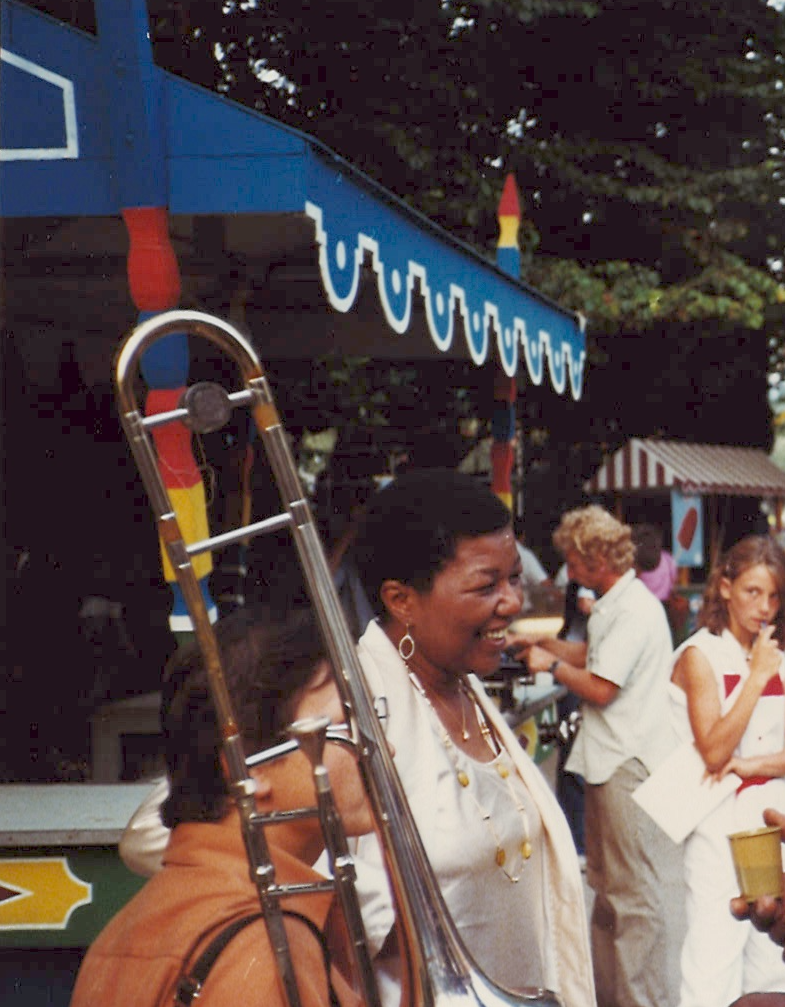
„You know, I’m not phony, I’m not social. I can’t just sit around and grin. I’m not really diplomatic in that fashion. So that blocked me from some assignments. I just can’t keep a false face on. And I admire those that can do it because they pave the way for those of us who don’t have the nerve or whatever it is. But I can’t make it work.“[1]
Melba Liston did not feel particularly comfortable in the spotlight. Solos were not her thing. She preferred working in the background, as an arranger—a job that has traditionally received little attention from the general public. “She could write most of the guys under the table without any effort,” commented the (classical) composer Hale Smith, who met her in the late 1950s[2]. Nearly forty years later, she was interviewed by the trumpeter Clora Bryant as part of the Smithsonian Jazz Oral History Program. Eleven years earlier, Liston had suffered a stroke—overwork, she believed, and frustration over the lack of recognition her music had received. She was partially paralyzed and had to give up the trombone. The pianist Randy Weston, together with other friends and colleagues, made sure she received a computer, which enabled her to continue arranging. Accompanied by her aunt, she later joined Weston on a trip to Morocco, where he was living for a time, and at a concert in Geneva she conducted the band with her left hand[3]. The stroke had clouded her memory; in her conversation with Bryant she could no longer recall many things and, on the other hand, had little desire to reflect on musical secrets. How she had come up with the voicings in “My Reverie,” which she wrote in 1956 for Dizzy Gillespie, or how she had managed to play such an impressive solo on it: no idea. I just played[4].
Childhood and youth
Melba Loretta Liston was born on January 13, 1926, in Kansas City, Missouri[5]. Her father died when she was still a child[6]. Her grandparents, with whom she spent much of her time, listened on the radio to Cab Calloway, Jimmie Lunceford, and Count Basie[7]. There was also a player piano whose pedals she would occasionally pump for her aunts so they could hear a blues or popular song played on it[8]. Music fascinated her in other ways as well; even as a child she developed a numerical system to remember the intervals of melodies she heard on the radio and wanted to sing back. When her school planned to introduce a music program, she and her mother visited a music store, where she saw a trombone. The salesman thought a clarinet or an accordion would be more suitable for a girl[9], but Melba insisted[10], and her mother eventually gave in[11]. She was largely self-taught on the trombone; her grandfather encouraged her, and soon she was playing melodies such as “Deep River” and “Rocking the Cradle of the Deep”[12]. Others in the family were less enthusiastic; music, they feared, would only bring the child into contact with a world of drugs and pimps[13]. At the time, Kansas City was an extraordinarily vibrant musical center, and she may have sensed some of that when older friends took her to the heart of the local jazz scene, the intersection of Eighteenth and Vine[14]. She was only eight years old when she was already performing on local radio. Music was so central to her life that others perceived her as a loner. Her only friends were children who loved music as much as she did[15].
In 1937, Melba Liston’s family moved to Los Angeles, where the highly gifted Melba skipped a grade. At McKinley Junior High School, she was fortunate to come under the guidance of music teacher Alma Hightower. Hightower was not only the great-aunt of saxophonist Vi Redd,[15] but had also taught other future jazz greats, including Dexter Gordon and Sonny Criss. During this time, Liston also met Eric Dolphy, who attended a different school.[16] Hightower introduced her students to all aspects of show business, as Liston later recalled: “We had to sing; we had to dance; we played harmonicas; we recited poetry; and we did variety-type things.”[17] Outside of school, she experienced live jazz for the first time,[18] and, together with her classmates, discovered which hotels the swing bands were staying at to get tips directly from the musicians. Her mother had come to accept her obsession: whenever friends couldn’t find her, she would just say, “Oh, there must be another band in town; just look in the trombone section.”[19] The young swing enthusiasts would listen to records together and memorize the solos.[20] Dexter Gordon later recalled how Liston would push others to learn the harmonies, think about arrangements, and write music for one another. Her musical care earned her the nickname “Mama” among her classmates.[21] Liston herself remembered copying Coleman Hawkins’ “Body and Soul” so many times for other saxophonists that she eventually didn’t even need to look at the sheet music.[22]
First jobs in Los Angeles
At sixteen, she received her membership card for the then still segregated musicians’ union in Los Angeles and, together with another young woman—the pianist of her high school band—secured a place in the pit band of the Lincoln Theatre led by Bardu Ali. A few years earlier, Ali had worked as a singer and conductor with the Chick Webb Orchestra[23] and had persuaded Webb to hire the young and still inexperienced Ella Fitzgerald[24]. In 1942, in the midst of the war, many male musicians had been drafted into the army. In Los Angeles’s Central Avenue Entertainment District[25], where the Lincoln Theatre—often referred to as the “West Coast Apollo”—was located, this created job opportunities for young female musicians, even in bands that would otherwise likely have been all-male[26]. The theater booked many well-known Black entertainers when they were in town. One band that impressed Liston was the International Sweethearts of Rhythm[27], an all-female ensemble. When they offered her the chance to join immediately, the young trombonist was briefly tempted, but declined at the last minute[28] after discovering that some of the band members were lesbians and fearing possible advances[29]. Otherwise, she recalls no particular problems, though she once overheard the theater manager complain about her, saying that it was apparently no longer enough to hire women—now they were hiring children as well[30]. Whenever smaller acts accompanied by Ali’s band did not bring their own arrangements, the pianist would quickly write some; and when he was absent due to illness one day, Bardu asked Liston if she could fill in—for an extra ten dollars. Learning by doing: as a trombonist, she explained, one always sits in the middle of the band and gets a good sense of how everything fits together. Moreover, trombonists are by nature more patient and less “flighty” than the reed players—a good quality for arrangers[31]. She played in Bardu Ali’s band for well over a year and a half[32].
One evening, none other than Louis Armstrong heard her and urged her to play a solo. That, however, was already not her thing at the time, as Liston later recalled[33]. Jam sessions, where her male colleagues liked to try themselves out, did not interest her either. Moreover, the sessions on Los Angeles’s Central Avenue were not really safe for women, as the trumpeter Clora Bryant noted: “A woman would rarely venture into a club unaccompanied. (…) Women instrumentalists, no matter how well known, steered clear of the jam sessions. Women who did venture into the performing arena found the range of opportunities limited.”[34]
Gerald Wilson
It was at the Lincoln Theatre that the trumpeter Gerald Wilson, who had previously played in the Jimmie Lunceford band, heard her. Wilson was looking for musicians for his own big band and hired Liston for the trombone section, as well as to serve as a copyist, extracting his arrangements into individual parts for the band. She had been a strong lead trombonist, he later recalled, and had also played good solos—usually better than the guys in the band[35]. And because women were still rare on that instrument, other stars of the time wanted to meet her, among them Duke Ellington and Count Basie[36].
Fortunately, we can get an idea of how this sounded, as Liston went into the studio several times with this orchestra. The music on one hand reflects the spirit of Count Basie of those years, with riff-driven arrangements leading into intense solos. On the other hand, you can hear that Wilson also drew on bebop, which he had learned from Dizzy Gillespie and Charlie Parker during their visits to the West Coast. For Liston, Wilson was something of a role model as an arranger—first while copying his scores, then when creating her own arrangements, which soon sounded so much like his that he would sometimes joke that she ought to leave the band, since no one would praise him for the pieces anymore[37]. How much she wrote at the time is unknown—she herself recalls it felt as if she had written half of the repertoire[38].
Among her arrangements is, for example, “Warm Mood”[39], featuring a sultry alto saxophone theme by Floyd Turnham with underlying big band voicings that suggest Liston had been listening to Duke Ellington records with Johnny Hodges.
In “Love Me a Long, Long Time”[40], her arrangement of the blues is noticeably influenced by Dizzy Gillespie’s bebop tonality, including subtle harmonic tensions in the background of the solos.
In “The Saint”[41], this influence is even more pronounced; and in “The Moors”[42], the distribution of the orchestra’s parts already shows early signs of her later style.
In Gerald Wilson’s arrangement of Basie’s “One O’Clock Jump”[43], Liston can also be heard as a trombonist—briefly, just eight bars, but extremely powerful and confident. As she recalls, even though she was reluctant to play solos, sometimes it was simply necessary to show people that she wasn’t just background, that she could really play[44].
Another solo can be found in a recording by the pianist Wilbert Baranco for a radio broadcast from January 1946:
On the nearly six-minute “Baranco Boogie”[45], among others, Snooky Young, Lucky Thompson, Melba Liston, Britt Woodman, and Buddy Collette can be heard—with Charles Mingus on bass in the rhythm section. And in October 1946, she appears in a rhythm ’n’ blues combo led by saxophonist Jack McVea, with whom she recorded various “boogies,” simple riff-based tunes, of which only one, the “Reetie Vootie Boogie”[46], features a trombone solo—competent, but not particularly outstanding.
Dexter Gordon
In June 1947, Dexter Gordon, with whom she was friends, persuaded[47] Liston to take part in a recording session with his quintet for the young, independent label Dial Records. On “Lullaby in Rhythm”[48], Liston can only be heard in the ensemble theme. On “Mischievous Lady”[49], a bebop tune that Gordon dedicated to her[50], she plays the bop theme in unison with the saxophonist and, after Gordon’s energetic solo, performs her own rather lyrical half solo chorus. It was, Liston later recalls, the first time she had played entirely without sheet music[51].
Liston assessed her own trombone playing as never being particularly fast, more of a ballad or blues player[52]. When improvising, she followed her ear intuitively if she felt the music, and if not, she searched for the notes according to the chords, being professional enough for that[53]. She cites trombonists like Jack Teagarden, J.J. Johnson, Tommy Dorsey (whom she had heard on the radio as a child[54]), and Lawrence Brown[55] as role models; but in reality, she did not like to talk much about role models[56]. She always felt more comfortable in the trombone section, emphasizing this both in 1956[57] in a conversation with Frank Ténot and in 1979 in an interview with Leonard Feather[58]. The team spirit in the section made her happy every time, she said, feeling like a kind of musical telepathy[59].
For her first recording session, Liston received a fee of $41.25 for three hours, “union scale,” meaning the rate negotiated by the musicians’ union[60]. Gordon and Liston remained friends until the end.
Dizzy Gillespie (I) and Billie Holiday
Liston stayed with Gerald Wilson until 1948, after which both of them played briefly with Count Basie (in Los Angeles). Basie had asked her for arrangements and let her fill in a few times in the trombone section[61]. She was at least present for a recording session in which the band recorded Don Redman’s hugely swinging “Just an Old Manuscript”[62]. Liston later said she was lucky to start her career at a time when there were still established big bands[63]. She also learned from the variety of demands in these orchestras: with Gillespie it had to burn, Billie Holiday wanted a more laid-back, bluesy feeling, Quincy Jones was somewhere in between, not quite so bluesy, more “white-collar,” and Basie worked with colors and feelings that felt more organized and routine[64].
When Gerald Wilson disbanded his band on the East Coast, Dizzy Gillespie took the opportunity to hire both Wilson and Liston for his short-lived orchestra[65], which at the time also included the young John Coltrane[66]. Confusion everywhere: Wilson also played in the trombone section[67], and Liston didn’t even know at first that Gillespie wanted her as a trombonist, not just as an arranger[68]. She sat in the band for about two months[69], for which unfortunately no sound recordings exist due to a recording ban by the American musicians’ union[70].
In the early summer of 1950, Wilson was asked by Billie Holiday’s management to put together a backing band for a tour[71]. The three-week rehearsals were scheduled in Philadelphia[72]. The eighteen-piece band was to play for three-quarters of an hour for dancing before Lady Day took the stage. Gigs were planned in Virginia, North and South Carolina, Florida, Georgia, and Louisiana – the deep South, with segregation and all. They played for an all-Black audience; if a few white fans did show up, they were directed to separate areas[73]. But even the Black people down there were different, Liston recalls. As the only other woman in the group, the manager asked her to share a room with Billie Holiday. Holiday needed someone to watch over her because of her drug and alcohol use[74].
But then everything went wrong. People were neither ready for Billie Holiday’s melancholic music nor for the bebop of the orchestra; they just wanted to dance[75]. And the tour was poorly or not at all organized. The band members waited for their pay, and the bus driver finally quit in Greensboro or Greenville, North Carolina; the manager disappeared as well. No driver, no money, deep in the segregated South; and every night hostile police knocked on the bus and threatened them that if anything happened in the city, they would be held accountable[76]. After three days, she and Gerald Wilson took a train to Kansas City and returned from there to the West Coast[77]. The experience had completely soured her on touring. And it wasn’t just the external circumstances. Bathroom breaks were usually too short to meet the needs of a woman[78]; she also repeatedly experienced assaults from her male colleagues. When Steven Isoardi, conducting an interview for the UCLA Oral History Program, asked what specifically she meant[79], Liston was clear: “rape and everything.” One just had to pay one’s dues. Gerald Wilson protected her for a while, but in Dizzy Gillespie’s band it started again immediately. Eventually it subsided, “with age”[80]. “Rape as hard dues, resolved by menopause,” summarize Monica Hairston O’Connell and Sherrie Tucker matter-of-factly[81].
Liston had just met her second husband and decided she did not want to live that way. Back in L.A., she largely gave up active music-making for a few years.
Interlude in California
She pursued further education and worked for three years full-time in the public school administration (Board of Education)[82], and later briefly for an insurance company[83]. She mostly put the trombone aside, but still arranged for one band or another, for example in October 1953 for recordings by the rhythm ’n’ blues singer Mel Walker[84]. And she appeared as an extra in films, for instance in a crowd scene in “The Ten Commandments” or alongside the Lana Turner–played lead in “The Prodigal”[85], playing a musician—though here with a lyre rather than a trombone.
Dizzy Gillespie (II)
When Gillespie was on the West Coast in November 1955, he made recordings for Norman Granz with a ten-piece lineup and hired Melba Liston, who alone filled the trombone section and wrote or arranged two of the four tracks: her own composition “Oasis” and “Flamingo”[86]. The following spring, Gillespie was to assemble a big band for a State Department tour through South Asia, Eastern Europe, and the Middle East. At the time of the first rehearsals, Gillespie was touring Europe with a Jazz at the Philharmonic lineup and tasked Quincy Jones with leading it. One of his instructions to Jones was to make sure Melba Liston was part of the band and that she wrote some of the arrangements. The musicians grumbled a bit that an unfamiliar trombonist had been flown in[87], but by the time they played her arrangements of “Stella by Starlight” and “Anitra’s Dance,” the protest had ended and Liston had earned the respect of the musicians. Well, besides her musical duties, by the time they were in Asia she also saw herself as a cook, in charge of needle and thread, as a hairdresser[88], and as a nurse[89]. A few years later, when she worked in Quincy Jones’ band, he would sometimes introduce her with a wink as “composer-arranger-seamstress”[90]. Liston herself recalls how grueling life on the road was: “You don’t have time to know or think about nothin‘ twice… whatever happens, ‘cause you know you’re not gonna be the one to drag the band. You’re gonna be on time, clean and fresh and together. And ‘cause you’re a girl, you know… carry your own luggage… you really gotta be strong. So that’s all you have time to think about, you ain’t gonna be thinkin‘ about wrong or right or good or bad or night and day… nothin‘ except pack, wash, do, move… boom, boom, boom! So that’s the story about the girl on the road.“[91]
Phil Woods was featured in her arrangement of "The Gypsy"; a highlight of the concerts was always her interpretation of the third movement from Edvard Grieg’s "Peer Gynt Suite," here called "Annie’s Dance"[92].
And in "My Reverie," based on a theme by Claude Debussy, Liston also stepped forward as a soloist in front of the band[93].
She also wrote arrangements for the singer Austin Cromer of “If You Could See Me Now”[94] and “Somewhere Over the Rainbow”[95].
And on “You’ll Be Sorry”[96] Liston can even be heard herself as a singer, not a professional voice, a little lisping, but quite appealing. In 1957 she played with this band, which also included Lee Morgan, Benny Golson, and Wynton Kelly, at the Newport Jazz Festival, and toured South America with it.
Trombonist Al Grey sat next to her in the trombone section and studied her alternate positions technique. As an arranger, she knew exactly what she wanted and insisted on it. Trombonist Benny Powell describes it vividly: she always seemed so calm, polite, and nice, but if musicians questioned her qualifications as an arranger, she could get quite direct, sometimes saying: “You can’t play it because you’re a bunch of sad muthafuckas!”[97] Just as many young musicians in the 1940s met at Mary Lou Williams’ apartment in Harlem to experiment on the piano or talk about music, Liston always had a hot soup on the stove and served as a mailing address for numerous colleagues.[98]
Freelance in the 1950s
After Gillespie’s South American tour, he disbanded the big band, and Liston was again without a job. In September, she went into the studio with alto saxophonist Ernie Henry for four tracks – two standards and one piece each by her and Benny Golson. In his Down Beat review, Martin Williams mainly criticizes Henry’s intonation, which he finds inexplicable given the outstanding musicians assembled here[99]. “Melba’s Tune,” at least, works quite well; Henry plays little more than the ballad’s theme, Lee Morgan the bridge, and Liston, who is also present as a trombonist, is heard briefly and in the background[100].
In an interview with Leonard Feather in 1956, Liston said she had been lucky to have so far avoided one of the “prisons” that most female musicians faced: she had never had to play in an all-girl band[101]. Just two years later, however, she was on the road with precisely such a band as the Melba Liston Quintet[102]. An agent had offered her a gig in Bermuda for a “girl band.” Bandleader and all-female ensemble; she later recalled that she had never really wanted to do either[103]. The trip to the Caribbean was a big success, but back in the States, one musician after another left the band. One became pregnant, she remembers[104], another just cried because she missed her husband[105]; they were all cocktail-bar musicians who were actually quite happy to resume their old lifestyle[106]. In the end, Liston was also glad, because she realized that by then her name carried enough weight that she could hire whoever she wanted, woman or man[107].
But Liston also wrote for other ensembles. She was somewhat dissatisfied with the assignments that came her way, complaining in a 1961 interview that people didn’t trust her enough. She would have liked to write something more “dramatic”; but because she was a woman, she was mainly offered things that were either “far out, weird, or mushy.” Still, she pointed out, she could just as easily write marches, polkas, mazurkas, or whatever else the occasion demanded – well, she added, maybe that didn’t have to be the case right at that moment[108].
She did, however, write things that were indeed “dramatic.” Late Date[109], for example, recorded by Art Blakey’s big band, clearly shows how she distinguished herself from other arrangers of the time.
The piece begins like a kind of trailing bell chimes / brass honks, over which a trumpet melody and a counter-melody from the saxophones emerge. The whole is largely through-composed and thrives on Liston-typical timbres, unusual pairings of instruments, or contrasts between the section groups. “Timbres”—that’s a term often used for her music; she herself isn’t entirely happy with it, saying she wouldn’t really call it “colors or that stuff.” “I like it and I write it, it’s very simple.”[110]
In 1957, she was hired for several recording sessions with Dinah Washington, and can be heard on “Crazy in Love,” recorded live at the Newport Jazz Festival in the summer of 1958, both as the trombonist in the septet behind Washington and as an arranger[111].
In the late 1950s, she met Gloria Lynne, who had just released a successful album. Lynne asked if she could sing Liston’s song “We Never Kissed,” for which Melba had written both the music and lyrics[112], and the piece quickly became part of the singer’s repertoire. When Lynne planned her second record in 1959, she asked Liston to handle the arrangements for vocals and string ensemble[113].
There wasn’t much time for preparation, and most of it was spent selecting the songs, Liston recalls. In the end, she had to crank out three to four arrangements per day to get everything finished on time[114]. What is clearly audible in these arrangements is Liston’s tight voicing, close harmonies, as in “Love, I’ve Found You”[115] – initially only in the strings, then together with the brass. Liston was actually supposed to conduct the ensemble as well, but on the day of the recording she was ill, so Quincy Jones, who had assisted her with the arrangements, took over the conducting[116].
The arrangements that Liston wrote in 1958 for the 10″ LP “Voilá” by the bebop singer Babs Gonzalez sound completely different. It is one of the swingier records in her discography and one that the singer describes in his autobiography as his “best”[117].
Gonzalez is accompanied by a top-notch septet, including Les Spann (flute), Johnny Griffin (tenor sax), Charlie Rouse (bass clarinet), Horace Parlan, and Roy Haynes, and in addition to this ensemble, Liston also writes for a supporting vocal quartet, the Modern Sounds. “Le Continental” in French and “Me, Spelled M-E, Me” are a true tour-de-force, and in “Movin‘ and Groovin'”[118] she makes skillful use of the sonic possibilities of the unusual horn section, while keeping the band in the background to support Gonzalez’s verbal explorations. A year later, Liston also participates on Gonzalez’s LP “Tales of Manhattan”[119], a kind of beat-poetry reading in the hippest bebop slang, accompanied by a small combo with James Moody as the only horn. Not much to arrange, one might think; here her task is primarily to lay the music around Gonzalez’s narrative.
Johnny Griffin engaged Liston in 1961 for six of the ten tracks on his album “White Gardenia,” a highly emotional tribute to the recently deceased Billie Holiday.
“That Old Devil Called Love”[120] is a particularly good example of how Liston transfers her characteristic emphasis on timbre to the string ensemble, or how, in the title track composed by Griffin himself[121], she keeps the horn section like a dark echo in the background and effectively uses pizzicato effects.
In 1962, she arranged music together with others for Charles Mingus for his Town Hall concert. Her piece of the evening was Mingus’ “Peggy’s Blue Skylight”[122], in which she also conducted the full ensemble.
This too was a last-minute project – on the day of the concert, she had set up a large table next to the stage, where the copyists wrote the final changes into the parts and distributed them to the musicians.[123].
For Dakota Staton, Liston wrote arrangements in 1963 for three of the ten pieces with which the singer made her comeback on the jazz scene at the Newport Jazz Festival in July, later released on the album Live and Swinging[124]. In March and August of the same year, she also went into the studio with vibraphonist Milt Jackson for an album that focused on a large brass section. Accordingly, the LP was titled For Someone I Love. Milt Jackson and Big Brass, featuring Jackson performing standards, three of his own compositions, and one each by Mary Lou Williams, Billy Strayhorn, and Melba Liston. One can easily imagine that this lineup, with its dark tonal quality, suited her particularly well: four trumpets, three trombones, three horns, one tuba – she rarely had so much brass. On the opener, Henry Mancini’s “Days of Wine and Roses”[125], she demonstrates what can be drawn from these sounds, how open and muted sections can be juxtaposed, and how contrasts with the virtuosic vibraphone or Thad Jones’ solo can be played.
Her own composition, “Just Waiting”[126], is a rather understated ballad with harmonically clever mood shifts and a quite effective use of the tuba in the main theme – later, she counted it, along with “Len Sirrah,” among her personal favorite compositions. Other highlights include her arrangements of “What’s Your Story, Morning Glory” and especially “Flamingo”[127], in which she weaves a dense yet transparent network of brass, enveloping Jackson’s theme like a blanket from all sides.
“What’s Your Story, Morning Glory” appeared on Jackson’s album for good reason. Around the same time, Liston was working on an album under the direction of Mary Lou Williams with band and vocal ensemble, Black Christ of the Andes. Liston had befriended Williams in 1957, when Dizzy Gillespie asked her to occasionally check in on his old friend, who had largely withdrawn from the music business and ran a thrift store in Harlem. On these visits, Liston reported to Gillespie that Williams had sat at the piano and played a few chords, “and you ought to hear them. They’re really great.”[128] Said and done: Gillespie commissioned Liston to arrange three movements from Williams’ Zodiac Suite[129] as well as “Carioca”[130], which he performed with the pianist as a guest at the Newport Jazz Festival in 1957 and which were thankfully preserved on record.
The Zodiac Suite had already been arranged by Williams together with Milt Orent in the 1940s for a chamber ensemble; however, a big band version did not exist until then. Liston’s arrangement attempts what she would do a year later with Randy Weston’s music: she translates Williams’ piano language into the sound world of the big band. As an intro, the band plays Williams’ “In the Land of Oo-Bla-Dee,” a well-selling record by the Gillespie Big Band from the 1940s, followed immediately by “Virgo.” Liston takes the piano ideas, elaborates them through the (not always entirely secure) horn sections, and Williams herself ensures with interjections that the cues end up reasonably on time. In “Libra,” Liston makes the most of the complex chords before Williams begins the theme on piano. The rhythm section drops out; a muted (and apparently notated) trumpet solo follows, then another solo piano section leading to the band’s closing theme, ending with a loud, dissonant chord[131]. The two women remained in contact, and Liston soon provided arrangements for newer compositions by her senior colleague, such as “Anima Christi” for tenor voice, choir, and jazz ensemble (including a bass clarinet and electric guitar). This collaboration ultimately culminated in the 1964 recorded album “Black Christ of the Andes”[132], Williams’ tribute to St. Martin De Porres, the first black saint canonized by the Catholic Church.
Quincy Jones
Liston had worked repeatedly with Quincy Jones since the mid-1950s, and when he formed his own big band in February 1959, he made sure that she was seated in the trombone section. A year later, the band was to appear in Harold Arlen’s musical “Free and Easy,” a revision of the 1946 show “St. Louis Woman,” not in the orchestra pit but costumed on stage itself[133]. The aim of the show was Broadway; however, it began in the Netherlands, in Utrecht, where the entire ensemble rehearsed for two months—the musicians, too, had to memorize their parts, since there were no music stands on stage. The premiere took place in Amsterdam, followed by Brussels and Paris[134]. Pearl Bailey and Harold Nicholas appeared in the leading roles; on Broadway, Nicholas was to be replaced by Sammy Davis Jr. But the Broadway premiere never happened. The music was magnificent, yet the content of the show, which also addressed racism in the American South, ultimately seemed too sensitive for the producers. Ninety-one performances in Europe—and then it was over.
Quincy Jones was frustrated: this was his dream band, and he recognized its enormous potential. Instead of dissolving it, he decided to tour Europe with the ensemble for ten months, performing concerts in Holland, Belgium, Italy, Yugoslavia, Finland, Austria, Germany, Sweden, France, Switzerland, and Portugal[135]. Whenever new music was needed, current or former band members provided it themselves: Ernie Wilkins, Billy Byers, Oliver Nelson, Benny Golson, and Melba Liston. As with Gillespie, she was primarily assigned the ballads, Liston later recalled, while Golson or Wilkins took care of the more swinging numbers[136], and Jones himself contributed the lighter pieces[137]. She later realized that it would have been more financially advantageous for her to compose her own works; for arranging standards, she received no additional royalties[138].
After her last practical experience with the women’s band, she was quite relieved to be sitting once again in an all-male ensemble with Quincy Jones. She wore an inconspicuous band uniform, but, “every now and then I try to get a little fancy – but that’s just to surprise the fellows in the band.”[139] With this orchestra, she toured Europe between February and June 1960. Fortunately, not only live concert recordings have been preserved on record, but also film documents, for example from Belgium and Switzerland[140]. In them we see Liston alongside her fellow trombonists Quentin Jackson, Jimmy Cleveland, and Åke Persson, and we hear that the band also performs Liston’s “My Reverie,” which had already been such a great success in Gillespie’s band[141].
They opened Nat King Cole’s concerts on his three-week European tour; and yet Jones was broke in the end—he had to borrow money to fly the band members back to the States[142]. Some of the musicians decided to remain in Europe; for Liston, that was never an option. She had already realized earlier that life on the road was really not for her: “It used to be 20 to 30 days on a bus sometimes without a hotel, bed or bath. Or we got stranded when a bus broke down in the snow and cold. And money was short.”[143] Moreover, she loved New York and felt that Europe could not offer her anything more than the Big Apple[144].
Randy Weston (I)
When Dizzy Gillespie’s big band performed at New York’s Birdland shortly before its dissolution in 1957, the pianist Randy Weston heard them there. He was particularly impressed by Liston's trombone playing, the fact that she was the only female musician in the band, but also by her “natural hairstyle” and her beauty[145]. After the set he introduced himself to her and only then discovered that she had written a number of the arrangements as well. Weston asked whether she might take a look at his composition “Little Niles”; this first resulted in an album and eventually in a collaboration lasting the next forty years[146]. It was this cooperation that led journalists to draw comparisons with Fletcher Henderson, Gil Evans, Quincy Jones, Benny Golson, Frank Foster, and Mary Lou Williams[147], who had all shaped the sound of an entire ensemble—Henderson that of the Benny Goodman Orchestra, Evans that of Miles Davis’s larger-ensemble recordings, and Williams that of the Andy Kirk Band.
Weston had first recorded “Little Niles,” a tribute to his son, with his trio in 1956. In October 1958 he went into the studio for an album of his own children’s songs, including pieces for his daughter Pamela, “Pam’s Waltz.” The liner notes were written by the poet Langston Hughes, whom Weston knew from his time in the Berkshires, where he had regularly attended Marshall Stearns’s music lectures at the Music Inn. The lineup for the new album was only a sextet, but from the very first note Liston succeeds in making the frontline sound much larger. In “Earth Birth”[148], for example, she interlocks the notes of the three horns in constantly shifting constellations, creating the impression that one is hearing entire horn sections.
Weston’s children’s songs were all written in three-four or six-eight time, meters that had interested him ever since he had worked in the Berkshires with a musician originally from Trinidad, the singer Macbeth, who knew how to make his calypso quadrilles swing in a particularly compelling way.[149].
It is said there was love between them, perhaps even a brief romantic liaison[150], but above all a love for music and for people, explains Weston—a spiritual connection that also encompassed their political and social views. Musically, it could certainly be compared to Ellington and Strayhorn; sometimes neither of them knew anymore whose idea was whose; it just fit together so well[151]. Liston radiated a kind of “revolutionary spirit,” already evident from her appearance, the way she wore her hair: in natural curls, never straightened or hidden under wigs, as was often fashionable for African-American women at the time[152].
Melba can also be heard on trombone on this recording, and Weston later recalls how she repeatedly had issues with trumpeters in his projects because she felt they did not play her parts as written[153]. Solos were still not really her thing; for the solo parts in “Earth Birth” or “Babe’s Blues,” he had to practically push her[154].
Regarding their collaboration, Weston explains: He would first play his pieces for her on the piano, then give her tape recordings of the piano versions to work with. Then they would discuss possible orchestrations[155], but also the story behind the pieces, after which she would suggest voicings and he would improvise on the piano[156]. Weston becomes even more specific in a 2008 NPR profile about Liston: “Take a piece like ‘Hi-Fly’. Okay, originally, ‘Hi-Fly’ was in a medium tempo. But I play it for Melba, and she just records what I’m doing. We’ve been talking about, What’s the meaning of the song. So, I say, Okay, Melba: ‘Hi-Fly’ came out of a drum rhythm, it was a rhythm that was something like this [drums with his fingers]. And from that rhythm, I picked it up on the piano. Then I added some chords to it. Okay. She’s recorded what I’d done. She would look at the chord… Why don’t you improvise a little bit on the theme? Just to hear how I would improvise on ‘Hi-Fly’. Then Melba would take that, and she would listen to that over and over and over. Then she would add her own chords and melodic ideas to the piece. At that she writes the parts for the various instruments, and out comes a Melba Liston arrangement. But hers was basically on my piano arrangements of a composition.”[157] Their musical minds were so closely aligned that he sometimes didn’t even know which idea came from whom, or, in his words (referring to a later, slower string arrangement by Liston of “Hi-Fly” from 1995): “And at one point Melba creates a line, a melody based on what I do, but it sounds like it’s me, but it’s not me, it’s her. So somehow she has this wonderful quality of being able to get into my creative process and taking it someplace else”[158].
Trombone quartets and musical interpretations
Following "Little Niles" came "Destry Rides Again," an album for which Liston once again wrote the arrangements, this time for a lineup with Weston and a rhythm section (including Elvin Jones on drums and Willie Rodriguez on congas) and a brass section of no less than four trombonists (including Liston herself). The idea for the ensemble may have been Liston’s, who in June 1956 had recorded an album with trombonist Frank Rehak, „Jazzville, Vol. 2“[159], and in December 1958 an album with four trombones and a rhythm section[160], "Melba Liston and Her 'Bones," with arrangements by her and her fellow instrumentalist Slide Hampton. In the liner notes for Rehak’s album (in fact: half an album he shared with pianist Alex Smith), Burt Korall writes about Melba Liston in a chauvinistic tone that she "plays not like a girl, but like a trombonist"[161]). The titles of Rehak’s pieces all refer to Gillespie’s tour of the Middle East, on which he also participated; Liston contributes “Insomnia”[162].
On „Melba Liston and Her 'Bones“, she can be heard on her own "You Don’t Say," a 40-bar piece (AABBA) that skillfully shifts between C major and A minor, in which she plays the second trombone solo after Bennie Green. All four trombones are given ample solo space; Liston can also be heard on the ballad "Wonder Why"[163], which she knew from Gillespie's repertoire where it was a feature for singer Austin Cromer, as well as as a soloist on Hampton’s "Christmas Eve," where she plays the fourth solo (with mute)[164].
„Melba Liston and Her ‚Bones“ was the only album she ever recorded under her own name. Why? “I don’t know. I have written for nearly everybody and conducted and played for and everything. But nobody has come to me for no action, and I haven’t been to anybody. I guess I’m a little shy. I don’t know…”[165] Vi Redd suspects that the time was not ripe, that it was something different whether a woman stood on stage as a singer or pianist or as a horn player, thus competing with her male colleagues[166]. And journalist Ira Gitler comments (echoing Burt Korall): “Melba Liston will surprise a lot of people who have never heard her at length before. She has more than a hint of Lawrence Brown in her background, but her foreground is modern without being stylized. As a woman, she is feminine; as a trombone player, very masculine.”[167]
The basic idea for „Destry Rides Again“ came from the label United Records, whose producers convinced Weston with the promise that if he recorded an album of music from a popular Broadway show, he could then realize his idea of recording a major work with "Uhuru Afrika." Weston looked at what was currently playing on Broadway and chose the cowboy musical "Destry Rides" by composer Harold Rome. From the very first notes, it is apparent that the music and the musicians had little in common. Nevertheless, they tried to appropriate the music as best they could. “I Say Hello”[168] was originally written by him in 3/4 time, Rome recalls in the liner notes, but then, because the show still needed a ballad, it was converted to 4/4. Nobody knew about this during the recording session—he himself hadn’t known the musicians beforehand—so he was all the more surprised when Liston took it upon herself to return the piece to waltz time.
In fact, several pieces on the album are in 3/4 or 6/8 time (“Rose Lovejoy of Paradise Valley,” “Anyone Would Love You,” “I Say Hello”). They weren’t particularly inspired, Weston later recalls; after all, they had only recorded the album in order to be able to realize “Uhuru Afrika.”[169].
A few years earlier, the trend of adapting musicals into jazz-themed albums had begun with “My Fair Lady,” often struggling because the musicians didn’t fully identify with the repertoire or because the musical’s dramatic arc couldn’t be convincingly realized in jazz interpretations. From 1961, there is at least a somewhat successful example of a Broadway musical adaptation with “A Jazz Version of Kean”, performed by the star-studded Riverside Jazz Stars (Liston, Blue Mitchell, Clark Terry, Jimmy Heath, Bobby Timmons, Ron Carter, among others). Liston contributed two very sound-conscious arrangements, the ballad “Penny Plain”[170] and the relaxed, catchy “Willow Willow Willow”[171].
John S. Wilson, in his review, was impressed by “Penny Plain,” but still judged: Unfortunately, both the musical source material and the participating artists had promised more; in the end, the result was rather routine musical work, and the solos (especially by Mitchell, Heath, and Timmons) did not generate the spark of vitality that this album desperately needed.[172].
In 1962 followed „The Soul of Hollywood“, an album with the pianist Junior Mance, dedicated to famous film music, on which Liston employed all sound sources at her disposal: trumpets, trombones, flutes, clarinet, bass clarinet, English horn, harp, marimba, every kind of percussion. As was typical for such theme albums at the time, Mance never strayed too far from the original; Harvey Pekar ultimately found it rather boring, but he did note Liston’s “never overlush” arrangements, especially for the woodwinds[173]. A good example of her work can be heard in “Never on Sunday”[174], in which she almost playfully handles the instrumentation, or, as the liner notes author suggests, writes small concerti around the pianist.
The Metronomes were a vocal quartet from Philadelphia, which, with Liston’s help, was to become a kind of male Lambert, Hendricks & Ross. The album “Something Big!”[175] contains standards and pieces from the current jazz repertoire (“Monk’s Mood,” “I Remember Clifford,” “’Round Midnight,” “A Night in Tunisia”). Liston had heard the quartet when they played with Quincy Jones in Philadelphia; afterwards, the group’s manager kept calling her to get her to do arrangements. In the summer of 1961, the quartet met every Sunday in their one-room apartment in Harlem. In the liner notes, Liston recounts how she tore apart the original arrangements, which the quartet had been quite proud of, to create something entirely different. Some of her decisions nearly drove the four young singers to give up: “We’ll never get through … What does she think we are … Nobody sings like that, with notes rubbing up all against each other … We’re not instrumentalists.”[176]
Randy Weston (II) + Elvin Jones
After “Destry Rides Again,” Randy Weston had the idea for a live recording with an all-star band, which included trumpeter Kenny Dorham and the legendary saxophonist Coleman Hawkins, arranged by Melba Liston. The brief liner notes for “Live at the Five Spot” (United Artists UAL 4066), recorded on October 26, 1959, do not say much about the music but report the difficulties surrounding the show: Coleman Hawkins was flown in at the last minute from Chicago, Roy Haynes likewise, but from Boston, Wilbur Little and the bassist traveled by train from Washington, D.C. Melba Liston had been in a hospital in California and sent her arrangements by airmail, which were only delivered shortly after all the musicians arrived at the club at 9:30 p.m. “There was no rehearsal—only very little warm-up time.”[177]
Weston's idea must have appealed to producer Tom Wilson, who had joined the A&R team at United Artists shortly before the recording date—a document of transition involving Hawkins, one of the most important saxophonists since the 1920s, trumpeter Kenny Dorham, whom Wilson had already employed for a project with Cecil Taylor and John Coltrane, and Weston, a pianist exploring the history of African American music through his compositions. “Live at the Five Spot” is an album that also perfectly embodies Wilson's concept of “Live Concert Fidelity,” as he called it, and as Ira Gitler confirms in his review, writing: “you can almost reach out and touch the players. Whoever the engineer is, he deserves credit.”[178] The singer Brock Peters performs a dramatic version of “Where.” Hawkins can be heard in Billy Strayhorn’s ballad “Star-Crossed Lovers.” And for “Lisa Lovely,” Weston brought in the 18-year-old drummer Clifford Jarvis on a second drum set.
In February 1965, Liston arranged the tracks for “And Then Again”, an album by drummer Elvin Jones. In his liner notes, Leonard Feather writes that Liston had by now become so sought-after as an arranger that she hardly had time to play trombone anymore—which she didn’t need to do on this date anyway, as that position was already filled by J.J. Johnson (listed under the pseudonym Hunt Peters for contractual reasons)[179]. Her task was to write backgrounds for Jones, just as she normally did for horns. “So he’s not just a drummer forthcoming as a leader, he’s part of an over-all musical picture in which the drums play an integral role.”[180] This can be clearly heard in “Len Sirrah,” where Liston alternates dissonant parallel lines with lyrical passages, giving the drums, which open the piece very prominently, a special framing. Geof Bradfield[181] points out how the same piece sounds completely different two years later in an arrangement for trumpeter Blue Mitchell[182].
On Jones’ album, her arrangement of her own “All Deliberate Speed”[183] (the title refers to the need for social change within the civil rights movement) shows clearly how she dresses all three Jones brothers (Thad and Hank Jones also play on this track) in a repetitive yet never boring sonic fabric. “I write better than I play,” she comments. “I’d like to write all the time, but when I do I miss my horn.”[184]
Randy Weston (III): „Uhuru Afrika“
The executives at United Artists did not keep their promise to Randy Weston to realize his Africa project in exchange for his musical album. With the help of Sarah Vaughan’s husband and manager C.B. Atkins, he was eventually able to place “Uhuru Africa” on the Roulette label. Weston was a founding member of the African American Musicians‘ Society, which sought to protect the rights of Black musicians, and Melba Liston would soon join as well—Weston as chairman, Liston as vice-chairman[185]. This is significant because “Uhuru Africa” must also be understood against the backdrop of a growing Black consciousness in the United States, which included a stronger interest in the African continent. Weston had been working on the suite for some time and was glad when Liston agreed to write the arrangements for a truly large ensemble: big band, an opera singer and a folk singer, six percussionists including Max Roach, Charli Persip, Babatunde Olatunji, and Candido. In the Melba Liston collection at Columbia College Chicago, there are notes showing how deeply Liston was involved in aesthetic decisions, including the respectful blending of two languages (Swahili, English) and two cultures[186]. And for the opening invocation[187] as well as the lyrics of “African Lady,” Weston managed to secure the poet Langston Hughes[188].
The album was released five months after the assassination of Patrice Lumumba with the help of the CIA and shortly after sixteen sub-Saharan nations joined the United Nations. In preparation, Weston and Liston were advised by several UN delegates, one of whom, Tuntemeke Sanga from Tanganyika, ultimately recited Hughes’ freedom poem on the record[189]. For Liston, working on this album as well as Weston’s next project was an opportunity to engage deeply with African music and culture[190]. Weston describes the process as follows: “Melba had great pride in herself and her people, and it came out clearly in her music. It was a natural thing for her to express the greatness of her people through music, just like it was for me, because we were constantly involved in the struggle of black people.”[191]
Weston also relied on Liston for the selection of musicians—in particular, Budd Johnson, Quentin Jackson, and Charli Persip were chosen on her recommendation[192]. Liston knows how to write for big band, and she understands Weston’s unique sonic vision, allowing her to translate it almost perfectly to the large ensemble. Right at the beginning, for example, in “Uhuru Kwanza”[193] (Freedom First), when the big band enters after the piano, one can hear the overtones that Weston draws from the piano’s strong attack also in the big band orchestration—in the way Liston blends the trombones and woodwinds together, making the trombones act as a sort of resonance chamber for the saxophones, or in a similar approach she uses shortly after with flutes and trumpets.
Langston Hughes describes in his liner notes how the instruments in “African Lady” evoke a kind of morning of freedom: “The flutes of Yusef Lateef and Les Spann are awakening birds. Benny Bailey’s muted trumpet sings a sunrise song behind the lyric voice of Martha Flowers. Then Cecil Payne greets the morning with a joyous solo punctuated by the brasses.”[194]
Weston summarizes Liston’s distinctive approach to arranging as: “Most arrangement writing is along horizontal lines, but Melba wrote the parts in a oblique direction.“[195] “Oblique,” slanted, indirect—perhaps that description fits best. It’s never just about harmony, never just about the effectiveness of individual instrumental sections, but always about altering tone, sound, timbre, and mood. Musicologist Lisa Barg describes the variety of colors at the beginning of “African Lady”: “In just under a minute and a half, the arrangement sets the quiet accompaniment of a trio (piano, bass and drums) against and within a stream of polyphonic countermelodies provided by the obbligato flutes and muted trumpet and deep splashes of color, such as the dissonant chordal pyramids that tag Flowers’s dramatic vocal crescendo for the line ‘African Lady’.”[196]
A similar variety in timbre can be found elsewhere in Liston’s work, an almost imperceptible polyphony of different voice characters that creates ever-new, subtly shifting colors. In the 3rd movement, “Bantu”[197], an energetic context features several of the outstanding soloists Weston was able to recruit for the project, including Julius Watkins, Clark Terry, Sahib Shihab, and the entire percussion group.
And the “Kucheza Blues”[198] becomes a kind of jam session, combining memories of Africa with the playful approach of hard bop, featuring solos by Budd Johnson, Benny Bailey, Jimmy Cleveland, Gigi Gryce, Kenny Burrell, and Weston himself.
Liston was also a perfectionist on this project, Weston recalls, changing things in the arrangement up until the very last moment[199]. Shortly after the album’s release, it was banned in South Africa; Weston did not perform the suite in concert until 1972[200].
After the release of “Uhuru Afrika,” Weston accompanied Langston Hughes in December 1961 on a trip to the AMSAC Cultural Festival in Lagos, Nigeria[201], where he met with local artists and intellectuals as well as performed with Lionel Hampton[202]. He documented his impressions in 1963 on the album “Music from The New African Nations featuring the Highlife”. Weston was particularly impressed by the dance quality of the music, which he experienced in a club in Lagos and captured in his piece “Caban Bamboo Highlife”[203].
The owner of the club was himself a drummer and guitarist; he composed “Niger Mambo”[204], which is also included on the album.
This time, Liston arranges for a lineup of six brass and two woodwind instruments, a rhythm section including drums, and two percussionists. In “Zulu”[205], a piece Weston had already recorded with his trio in 1955 and which was now adapted to the highlife atmosphere of the album, one can hear very clearly how she manages to transfer Weston’s piano language to the ensemble—the open octaves, for example, which seem to resonate because he hammers them into the keys with such force.
And in “Congolese Children”[206], Weston’s adaptation of a Bashai folk song[207], it sounds as if one is listening to a Nigerian village band in an arrangement that suggests the collectivity of a New Orleans brass band, yet at no point does it feel historicizing or culturally appropriative.
One can sense that Liston absorbed a great deal from this project, and one can also sense how much this music resonated within her when reading the description of the orchestral composition “African Joys,” which Liston rehearsed in 1980 with the student ensemble at Northeastern University, though it was never recorded.[208].
Weston's next collaboration with Liston comes from 1973, “Tanjah”, again recorded with a big band and a large rhythm section. The LP begins and ends with two of his best-known compositions, “Hi-Fly”[209] and “Little Niles”[210], and alongside the African influences, Afro-Cuban elements are especially present here. By this time, Weston had visited the African continent several times and had lived in Morocco between 1967 and 1972, absorbing influences that are particularly audible in the album’s title track, featuring Ahmed Abdul-Malik on the oud[211].
Assembly line writing + symphony orchestra
In the 1960s, Melba Liston was in demand as a freelance arranger for projects that hovered somewhere between jazz and popular music. She even worked a few times with Duke Ellington, she later recalled, and also wrote for Abbey Lincoln and Ray Charles[212]. At the beginning of the decade, she wrote arrangements for Solomon Burke and worked for two years on Tony Bennett’s show at the Copacabana Club[213]. She was even asked to arrange circus music by a unicycle juggler[214] who liked Gillespie’s “Manteca” so much that he wanted parts of it in his act[215]. Above all, in these years Liston entered the commercial business, writing countless arrangements, particularly for the Motown Records label. In 1964, she served for a while as musical director for pop singer Eddie Fisher[216]. For Billy Eckstine, she arranged the 1965 album “The Prime of My Life”[217]; she also provided arrangements for Diana Ross and the Supremes, although it is not known for which album. Together with Jerome Richardson and Ernie Wilkins, Liston also contributed to the arrangements for Marvin Gaye’s LP “When I’m Alone I Cry”[218].
She herself refers to this period as “assembly line work”[219]. These were sometimes more, sometimes less ambitious charts, such as her two arrangements on the debut album “For the First Time” by singer Kim Weston, who had by then moved from Motown to MGM, “Come Rain Or Come Shine”[220] and “When the Sun Comes Out”[221].
And there was plenty of material that was never released because the style didn’t fit the label[222]. In the end, the producers eventually didn’t fully trust her anymore to deliver musically exactly what the company envisioned: her musical ethos had stood in her way during these years[223].
In the Melba Liston Collection at Columbia College in Chicago, one gets a very good insight into her range. In addition to jazz gigs, Liston was in demand for commercial productions, recordings by Marvin Gaye (“Goodbye”[224]), Ivy Jo Hunter, Billy Eckstine, Louis Jordan (“Texarkana Twist”[225]), the harpist Betty Glamann, the singer Lyn Roman, and in the 1970s also Jon Lucien, the Stovall Sisters (LP “The Stovall Sisters”[226]), the soul singer Calvin Scott (album “I’m not blind… I just can’t see”[227]) or the Jamaican singer Funky Brown (“Any Day Now”[228]).
And besides the scores documented in the Liston Collection, there are probably quite a few more for which she worked as a “ghost writer,” as an arranger tasked with adapting pieces “in the style of”[229]. Emmett Price III even suggests that some of Quincy Jones‘ television or film music may have been at least partly written by Liston[230]. In fact, there weren’t that many arrangers in those years who could successfully move between the worlds of pop music and advanced jazz: Quincy Jones, Neal Hefti, Ernie Wilkins, Jerome Richardson, Thad Jones, Benny Golson, Oliver Nelson… and Melba Liston.
In an interview with Leonard Feather, she recalled that the realities of the music world in the 1950s and early 1960s had completely thrown her off balance: “By the 1960s I was really lost. I just took any job that came along: assembly line writing for Motown, arranging for Eddie Fisher—bless his heart, I don’t want to say anything bad about him: he just didn’t keep very good time.”[231] The fellow musicians, even friends of hers, would constantly harass her: “You’re not supposed to be up there conducting me!” They certainly didn’t mean it maliciously; it was just natural male chauvinism[232]. All of this took a huge toll on her, including her health—she could hardly walk anymore and eventually needed a cane.
There were also musical highlights. At the end of the 1960s, for example, Liston founded the publishing company Étoile Music Productions together with Phil Woods and Clark Terry, aiming to take their business into their own hands. And again, it was “learning on the job”: Liston wrote arrangements for Terry’s Big B-A-D Band and the Buffalo Philharmonic Orchestra and had to rewrite all the symphonic parts because her notation did not conform to the standard practices in the philharmonic world[233]. Terry still used the charts when performing with symphony orchestras, Liston reported in 1980, which she knew because he always paid her royalties for such performances[234].
Liston also collaborated with Randy Weston on an album that clearly demonstrates the effectiveness of her work with strings, "Earth Birth" from 1995, featuring Weston’s trio and the Orchestre du Festival de Jazz de Montréal, a 25-piece string ensemble. In 1981, she had already written an arrangement of “Three African Queens” for the Boston Pops Orchestra under John Williams, recalls Weston, which became the foundational idea for the later album[235]. In “Hi-Fly”[236], one can clearly hear how Liston achieves string effects similar to those with brass: playing with dark and bright sounds, letting chords resonate.
"Portrait of Billie Holiday"[237] is a remake of Weston’s “Cry Me Not,” a piece that Liston had already arranged in 1961 for a recording with Freddie Hubbard[238]. It is quite revealing to listen to both recordings side by side, noting the voicings she developed with the three-piece horn section on the earlier recording (Hubbard, Julian Priester, Jimmy Heath), and how the possibilities of the string section inspire her to different, yet equally lyrical, solutions.
Jamaica
When she was still at Alma Hightower’s school, Melba Liston had told herself, “When I’m retired someday, I want to recognize and nurture young talent”[239]. That opportunity came sooner than she had planned. In 1964, Mary Lou Williams founded a festival in her hometown of Pittsburgh and asked Liston both to take on the musical direction and to assist in founding the Pittsburgh Jazz Orchestra[240]. At the same time, the trombonist became involved in school projects in Washington, D.C.[241] as well as in New York[242], where she contributed to the initiative Jazz Mobile, founded by pianist Billy Taylor, and collaborated with the Harlem Backstreet Tour Orchestra. In 1967, she also founded the Youth in Action Orchestra at the Pratt Institute in Brooklyn[243].
In 1974, her friend Randy Weston took her on a trip to Jamaica. The warm weather and relaxed atmosphere did her a lot of good, and when the Minister of Culture offered her the opportunity to lead a new department for African American Studies at the Jamaica School of Music, she accepted immediately. She had to fight for her position at the school, for example against the 73-year-old British rector, who already hated the idea that there would now be a bunch of Rastafaris walking around the campus[244]. Unlike the other departments, hers was to be open to everyone, including the poorer and less-educated people from the neighborhood[245].
She taught music theory, ear training, and led four ensembles and a large concert band[246], for which she also composed and arranged—"I write a little above their natural level, but below where I'd really like to be."[247] The repertoire included her own pieces, Ellington's "Caravan," compositions by Herbie Hancock and Oliver Nelson, "Bantu" by Randy Weston, as well as works by local Jamaican musicians[248]. In the end, even colleagues who initially did not want jazz at the school were proud of the students she had worked with so intensively[249]. She started with 40 students, and by 1977 there were already 80; she had assistance in her courses and could repeatedly bring in American colleagues for workshops, such as Frank Foster, Elvin Jones, or Lester Bowie[250]. Among her students was trombonist Ronald "Nambo" Robinson, who later wrote the arrangement for Bob Marley's "Buffalo Soldier" (1980)[251].
In 1976, Liston composed the music for the Jamaican comedy film "Smile Orange. The Jamaican Experience"[252], an adaptation of the play "Smile Orange" about a third-rate tourist hotel on the island. The film score is situated somewhere between soul, rhythm ’n’ blues, reggae, ska, calypso, and a touch of jazz.
Not only had Liston been living on the island for four years by then, she had also deliberately built a department that placed jazz at the center while simultaneously maintaining an awareness of local culture. This context helps understand the music she composed in 1979 for "The Dread Mikado," a kind of Jamaican adaptation of the Gilbert and Sullivan operetta "The Mikado," performed by the Jamaica Musical Theater Company and influenced by an earlier version, "The Black Mikado," which had enjoyed success in London in 1975[253]. No recordings exist, but the Liston Collection in Chicago contains the songs, which reference Jamaican traditions such as reggae, mento, and calypso[254].
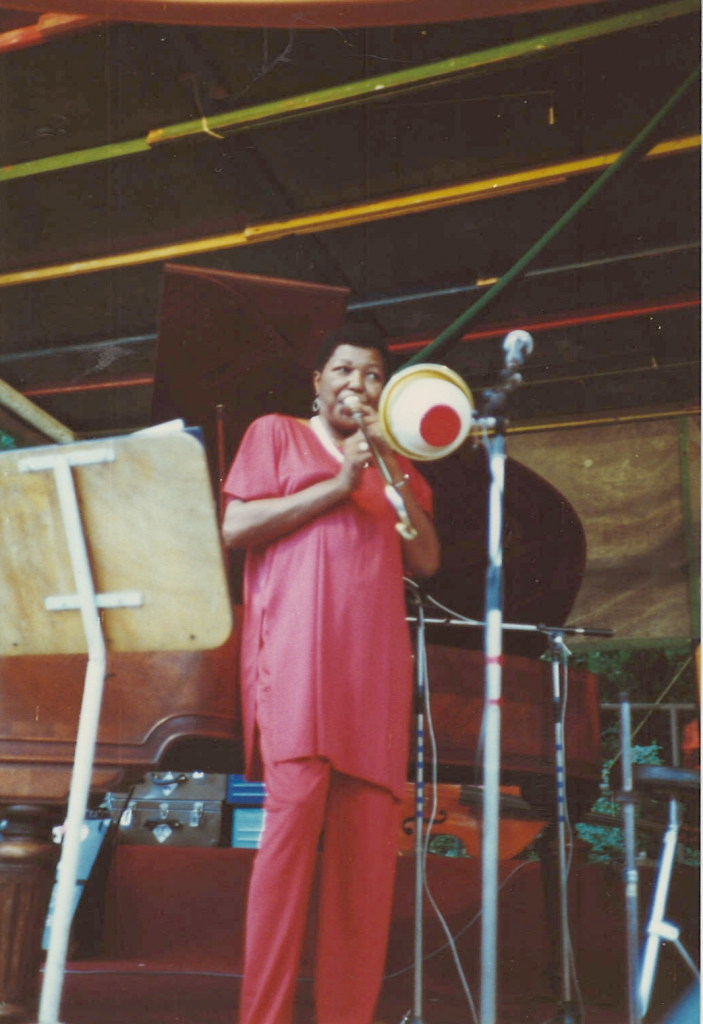
Return home
In the 1970s, the jazz world in the U.S. underwent a shift in awareness. In 1977, the label Stash Records released a double LP titled "Jazz Women. A Feminist Retrospective"[255], which for the first time drew attention to the contributions of female musicians and included Liston's "My Reverie" for Dizzy Gillespie. In 1979, two jazz enthusiasts from Kansas City, with the help of pianist Marian McPartland and critic Leonard Feather, organized the first Kansas City Women’s Jazz Festival to highlight the presence of women in the jazz scene. They contacted Liston in Jamaica, and it took nearly a year of persuasion—on the island, she had hardly touched her instrument[256]. During rehearsals with the All-Stars she was to perform with, she was frustrated by the rhythm section and only relaxed when Marian McPartland replaced the originally planned pianist in the trio with bassist Carol Kaye. In the end, the audience cheered, and the success encouraged Liston to consider returning to the United States, especially as the political situation in Jamaica was deteriorating: "It was a war going on down there. The money had dropped down to zilch."[258].
Back in the U.S., she missed her students, "all my children," as she called them, but also remembered how much she longed to write for "more advanced musicians"[259]. In New York, she founded the septet Melba Liston and Company, an all-female band with two trombones (Liston and Janice Robinson), two saxophones, plus rhythm section (no trumpets, which, it was said, intimidated her)[260]. While there are no official recordings of this lineup, a radio profile of Liston features at least a short excerpt of her composition "Ben Loves Lu"[261]. The band’s repertoire included swing and bebop, pieces by Duke Ellington, Miles Davis, Fats Waller, Patti Bown, Mary Lou Williams, and her own compositions. The lineup soon changed: Britt Woodman replaced Janice Robinson; occasionally another horn joined; in any case, Liston ensured she always had musicians who could provide her distinctive tonal palette[262]. In the early 1980s, the band toured China and Malaysia. Liston, who had been walking with a cane for years, enjoyed a drink—"she had a taste for hard liquor," recalled Dottie Dodgion, the band’s drummer[263]. This fact may be of interest when one finds in a cocktail recipe book a gin drink named "Mischievous Lady" in her honor[264]. Melba Liston & Company existed in various lineups—and with declining quality, as even Dodgion admits—until 1983[266].
In 1985, Liston was approached to arrange music for an Eubie Blake tribute at the Kool Jazz Festival in New York, which ultimately did not happen due to lack of funding[267]. In April 1985, she suffered her first stroke while working on a reggae album she had already begun in Jamaica. She also planned to become more involved in jazz education, bringing young people closer to the evolution of jazz and conducting workshops for arrangers[268].
After the Stroke
On April 1, 1985, Liston suffered her first stroke[269]. By November and December, she was already able to conduct concerts again, including one at the Jazz Center on Lafayette Street in the East Village[270]. Further strokes eventually led to right-sided paralysis, memory loss, and speech difficulties. Her trombone had been stolen in New York just as she was considering learning to play it with her left hand[271]. Good friends, including Randy Weston and bassist Major Holley, organized a benefit concert in Los Angeles in October 1990. With the proceeds, she bought a computer and learned to use it for arranging[272]. One of the first albums created this way was Weston's double CD The Spirits of Our Ancestors[273], recorded in May 1991, once again an album with strong African influences, this time featuring guests Dizzy Gillespie and Pharoah Sanders. Weston had spent much time in Morocco, studying the music of the Gnawa musicians. On Spirits, there is a Gnawa piece with singer and guembri player Yassir Chadly, as well as Weston's "Blue Moses," based on a Gnawa spiritual (with Sanders), and "African Sunrise," a composition for (and with) Dizzy Gillespie. The album contains solo numbers, improvisations, and several pieces arranged by Liston using the computer, among which "The Call" stands out, featuring percussionist Big Black with a Yoruba rhythm.
The next Weston-Liston collaboration was the CD Volcano Blues[274], recorded in February 1993 and released under both their names. The entire album is a celebration of the blues with musicians from different generations. In addition to Weston and Charli Persip, Weston's band features alto saxophonist Talib Kibwe and trombonist Benny Powell, along with trumpeter Wallace Roney and veteran colleagues such as saxophonist Teddy Edwards and guitarist/singer Johnny Copeland. Liston's arrangement of "Chalabati Blues" focuses on brass interjections, exploiting the contrast between dark timbres (trombone, baritone sax) and bright colors (flute, soprano sax). Throughout "Penny Packer Blues" and the closing swing piece "Blues for Elma Lewis," the full range of the ensemble—from the lowest to the highest instruments—is showcased.
She recalls having been looked at askance for her approach to arranging: “They’re so accustomed to all the reeds playing this way, and all the trumpets playing this way, so when they get my arrangement, the saxophone might be playing with the trombones, this one might be playing with the trumpets, and the mixture slows things up. Every now and then I get some kind of funny remarks from the dudes – ‘Why can’t you write like everybody else?’ but then, after they get used to it, they find out that they like it very much.” [275] In "The Nafs," a reduced arrangement effectively propels the solo parts of Hamiet Bluiett and Weston. Two Count Basie numbers ("Volcano," "Harvard Blues") evoke the riff tradition from Liston’s hometown of Kansas City. Weston's "Blues for Strayhorn" inspires Liston to create serene tonal planes, coaxing the maximum range of colors from the five horns.
Reflecting on her composition process years later, she said: “I usually sort of meditate on it for a long time, and get an idea or a plan in my head, and then I will go to the keyboard and work at it, and search for moods and colors to give the feeling of whatever the story is that I’m trying to tell.” [276] Even at school, she had been bored with trombone parts, preferring instead the baritone saxophone or cello parts because they had more beautiful, melodic lines. “Whenever I wrote something, I always tried to make the lines individually beautiful so the player could put more feeling into it (…) So I try to make all the parts sort of free and special. Melodic.” [277]
The last album she was set to work on was Randy Weston’s “Khepera”, music in which Weston aimed to pay tribute to Africa’s spiritual traditions, blending West African polyrhythms with brass sounds and deep chord clusters. [278] His trio is augmented by horn players like Talib Kibwe, Benny Powell, and Pharoah Sanders, as well as the African master drummer Chief Bey and Chinese pipa player Min Xiao Fen. There is a new version of “Niger Mambo” from the LP Music from The New African Nations, featuring an alto sax solo by Kibwe that at times almost sounds like a North African double-reed instrument. Weston explains why such projects worked best with Liston: “We were blessed, because although there was segregation, we had the best of everything, the blues and black church, the jazz, calypso… We had all of that experience. Melba’s able to describe all of that in her arrangements. So if I say, 'Okay Melba, we’re going to Jamaica today,‘ she’s going to write about Jamaica, or I say, 'We’re going to the Congo, to Mississippi…‘” [279]
"You do the singing, I’ll do the arrangements!"
Singer Leon Thomas recalls arriving quite unprepared at a rehearsal with Art Blakey in the late 1950s. Melba Liston was also in the studio, bringing arrangements and encouraging him: “You do the singing, I’ll do the arrangements!” [280] She knew that part of her role was to give soloists a certain freedom. She was an arranger, conductor, and musical director of numerous sessions. “If you take care of your music,” Liston continued in her encouragement to the young singer, “the music will take care of you.” A beautiful motto, though one that didn’t entirely apply to her own career. Apart from a single album under her own name, she wrote her music exclusively for other colleagues.
Melba Liston was acutely aware of the challenges faced as a Black female instrumentalist in the jazz scene: “First you are a jazz musician, then you are black, then you are female. I mean it goes down the line like that. We’re like the bottom of the heap.” [281] In the end, she expressed her frustration with the music industry quite plainly: “Bebop will be here, but whites will be playing it. We didn’t teach our children to love the music.” No matter how often she got involved—as she did in various organizations [282]—she felt the system would always prevail [283].
Randy Weston was captivated by her openness, which shone through despite her shyness. The naturalness that had impressed him during their first meeting—when Liston was still playing in Dizzy Gillespie’s big band—was also noticed outside the music world. The magazines Jet and Ebony, aimed at an African American readership, published photos of Liston, highlighting especially the “natural look” of her hair, similar to Odetta and Abbey Lincoln. Jet specifically noted: “Melba Liston had her own unique way of dramatizing the aims of the confab (resolve problems concerning jobs, race bias and the Negro image). Her gimmick: She allowed her hair to revert to its natural state to express her ’nationalistic‘ views.” [284]
Melba Liston revealed that she had been married three times. Each time, she put aside her instrument and tried simply to be a wife [285]. Her first husband was in the army for three years; when he returned, she wasn’t willing to give up her gig just to go back to him. She met her second husband, Jason, around 1949/50. Because of him, she had given up touring and taken a desk job. The marriage lasted a few years, but when Gillespie invited her to join his new big band, she didn’t say no. Her third husband was Nell Harris, whom she married in 1969 and to whom she had already dedicated her composition “Len Sirrah” in 1965 [286]. But even that marriage did not last [287].
After her first stroke, Melba Liston received multiple honors. In 1986, she was awarded the Mary Lou Williams Award by the Kennedy Center, and in 1987, she was named an NEA Jazz Master by the National Endowment for the Arts. She passed away on April 23, 1999, in Los Angeles at the age of 73, succumbing to complications from her multiple strokes.
[1] Dalia Pagani: Melba Liston. Interview, in: Cadence, 11/5 (May 1985): 11
[2] „She could write most of the guys under the table without trying, and I’m talking about some of the best out there.“ Zit nach: Erica Kaplan: Melba Liston. It’s All From My Soul, in: The Antioch Review, 57/3 (Summer 1999): 415
[3] Leonard Feather: JAZZ. Melba Liston: Tribute to Jazz Pioneer, in: Los Angeles Times <www.latimes.com>, 14. October 1990
[4] Clora Bryant: Melba Liston. NEA Jazz Master (1987). Smithsonian Jazz Oral History Programm (1996)
[5] Leslie Gourse: Melba Liston. Magnificent trombone obsession, in: New York Amsterdam News, 20. Juni 1981: 36
[6] Dalia Pagani: Melba Liston. Interview, in: Cadence, 11/5 (May 1985): 5
[7] Dalia Pagani: Melba Liston. Interview, in: Cadence, 11/5 (May 1985): 5
[8] Stan Woolley: Melba Liston. The trombonist, arranger and composer talks to Stan Woolley, in: Jazz Journal, 40/2 (Februar 1987): 20
[9] W. Royal Stokes: The Essential W. Royal Stokes Jazz, Blues, and Beyond Reader, Elkins/WV 2020 (Hannah Books): 107
[10] Erica Kaplan: Melba Liston. It’s All From My Soul, in: The Antioch Review, 57/3 (Summer 1999): 417
[11] Leslie Gourse: Melba Liston. Magnificent trombone obsession, in: New York Amsterdam News, 20. Juni 1981: 36
[12] Linda Dahl: Stormy Weather. The Music and Lives of a Century of Jazzwomen, New York 1984 (Pantheon Books): 252
[13] W. Royal Stokes: The Essential W. Royal Stokes Jazz, Blues, and Beyond Reader, Elkins/WV 2020 (Hannah Books): 107
[14] Linda Dahl: Stormy Weather. The Music and Lives of a Century of Jazzwomen, New York 1984 (Pantheon Books): 253
[15] Eric Porter: „Out of the Blue“. Black Creative Musicians and the Challenge of Jazz, 1940-1995, Ann Arbor/MI 1997 (The University of Michigan): 44
[16] Erica Kaplan: Melba Liston. It’s All From My Soul, in: The Antioch Review, 57/3 (Summer 1999): 417
[17] W. Royal Stokes: The Essential W. Royal Stokes Jazz, Blues, and Beyond Reader, Elkins/WV 2020 (Hannah Books): 108
[18] Dalia Pagani: Melba Liston. Interview, in: Cadence, 11/5 (May 1985): 5
[19] Paul F. Berliner: Thinking in Jazz. The Infinite Art of Improvisation, Chicago 1994 (University of Chicago Press): 38
[20] Paul F. Berliner: Thinking in Jazz. The Infinite Art of Improvisation, Chicago 1994 (University of Chicago Press): 96
[21] Maxine Gordon: Sophisticated Giant. The Life and Legacy of Dexter Gordon, Oakland/CA 2019 (University of California Press): 85
[22] Paul F. Berliner: Thinking in Jazz. The Infinite Art of Improvisation, Chicago 1994 (University of Chicago Press): 97
[23] Dalia Pagani: Melba Liston. Interview, in: Cadence, 11/5 (May 1985): 6
[24] Bob Bach: Hall of Fame, Ella Fitzgerald. The First Lady of Song. Everybody who is anybody in the music business agrees that Ella is the greatest but still she isn’t on the air: Bob Bach gives the subject an airing, in: Metronome, 63/11 (November 1947): 20-23; reprint, in: Leslie Gourse: The Ella Fitzgerald Companion. Seven Decades of Commentary, New York 1998 (Schirmer Books): 42-46; hier: 45
[25] Clora Bryant et al (eds.): Central Avenue Sounds. Jazz in Los Angeles, Berkeley/CA 1998 (University of California Press): 257
[26] Linda Dahl: Stormy Weather. The Music and Lives of a Century of Jazzwomen, New York 1984 (Pantheon Books): 254
[27] Clora Bryant et al (eds.): Central Avenue Sounds. Jazz in Los Angeles, Berkeley/CA 1998 (University of California Press) 257
[28] Frank Ténot: Melba Liston. „Je ne suis pas une femme, mais un musicien“, in: Jazz Magazine, May 1956: 9
[29] Monica Hairston O’Connell & Sherrie Tucker: Not One to Toot Her Own Horn (?). Melba Liston’s Oral Histories and Classroom Presentations, in: Black Music Research Journal, 34/1 (Spring 2014): 140
[30] Benjamin S. Page: A Toast to Melba, in: Down Beat, 28/1 (5 Januar 1961): 19: „It wasn’t enough that they had to bring a female here to play. They had to bring a child.“
[31] Linda Dahl: Stormy Weather. The Music and Lives of a Century of Jazzwomen, New York 1984 (Pantheon Books): 255
[32] Clora Bryant et al (eds.): Central Avenue Sounds. Jazz in Los Angeles, Berkeley/CA 1998 (University of California Press): 258; Dalia Pagani: Melba Liston. Interview, in: Cadence, 11/5 (May 1985): 6
[33] Nancy Wilson: NPR Jazz Profile. Melba Liston: Bones Of An Arranger, 9. Juli 2008. https://www.npr.org/2008/07/09/92349036/melba-liston-bones-of-an-arranger (aufgerufen am 28. Dezember 2025)
[34] Donica L. Stein: Clora Bryant. Gender Issues in the Career of a West Coast Jazz Musician, in: Jacqueline Cogdell DjeDje & Eddie S. Meadows (eds.): California Soul. Music of African Americans in the West, Berkeley/CA 1998 (University of California Press): 285
[35] Clora Bryant et al (eds.): Central Avenue Sounds. Jazz in Los Angeles, Berkeley/CA 1998 (University of California Press): 334
[36] Linda Dahl: Stormy Weather. The Music and Lives of a Century of Jazzwomen, New York 1984 (Pantheon Books): 255
[37] John S. Wilson: Melba Liston Returns With Horns and Baton, in: New York Times, 6. Juni 1980: C5; siehe auch: Paul F. Berliner: Thinking in Jazz. The Infinite Art of Improvisation, Chicago 1994 (University of Chicago Press): 290
[38] Paul F. Berliner: Thinking in Jazz. The Infinite Art of Improvisation, Chicago 1994 (University of Chicago Press): 290
[39] Gerald Wilson Orchestra: „Warm Mood“, Los Angeles 1946. Black & White 778. https://youtu.be/WGmvZASzVuU (aufgerufen am 21. Dezember 2025)
[40] Gerald Wilson Orchestra: „Love Me a Long, Long Time“, Los Angeles 1945. Exclusive 150. https://youtu.be/I8MPS5bWM78 (aufgerufen am 21. Dezember 2025)
[41] Gerald Wilson Orchestra: „The Saint“. Los Angeles, 1946. B&W 813. https://youtu.be/kmBRycPE2Is (aufgerufen am 26. Dezember 2025)
[42] Gerald Wilson Orchestra: „The Moors“. Los Angeles, 1946. B&W 813. https://youtu.be/qiFvpG8458M (aufgerufen am 26. Dezember 2025)
[43] Gerald Wilson Orchestra: „One O’Clock Jump“, Los Angeles 1946. Black & White 778. https://youtu.be/1tSyntKa7TU (aufgerufen am 21. Dezember 2025)
[44] W. Royal Stokes: The Essential W. Royal Stokes Jazz, Blues, and Beyond Reader, Elkins/WV 2020 (Hannah Books): 108
[45] Wilbert Baranco Orchestra: „Baranco Boogie“, AFRS Jubilee, Januar 1946. Hep 15. https://youtu.be/H_iAGjt-Dng (aufgerufen am 21. Dezember 2025)
[46] Jack McVea: „Reetie Vootie Boogie“. Los Angeles, October 1946 (Black & White 809). https://youtu.be/VY3ajiPJB-w (aufgerufen am 31. Dezember 2025)
[47] Maxine Gordon: Sophisticated Giant. The Life and Legacy of Dexter Gordon, Oakland/CA 2019 (University of California Press): 77
[48] Dexter Gordon: „Lullaby in Rhythm“, Hollywood, 5. Juni 1947. Dial 1038. https://youtu.be/2OMj71LUjy8 (aufgerufen am 21. Dezember 2025)
[49] Dexter Gordon: „Mischievous Lady“, Hollywood, 5. Juni 1947. Dial 1018. https://youtu.be/U37oh5Yr4GM (aufgerufen am 21. Dezember 2025)
[50] Maxine Gordon: Sophisticated Giant. The Life and Legacy of Dexter Gordon, Oakland/CA 2019 (University of California Press): 77
[51] Maxine Gordon: Sophisticated Giant. The Life and Legacy of Dexter Gordon, Oakland/CA 2019 (University of California Press): 79
[52] Stan Woolley: Melba Liston. The trombonist, arranger and composer talks to Stan Woolley, in: Jazz Journal, 40/2 (Februar 1987): 20
[53] Paul F. Berliner: Thinking in Jazz. The Infinite Art of Improvisation, Chicago 1994 (University of Chicago Press): 208
[54] W. Royal Stokes: The Essential W. Royal Stokes Jazz, Blues, and Beyond Reader, Elkins/WV 2020 (Hannah Books): 108
[55] Frank Ténot: Melba Liston. „Je ne suis pas une femme, mais un musicien“, in: Jazz Magazine, May 1956: 9
[56] Benjamin S. Page: A Toast to Melba, in: Down Beat, 28/1 (5 Januar 1961): 18
[57] Frank Ténot: Melba Liston. „Je ne suis pas une femme, mais un musicien“, in: Jazz Magazine, May 1956: 9
[58] Leonard Feather: A Toast to Melba, in: Jazz Forum, #61 (1979): 39
[59] Leonard Feather: A Toast to Melba, in: Jazz Forum, #61 (1979): 39
[60] Maxine Gordon: Sophisticated Giant. The Life and Legacy of Dexter Gordon, Oakland/CA 2019 (University of California Press): 82
[61] Dalia Pagani: Melba Liston. Interview, in: Cadence, 11/5 (May 1985): 6
[62] Count Basie: „Just an Old Manuscript“, Los Angeles, 11. April 1949. Victor LPM1112. https://youtu.be/IUufGROUB_I (aufgerufen am 21. Dezember 2025)
[63] Sally Placksin: American Women in Jazz, 1900 to the Present. Their Words, Lives, and Music, New York 1982 (Seaview Books): 180
[64] Paul F. Berliner: Thinking in Jazz. The Infinite Art of Improvisation, Chicago 1994 (University of Chicago Press): 445
[65] Dizzy Gillespie (& Al Fraser): To Be Or Not To Bop. Memoirs – Dizzy Gillespie, Garden City/NY 1979 (Doubleday & Company): 356; Clora Bryant et al (eds.): Central Avenue Sounds. Jazz in Los Angeles, Berkeley/CA 1998 (University of California Press): 259
[66] Clora Bryant: Melba Liston. NEA Jazz Master (1987). Smithsonian Jazz Oral History Programm (1996)
[67] Stan Woolley: Melba Liston. The trombonist, arranger and composer talks to Stan Woolley, in: Jazz Journal, 40/2 (Februar 1987): 20
[68] Dalia Pagani: Melba Liston. Interview, in: Cadence, 11/5 (May 1985): 6-7
[69] Dalia Pagani: Melba Liston. Interview, in: Cadence, 11/5 (May 1985): 7
[70] Stan Woolley: Melba Liston. The trombonist, arranger and composer talks to Stan Woolley, in: Jazz Journal, 40/2 (Februar 1987): 20
[71] Sally Placksin: American Women in Jazz, 1900 to the Present. Their Words, Lives, and Music, New York 1982 (Seaview Books): 181; Clora Bryant et al (eds.): Central Avenue Sounds. Jazz in Los Angeles, Berkeley/CA 1998 (University of California Press): 259; in einem anderen Interview nennt fälschlicherweise sie North Carolina: Dalia Pagani: Melba Liston. Interview, in: Cadence, 11/5 (May 1985): 7
[72] Julia Blackburn: With Billie, London 2005 (Jonathan Cape): 240
[73] Julia Blackburn: With Billie, London 2005 (Jonathan Cape): 243-244
[74] Julia Blackburn: With Billie, London 2005 (Jonathan Cape): 244-245
[75] Stan Woolley: Melba Liston. The trombonist, arranger and composer talks to Stan Woolley, in: Jazz Journal, 40/2 (Februar 1987): 20
[76] Julia Blackburn: With Billie, London 2005 (Jonathan Cape): 246-247
[77] Die Geschichte wurde oft wiederholt, statt North Carolina wurde gern Charleston, South Carolina, als Endpunkt der misslungenen Tournee angegeben.
[78] Leslie Gourse: Melba Liston. Magnificent trombone obsession, in: New York Amsterdam News, 20. Juni 1981: 36
[79] Steven Isoardi: Interview of Melba Liston. UCLA Library. Center for Oral History Research. 12. September 1992. https://oralhistory.library.ucla.edu/catalog/21198-zz0008zqzt?counter=36 (aufgerufen am 26. Dezember 2025)
[80] Clora Bryant et al (eds.): Central Avenue Sounds. Jazz in Los Angeles, Berkeley/CA 1998 (University of California Press): 259
[81] Monica Hairston O’Connell & Sherrie Tucker: Not One to Toot Her Own Horn (?). Melba Liston’s Oral Histories and Classroom Presentations, in: Black Music Research Journal, 34/1 (Spring 2014): 143
[82] Leonard Feather: Linernotes, „Melba Liston and Her ‚Bones“. New York, Dezember 1958 (Jazz Workshop JW109); W. Royal Stokes: The Essential W. Royal Stokes Jazz, Blues, and Beyond Reader, Elkins/WV 2020 (Hannah Books): 108
[83] Clora Bryant: Melba Liston. NEA Jazz Master (1987). Smithsonian Jazz Oral History Programm (1996): 14-15
[84] Wiederveröffentlicht auf „The Mercury Blues ‚N‘ Rhythm Story 1945-1955“ (Mercury 314 528 292-2), CD6 von 8 (1996)
[85] Clora Bryant: Melba Liston. NEA Jazz Master (1987). Smithsonian Jazz Oral History Programm (1996): 23. Vgl. https://youtu.be/FM1BIJmGCXo (ca. ab 23:48) (aufgerufen am 22. Dezember 2025)
[86] Frank Ténot: Melba Liston. „Je ne suis pas une femme, mais un musicien“, in: Jazz Magazine, May 1956: 9
[87] Dalia Pagani: Melba Liston. Interview, in: Cadence, 11/5 (May 1985): 6
[88] Linda Dahl: Stormy Weather. The Music and Lives of a Century of Jazzwomen, New York 1984 (Pantheon Books): 255-256
[89] Paul Ward Perry: Music. Melba Liston’s Slide to Success, in: The New Crisis, Mar/Apr.2000: 38
[90] John S. Wilson: Melba Liston Is Mostly Unseen. Jazz Trombonist at Basin Street East Avoids Limelight, in: New York Times, 20. October 1961: 40
[91] Dalia Pagani: Melba Liston. Interview, in: Cadence, 11/5 (May 1985): 8
[92] Dizzy Gillespie: „Annie’s Dance“. New York, 25. Mai bis 6. Juni 1956 (Verve MGV8017). https://youtu.be/YtQo7jHAZ3w (aufgerufen am 22. Dezember 2025)
[93] Darren Mueller: At the Vanguard of Vinyl. A Cultural History of the Long-Playing Record in Jazz, Durham/NC 2015 (Duke University): 167. Dizzy Gillespie: „My Reverie“. New York, 25.Mai bis 6. Juni 1956 (Norgran MGN1084). https://youtu.be/YDgPVaPA7VI (aufgerufen am 22. Dezember 2025)
[94] Dizzy Gillespie: „If You Could See Me Now“. New York, 7. April 1957 (Verve MGV8222). https://youtu.be/zZPoj9rDCOI (aufgerufen am 22. Dezember 2025)
[95] Dizzy Gillespie Big Band: „Somewhere Over the Rainbow“. New York, 7.April 1957. Verve MGV8222. https://youtu.be/8TcHUwvcYDE(aufgerufen am 28. Dezember 2025)
[96] Dizzy Gillespie: „You’ll Be Sorry“. New York, Juli 1957 (Verve 527900-2). https://youtu.be/YtQo7jHAZ3w (aufgerufen am 22. Dezember 2025)
[97] Erica Kaplan: Melba Liston. It’s All From My Soul, in: The Antioch Review, 57/3 (Summer 1999): 424
[98] Eric Porter: „Out of the Blue“. Black Creative Musicians and the Challenge of Jazz, 1940-1995, Ann Arbor/MI 1997 (The University of Michigan): 58-59
[99] Martin Williams: Ernie Henry: Last Chorus (Riverside RLP 12-266), in: Down Beat, 25. Dezember 1958: 34
[100] Ernie Henry: „Melba’s Tune“. New York, 23. September 1957 (Riverside RLP12-248). https://youtu.be/DOcT9iooEpo (aufgerufen am 26. Dezember 2025)
[101] Leonard Feather: The New Melba, in: Melody Maker, 7. Juli 1956: 5: „Melba says she has managed to escape one peculiar form of imprisonment that threatens most feminine musicians: she has never workd in an all-girl band!“
[102] NN: Melba Liston Quintet Tops Lounge Card, in: Pittsburgh Courier, 8. November 1958: 20
[103] Benjamin S. Page: A Toast to Melba, in: Down Beat, 28/1 (5 Januar 1961): 19
[104] John S. Wilson: Melba Liston Returns With Horns and Baton, in: New York Times, 6. Juni 1980: C5
[105] John S. Wilson: Melba Liston Is Mostly Unseen. Jazz Trombonist at Basin Street East Avoids Limelight, in: New York Times, 20. October 1961: 40
[106] John S. Wilson: Melba Liston Returns With Horns and Baton, in: New York Times, 6. Juni 1980: C5
[107] Linda Dahl: Stormy Weather. The Music and Lives of a Century of Jazzwomen, New York 1984 (Pantheon Books): 257
[108] Benjamin S. Page: A Toast to Melba, in: Down Beat, 28/1 (5 Januar 1961): 18
[109] Art Blakey Big Band: „Late Date“. New York, Dezember 1957 (Bethlehem BCP6027). https://youtu.be/cATxoaPooK0 (aufgerufen am 28. Dezember 2025)
[110] Melba Liston, in: Nancy Wilson: NPR Jazz Profile. Melba Liston: Bones Of An Arranger, 9. Juli 2008. https://www.npr.org/2008/07/09/92349036/melba-liston-bones-of-an-arranger (aufgerufen am 29. Dezember 2025)
[111] Dinah Washington: „Crazy Love“. Newport Jazz Festival, 6. Juli 1958 (EmRacy MG36141). https://youtu.be/ZBXLooODZz8 (aufgerufen am 24. Dezember 2025)