
Please also check out our curated collection of Podcasts!

Stephen Reimer’s (University of Alberta) course page for “Manuscript Studies: Medieval and Early Modern” includes a concise overview of different kinds of editions one might produce from early texts.
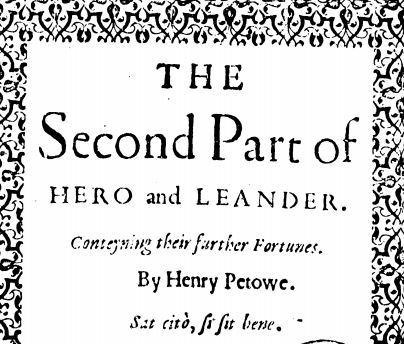
Click this image, taken from the Petowe continuation of Marlowe’s Hero and Leander, to visit About Editions.

The Kit Marlowe Project is licensed under a Creative Commons Attribution-NonCommercial-ShareAlike 4.0 International License.

Accessed through Laurence Anthony’s Website, AntConc is a downloadable app that facilitates corpus and concordance analyses.
Click the logo to learn more or to download AntConc!

The Kit Marlowe Project is licensed under a Creative Commons Attribution-NonCommercial-ShareAlike 4.0 International License.

Hosted by The Digital Commonwealth, The Boston Public Library’s Shakespeare Collection is home to digitized images of works by and about William Shakespeare in the Thomas Pennant Barton Collection.
For more information about how to navigate and use The Boston Public Library, including instructions for how Massachusetts residents and students can get an e-Card, click here.

The Kit Marlowe Project is licensed under a Creative Commons Attribution-NonCommercial-ShareAlike 4.0 International License.

The British Book Trade Index, also known as BBTI, provides information about early modern English stationers. It serves as an index to many sources of information.
Click the image to go to the site or here to learn more!
The Kit Marlowe Project is licensed under a Creative Commons Attribution-NonCommercial-ShareAlike 4.0 International License.

The British Library offers accessible blogs about early modern authors in historical, literary, and critical contexts. Though the “Explore Shakespeare and Renaissance Writers in Context” subsection is currently unavailable, this blog post provides some information in the meantime.
Click the logo to visit The British Library and explore!
The Kit Marlowe Project is licensed under a Creative Commons Attribution-NonCommercial-ShareAlike 4.0 International License.

CADRE, also known as Co-Authored Drama in Renaissance England, is a website created for those who wish to share information about the co-authorship of plays from the Early Modern Period.
CADRE is inspired by the Lost Plays Database, both of which promote discussion and collaboration amongst scholars in wiki-style forums.
To begin exploring CADRE, click the image!

The Kit Marlowe Project is licensed under a Creative Commons Attribution-NonCommercial-ShareAlike 4.0 International License.
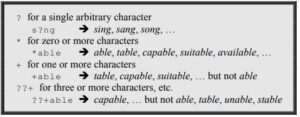
This PDF is an excellent resource for learning about and experimenting with regular expression (aka “RegEx”) syntax queries.
Click the image, taken from the PDF, to open the document in a new tab, or click the link below to download it.
CQPWEB_Simple_Syntax_HelpDownload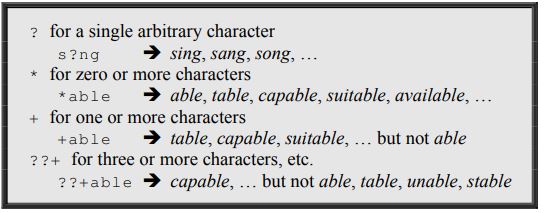
The Kit Marlowe Project is licensed under a Creative Commons Attribution-NonCommercial-ShareAlike 4.0 International License.

The Database of Early English Playbooks, also known as DEEP, is home to every playbook produced in England, Scotland, and Ireland from the beginning of printing up until 1660. The database not only contains playbooks but also information about titles, para-textual matter, advertising features, bibliographic details, and theatrical backgrounds.
Anyone interested in the publishing, printing, and marketing of the English Renaissance drama should take a look at DEEP.
To learn how to use DEEP, click here. For those ready to explore, click the logo.
The Kit Marlowe Project is licensed under a Creative Commons Attribution-NonCommercial-ShareAlike 4.0 International License.

Digital Renaissance Editions, inspired by the Internet Shakespeare Editions, is a place to access scholarly editions of early English drama. The site includes photos, modern text, and supplementary materials. The main focus of Digital Renaissance Editions is to encourage the production of peer-reviewed scholarly work revolving around plays written by predecessors, contemporaries, and successors of Shakespeare.
DRE has both a Performance Database, home to multimedia related to early English drama plays, and a Critical Companion, where peer-reviewed essays are published that compliment and engage with the plays and the societal and cultural time in which they were produced.
Click the griffon to visit Digital Renaissance Editions!
The Kit Marlowe Project is licensed under a Creative Commons Attribution-NonCommercial-ShareAlike 4.0 International License.

Sarah Werner, also known by the name of her blog, Wynken de Worde, has collated an exceptional list of open-access Early Modern Digital Collections. All of these resources allow access to early modern primary texts.
Click the image to visit Sarah Werner’s blog, Wynken de Worde!

The Kit Marlowe Project is licensed under a Creative Commons Attribution-NonCommercial-ShareAlike 4.0 International License.

Early Print Lab offers text analysis tools and computational approaches to exploring works printed before 1700 in the Early English Books Online database.
Click the logo to check out Early Print Lab!

The Kit Marlowe Project is licensed under a Creative Commons Attribution-NonCommercial-ShareAlike 4.0 International License.
Text Creation Partnership
Keywords in Context
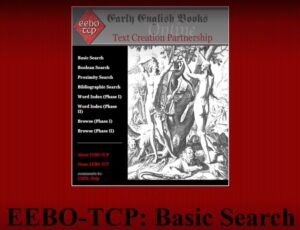
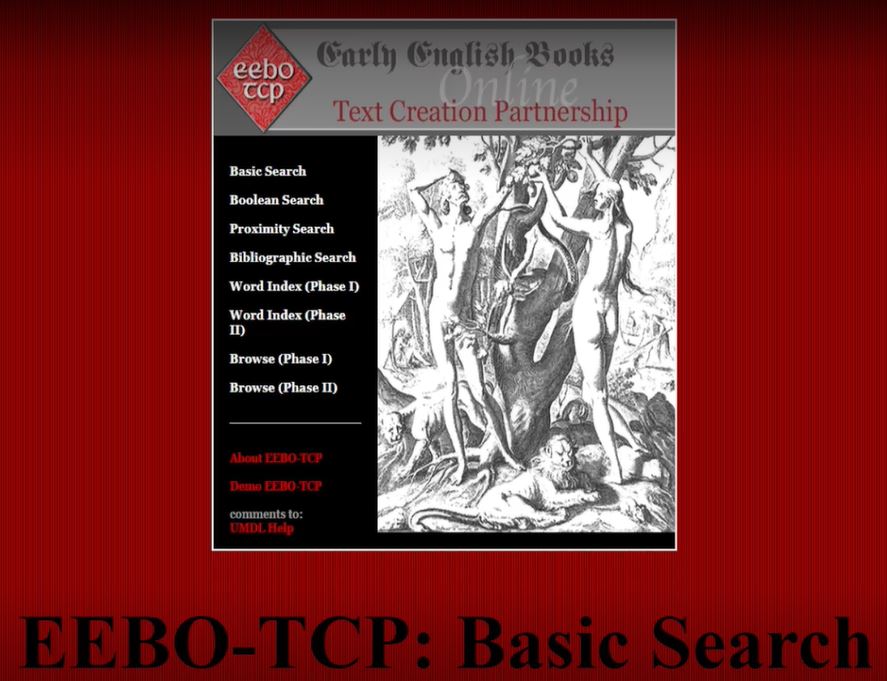
The EEBO-TCP: Text Creation Partnership database offers rough transcriptions of selected texts from the EEBO database.
This tool allows one to search the Early English Books Online (EEBO) database for key words using both fuzzy searches and regular expressions.
Tutorial Videos
The Kit Marlowe Project has created tutorial videos for navigating the EEBO-TCP database. Click the image here to watch the EEBO-TCP Tutorial Videos.
The Kit Marlowe Project is licensed under a Creative Commons Attribution-NonCommercial-ShareAlike 4.0 International License.

The English Short Title Catalogue, also known as ESTC, is a valuable resource for discovering reliable bibliographic information for works printed before 1801 in England, Scotland, Ireland, and abroad.
It currently has over 500,000 available records and can be accessed through the CERL database site.
Click the logo to visit the English Short Title Catalogue!

The Kit Marlowe Project is licensed under a Creative Commons Attribution-NonCommercial-ShareAlike 4.0 International License.

Welcome to The Kit Marlowe Project fanfic section, a place where the lines between history and imagination become blurred. Explore the various fanfic novels surrounding Christopher Marlowe and his demise–or survival–below.
Using the information provided by The Kit Marlowe Project, you can weave between fact and fiction should you choose to explore these novels further. Be sure to check out our What We Know page.

This Marlowe

The Intelligencer

Now and Then Stab

Murder Most Foul

Marlowe’s Murder

Lightborne

License to Quill

Horses of the Night

By Any Other Name

A Tip for the Hangman

A Dead Man in Deptford
The Kit Marlowe Project is licensed under a Creative Commons Attribution-NonCommercial-ShareAlike 4.0 International License.

The Folger Shakespeare Library is home to many brilliant resources and projects. In this post, you’ll be able to read a bit about each.
Digital Collections:
There are 8 kinds: Books, Manuscripts, Art & Objects, Shakespeare, Bindings, Folger Archives, Reference Images, and Microfilm Images.
Take a look through the collections to learn more about relevant literature, all things Shakespeare, surviving documents and art, other authors from Shakespeare’s time, and to explore the Folger’s many media forms.
Click on the image to the right to learn more about it!

A page from a book by Jacobus A. Bruck, 1615, described by the Folger as “man with trained bear.”

Above is an image of the fifth edition of Shakespeare’s Rape of Lucrece, contributed by the Huntington Library, dated 1607.
Shakespeare Documented:
A growing exhibit featuring primary source documents and commentaries about Shakespeare’s career as a playwright, poet, and actor, his family documents, and his 17th century legacy. This is a great resource for learning more about Shakespeare’s private and public life.
To begin exploring “Shakespeare Documented“, click here!
Shakespeare’s Works: The Folger Shakespeare Library is home to all of Shakespeare’s works, organized alphabetically and easy to access. When exploring each text, the Folger provides an introduction to each play or poem, access options (read online, download, or buy), the ability to search within the work itself, view images from the Folger collection, access essays, blogs, and additional resources related to the work, and view early printed texts. Specifically for teachers, the Folger Shakespeare Library also offers teaching materials and lesson plans. Anything there is to know about Shakespeare’s full works can be found here.

The image above offers a glimpse of the “All Shakespeare’s Works” page on the Folger Shakespeare Library site. Click on it to explore!

Above is a project poster found on the EMED page. Click on it to learn more about the EMED’s teaching resources!
Early Modern English Drama:
A project administered by the Folger Shakespeare Library, the Digital Anthology of Early Modern English Drama is home to other plays from Shakespeare’s time. Providing full play texts by many different authors, the EMED ensures surviving plays from London’s early modern theatres are accessible, and spotlights them with this resource. The EMED allows readers to access the plays in original or regularized spelling.
The EMED also has a resource page, where people can access information about editing, performance, data, facsimiles, and teaching. An invaluable resource, the EMED allows us to think about the variety of writers and drama texts that were written, produced, and performed in Shakespeare’s time.
Click here to access the “Early Modern English Drama” page and explore!
The Collation:
The Collation is a place to find and access information and observations from researchers and staff at the Folger Shakespeare Library. One can scroll through different blog posts by different authors about a variety of topics. Click here to check out the blog posts!

This image is from a blog called, “Folger Mysteries, September 2025 edition“, in which a series of images are provided along with the question, “Dear Collation readers: What’s going on with all of these dots?” Here, The Collation encourages people to make their own hypotheses and leave them in the comments, creating a conversation about the mystery dots. The Collation is not only educational and informative about what the Folger staff and researchers are up to, but also encourages people interested in the Folger to be a part of the inquiry and dialogue.

The EMMO logo. Click it to begin browsing transcriptions!
Early Modern Manuscripts Online:
A Folger project that focuses on the sixteenth and seventeenth century transcriptions, metadata, and manuscript images. This project provides easily-accessible information for both scholars and the public. Not only does EMMO provide digital access to a number of manuscripts, but it also encourages people to learn paleography (deciphering old handwriting), a crucial skill for anyone interested in older texts.
Click here to browse the Early Modern Manuscripts Online project!
The Kit Marlowe Project is licensed under a Creative Commons Attribution-NonCommercial-ShareAlike 4.0 International License.

Graphemica is a great resource for finding Unicode for especially tricky special characters and printer’s ornaments.
Click the logo to visit Graphemica, and be sure to click the letters of the logo while you’re there!

The Kit Marlowe Project is licensed under a Creative Commons Attribution-NonCommercial-ShareAlike 4.0 International License.
The Harry Ransom Center at the University of Texas, Austin, offers digital versions of early rare books under a Creative Commons license. The books offered range from the early years of print in the West to the 21st century. Subjects range from mathematics to natural sciences to literature.
Click the image to visit the Harry Ransom Center and browse their collection!
The Kit Marlowe Project is licensed under a Creative Commons Attribution-NonCommercial-ShareAlike 4.0 International License.

Originally founded in 1965 by Professor Michael Samuels at the University of Glasgow, The Historical Thesaurus of English is an online record of almost every known English word from the early medieval times to the present day.
Organized into different categories of meaning, the Historical Thesaurus is an invaluable source to anyone interested in the history of language and its evolution. Combining words from both the Oxford English Dictionary and A Thesaurus of Old English, it is the first historical thesaurus created for any language.
To browse the Historical Thesaurus of English, click the logo!

The Kit Marlowe Project is licensed under a Creative Commons Attribution-NonCommercial-ShareAlike 4.0 International License.

Specifically created for students interested in history and literature, Ian’s Historical English Calendar is an online handbook that provides information about dates in English history. The calendar is divided into four main sections: Ecclesiastical Calendar, Regnal Years, Old and New Style Dates, and Day of the Week.
Ian’s Historical English Calendar is easy to navigate. Give it a go by clicking the image!
The Kit Marlowe Project is licensed under a Creative Commons Attribution-NonCommercial-ShareAlike 4.0 International License.
The Journal of Marlowe Studies is an open-access journal that publishes peer-reviewed essays about Christopher Marlowe’s poems and plays. Supported by the Marlowe Society (UK) and the Marlowe Society of America, the journal accepts scholarly explorations as well as reviews of books and productions of plays world-wide. They are also open to suggestions about guest-edited issues and film reviews. To contact the journal, click here.
To head to the Journal of Marlowe Studies and begin exploring, click the logo.
The Kit Marlowe Project is licensed under a Creative Commons Attribution-NonCommercial-ShareAlike 4.0 International License.

Latinx Shakespeares are productions and adaptations of Shakespeare’s works that are made Latinx through settings, themes, and dramaturgy.
This archive includes Latinx Shakespeares plus Latinx-authored and/or Latinx themed productions and adaptations of Shakespeare, as well as of other writers.

The Kit Marlowe Project is licensed under a Creative Commons Attribution-NonCommercial-ShareAlike 4.0 International License.

Following a wiki-style forum, Lost Plays Database encourages collaboration amongst scholars through the sharing and editing of information about lost plays from 1570 to 1642. In doing so, lost plays are included in scholarly discussions about theatrical activity in the Early Modern Period.

The Kit Marlowe Project is licensed under a Creative Commons Attribution-NonCommercial-ShareAlike 4.0 International License.

Luminarium: Anthology of English Literature provides links to information and selected editions of Marlowe’s works that are available online. Luminarium is an excellent resource for literary study beyond the English Renaissance; it anthologizes Medieval through Restoration literature.
Click the image to visit the Luminarium page on Christopher Marlowe.

The Kit Marlowe Project is licensed under a Creative Commons Attribution-NonCommercial-ShareAlike 4.0 International License.

The Marlowe Bibliography Online is produced by both the Marlowe Society of America and the University of Melbourne. The bibliography aims to encourage scholarship on Christopher Marlowe’s works by providing an accessible, searchable annotated bibliography.
Click on the banner logo to explore Marlowe Bibliography Online!
The Kit Marlowe Project is licensed under a Creative Commons Attribution-NonCommercial-ShareAlike 4.0 International License.

Inspired by Shakespeare Census, Marlowe Census aims to find and present the works of Christopher Marlowe through 1700. Focusing on Marlowe’s print works from the early modern period, the census includes 338 copies and 3 fragments.
Marlowe Census was created by Rob Carson. Click the image to check it out!

The Kit Marlowe Project is licensed under a Creative Commons Attribution-NonCommercial-ShareAlike 4.0 International License.

“Marlowepedia“ is a dual-language wiki-style encyclopedia of all things Marlowe, created by Patricia Hoda. Both English and German translations of content are available, as well as a Bibliografie, or database, featuring over 2,000 titles related to Christopher Marlowe.
To explore “Marlowepedia“, click the image!

The Kit Marlowe Project is licensed under a Creative Commons Attribution-NonCommercial-ShareAlike 4.0 International License.

The Mayors and Sheriffs of London (MASL) is a searchable, open-access database providing information about London’s mayors, sheriffs, and wardens from 1190 to the present. Although it launched in 2009, it is regularly updated.
MASL cites sources for all of its information, often from city and company manuscripts, and also provides exact dates when possible. MASL is edited by Anne Lancashire (Professor Emerita, University of Toronto) and hosted by the University of Toronto Library.
To check out Mayors & Sheriffs of London, click the image!
The Kit Marlowe Project is licensed under a Creative Commons Attribution-NonCommercial-ShareAlike 4.0 International License.

Take the Social Status Calculator for Early Modern Individuals and find out which of the ten classes of early modern society your answers put you in.
Click the logo to check it out!
The Kit Marlowe Project is licensed under a Creative Commons Attribution-NonCommercial-ShareAlike 4.0 International License.

The Map of Early Modern London‘s Agas Map is a terrific resource for mapping London locations, and their Gazetteer is an invaluable resource for looking up place names. Here you’ll also find handy “how to” guides for using selected digital resources created by Stonehill students in Spring 2014.
The introductory “how to” videos will help you navigate the Map of Early Modern London (aka MoEML) website. Click the image to go to the Kit Marlowe Project’s MoEML Tutorial Videos.
The Kit Marlowe Project is licensed under a Creative Commons Attribution-NonCommercial-ShareAlike 4.0 International License.

The New Variorum Edition of Shakespeare, also known as NVS, aims to make Shakespeare’s texts and international criticism accessible world-wide. The site uses a digital humanities approach in order to make it interactive and informative.
The NVS has three main goals: to teach researchers and students about variorum editing, to enable searching across and within texts, and to reference and provide access to other Shakespeare resources.
Click the NVS logo to browse the texts and their criticisms!

The Kit Marlowe Project is licensed under a Creative Commons Attribution-NonCommercial-ShareAlike 4.0 International License.

New York University’s Libraries have created a brilliant Lib Guide that offers a compendium of modern critical resources for learning about Kit Marlowe’s life and times. It’s a great starting point for researching any Marlowe-related topic.
Click the NYU logo to check it out!

The Kit Marlowe Project is licensed under a Creative Commons Attribution-NonCommercial-ShareAlike 4.0 International License.
“¶ This is a list of online databases, catalogues, projects, images, video, reference works, &c, for the study of early modern plays at the intersection of performance and print. Two caveats: (1) it is not an exhaustive list; and (2) it is meant to supplement—not replace—scholarship published in more traditional venues such as journals, edited collections, and monographs. ¶ Some of the resources focus on textual iterations of plays, while others are more interested in performance. Many, in their own ways, illuminate and/or pose questions about dramatic bi-modality. ¶ Several of these resources are only accessible via an institutional subscription. In these cases, I have linked to Penn State Libraries’ access portal. ¶ Finally, thank you to colleagues who have collected and shared many of these links on their own sites—see the blog section below, for example—as well as to those who have alerted me to newly completed and in-progress projects of interest. As always, if you know of a resource that’s not on this list but you think should be, please email me ( roaringgirle [at] gmail [dot] com ).” – Claire Bourne
The Kit Marlowe Project is licensed under a Creative Commons Attribution-NonCommercial-ShareAlike 4.0 International License.

The Oxford Classical Dictionary is a great reference for learning about all manners of classical terms and figures. The OED covers a wide variety of ancient subjects, including literature, law, and philosophy.
Click the image to check out the Oxford Classical Dictionary yourself!

The Kit Marlowe Project is licensed under a Creative Commons Attribution-NonCommercial-ShareAlike 4.0 International License.

The Oxford Reference is an excellent resource for information about classical and early modern figures. The reference provides succinct definitions and comprehensive encyclopedia entries on a varieties of subjects, including literature, linguistics, language reference, and even name studies.
Click the image to visit Oxford Reference and explore for yourself!

The Kit Marlowe Project is licensed under a Creative Commons Attribution-NonCommercial-ShareAlike 4.0 International License.
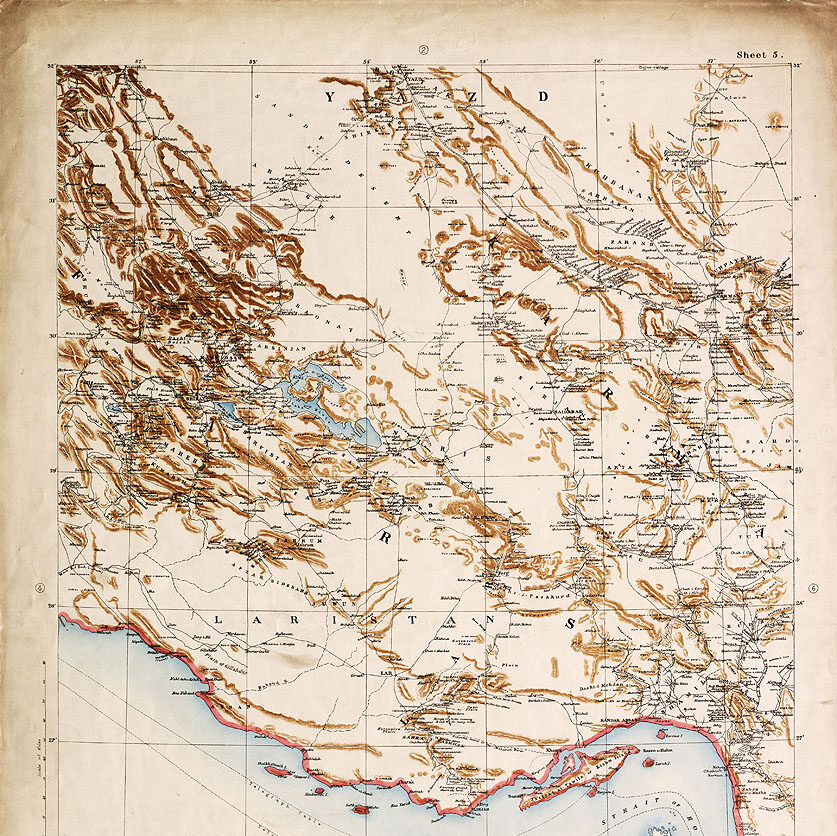
Pelagios’s Recogito is a web-based platform from which one may upload .txt files, tag placeNames, create maps, and more.
The Map of Persia shown here, similar to the image on the Recogito homepage, is from the British Library’s collection of maps.
Click the image to visit Recogito.
The Kit Marlowe Project is licensed under a Creative Commons Attribution-NonCommercial-ShareAlike 4.0 International License.

The Perseus Project site is a great resource for learning about classical and mythological history and figures.
Click the logo to explore Perseus Project!

The Kit Marlowe Project is licensed under a Creative Commons Attribution-NonCommercial-ShareAlike 4.0 International License.

Purdue OWL attempts to follow the Modern Language Association‘s ever changing citation conventions. Purdue OWL is a fantastic resource for writing of every kind.
Scan or click on the QR Code to visit Purdue OWL!
The Kit Marlowe Project is licensed under a Creative Commons Attribution-NonCommercial-ShareAlike 4.0 International License.
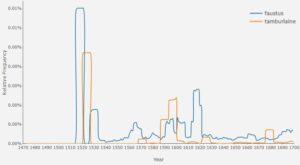
Quintessence is an excellent tool for text-based data analysis. Quintessence, produced by UC Davis DataLab, draws on 60,000 texts to generate in-depth analytics for word meanings, word frequencies, and text topics.
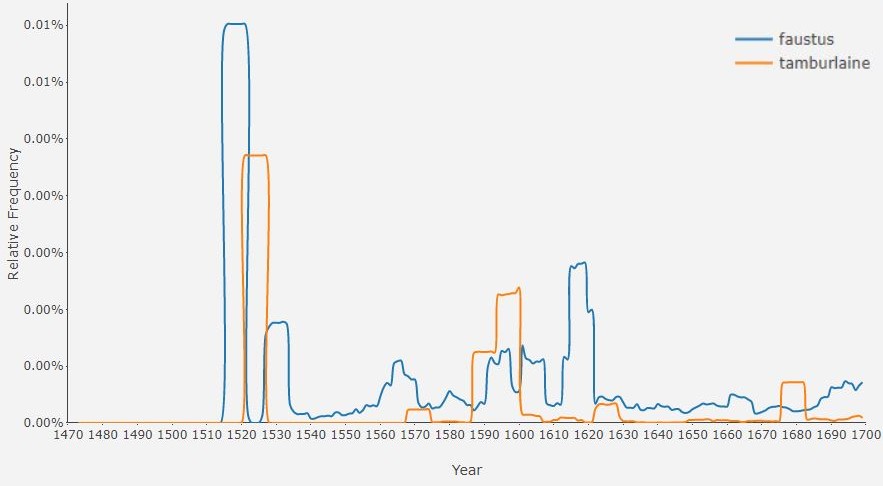
The image here is a graph from the Quintessence “Word Frequency” page, comparing the frequency of the words “faustus” and “tamburlaine” over time.
Click the graph to go straight to the “Word Frequency” page or click here to go to the Quintessence home page.
Project Quintessence: A Dynamic Explorer for Early Modern Texts, UC Davis DataLab. 2021. http://quintessence.ds.library.ucdavis.edu.
The Kit Marlowe Project is licensed under a Creative Commons Attribution-NonCommercial-ShareAlike 4.0 International License.

Rams Write is a by-students-for-students LibGuide published by Framingham State University that includes tips for paper organization, revision, clarity, frequently confused words, and grammar and mechanics.
Click the logo to visit Rams Write!

The Kit Marlowe Project is licensed under a Creative Commons Attribution-NonCommercial-ShareAlike 4.0 International License.

Records of Early English Drama, also known as REED, provides access to all surviving records of drama, secular music, and popular entertainment in England. Records range from the Middle Ages until 1642.
REED allows students, researchers, scholars, and curious readers to step back in time and immerse themselves in the records of the past.
To learn how to use the site, click here.
To begin searching through REED‘s records, click the logo!

The Kit Marlowe Project is licensed under a Creative Commons Attribution-NonCommercial-ShareAlike 4.0 International License.
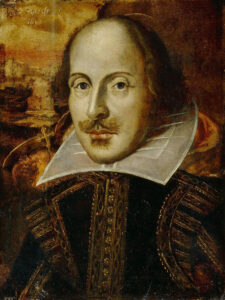
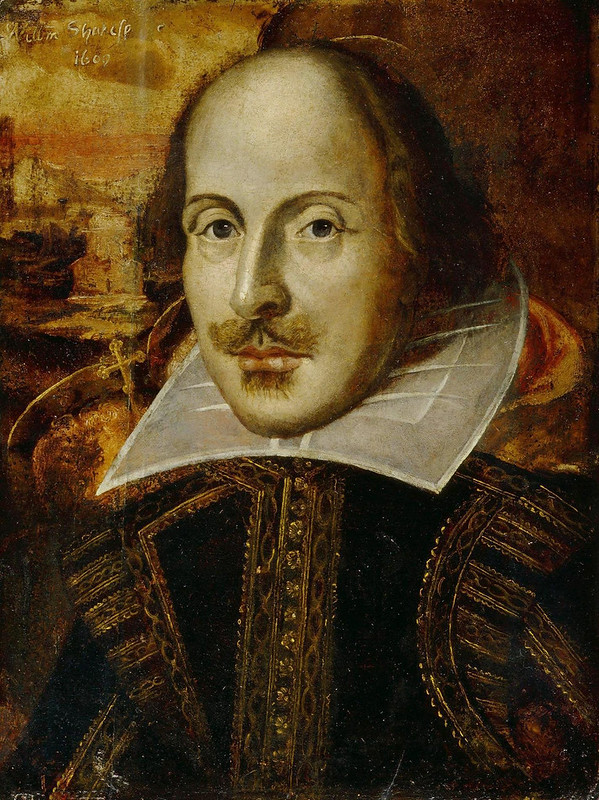
Curated by Thea Buckley, Shakespeare and Early Modern Streams features streaming productions of Shakespeare’s work, along with the work of his contemporaries.
Click the portrait of Shakespeare to check out Shakespeare and Early Modern Streams!
The Kit Marlowe Project is licensed under a Creative Commons Attribution-NonCommercial-ShareAlike 4.0 International License.
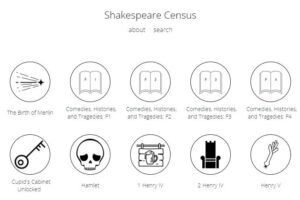
The Shakespeare Census is a great resource for accessing and learning about all surviving copies and editions of Shakespeare’s works, excluding the folios, through 1700. The Shakespeare Census does not include items of modern scholarship in their records.
Click the logo to access and read one of the 43 works available on Shakespeare Census!
Shakespeare Census. Ed. Adam G. Hooks and Zachary Lesser. Created 2018. Accessed 07 April 2021. . SC n.
The Kit Marlowe Project is licensed under a Creative Commons Attribution-NonCommercial-ShareAlike 4.0 International License.

Shakespeare Reloaded is a rich resource offering both teachers and students tools, games, theories, and techniques for generating imaginative environments from which to engage with Shakespeare and his contemporaries.
Click the logo to go to Shakespeare Reloaded!

The Kit Marlowe Project is licensed under a Creative Commons Attribution-NonCommercial-ShareAlike 4.0 International License.
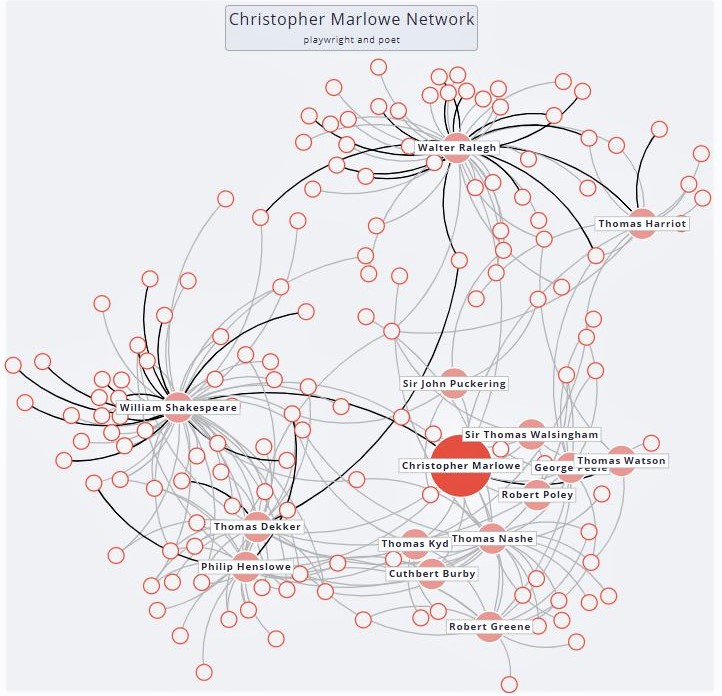
Six Degrees of Francis Bacon is a collaborative and adaptable digital reconstruction of the early modern social network. Scholars, researchers, and students can interact with and edit the network.
Six Degrees of Francis Bacon is hosted by Carnegie Mellon University Libraries and data can be accessed for download both on the site and as part of Folger Shakespeare Library’s digital collections.
The image is a visualization in the hooke format of Christopher Marlowe’s social network. Check out Six Degrees of Francis Bacon to explore Marlowe’s network further!
The Kit Marlowe Project is licensed under a Creative Commons Attribution-NonCommercial-ShareAlike 4.0 International License.

TAPAS is a free, online resource for publishing, archiving, and sharing Text Encoding Initiative (TEI) projects. The site is currently undergoing a technical overhaul, but for details about the process and any updates, click here.
When up and running, TAPAS Project: Kit Marlowe has pages for many of Marlowe’s works. Once available, a link to the site will be provided here.

The Kit Marlowe Project is licensed under a Creative Commons Attribution-NonCommercial-ShareAlike 4.0 International License.
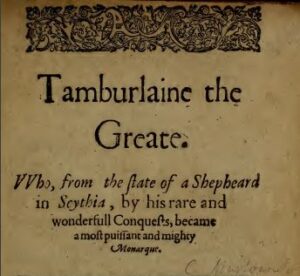
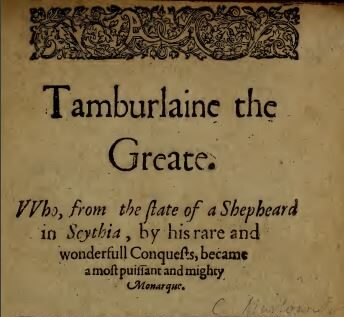
The Thomas Pennant Barton Shakespeare Collection at the Boston Public Library is an online treasure trove of early modern works published around Shakespeare’s time. Among many wonders, the collection contains Marlowe’s Tamburlaine.
Click on the image to go straight to Tamburlaine the Greate, or click here to go to The Thomas Pennant Barton Collection, accessible through Internet Archive.
The Kit Marlowe Project is licensed under a Creative Commons Attribution-NonCommercial-ShareAlike 4.0 International License.

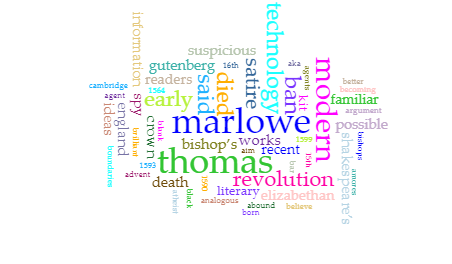
Voyant Tools is a web-based platform that allows one to upload a Word doc or PDF and generate visualizations of text-based data, including single text and corpus analyses.
The image depicts a Voyant Tools generated visualization of term analytics of the top 55 words from the “Why Kit Marlowe?” section of the Kit Marlowe Project’s about page.
The Kit Marlowe Project is licensed under a Creative Commons Attribution-NonCommercial-ShareAlike 4.0 International License.

The WordWeb/IDEM database maps the dense network of quotations, cross-references and in-jokes that links hundreds of English plays from Shakespeare’s time. If a comedy or tragedy was a hit on the Elizabethan stage, names and phrases could go viral:
Thomas Kyd in 1588: “Hamlet, revenge!”
William Shakespeare’s Hamlet in 1600: “O, vengeance!”
William Shakespeare in 1600: “What is this quintessence of dust?”
John Marston in 1603: “And here’s the very quintessence of ducks!”
You can now search and browse the WordWeb/IDEM database and explore. See what phrases early modern dramatists borrowed from each other and from other sources and find answers to questions like these!

The Kit Marlowe Project is licensed under a Creative Commons Attribution-NonCommercial-ShareAlike 4.0 International License.

The World History Encyclopedia, formerly the Ancient History Encyclopedia, is a useful resource for looking up classical figures.
Click the logo to visit the World History Encyclopedia and explore!

The Kit Marlowe Project is licensed under a Creative Commons Attribution-NonCommercial-ShareAlike 4.0 International License.
