You Can Make A Microprocessor That’s All Your Own

For a while now we’ve followed the slow progression of affordable integrated circuit fabrication, and through the likes of Tiny Tapeout we’ve seen impressive strides made. But they’re not the only player in the space, and [Breaking Taps] has a video showing their microprocessor built using wafer.space.

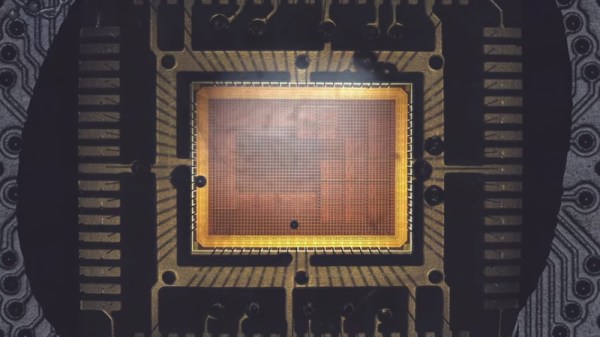
The microprocessor itself is a little unusual, being a transport triggered architecture design with two busses. The whole thing might better be described as a system-on-chip than a microprocessor, as like a microcontroller it contains both memory and peripherals. He’s used Spade to design the thing, and we get an in-depth look at all the steps involved between design and fabrication. It’s a level or two more difficult than passing the DRC standards for your PCB fabricator. The result is a chip carrier with the chip itself visible under clear epoxy. It’s using an old fabrication technology so the silicon is surprisingly big, but unlike Tiny Tapeout’s cell based fabrication the whole chip is the one circuit. Mounting it on a PCB and using a breadboard, he’s able to demonstrate it running simple programs.

It’s clear that having your own IC fabricated is not for everyone, as even though wafer.space has performed minor miracles it’s still a service for people with a few dollars in hand. But look at it this way, we’re still near the start of this particular curve, and we expect that further affordability breakthroughs will follow.

Continue reading “You Can Make A Microprocessor That’s All Your Own” →

Hackaday Links Column Banner

Hackaday Links: June 21, 2026

Today marks the summer solstice, the longest day of the year and the start of astronomical summer in the Northern Hemisphere. This doesn’t really have much to do with hacking hardware or building gadgets other than the fact that from this point on you’ll have progressively less daylight hours to do it in each day. Of course, if you do your best work in the middle of the night this won’t impact things much.

If you’re as likely to find a controller in your hand as a soldering iron in the evenings, you might be interested in a recent filing against Sony. Lawyers representing a group of four gamers allege that the entertainment giant is violating a California law that says digital storefronts need to make it clear that buyers don’t technically own the games in question but are merely licensing them — a license which, as we’ve seen in the past, can be revoked or modified at any time with no restitution made to the purchaser.

Now while we agree conceptually that selling gamers a license rather than an actual copy of the game is clearly a one-sided deal, we’re still not sure this case has a lot of merit. As far as we can tell, Sony does make it clear in the fine print that you’re not really going to own anything once they take your money. Or, at the very least, they make it equally as clear as any other company that’s selling digital downloads these days. Should the court actually find that said fine print is a little too fine, it could conceivably have ramifications throughout the entertainment industry. This is certainly a case to keep an eye on.

Continue reading “Hackaday Links: June 21, 2026” →

The Zeloof Z2 Intergrated Circuit Has 100 Transistors

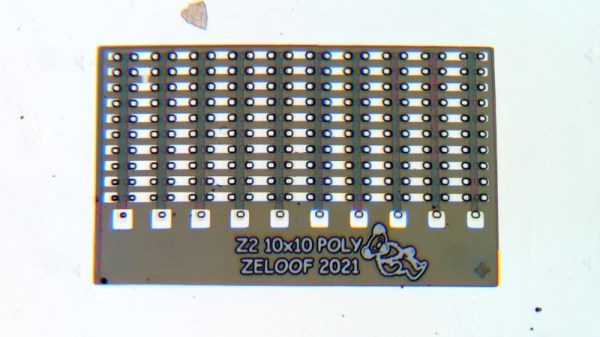
Back in 2018 we reported on the first silicon integrated circuit to be produced in a homemade chip fab. It was the work of [Sam Zeloof], and his Z1 chip was a modest six-transistor amplifier. Not one to rest on his laurels, he’s back with another chip, this time the Z2 is a hundred-transistor array. The Z2 occupies about a quarter of the area of the previous chip and uses a 10µm polysilicon gate process as opposed to the Z1’s metal gates. It won’t solve the global chip shortage, but this is a major step forward for anyone interested in building their own semiconductors.

The transistors themselves are FETs, and [Sam] is pleased with their consistency and characteristics. He’s not measured his yield on all samples, but of the twelve chips made he says he has one fully functional chip and a few others with at least 80% functionality. The surprise is that his process is less complex than one might expect, which he attributes to careful selection of a wafer pre-treated with the appropriate oxide layer.

You can see more about the Z2 in the video below the break. Meanwhile, should you wish to learn more about the Z1 you can see [Sam’s] Hackaday Superconference talk on the subject. We’re looking forward to the Z3 when it eventually arrives, with bated breath!

Continue reading “The Zeloof Z2 Intergrated Circuit Has 100 Transistors” →