Super Mario 64 Comes To The Microsoft Zune

As a portable media player, Microsoft’s Zune simply couldn’t compete with Apple’s juggernaut iPod — the latter essentially becoming the de facto personal media player until smartphones took over. But in 2026 it might be Microsoft that gets the last laugh, as thanks to [rsheldiii] the Zune can now play Super Mario 64.

The software is based on sm64ex, and notably doesn’t include the ROM file necessary to actually run the game. But presuming a legal dump of a cartridge has been done, building and loading it onto a Zune HD is straightforward enough. From there the player is presented with a controller interface on the device’s touchscreen overlaid with the video output from the game. Some interesting things are happening in the background here as well, like using NVIDIA’s Tegra tools to pre-compile shaders so the 2009-era processor can handle the rest of the gameplay.

Although it didn’t enjoy the mainstream success of the iPod, the Zune was actually a pretty solid device, and even though the last of them rolled off the assembly line back in 2012, there’s still a fairly active userbase for it. Modern improvements have added Bluetooth and solid-state drive upgrades for them have been available almost since they were first released.

With Latest Update, Alexa Refuses To Pass The Aux

Although the feature has been deleted from newer models, there was a time when Amazon’s Echo devices included a 3.5 mm “aux” input jack that let you connect other audio sources to the smart speaker. Alexa would even let you switch over to an external source with a voice command — or at least, it used to.

As first reported by Reddit user [n8-sd], Amazon has started informing users that voice control over the 3.5 mm jack is no longer supported. While the physical input will still function on models equipped with it, if you want to mute the audio coming from an external device you’ll have to wade through the Alexa smartphone application to do it.

In a statement to Ars Technica, an Amazon rep confirmed that voice control over the auxiliary input has been removed as of the latest software version, and that their analytics showed not many people were using the feature in the first place. They also pointed out that no changes have been made to voice control of Bluetooth devices. While we don’t doubt that the total number of users that were physically plugging an audio source into their Echos was probably low in the grand scheme of things, that doesn’t really explain why such a simple feature needed to be actively removed.

Some commenters have theorized that the real reason behind the change is the fact that Amazon has no way of monitoring what users are playing over the auxiliary input. Since cataloging and selling the media consumption habits of users is big business these days, that’s a problem. While they might prefer to disable the feature entirely, they know that would stir up some bad press, so they’re opting to simply make it more annoying to use. We’re not saying we entirely buy this explanation, but it’s not the craziest thing we’ve ever heard either.

Although the Echo devices have never been particularly hackable, they have enjoyed a certain amount of success with tech-savvy users, making it all the more disappointing to see the ecosystem seemingly becoming less capable over time.

Is This The Smallest Internet Radio?

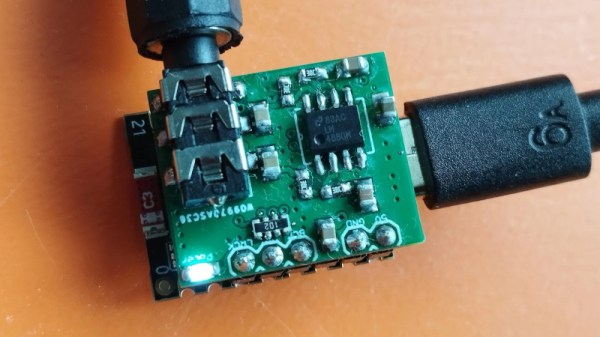
Internet radios have been a thing in some form for the last quarter century, and the advent of cheap networked microcontrollers has made them easier than ever to build. But just how small can one be made? [Milen] has made one that’s about as small as we’ve seen, and put it up on Instructables.

The hardware recipe is straightforward enough; take a microcontroller, connect it to the internet, and have your internet radio software squirt its output to a DAC. In this case the microcontroller is an ESP32-C£ on a very small dev board, and clipped to that is a custom PCB with a PCM5102A I2S DAC and an amplifier. The whole thing is tiny, small enough in fact that the two connectors are significant in size compared to it.

Whether or not it’s a practical device for listening remains to be seen, but it’s certainly tiny. But the question is, could it be made smaller? Perhaps eschewing the connectors would be an easy win, and in return for a loss in quality the ESP has a built-in DAC that’s not intended for audio but can be used. If you have any bright ideas, we’d be interested to hear them.

We’ve seen plenty of internet radios over the years, and for some reason this cassette-shaped one appeals to us.

Making A Digital Music Player For Cassette Decks

In the cross-over between the era of tapes into that of MP3s, you’d see quite a few of those special cassette tapes that were actually digital music players inside. Some simply provided a 3.5 mm input, while others were complete MP3 players or Bluetooth receivers that just happened to also output to the magnetic read head of a cassette player. Recently [Jonathan Rowny] decided to make his own version of the latter.

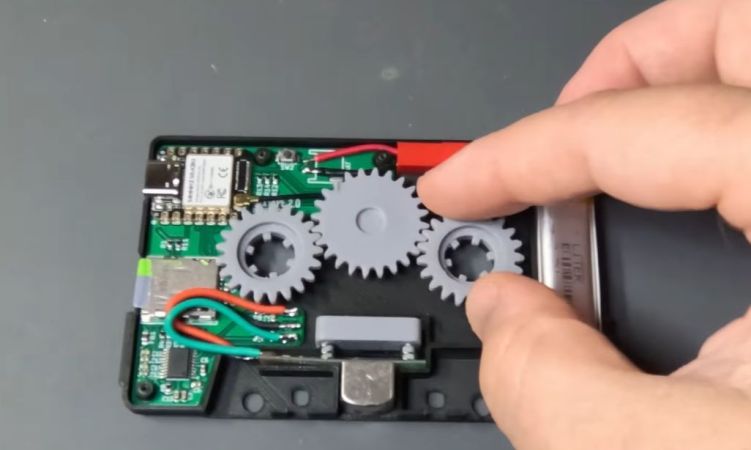
Although getting the actual audio signal into the read head is easy enough – requiring little more than its equivalent being used as a write head on the cassette side – actually interfacing with the player’s mechanisms like auto-stop, reverse and so on requires the use of some gearing that detect motion on what would be the tape spools, as well as transfer the motion from the take-up spool to the other spool so that features like the auto-stop mechanism don’t get triggered.

A lot of inspiration here can be found in e.g. the videos made by [Clint] of [Lazy Game Reviews] who looked at a number of examples – including their internals – over the years, with various levels of functionality. For this particular implementation an ESP32-S3 module is used for the brains, along with a microSD card reader for music and a PCM5102 I2S audio codec to create the analog audio signal.

The gears were printed using an SLA printer and seem to work all right. Unfortunately he didn’t realize the importance of the capstan as the mechanism that actually transports the tape, so its motion was not measured as is done in the better cassette adapters. This will likely be corrected in a future iteration, however.

Continue reading “Making A Digital Music Player For Cassette Decks” →

DOOM Played On Series Of 555 Timers

It’s technically true that any piece of software can be reproduced in hardware, although modern software’s size and complexity generally makes this a non-starter. But if we go far enough back in time, older software becomes easier and easier to implement in hardware. The original DOOM from 1993 might one day be recreated in full this way, but that day is not today. Instead, [Nick] has recreated the original music from that game, playing the opening track in nothing but 555 timers.

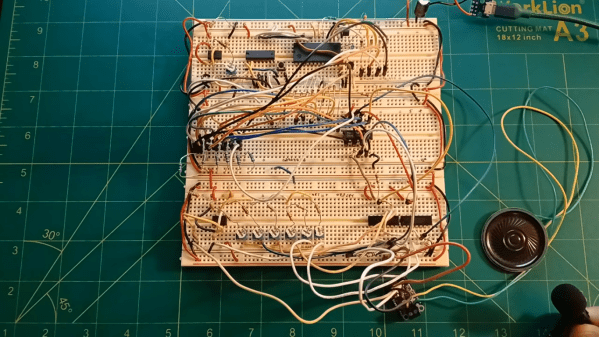
The circuit starts with a 555 timer that acts as a system clock with a rate of just over 7 Hz. These pulses feed a binary counter which in turn feeds a decoder, giving the circuit 15 positions. Each output of the decoder feeds to a diode matrix which stores information about what pitch the circuit should play. The circuit only needs to play six pitches so the diodes effectively connect each moment in time to one of these six notes. From there the circuit feeds into a set of switches which select different resistor networks of another 555 which is actually responsible for producing sound. The resistor networks have different values to adjust the timing of the 555 to produce different pitches.

Of course this entire exercise is largely academic as almost any microcontroller would be able to be programmed to play this chiptune quite easily, but it’s not a bad idea to get down into the weeds of digital logic from time to time in order to refine one’s skills and knowledge about what’s really going on in the inner workings of circuits. Or, go even deeper than that and build the logic gates themselves from first principles.

Continue reading “DOOM Played On Series Of 555 Timers” →

Child-Friendly Music Player Uses RFID

[David] has a young child who is clever enough to use a computer to play music, but he doesn’t quite want to hand over the mouse just yet. Thus, he set about building an electronic music player that could be operated in an altogether simpler fashion. 

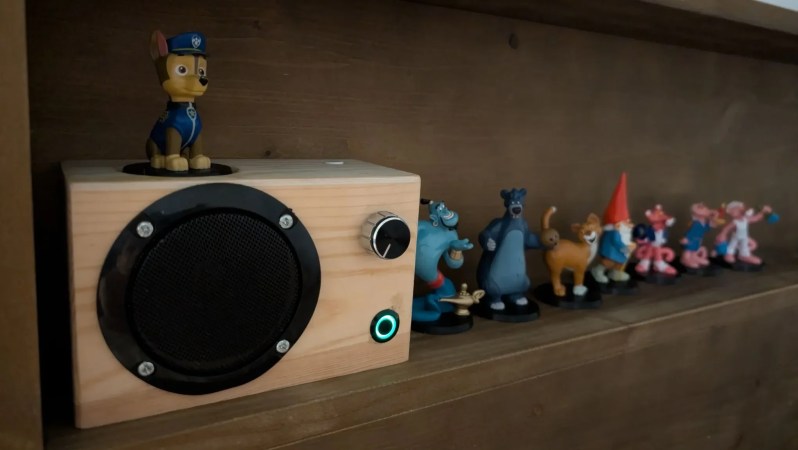
The build is based around an Arduino Nano — its job is to read RFID tags via an RC522 reader, with the tags themselves embedded in a series of small dolls belonging to [David]’s daughter. Upon reading the tag, the Arduino Nano chats over serial with a DFPlayer Mini module, which reads a playlist of MP3 files off of an SD card and plays them over a small 4 ohm speaker that [David] had laying around. It’s a simple build, with the components all neatly wrapped up in a handsome wooden case with a volume control and a skip button for if any one song becomes too annoying for a repeat listen.

We’ve featured other builds in this vein before, too. There’s something satisfying about a music player with such a simple interface—no delicate media to fiddle with, just pop the toy on top and get the playlist you were looking for. If you’re creating your own little musical builds at home, we’d love to see them on the tipsline.

Mic Jammer Relies On Ultrasound

Today’s phone microphones are perfectly adept at picking up sound in all sorts of conditions, and they’re backed by all kinds of processing techniques to filter out noise and capture clean audio. [mcore1976] has been working on a device to jam phone microphones that might be listening in, however, countering fancy processing techniques in turn. 

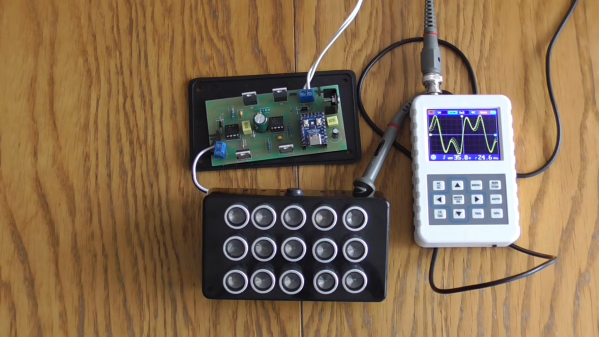
The build uses a microcontroller brain to control an array of ultrasonic transducers. [mcore1976] has created many revisions of the project, each time improving its ability to jam microphones in modern hardware. The latest revision uses an RP2040 microcontroller and a MOSFET drive stage to control 20-80 ultrasonic transducers. They’re driven with a PWM signal generated from the RP2040 itself. The signal output is specifically modulated to try and confuse the automatic gain control systems used in many modern phones in order to make it difficult for them to record clear audio when the jammer is running. As [mcore1976] demonstrates with an iPhone 17, his voice is completely lost amidst unintelligible garbled noise while the jammer is switched on.

It’s a niche idea, and perhaps most interesting because it affects phone microphones while being largely inaudible to the human ear. We’ve featured other interesting jamming devices of late, too. Video after the break.

Continue reading “Mic Jammer Relies On Ultrasound” →