Log In


Pegmatite
A rock subtype
This page is currently not sponsored. Click here to sponsor this page.




About Pegmatite
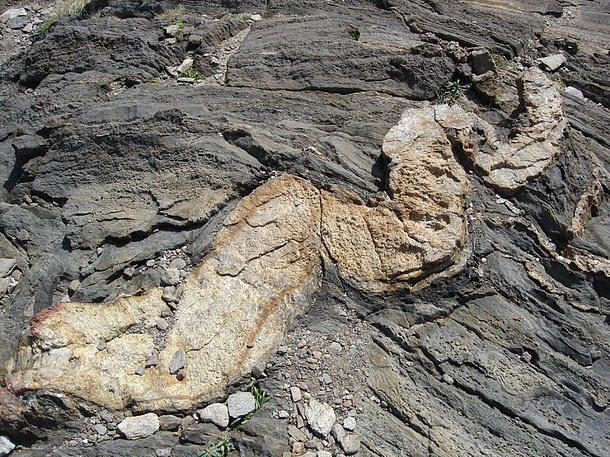
A term originally suggested by Haüy as a synonym for graphic granite, but now mostly used as primarily a textural term for the very coarse-grained facies of any type of igneous rock. The term describes both a coarse-grained igneous texture and a structural body consisting of such rock.
An unusually coarse-grained igneous rock, with interlocking, equigranular crystals, usually found as irregular dikes, lenses, or veins, esp. at the margins of batholiths. Most grains are 1 cm or more in diameter. The dykes and veins typically have symmetrical zonations, with crystals growing inwards from the walls. Although pegmatites having gross compositions similar to various other rock types are known, their composition is generally that of granite. The mineralogy may be simple or complex and may include rare minerals rich in such elements as lithium, beryllium, caesium, boron, fluorine, niobium, tantalum, uranium, and rare earths, often in miaroles. Pegmatites represent the last and most hydrous portion of a magma to crystallize, rich in volatiles like F, B, P, etc. and hence contain high concentrations of minerals present only in trace amounts in normal granitic rocks. Arguably, these rocks can be considered to be as much hydrothermal as igneous in origin.
The most up-to-date classification scheme for pegmatites was presented by Müller et al. (2022) and Wise et al. (2022).
The history of pegmatite research until the early 1960s is carefully summarised and critical discussed by Schneiderhöhn (1961) in much detail.
See also pegmatoid: a term commonly used for pegmatite-like rocks that don’t quite fit the definition. Most of them are metamorphogenic.
See also aplite, a fine-grained "analogue".
An unusually coarse-grained igneous rock, with interlocking, equigranular crystals, usually found as irregular dikes, lenses, or veins, esp. at the margins of batholiths. Most grains are 1 cm or more in diameter. The dykes and veins typically have symmetrical zonations, with crystals growing inwards from the walls. Although pegmatites having gross compositions similar to various other rock types are known, their composition is generally that of granite. The mineralogy may be simple or complex and may include rare minerals rich in such elements as lithium, beryllium, caesium, boron, fluorine, niobium, tantalum, uranium, and rare earths, often in miaroles. Pegmatites represent the last and most hydrous portion of a magma to crystallize, rich in volatiles like F, B, P, etc. and hence contain high concentrations of minerals present only in trace amounts in normal granitic rocks. Arguably, these rocks can be considered to be as much hydrothermal as igneous in origin.
The most up-to-date classification scheme for pegmatites was presented by Müller et al. (2022) and Wise et al. (2022).
The history of pegmatite research until the early 1960s is carefully summarised and critical discussed by Schneiderhöhn (1961) in much detail.
See also pegmatoid: a term commonly used for pegmatite-like rocks that don’t quite fit the definition. Most of them are metamorphogenic.
See also aplite, a fine-grained "analogue".
Unique Identifiers
Mindat ID:
50315
Long-form identifier:
mindat:1:1:50315:0
Similar Names
| Pegmatoid | A rock subtype |
Classification of Pegmatite
- Rock
- Igneous rock
- Pegmatite
- Igneous rock
Sub-divisions of Pegmatite
Age distribution
Recorded ages:
Mesoproterozoic to Triassic : 1170 ± 24 Ma to 237,3 ± 1 Ma - based on 8 recorded ages.
Sample ages:
| Sample ID | Recorded age | Geologic Time | Dating method |
|---|---|---|---|
| 1 | ~285 Ma | Cisuralian | K/Ar |
| 2 | 415 ± 12 Ma | Early/Lower Devonian | |
| 3 | 1020 to 980 Ma | Proterozoic | Rb, K, U-Pb |
| 4 | 1170 ± 24 Ma | Stenian | K-Ar |
Sample references:
Chemical Analysis
Oxide wt%:
| 1 | 2 | |
|---|---|---|
| SiO2 | 72.98 % | 71.08 % |
| Al2O3 | 15.17 % | 15.65 % |
| Fe2O3 | 0.48 % | 1.28 % |
| MnO | 0.06 % | 0.19 % |
| CaO | 0.65 % | 1.04 % |
| Na2O | 5.39 % | 7.72 % |
| K2O | .29 % | 0.77 % |
| H2O+ | 0.22 % | |
| H2O- | 0.23 % | |
| Total: | 95.02 % | 98.18 % |
Sample references:
| ID | Locality | Reference | Notes |
|---|---|---|---|
| 1 | Birch Portage pegmatites, Jan Lake, Saskatchewan, Canada | Barren pegmatite. The bulk chemistry of the rocks was determined primarily by X‑ray fluorescence (XRF), with flame photometry used specifically for alkali elements. | |
| 2 | " " | Beryl pegmatite The bulk chemistry of the rocks was determined primarily by X‑ray fluorescence (XRF), with flame photometry used specifically for alkali elements. |
Synonyms of Pegmatite
Other Language Names for Pegmatite
Common Associates
Associations Based on Photo Data:
| 24 photos of Pegmatite associated with Quartz | SiO2 |
| 22 photos of Pegmatite associated with Muscovite | KAl2(AlSi3O10)(OH)2 |
| 15 photos of Pegmatite associated with Schorl | NaFe2+3Al6(Si6O18)(BO3)3(OH)3(OH) |
| 10 photos of Pegmatite associated with K Feldspar | |
| 9 photos of Pegmatite associated with Feldspar Group | |
| 6 photos of Pegmatite associated with Biotite | K(Fe2+/Mg)2(Al/Fe3+/Mg/Ti)([Si/Al/Fe]2Si2O10)(OH/F)2 |
| 5 photos of Pegmatite associated with Albite | Na(AlSi3O8) |
| 5 photos of Pegmatite associated with 'Schist' | |
| 5 photos of Pegmatite associated with Beryl | Be3Al2(Si6O18) |
| 5 photos of Pegmatite associated with 'Yttrofluorite' | (Ca1-xYx)F2+x where 0.05 < x < 0.3 |
Internet Links for Pegmatite
mindat.org URL:
https://www.mindat.org/min-50315.html
Please feel free to link to this page.
Please feel free to link to this page.
References for Pegmatite
Reference List:
Derry, D. R. (1931) The Genetic Relationships of Pegmatites, Aplites, and Tin Veins. Geological Magazine, 68 (10) 454-475 doi:10.1017/s0016756800097570
Davison, E. H. (1932) Pegmatites, Aplites and Tin Veins. Geological Magazine, 69 (1) 47 doi:10.1017/s0016756800095881
Boydell, H. C. (1932) The Genetic Relationships of Pegmatites, Aplites and Tin Veins. Geological Magazine, 69 (3) 142 doi:10.1017/s0016756800097028
Jahns, Richard H. (1953) The genesis of pegmatites. I. Occurrence and origin of giant crystals. American Mineralogist, 38 (7-8) 563-598
Fisher, D. Jerome (1958) Pegmatite phosphates and their problems. American Mineralogist, 43 (3-4) 181-207
Le Maitre, R. W. - Ed. (2002) Igneous Rocks - A Classification and Glossary of Terms (2nd ed.) Cambridge University Press. doi:10.1017/cbo9780511535581
Cerny, P., Ercit, T. S. (2005) The Classification of Granitic Pegmatites Revisited. The Canadian Mineralogist, 43 (6) 2005-2026 doi:10.2113/gscanmin.43.6.2005
Fransolet, André-Mathieu (2007) Phosphate associations in the granitic pegmatites: the relevant signification of these accessory minerals. Granitic Pegmatites: The State of the Art - International Symposium. 06th - 12th May 2007, Porto, Portugal.
London, D. (2009) THE ORIGIN OF PRIMARY TEXTURES IN GRANITIC PEGMATITES. The Canadian Mineralogist, 47 (4) 697-724 doi:10.3749/canmin.47.4.697
Černý, P., London, D., Novák, M. (2012) Granitic Pegmatites as Reflections of Their Sources. Elements, 8 (4). 289-294 doi:10.2113/gselements.8.4.289
Thomas, Rainer, Davidson, Paul, Beurlen, Hartmut (2012) The competing models for the origin and internal evolution of granitic pegmatites in the light of melt and fluid inclusion research. Mineralogy and Petrology, 106 (1) 55-73 doi:10.1007/s00710-012-0212-z
London, D., Morgan, G. B. (2012) The Pegmatite Puzzle. Elements, 8 (4) 263-268 doi:10.2113/gselements.8.4.263
Linnen, R. L., Van Lichtervelde, M., Černý, P. (2012) Granitic Pegmatites as Sources of Strategic Metals. Elements, 8 (4). 275-280 doi:10.2113/gselements.8.4.275
London, D., Kontak, D. J. (2012) Granitic Pegmatites: Scientific Wonders and Economic Bonanzas. Elements, 8 (4) 257-261 doi:10.2113/gselements.8.4.257
Galliski, M. A., London, D., Novak, M., Martin, R. F. (2012) Granitic Pegmatites and their Minerals: a Tribute to Petr Černý. The Canadian Mineralogist, 50 (4). 777-780 doi:10.3749/canmin.50.4.777
Galliski, M. A., London, D., Novák, M., Martin, R. F. (2012) Granitic pegmatites and their minerals: a second tribute to Petr Černý. The Canadian Mineralogist, 50 (6). 1441-1444 doi:10.3749/canmin.50.6.1441
Dill, Harald G. (2015) Pegmatites and aplites: Their genetic and applied ore geology. Ore Geology Reviews, 69. 417-561 doi:10.1016/j.oregeorev.2015.02.022
Müller, Axel, Thomas, Rainer (2016) The genesis of granitic pegmatites- recent controversies. Norsk Mineralsymposium 2016, 9-12
Dill, Harald G. (2016) The CMS classification scheme (Chemical composition – Mineral assemblage – Structural geology) – linking geology to mineralogy of pegmatitic and aplitic rocks. Neues Jahrbuch für Mineralogie - Abhandlungen Journal of Mineralogy and Geochemistry, 193 (3) 231-263 doi:10.1127/njma/2016/0304
Sánchez-Muñoz, Luis, Müller, Axel, Andrés, Sol López, Martin, Robert F., Modreski, Peter J., de Moura, Odulio J.M. (2017) The P–Fe diagram for K-feldspars: A preliminary approach in the discrimination of pegmatites. Lithos, 272. 116-127 doi:10.1016/j.lithos.2016.10.030
Beskin, S. M., Marin, Yu. B. (2018) Classification of Granitic Pegmatites and Pegmatite-Bearing Granitic Systems. Geology of Ore Deposits, 60 (7) 578-586 doi:10.1134/s1075701518070024
Müller, Axel, Simmons, William, Beurlen, Hartmut, Thomas, Rainer, Ihlen, Peter M., Wise, Michael, Roda-Robles, Encarnación, Neiva, Ana M.R., Zagorsky, Victor (2022) A proposed new mineralogical classification system for granitic pegmatites – Part I: History and the need for a new classification. The Canadian Mineralogist, 60 (2) 203-227 doi:10.3749/canmin.1700088

Sagåsen Quarry, Sagåsen, Auenlandet, Porsgrunn, Telemark, Norway