Log In


Tacharanite
A valid IMA mineral species - grandfathered
This page is currently not sponsored. Click here to sponsor this page.

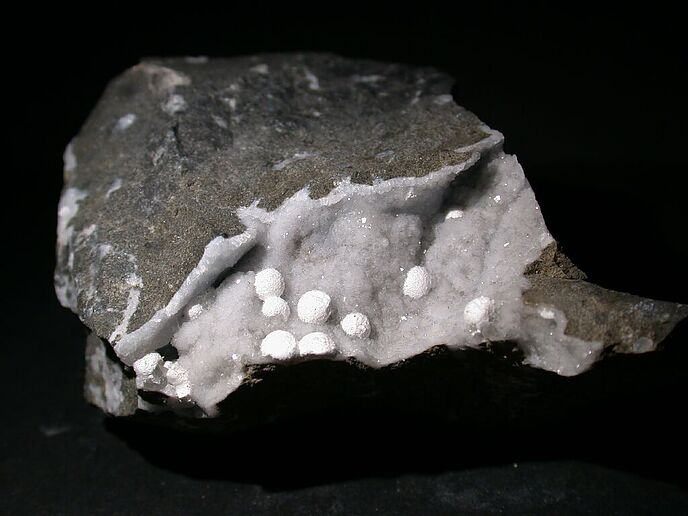


About Tacharanite
Formula:
Ca12Al2Si18O33(OH)36
Colour:
White
Lustre:
Vitreous, Dull
Hardness:
5
Specific Gravity:
2.33 - 2.36
Crystal System:
Monoclinic
Name:
From Gaelic "tacharan", a changeling, because the mineral breaks down into other compounds if left standing in air. (Note, however, that some specimens stored in collections for years showed no indication of any alteration when checked by powder X-ray diffraction.) Pronounced TĂ·KHERENAIT.
Unique Identifiers
Mindat ID:
3864
Long-form identifier:
mindat:1:1:3864:1
Similar Names
| Tasheranit | A synonym of Tazheranite |
IMA Classification of Tacharanite
Approved, 'Grandfathered' (first described prior to 1959)
First published:
1961
Classification of Tacharanite
9.HA.75
9 : SILICATES (Germanates)
H : Unclassified silicates
A : With Alkali and Alkali-earth Elements
9 : SILICATES (Germanates)
H : Unclassified silicates
A : With Alkali and Alkali-earth Elements
72.3.2.6
72 : PHYLLOSILICATES Two-Dimensional Infinite Sheets with Other Than Six-Membered Rings
3 : Two-Dimensional Infinite Sheets with Other Than Six-Membered Rings with 3-, 4-, or 5-membered rings and 8-membered rings
72 : PHYLLOSILICATES Two-Dimensional Infinite Sheets with Other Than Six-Membered Rings
3 : Two-Dimensional Infinite Sheets with Other Than Six-Membered Rings with 3-, 4-, or 5-membered rings and 8-membered rings
16.11.8
16 : Silicates Containing Aluminum and other Metals
11 : Aluminosilicates of Ca and Mg with or without alkalis
16 : Silicates Containing Aluminum and other Metals
11 : Aluminosilicates of Ca and Mg with or without alkalis
Mineral Symbols
As of 2021 there are now IMA–CNMNC approved mineral symbols (abbreviations) for each mineral species, useful for tables and diagrams.
| Symbol | Source | Reference for Standard |
|---|---|---|
| Tch | IMA–CNMNC | Warr, L.N. (2021). IMA–CNMNC approved mineral symbols. Mineralogical Magazine, 85(3), 291-320. doi:10.1180/mgm.2021.43 |
Physical Properties of Tacharanite
Vitreous, Dull
Transparency:
Translucent
Colour:
White
Hardness:
5 on Mohs scale
Cleavage:
Perfect
{001}
{001}
Fracture:
Conchoidal
Comment:
tenacity: tough
Density:
2.33 - 2.36 g/cm3 (Measured) 2.28 g/cm3 (Calculated)
Optical Data of Tacharanite
Type:
Biaxial (+)
RI values:
nα = 1.518 - 1.525 nγ = 1.53 - 1.537
Max. Birefringence:
δ = 0.012
Based on recorded range of RI values above.
Based on recorded range of RI values above.
Interference Colours:
The colours simulate birefringence patterns seen in thin section under crossed polars. They do not take into account mineral colouration or opacity.
Michel-Levy Bar The default colours simulate the birefringence range for a 30 µm thin-section thickness. Adjust the slider to simulate a different thickness.
Grain Simulation You can rotate the grain simulation to show how this range might look as you rotated a sample under crossed polars. Each grain retains its interference colour (retardation) while its brightness falls to black at extinction and reaches a maximum between extinction positions.
The colours simulate birefringence patterns seen in thin section under crossed polars. They do not take into account mineral colouration or opacity.
Michel-Levy Bar The default colours simulate the birefringence range for a 30 µm thin-section thickness. Adjust the slider to simulate a different thickness.
Grain Simulation You can rotate the grain simulation to show how this range might look as you rotated a sample under crossed polars. Each grain retains its interference colour (retardation) while its brightness falls to black at extinction and reaches a maximum between extinction positions.
Surface Relief:
None to Very Low
Relative to Canada balsam mounting medium (n ≈ 1.537).
Relative to Canada balsam mounting medium (n ≈ 1.537).
This shows the grain boundary and Becke line effect under plane-polarised
light, based on the contrast between this mineral's average refractive
index and the mounting medium. It does not take into account mineral
colouration.
In focus
Interference Figure:
This shows the idealized biaxial acute bisectrix (Bxa) interference figure
- the conoscopic view for a grain cut perpendicular to the acute bisectrix, using
this mineral's 2V. The two small white dots mark the melatopes - the points
where the two optic axes emerge - and are shown only when they fall within the
field of view. The coloured bands are isochromatics, and the dark bands are
isogyres.
Rotate the stage: at 0°/90° the isogyres form a cross through the melatopes; at 45° they pull apart into curved hyperbolas. That splitting on rotation - absent in a uniaxial figure - is the standard diagnostic test for telling biaxial minerals from uniaxial ones. If 2V is large, the melatopes may fall outside the field of view, as they often do at the microscope too.
No measured or calculated 2V is on file for this mineral, so the value used here (90°) is estimated from its recorded refractive indices and optic sign, not from a direct 2V measurement.
Rotate the stage: at 0°/90° the isogyres form a cross through the melatopes; at 45° they pull apart into curved hyperbolas. That splitting on rotation - absent in a uniaxial figure - is the standard diagnostic test for telling biaxial minerals from uniaxial ones. If 2V is large, the melatopes may fall outside the field of view, as they often do at the microscope too.
No measured or calculated 2V is on file for this mineral, so the value used here (90°) is estimated from its recorded refractive indices and optic sign, not from a direct 2V measurement.
Dispersion:
relatively strong
Chemistry of Tacharanite
Mindat Formula:
Ca12Al2Si18O33(OH)36
Element Weights:
| Element | % weight |
|---|---|
| O | 50.625 % |
Maglovec quarry, Vyšná Šebastová, Prešov District, Prešov Region, Slovakia