Log In


Barahonaite-(Al)
A valid IMA mineral species
This page is currently not sponsored. Click here to sponsor this page.
About Barahonaite-(Al)
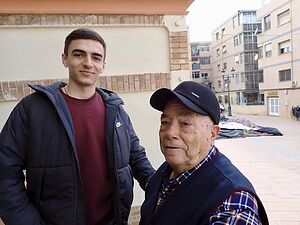
Antonio Barahona (right) and his grandson.
Formula:
(Ca,Cu,Na,Fe3+,Al)12Al2(AsO4)8(OH,Cl)x · nH2O
Colour:
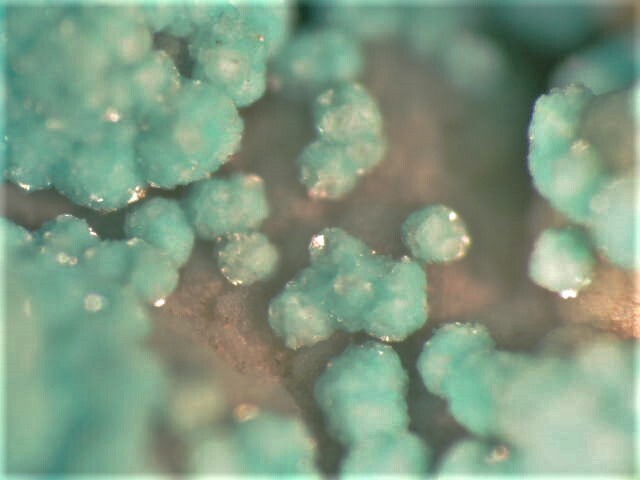
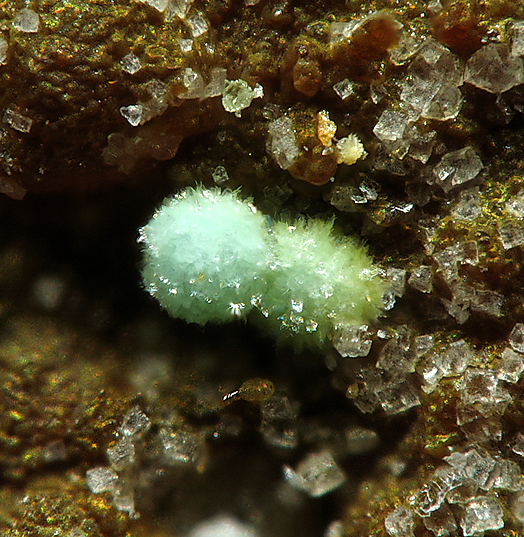
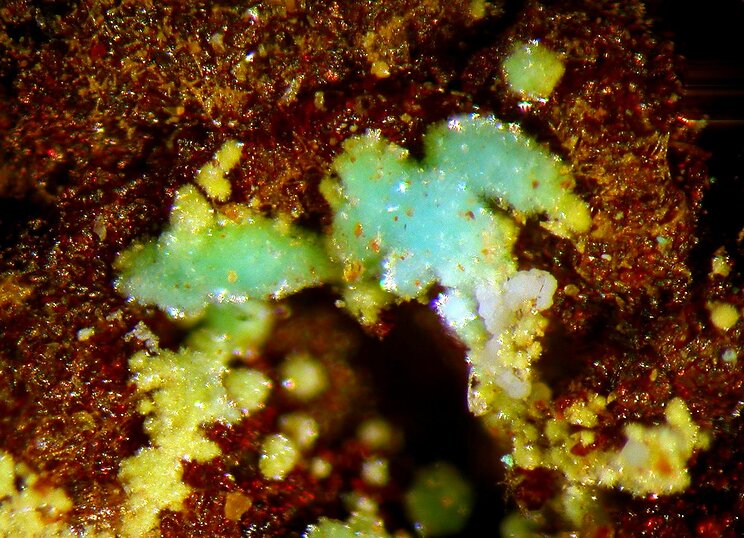
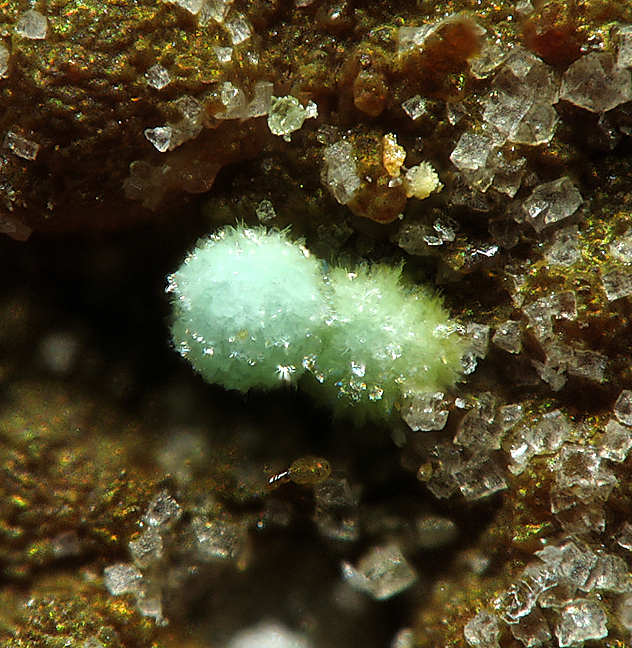
Pale blue
Lustre:
Vitreous
Specific Gravity:
3.03
Crystal System:
Monoclinic
Name:
Named for Antonio Barahona (1937- ), Spanish mineral collector and micromounter, who first noticed that this material might be a new mineral.
Type Locality:
Smolianinovite group (?).
The Al analogue of barahonaite-(Fe).
May appear visually similar to attikaite.
The Al analogue of barahonaite-(Fe).
May appear visually similar to attikaite.
Unique Identifiers
Mindat ID:
31728
Long-form identifier:
mindat:1:1:31728:9
Similar Names
| Barahonaite | A synonym | |
| Barahonaite-(Fe) | A valid IMA mineral species | (Ca,Cu,Na,Fe3+,Al)12Fe23+(AsO4)8(OH,Cl)x · nH2O |
IMA Classification of Barahonaite-(Al)
Approved
IMA Formula:
(Ca,Cu2+,Na,Fe3+,Al)12Al2(As5+O4)8(OH,Cl)x·nH2O
Approval year:
2007
First published:
2008
Classification of Barahonaite-(Al)
8.CH.60
8 : PHOSPHATES, ARSENATES, VANADATES
C : Phosphates without additional anions, with H2O
H : With large and medium-sized cations, RO4:H2O < 1:1
8 : PHOSPHATES, ARSENATES, VANADATES
C : Phosphates without additional anions, with H2O
H : With large and medium-sized cations, RO4:H2O < 1:1
40.6.4.1
40 : HYDRATED NORMAL PHOSPHATES,ARSENATES AND VANADATES
6 : (AB)5(XO4)4·xH2O
40 : HYDRATED NORMAL PHOSPHATES,ARSENATES AND VANADATES
6 : (AB)5(XO4)4·xH2O
Mineral Symbols
As of 2021 there are now IMA–CNMNC approved mineral symbols (abbreviations) for each mineral species, useful for tables and diagrams.
| Symbol | Source | Reference for Standard |
|---|---|---|
| Bho-Al | IMA–CNMNC | Warr, L.N. (2021). IMA–CNMNC approved mineral symbols. Mineralogical Magazine, 85(3), 291-320. doi:10.1180/mgm.2021.43 |
Physical Properties of Barahonaite-(Al)
Vitreous
Transparency:
Transparent, Translucent
Colour:
Pale blue
Streak:
White
Hardness Data:
Could not be measured
Comment:
Not determinable, crusts are easily scratched with a fingernail, likely due to disaggregation rather than true hardness.
Tenacity:
Brittle
Density:
3.03 g/cm3 (Measured) 2.98(9) g/cm3 (Calculated)
Comment:
Calculated value depends on the value of H2O that is used.
Optical Data of Barahonaite-(Al)
Type:
Biaxial (-)
RI values:
nα = 1.616(2) nγ = 1.622(2)
Max. Birefringence:
δ = 0.006
Based on recorded range of RI values above.
Based on recorded range of RI values above.
Interference Colours:
The colours simulate birefringence patterns seen in thin section under crossed polars. They do not take into account mineral colouration or opacity.
Michel-Levy Bar The default colours simulate the birefringence range for a 30 µm thin-section thickness. Adjust the slider to simulate a different thickness.
Grain Simulation You can rotate the grain simulation to show how this range might look as you rotated a sample under crossed polars. Each grain retains its interference colour (retardation) while its brightness falls to black at extinction and reaches a maximum between extinction positions.
The colours simulate birefringence patterns seen in thin section under crossed polars. They do not take into account mineral colouration or opacity.
Michel-Levy Bar The default colours simulate the birefringence range for a 30 µm thin-section thickness. Adjust the slider to simulate a different thickness.
Grain Simulation You can rotate the grain simulation to show how this range might look as you rotated a sample under crossed polars. Each grain retains its interference colour (retardation) while its brightness falls to black at extinction and reaches a maximum between extinction positions.
Surface Relief:
High (positive)
Relative to Canada balsam mounting medium (n ≈ 1.537).
Relative to Canada balsam mounting medium (n ≈ 1.537).
This shows the grain boundary and Becke line effect under plane-polarised
light, based on the contrast between this mineral's average refractive
index and the mounting medium. It does not take into account mineral
colouration.
In focus
Interference Figure:
This shows the idealized biaxial acute bisectrix (Bxa) interference figure
- the conoscopic view for a grain cut perpendicular to the acute bisectrix, using
this mineral's 2V. The two small white dots mark the melatopes - the points
where the two optic axes emerge - and are shown only when they fall within the
field of view. The coloured bands are isochromatics, and the dark bands are
isogyres.
Rotate the stage: at 0°/90° the isogyres form a cross through the melatopes; at 45° they pull apart into curved hyperbolas. That splitting on rotation - absent in a uniaxial figure - is the standard diagnostic test for telling biaxial minerals from uniaxial ones. If 2V is large, the melatopes may fall outside the field of view, as they often do at the microscope too.
No measured or calculated 2V is on file for this mineral, so the value used here (90°) is estimated from its recorded refractive indices and optic sign, not from a direct 2V measurement.
Rotate the stage: at 0°/90° the isogyres form a cross through the melatopes; at 45° they pull apart into curved hyperbolas. That splitting on rotation - absent in a uniaxial figure - is the standard diagnostic test for telling biaxial minerals from uniaxial ones. If 2V is large, the melatopes may fall outside the field of view, as they often do at the microscope too.
No measured or calculated 2V is on file for this mineral, so the value used here (90°) is estimated from its recorded refractive indices and optic sign, not from a direct 2V measurement.
Comments:
Interference color is grey to yellow.
Presumed to be biaxial (–), analogous to the optic sign
for barahonaite-(Fe).
β was not determined.
Presumed to be biaxial (–), analogous to the optic sign
for barahonaite-(Fe).
β was not determined.
Chemistry of Barahonaite-(Al)
Mindat Formula:
(Ca,Cu,Na,Fe3+,Al)12Al2(AsO4)8(OH,Cl)x · nH2O
Crystallography of Barahonaite-(Al)
Crystal System:
Monoclinic
Class (H-M):
2/m - Prismatic
Space Group:
P2/b
Cell Parameters:
a = 9.972 Å, b = 22.44 Å, c = 5.272 Å
β = 92.9°
β = 92.9°
Ratio:
a:b:c = 0.444 : 1 : 0.235
Unit Cell V:
1,178.21 ų (Calculated from Unit Cell)
Morphology:
Plates, commonly curved, with a maximum size of ~50 µm in diameter and thickness <1 µm.
X-Ray Powder Diffraction
Powder Diffraction Data:
| d-spacing | Intensity |
|---|---|
| 22.0 Å | (100) |
| 11.16 Å | (70) |
| 4.983 Å | (50) |
| 3.655 Å | (25) |
| 3.333 Å | (45) |
| 3.003 Å | (30) |
| 2.767 Å | (30) |
Geological Environment
Paragenetic Mode(s):
| Paragenetic Mode | Earliest Age (Ga) |
|---|---|
| Stage 7: Great Oxidation Event | <2.4 |
| 47a : [Near-surface hydration of prior minerals] | |
| 47d : [Arsenates, antimonates, selenates, bismuthinates] | |
| 47g : [Halogen-bearing surface weathering minerals] |
Type Occurrence of Barahonaite-(Al)
General Appearance of Type Material:
Beads, coalesced beads, and crusts of submillimetric thickness whose surfaces commonly glisten because of the presence of plates, up to 50 µm in diameter (Utah), and razor-thin, tabular, composite crystals, up to 20 µm long (Spain). The crystal units are somewhat divergent, and the texture varies from rosette to boxwork-like.
Place of Conservation of Type Material:
Canadian Museum of Nature at Ottawa, Ontario, Canada, number CMNMC 85719.
Geological Setting of Type Material:
An oxidation mineral occurring as coatings and within closely spaced fractures in weathered siliceous and micaceous host-rocks.
Associated Minerals at Type Locality:
Synonyms of Barahonaite-(Al)
Other Language Names for Barahonaite-(Al)
Common Associates
Associations Based on Photo Data:
| 6 photos of Barahonaite-(Al) associated with Conichalcite | CaCu(AsO4)(OH) |
| 6 photos of Barahonaite-(Al) associated with Barahonaite-(Fe) | (Ca,Cu,Na,Fe3+,Al)12Fe3+2(AsO4)8(OH,Cl)x · nH2O |
| 5 photos of Barahonaite-(Al) associated with Alumolukrahnite | Ca[CuAl](AsO4)2(H2O,OH)2 |
| 3 photos of Barahonaite-(Al) associated with Allophane | (Al2O3)(SiO2)1.3-2 · 2.5-3H2O |
| 2 photos of Barahonaite-(Al) associated with Olivenite | Cu2(AsO4)(OH) |
Gold Hill Mine, Gold Hill, Gold Hill Mining District, Tooele County, Utah, USA