Log In


Paraumbite
A valid IMA mineral species
This page is currently not sponsored. Click here to sponsor this page.


About Paraumbite
Formula:
K3Zr2H(Si3O9)2 · nH2O
Colour:
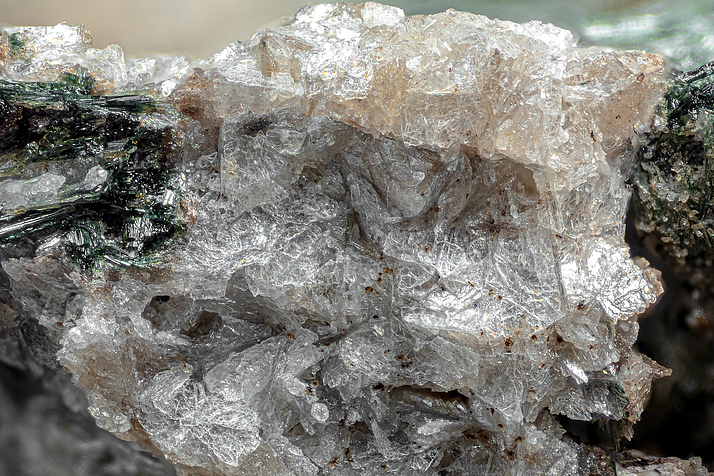
Colorless to white, gray, pale green
Lustre:
Vitreous, Pearly
Hardness:
4½
Specific Gravity:
2.59
Crystal System:
Orthorhombic
Name:
Name derives from the Greek 'para' for near, and umbite, for the close structural similarity to that mineral.
Type Locality:
This page provides mineralogical data about Paraumbite.
Unique Identifiers
Mindat ID:
3117
Long-form identifier:
mindat:1:1:3117:8
IMA Classification of Paraumbite
Approved
IMA Formula:
K3Zr4+2H(Si3O9)2·3H2O
Approval year:
1982
First published:
1983
Classification of Paraumbite
9.DG.25
9 : SILICATES (Germanates)
D : Inosilicates
G : Inosilicates with 3-periodic single and multiple chains
9 : SILICATES (Germanates)
D : Inosilicates
G : Inosilicates with 3-periodic single and multiple chains
59.2.1.2
59 : CYCLOSILICATES Three-Membered Rings
2 : Three-Membered Rings, hydrated
59 : CYCLOSILICATES Three-Membered Rings
2 : Three-Membered Rings, hydrated
14.10.17
14 : Silicates not Containing Aluminum
10 : Silicates of Zr or Hf
14 : Silicates not Containing Aluminum
10 : Silicates of Zr or Hf
Mineral Symbols
As of 2021 there are now IMA–CNMNC approved mineral symbols (abbreviations) for each mineral species, useful for tables and diagrams.
| Symbol | Source | Reference for Standard |
|---|---|---|
| Pumb | IMA–CNMNC | Warr, L.N. (2021). IMA–CNMNC approved mineral symbols. Mineralogical Magazine, 85(3), 291-320. doi:10.1180/mgm.2021.43 |
Physical Properties of Paraumbite
Vitreous, Pearly
Transparency:
Transparent, Translucent
Comment:
pearly on cleavages.
Colour:
Colorless to white, gray, pale green
Streak:
White
Hardness:
4½ on Mohs scale
Hardness:
VHN100=280 - 504 - Vickers
Cleavage:
Perfect
(010) micaceous, (100) and {110}, less perfect
(010) micaceous, (100) and {110}, less perfect
Fracture:
Irregular/Uneven
Density:
2.59 g/cm3 (Measured) 2.92 g/cm3 (Calculated)
Optical Data of Paraumbite
Type:
Biaxial (-)
RI values:
nα = 1.588(2) nβ = 1.601(2) nγ = 1.610(2)
2V:
Measured: 82° , Calculated: 78°
Max. Birefringence:
δ = 0.022
Based on recorded range of RI values above.
Based on recorded range of RI values above.
Interference Colours:
The colours simulate birefringence patterns seen in thin section under crossed polars. They do not take into account mineral colouration or opacity.
Michel-Levy Bar The default colours simulate the birefringence range for a 30 µm thin-section thickness. Adjust the slider to simulate a different thickness.
Grain Simulation You can rotate the grain simulation to show how this range might look as you rotated a sample under crossed polars. Each grain retains its interference colour (retardation) while its brightness falls to black at extinction and reaches a maximum between extinction positions.
The colours simulate birefringence patterns seen in thin section under crossed polars. They do not take into account mineral colouration or opacity.
Michel-Levy Bar The default colours simulate the birefringence range for a 30 µm thin-section thickness. Adjust the slider to simulate a different thickness.
Grain Simulation You can rotate the grain simulation to show how this range might look as you rotated a sample under crossed polars. Each grain retains its interference colour (retardation) while its brightness falls to black at extinction and reaches a maximum between extinction positions.
Surface Relief:
Moderate (positive)
Relative to Canada balsam mounting medium (n ≈ 1.537).
Relative to Canada balsam mounting medium (n ≈ 1.537).
This shows the grain boundary and Becke line effect under plane-polarised
light, based on the contrast between this mineral's average refractive
index and the mounting medium. It does not take into account mineral
colouration.
In focus
Interference Figure:
This shows the idealized biaxial acute bisectrix (Bxa) interference figure
- the conoscopic view for a grain cut perpendicular to the acute bisectrix, using
this mineral's 2V. The two small white dots mark the melatopes - the points
where the two optic axes emerge - and are shown only when they fall within the
field of view. The coloured bands are isochromatics, and the dark bands are
isogyres.
Rotate the stage: at 0°/90° the isogyres form a cross through the melatopes; at 45° they pull apart into curved hyperbolas. That splitting on rotation - absent in a uniaxial figure - is the standard diagnostic test for telling biaxial minerals from uniaxial ones. If 2V is large, the melatopes may fall outside the field of view, as they often do at the microscope too.
Rotate the stage: at 0°/90° the isogyres form a cross through the melatopes; at 45° they pull apart into curved hyperbolas. That splitting on rotation - absent in a uniaxial figure - is the standard diagnostic test for telling biaxial minerals from uniaxial ones. If 2V is large, the melatopes may fall outside the field of view, as they often do at the microscope too.
Dispersion:
relatively strong
Chemistry of Paraumbite
Mindat Formula:
K3Zr2H(Si3O9)2 · nH2O
Element Weights:
Common Impurities:
Ti,Hf,Fe,Na,K
Crystallography of Paraumbite
Crystal System:
Orthorhombic
Class (H-M):
mm2 - Pyramidal
Cell Parameters:
a = 10.36(2) Å, b = 13.27(2) Å, c = 14.56(1) Å
Ratio:
a:b:c = 0.781 : 1 : 1.097
Unit Cell V:
2,001.67 ų (Calculated from Unit Cell)
Z:
4
Comment:
Space Group: P2cm:
X-Ray Powder Diffraction
Powder Diffraction Data:
| d-spacing | Intensity |
|---|---|
| 6.46 Å | (80) |
| 5.95 Å | (100) |
| 3.34 Å | (70) |
| 3.01 Å | (90) |
| 2.90 Å | (70) |
| 2.56 Å | (60) |
Geological Environment
Paragenetic Mode(s):
| Paragenetic Mode | Earliest Age (Ga) |
|---|---|
| Stage 3a: Earth’s earliest Hadean crust | >4.50 |
| 9 : Lava/xenolith minerals (hornfels, sanidinite facies) | |
| Near-surface Processes | |
| 22 : Hydration and low-? subsurface aqueous alteration (see also #23) | |
| Stage 4b: Highly evolved igneous rocks | >3.0 |
| 35 : Ultra-alkali and agpaitic igneous rocks |
Type Occurrence of Paraumbite
General Appearance of Type Material:
Equant crystals, to 1 mm; massive.
Place of Conservation of Type Material:
Geology Museum, Kola Branch, Academy of Sciences, Apatity, Russia, 5842, 5843.
Mineralogical Museum, St. Petersburg University, St. Petersburg, Russia, 17065.
Mining Institute, St. Petersburg, Russia, 1630/1.
Il'menskii Preserve Museum, Miass, Russia, 13095vr.
A.E. Fersman Mineralogical Museum, Academy of Sciences, Moscow, Russia, 82760, vis3464, vis4544, vis4545, vis5045.
Mineralogical Museum, St. Petersburg University, St. Petersburg, Russia, 17065.
Mining Institute, St. Petersburg, Russia, 1630/1.
Il'menskii Preserve Museum, Miass, Russia, 13095vr.
A.E. Fersman Mineralogical Museum, Academy of Sciences, Moscow, Russia, 82760, vis3464, vis4544, vis4545, vis5045.
Geological Setting of Type Material:
Replacing wadeite in a pegmatite in a differentiated alkalic massif.
Associated Minerals at Type Locality:
Synonyms of Paraumbite
Other Language Names for Paraumbite
Common Associates
Associations Based on Photo Data:
Related Minerals - Strunz-mindat Grouping
| 9.DG. | Barrydawsonite-(Y) | Na1.5Y0.5CaSi3O8(OH) |
| 9.DG. | Paratobermorite | Ca5AlSi5O16(OH) · 5H2O |
| 9.DG. | Calcinaksite | KNaCa(Si4O10) · H2O |
| 9.DG. | Alvesite | NaKZrSi6O15 · 2H2O |
| 9.DG.02 | Steedeite | NaMn2[Si3BO9](OH)2 |
| 9.DG.02 | Nolzeite | NaMn2[Si3BO9](OH)2 · 2H2O |
| 9.DG.05 | Murakamiite | LiCa2Si3O8(OH) |
| 9.DG.05 | Serandite | NaMn2+2Si3O8(OH) |
| 9.DG.05 | Bustamite | CaMn2+(Si2O6) |
| 9.DG.05 | Pectolite | NaCa2Si3O8(OH) |
| 9.DG.05 | Tanohataite | LiMn2Si3O8(OH) |
| 9.DG.05 | Dalnegorskite | Ca5Mn2+(Si3O9)2 |
| 9.DG.05 | 'Wollastonite-1A' | CaSiO3 |
| 9.DG.05 | Wollastonite | Ca3(Si3O9) |
| 9.DG.05 | Ferrobustamite | CaFe2+(Si2O6) |
| 9.DG.05 | Schizolite | NaCaMnSi3O8(OH) |
| 9.DG.07 | Cascandite | CaScSi3O8(OH) |
| 9.DG.08 | Plombièrite | Ca5Si6O16(OH)2 · 7H2O |
| 9.DG.10 | Clinotobermorite | Ca5Si6O17 · 5H2O |
| 9.DG.10 | Riversideite | Ca5Si6O16(OH)2 · 2H2O |
| 9.DG.10 | Tobermorite | Ca5Si6O17 · 5H2O |
| 9.DG.12 | Jusite | Na2Ca15Al4Si16O54 · 17H2O |
| 9.DG.12 | Kenotobermorite | Ca4Si6O15(OH)2 · 5H2O |
| 9.DG.15 | Foshagite | Ca4(Si3O9)(OH)2 |
| 9.DG.20 | Jennite | Ca9(Si3O9)2(OH)8 · 8H2O |
| 9.DG.20 | Kamenevite | K2TiSi3O9 · H2O |
| 9.DG.25 | Umbite | K2(Zr,Ti)Si3O9 · H2O |
| 9.DG.30 | Sørensenite | Na4SnBe2Si6O16(OH)4 |
| 9.DG.32 | Escheite | Ca2NaMnTi5[Si12O34]O2(OH)3 · 12H2O |
| 9.DG.35 | Xonotlite | Ca6(Si6O17)(OH)2 |
| 9.DG.40 | Hillebrandite | Ca2(SiO3)(OH)2 |
| 9.DG.45 | Zorite | Na8(Ti,Nb)5(Si6O17)2(OH,O)5 · 14H2O |
| 9.DG.45 | Chivruaiite | Ca4(Ti,Nb)5(Si6O17)2(OH,O)5 · 13-14H2O |
| 9.DG.50 | Haineaultite | (Na,Ca)5Ca(Ti,Nb)5(Si6O17)2(OH,F)8 · 5H2O |
| 9.DG.55 | Epididymite | Na2Be2Si6O15 · H2O |
| 9.DG.60 | Eudidymite | Na2Be2Si6O15 · H2O |
| 9.DG.65 | Elpidite | Na2ZrSi6O15 · 3H2O |
| 9.DG.65 | Patynite | NaKCa4[Si9O23] |
| 9.DG.67 | Whelanite | Cu2+2Ca6[Si6O17(OH)](CO3)(OH)3 · 2H2O |
| 9.DG.70 | Enricofrancoite | KNaCaSi4O10 |
| 9.DG.70 | Yusupovite | Na2Zr(Si6O15) · 2.5H2O |
| 9.DG.70 | Litidionite | KNaCuSi4O10 |
| 9.DG.70 | Fenaksite | (K,Na)4(Fe,Mn)2(Si4O10)2(OH,F) |
| 9.DG.70 | Manaksite | KNaMnSi4O10 |
| 9.DG.75 | Senkevichite | CsKNaCa2TiO[Si7O18](OH) |
| 9.DG.75 | Tinaksite | K2Na(Ca,Mn2+)2TiO[Si7O18(OH)] |
| 9.DG.75 | Tokkoite | K2Ca4[Si7O18(OH)](OH,F) |
| 9.DG.80 | Fluorcanasite | K3Na3Ca5Si12O30F4 · H2O |
| 9.DG.80 | Canasite | K3Na3Ca5Si12O30(OH)4 |
| 9.DG.85 | Miserite | K1.5-x(Ca,Y,REE)5(Si6O15)(Si2O7)(OH,F)2 · yH2O |
| 9.DG.90 | Frankamenite | K3Na3Ca5(Si12O30)(F,OH)4 · H2O |
| 9.DG.92 | Charoite | (K,Sr)15-16(Ca,Na)32[Si6O11(O,OH)6]2[Si12O18(O,OH)12]2[Si17O25(O,OH)18]2(OH,F)4 · ~3H2O |
| 9.DG.95 | Yuksporite | K4(Ca,Na)14(Sr,Ba)2(◻,Mn,Fe)(Ti,Nb)4(O,OH)4(Si6O17)2(Si2O7)3(H2O,OH)3 |
| 9.DG.97 | Eveslogite | (Na,K,Ca,Sr,Ba)48 [(Ti,Nb,Mn,Fe2+)12Si48O144(OH)12](F,OH,Cl)14 |
Wadeite point, Eveslogchorr Mt, Murmansk Oblast, Russia