Log In


Osumilite
A valid IMA mineral species - grandfathered
This page is currently not sponsored. Click here to sponsor this page.


About Osumilite

Formula:
K◻2Fe2+2Al3[Al2Si10O30]
some Na reported in the B site (dominated by ◻ in the end-member formula);
some Mg reported in the A site (dominated by Fe in the end-member formula)
some Mg reported in the A site (dominated by Fe in the end-member formula)
Colour:
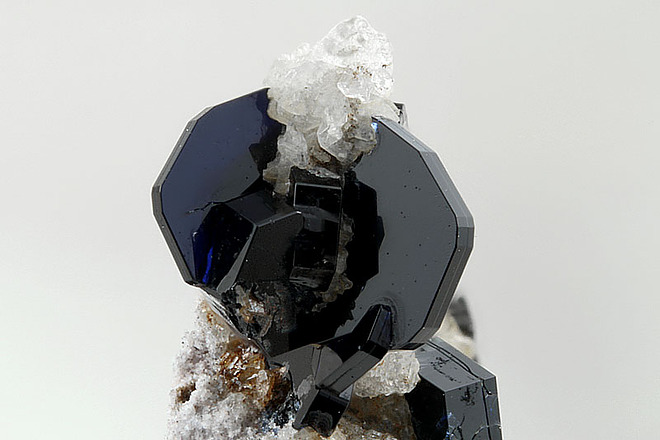
Black, dark blue, dark brown, pink, gray
Lustre:
Vitreous
Hardness:
5 - 6
Specific Gravity:
2.58 - 2.68
Crystal System:
Hexagonal
Member of:
Name:
Named in 1953 by Akiho Miyashiro for the Osumi Peninsula, Japan, on which the type locality is found.
Type Locality:
Osumilite Group.
Difficult to distinguish from Osumilite-(Mg).
Compare 'UM1984-35-SiO:AlCaFeKMg'.
From Belakovskiy (2013), summarizing Chukanov et al. (2013):
"Chemical data for osumilite in original paper (Miyashiro 1956) show that it is Mg‑dominant. However this analysis shows the sum of cations Si+Al+Fe+Mg+Mn (for O = 30) is 0.78 more then the theoretical value. The study of osumilite type locality material (Armbruster and Oberhänsli 1988; abstracted paper) show the significant Fe2+ prevalence over Mg. Anyway, the name osumilite had been assigned by IMA CNMNC Fe2+-dominant osumilite."
Difficult to distinguish from Osumilite-(Mg).
Compare 'UM1984-35-SiO:AlCaFeKMg'.
From Belakovskiy (2013), summarizing Chukanov et al. (2013):
"Chemical data for osumilite in original paper (Miyashiro 1956) show that it is Mg‑dominant. However this analysis shows the sum of cations Si+Al+Fe+Mg+Mn (for O = 30) is 0.78 more then the theoretical value. The study of osumilite type locality material (Armbruster and Oberhänsli 1988; abstracted paper) show the significant Fe2+ prevalence over Mg. Anyway, the name osumilite had been assigned by IMA CNMNC Fe2+-dominant osumilite."
Unique Identifiers
Mindat ID:
3039
Long-form identifier:
mindat:1:1:3039:3
Similar Names
| Osmelite | A synonym of Pectolite | |
| Osumilite-(K,Mg) | A discredited species name | |
| Osumilite-(Mg) | A valid IMA mineral species | K◻2Mg2Al3[Al2Si10O30] |
IMA Classification of Osumilite
Approved, 'Grandfathered' (first described prior to 1959)
IMA Formula:
KFe2+2(Al5Si10)O30
First published:
1953
Classification of Osumilite
9.CM.05
9 : SILICATES (Germanates)
C : Cyclosilicates
M : [Si6O18]12- 6-membered double rings (sechser-Doppelringe)
9 : SILICATES (Germanates)
C : Cyclosilicates
M : [Si6O18]12- 6-membered double rings (sechser-Doppelringe)
63.2.1a.6
63 : CYCLOSILICATES Condensed Rings
2 : Condensed Rings (Milarite - Osumilite group)
63 : CYCLOSILICATES Condensed Rings
2 : Condensed Rings (Milarite - Osumilite group)
16.24.16
16 : Silicates Containing Aluminum and other Metals
24 : Aluminosilicates of Fe, Mg, Ca and alkalis
16 : Silicates Containing Aluminum and other Metals
24 : Aluminosilicates of Fe, Mg, Ca and alkalis
Mineral Symbols
As of 2021 there are now IMA–CNMNC approved mineral symbols (abbreviations) for each mineral species, useful for tables and diagrams.
Please only use the official IMA–CNMNC symbol. Older variants are listed for historical use only.
Please only use the official IMA–CNMNC symbol. Older variants are listed for historical use only.
| Symbol | Source | Reference for Standard |
|---|---|---|
| Osm | IMA–CNMNC | Warr, L.N. (2021). IMA–CNMNC approved mineral symbols. Mineralogical Magazine, 85(3), 291-320. doi:10.1180/mgm.2021.43 |
| Osu | Siivolam & Schmid (2007) | Siivolam, J. and Schmid, R. (2007) Recommendations by the IUGS Subcommission on the Systematics of Metamorphic Rocks: List of mineral abbreviations. Web-version 01.02.07. IUGS Commission on the Systematics in Petrology. download |
| Osm | Whitney & Evans (2010) | Whitney, D.L. and Evans, B.W. (2010) Abbreviations for names of rock-forming minerals. American Mineralogist, 95, 185–187 doi:10.2138/am.2010.3371 |
| Osm | The Canadian Mineralogist (2019) | The Canadian Mineralogist (2019) The Canadian Mineralogist list of symbols for rock- and ore-forming minerals (December 30, 2019). download |
Physical Properties of Osumilite
Vitreous
Transparency:
Transparent, Translucent
Colour:
Black, dark blue, dark brown, pink, gray
Comment:
Strongly pleochroic
Hardness:
5 - 6 on Mohs scale
Tenacity:
Brittle
Cleavage:
Poor/Indistinct
Indistinct, parallel and perpendicular {0001}
Indistinct, parallel and perpendicular {0001}
Density:
2.58 - 2.68 g/cm3 (Measured) 2.71 g/cm3 (Calculated)
Optical Data of Osumilite
Type:
Uniaxial (+/-)
RI values:
nω = 1.539 - 1.547 nε = 1.545 - 1.551
2V:
Measured: 28° to 45°, Calculated: 0.0° to 0.0°
Max. Birefringence:
δ = 0.004 - 0.006
Based on recorded range of RI values above.
Based on recorded range of RI values above.
Interference Colours:
The colours simulate birefringence patterns seen in thin section under crossed polars. They do not take into account mineral colouration or opacity.
Michel-Levy Bar The default colours simulate the birefringence range for a 30 µm thin-section thickness. Adjust the slider to simulate a different thickness.
Grain Simulation You can rotate the grain simulation to show how this range might look as you rotated a sample under crossed polars. Each grain retains its interference colour (retardation) while its brightness falls to black at extinction and reaches a maximum between extinction positions.
The colours simulate birefringence patterns seen in thin section under crossed polars. They do not take into account mineral colouration or opacity.
Michel-Levy Bar The default colours simulate the birefringence range for a 30 µm thin-section thickness. Adjust the slider to simulate a different thickness.
Grain Simulation You can rotate the grain simulation to show how this range might look as you rotated a sample under crossed polars. Each grain retains its interference colour (retardation) while its brightness falls to black at extinction and reaches a maximum between extinction positions.
Surface Relief:
None to Very Low
Relative to Canada balsam mounting medium (n ≈ 1.537).
Relative to Canada balsam mounting medium (n ≈ 1.537).
This shows the grain boundary and Becke line effect under plane-polarised
light, based on the contrast between this mineral's average refractive
index and the mounting medium. It does not take into account mineral
colouration.
In focus
Interference Figure:
This shows the idealized uniaxial interference figure - the conoscopic
(convergent-light, Bertrand-lens-in) view, for a grain cut with the optic axis
centred and vertical. The coloured rings are isochromatics, computed with the
same physics as the Michel-Lévy bar above; the dark cross is the isogyre.
For a genuinely uniaxial mineral viewed this way, that cross stays perfectly stationary if you rotate the stage - unlike a biaxial mineral, where it splits apart on rotation. That invariance is itself the standard diagnostic test for telling uniaxial and biaxial minerals apart at the microscope.
For a genuinely uniaxial mineral viewed this way, that cross stays perfectly stationary if you rotate the stage - unlike a biaxial mineral, where it splits apart on rotation. That invariance is itself the standard diagnostic test for telling uniaxial and biaxial minerals apart at the microscope.
Optical Extinction:
Nominally uniaxial(+/-), but may be anomalously biaxial (+/-) with a 2V° from 0 (so true uniaxial) up to ~45°.
Pleochroism:
Visible
Comments:
O = light blue to bluish purple, pale pink, pale yellow-brown; E = colorless to brown.
Comments:
Anomalously biaxial.
Chemistry of Osumilite
Mindat Formula:
K◻2Fe2+2Al3[Al2Si10O30]
some Na reported in the B site (dominated by ◻ in the end-member formula);
some Mg reported in the A site (dominated by Fe in the end-member formula)
some Na reported in the B site (dominated by ◻ in the end-member formula);
some Mg reported in the A site (dominated by Fe in the end-member formula)
Element Weights:
Common Impurities:
Ti,Mn,Ba,Na,Mg
Crystallography of Osumilite
Crystal System:
Hexagonal
Class (H-M):
6/mmm(6/m2/m2/m) - Dihexagonal Dipyramidal
Space Group:
P6/mcc
Setting:
P6/mcc
Cell Parameters:
a = 10.13(4) Å, c = 14.31(5) Å
Ratio:
a:c = 1 : 1.413
Unit Cell V:
1,271.71 ų (Calculated from Unit Cell)
Z:
2
Morphology:
Hexagonal, tabular. Well developed {0001}, {1010}, {1120}. Also {2130}, {1011}, {1012}, {1122}.
Twinning:
Rarely, perpendicular to {0001}.
Crystal Structure
Load
Unit Cell | Unit Cell Packed
2x2x2 | 3x3x3 | 4x4x4
Unit Cell | Unit Cell Packed
2x2x2 | 3x3x3 | 4x4x4
Show
Big Balls | Small Balls | Just Balls | Spacefill
Polyhedra Off | Si Polyhedra | All Polyhedra
Remove metal-metal sticks
Big Balls | Small Balls | Just Balls | Spacefill
Polyhedra Off | Si Polyhedra | All Polyhedra
Remove metal-metal sticks
Display Options
Black Background | White Background
Perspective On | Perspective Off
2D | Stereo | Red-Blue | Red-Cyan
Black Background | White Background
Perspective On | Perspective Off
2D | Stereo | Red-Blue | Red-Cyan
View
CIF File Best | x | y | z | a | b | c
CIF File Best | x | y | z | a | b | c
Rotation
Stop | Start
Stop | Start
Labels
Console Off | On | Grey | Yellow
Console Off | On | Grey | Yellow
Data courtesy of the American Mineralogist Crystal Structure Database. Click on an AMCSD ID to view structure
| ID | Species | Reference | Link | Year | Locality | Pressure (GPa) | Temp (K) |
|---|---|---|---|---|---|---|---|
| 0007263 | Osumilite | Balassone G, Mormone A, Rossi M, Bernardi A, Fisch M, Armbruster T, Malsy K, Berger A (2008) Crystal chemical and structural characterization of an Mg-rich osumilite from Vesuvius volcano (Italy) European Journal of Mineralogy 20 713-720 | 2008 | Vesuvius volcano, Italy | 0 | 293 | |
| 0007256 | Osumilite | Seryotkin Y V, Sokol E V, Bakakin V V, Likhacheva A Y (2008) Pyrometamorphic osumilite: occurrence, paragenesis, and crystal structure as compared to cordierite European Journal of Mineralogy 20 191-198 | 2008 | South Urals, Russia | 0 | 293 | |
| 0006586 | Osumilite | Winter W, Armbruster T, Lengauer C (1995) Crystal structure refinement of synthetic osumilite-type phases: BaMg2Al6Si9O30, SrMg2Al6Si9O30 and Mg2Al4Si11O30 European Journal of Mineralogy 7 277-286 | 1995 | 0 | 293 | ||
| 0006585 | Osumilite | Winter W, Armbruster T, Lengauer C (1995) Crystal structure refinement of synthetic osumilite-type phases: BaMg2Al6Si9O30, SrMg2Al6Si9O30 and Mg2Al4Si11O30 European Journal of Mineralogy 7 277-286 | 1995 | 0 | 293 | ||
Funtanafigu quarry, Marrubiu, Oristano Province, Sardinia, Italy