Log In


Carbonado
A variety of Diamond
This page is currently not sponsored. Click here to sponsor this page.


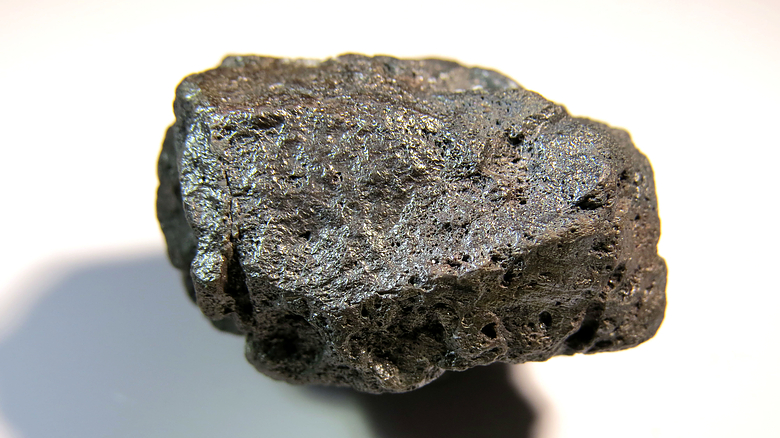

About Carbonado
Formula:
C
Colour:
Black, gray, brown
Lustre:
Resinous
A massive (polycrystalline), porous, opaque, gray, brown, or black variety of diamond used as an abrasive and in rock drills.
Five different theories for the formation of carbonado have been discussed.
1. Meteoritic impact;
2. Growth and sintering in the crust or mantle;
3. Subduction;
4. Radioactive ion implantation of carbon substrates;
5. Extraterrestrial.
To understand the genesis of carbonado, it is necessary to take into account the following:
1 - The clastic form of its outcrops, indicating that they are fragments of a large geological body;
2 - The high degree of mechanical wear, which, along with the isotopic age, indicates the antiquity of these diamonds: Archean or early Proterozoic;
3 - True carbonados are an endemic variety of diamond, and they are distributed only in territories in Brazil and Central Africa, which, within Gondwana, were united and separated only in the Mesozoic due to the opening of the Atlantic.
The most likely precursor to carbonado is shungite or both carbonado and shungite originated from a similar precursor substance. It corresponds to carbonado in carbon isotope composition, age, and presence of mineral impurities.
See also the varieties bort, ballas.
Five different theories for the formation of carbonado have been discussed.
1. Meteoritic impact;
2. Growth and sintering in the crust or mantle;
3. Subduction;
4. Radioactive ion implantation of carbon substrates;
5. Extraterrestrial.
To understand the genesis of carbonado, it is necessary to take into account the following:
1 - The clastic form of its outcrops, indicating that they are fragments of a large geological body;
2 - The high degree of mechanical wear, which, along with the isotopic age, indicates the antiquity of these diamonds: Archean or early Proterozoic;
3 - True carbonados are an endemic variety of diamond, and they are distributed only in territories in Brazil and Central Africa, which, within Gondwana, were united and separated only in the Mesozoic due to the opening of the Atlantic.
The most likely precursor to carbonado is shungite or both carbonado and shungite originated from a similar precursor substance. It corresponds to carbonado in carbon isotope composition, age, and presence of mineral impurities.
See also the varieties bort, ballas.
Unique Identifiers
Mindat ID:
27227 (as Carbonado)
1282 (as Diamond)
1282 (as Diamond)
Long-form identifier:
mindat:1:1:27227:8 (as Carbonado)
mindat:1:1:1282:5 (as Diamond)
mindat:1:1:1282:5 (as Diamond)
Similar Names
| Carbonate | |
| Carbonite | A rock subtype |
| Carbonite (of Heinrich) | |
| Carbonite (of Lucas) | |
| Carbonite (of Mueller) | A variety of 'Pyrobitumen' |
Physical Properties of Carbonado
Resinous
Colour:
Black, gray, brown
Chemistry of Carbonado
Mindat Formula:
C
Element Weights:
| Element | % weight |
|---|---|
| C | 100.000 % |
Calculated from ideal end-member formula.
Elements listed:
Synonyms of Carbonado
Black Diamond (in part)
Common Associates
Other Information
Health Risks:
No information on health risks for this material has been entered into the database. You should always treat mineral specimens with care.
Internet Links for Carbonado
mindat.org URL:
https://www.mindat.org/min-27227.html
Please feel free to link to this page.
Please feel free to link to this page.
Search Engines:
Mineral Dealers:
References for Carbonado
Reference List:
[2]Sautter, Violaine, Lorand, Jean -Pierre, Cordier, Patrick, Rondeau, Benjamin, Leroux, Hugues, Ferraris, Cristiano, Pont, Sylvain (2011) Petrogenesis of mineral micro-inclusions in an uncommon carbonado. European Journal of Mineralogy, 23 (5) 721-729 doi:10.1127/0935-1221/2011/0023-2154
Kaminsky, F. V.; Wirth, R.; Morales, L. (2013) Internal texture and syngenetic inclusions in carbonado. The Canadian Mineralogist, 51 (1). 39-55 doi:10.3749/canmin.51.1.39
www.geologypage.com (n.d.) http://www.geologypage.com/2016/04/geologists-discover-origin-of-earths.html
Localities for Carbonado
Showing 7 localities.
 symbol to view information about a locality.
The
symbol to view information about a locality.
The Locality List
 - This locality has map coordinates listed.
- This locality has estimated coordinates.
ⓘ - Click for references and further information on this occurrence.
? - Indicates mineral may be doubtful at this locality.
- This locality has map coordinates listed.
- This locality has estimated coordinates.
ⓘ - Click for references and further information on this occurrence.
? - Indicates mineral may be doubtful at this locality.
 - Good crystals or important locality for species.
 - World class for species or very significant.
(TL) - Type Locality for a valid mineral species.
(FRL) - First Recorded Locality for everything else (eg varieties).
- World class for species or very significant.
(TL) - Type Locality for a valid mineral species.
(FRL) - First Recorded Locality for everything else (eg varieties).
All localities listed without proper references should be considered as questionable.
Brazil | |
| Derby (1907) +1 other reference | |
| Herold et al. (2014) | |
Indonesia | |
| Herold et al. (2014) | |
Russia | |
| Kaminsky et al. (2016) |
| chemistry and genesis et al. (in Russian) +1 other reference |
| Shcheka et al. (2006) |
Venezuela | |
| NEWMAN |

Paraguaçu river, Andaraí, Bahia, Brazil