Log In


Efremovite
A valid IMA mineral species
This page is currently not sponsored. Click here to sponsor this page.



About Efremovite

Ivan A. Yefremov
Formula:
(NH4)2Mg2(SO4)3
Colour:
Gray, white
Lustre:
Vitreous, Dull
Hardness:
2
Specific Gravity:
2.52 (Calculated)
Crystal System:
Isometric
Member of:
Name:
Named in honour of Dr. Ivan Antonovich Yefremov (Ива́н Анто́нович (Анти́пович) Ефре́мов) (22 April 1908, Vyritsa, St. Petersburg, Russian Empire – 5 October 1972, Leningrad, USSR), paleontologist and geologist at the Paleontological Institute, Moscow. He was also a science fiction writer.
Type Locality:
Mg analogue of ferroefremovite.
A hygroscopic ammonium magnesium sulphate that hydrates to boussingaultite at room temperature.
Compare also Unnamed (NH4-Mg Sulphate Hydrate).
A hygroscopic ammonium magnesium sulphate that hydrates to boussingaultite at room temperature.
Compare also Unnamed (NH4-Mg Sulphate Hydrate).
Unique Identifiers
Mindat ID:
1355
Long-form identifier:
mindat:1:1:1355:6
IMA Classification of Efremovite
Approved
IMA Formula:
(N3-H4)2Mg2(S6+O4)3
Approval year:
1987
First published:
1989
Classification of Efremovite
7.AC.10
7 : SULFATES (selenates, tellurates, chromates, molybdates, wolframates)
A : Sulfates (selenates, etc.) without additional anions, without H2O
C : With medium-sized and large cations
7 : SULFATES (selenates, tellurates, chromates, molybdates, wolframates)
A : Sulfates (selenates, etc.) without additional anions, without H2O
C : With medium-sized and large cations
28.4.4.3
28 : ANHYDROUS ACID AND NORMAL SULFATES
4 : Miscellaneous
28 : ANHYDROUS ACID AND NORMAL SULFATES
4 : Miscellaneous
25.3.16
25 : Sulphates
3 : Sulphates of Mg
25 : Sulphates
3 : Sulphates of Mg
Mineral Symbols
As of 2021 there are now IMA–CNMNC approved mineral symbols (abbreviations) for each mineral species, useful for tables and diagrams.
| Symbol | Source | Reference for Standard |
|---|---|---|
| Efr | IMA–CNMNC | Warr, L.N. (2021). IMA–CNMNC approved mineral symbols. Mineralogical Magazine, 85(3), 291-320. doi:10.1180/mgm.2021.43 |
Physical Properties of Efremovite
Vitreous, Dull
Transparency:
Opaque
Comment:
Aggregates dull, presumably vitreous as grains
Colour:
Gray, white
Hardness:
2 on Mohs scale
Cleavage:
None Observed
Fracture:
Irregular/Uneven
Density:
2.52 g/cm3 (Calculated)
Optical Data of Efremovite
Type:
Isotropic
RI values:
n = 1.550(1)
Surface Relief:
Low (positive)
Relative to Canada balsam mounting medium (n ≈ 1.537).
Relative to Canada balsam mounting medium (n ≈ 1.537).
This shows the grain boundary and Becke line effect under plane-polarised
light, based on the contrast between this mineral's average refractive
index and the mounting medium. It does not take into account mineral
colouration.
In focus
Chemistry of Efremovite
Mindat Formula:
(NH4)2Mg2(SO4)3
Element Weights:
Crystallography of Efremovite
Crystal System:
Isometric
Class (H-M):
23 - Tetartoidal
Space Group:
P213
Cell Parameters:
a = 9.99(1) Å
Unit Cell V:
997.00 ų (Calculated from Unit Cell)
Z:
4
X-Ray Powder Diffraction
Powder Diffraction Data:
| d-spacing | Intensity |
|---|---|
| 5.76 Å | (35) |
| 4.07 Å | (70) |
| 3.15 Å | (100) |
| 3.00 Å | (35) |
| 2.668 Å | (50) |
| 1.620 Å | (25). |
Geological Environment
Paragenetic Mode(s):
| Paragenetic Mode | Earliest Age (Ga) |
|---|---|
| Stage 7: Great Oxidation Event | <2.4 |
| 45a : [Sulfates, arsenates, selenates, antimonates] | |
| 45b : [Other oxidized fumarolic minerals] | |
| Stage 10a: Neoproterozoic oxygenation/terrestrial biosphere | <0.6 |
| 50 : Coal and/or oil shale minerals | <0.36 |
| Stage 10b: Anthropogenic minerals | <10 Ka |
| 54 : Coal and other mine fire minerals (see also #51 and #56) |
Type Occurrence of Efremovite
General Appearance of Type Material:
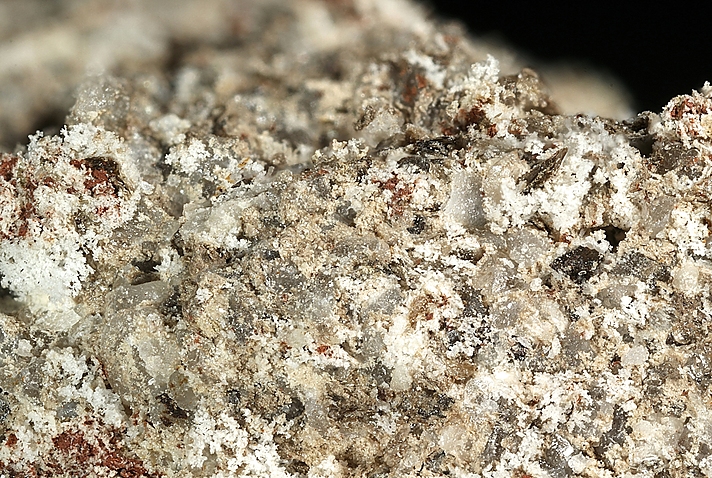
Equant grains, 0.01-0.015 mm, in gray to white aggregates.
Place of Conservation of Type Material:
Fersman Mineralogical Museum, Academy of Sciences, Moscow.
Geological Setting of Type Material:
From a fumarole at burning dumps at coal mine shafts
Associated Minerals at Type Locality:
Synonyms of Efremovite
Other Language Names for Efremovite
Relationship of Efremovite to other Species
Member of:
Other Members of Langbeinite Group:
| Calciolangbeinite | K2Ca2(SO4)3 | Iso. 23 : P213 |
| Ferroefremovite | (NH4)2Fe2+2(SO4)3 | Iso. 23 : P213 |
| Langbeinite | K2Mg2(SO4)3 | Iso. 23 : P213 |
Heřmanice dump, Heřmanice, Ostrava, Ostrava-City District, Moravian-Silesian Region, Czech Republic