Translated article from Vrij Nederland, 15 October 2005, by Easy Aloha.
The song 'Popcorn' by Gershon Kingsley is a melody you can't resist. Even people who hate the song have to admit it has a stubborn quality.
Everybody knows the song 'Popcorn' by Gershon Kingsley. Older people will remember it as the crazy summer hit of 1972. Younger readers know it as a jingle, the Crazy Frog Popcorn remix, or as a ringtone. Tup-tup-tup-tup-tuptuptup. If you don't know what it's about, do a search on the internet. You know it. And if you didn't know it yet, you won't forget it from now on. 'Popcorn' is a classic earworm. The song has been covered hundreds and hundreds of times: by Japanese punk bands, Kraftwerk, Aphex Twin and now the Crazy Frog.
It is one of the biggest, if not the biggest, instrumental hits of all time. 'Popcorn' was written by the now 82-year-old synthesizer pioneer Gershon Kingsley, who was releasing a new album in November 2005: God is a Moog.
In the book The Man Who Mistook His Wife for a Hat, Oliver Sacks tells us about the peculiar autistic twins John and Michael. The boys had a thing with numbers. If Sacks called out just any number, there was usually no response. But the boys jumped up when he called a prime number — a number divisible only by one or itself. It made them happy. Anybody can work out that thirty-seven is a prime number. But John and Michael recognised prime numbers of six or seven digits without thinking. Something that would seem unimaginable at first glance.
Maybe this is a case of a sensitivity that everybody knows — a sensitivity that resembles what 'normal people' experience when listening to music. You can interpret 1373 as a melody: the first note of a scale, then the third, then the seventh, then the third again. There are numbers (melodies) that tell us nothing. There are numbers that make us sad, numbers that move us, and numbers we immediately recognise as special — ones that enter the brain and stay there. Melodies that drive certain people to distraction: musical prime numbers.
If they exist, Gershon Kingsley's 'Popcorn' must be the musical equivalent of such a prime number. It is an example of a melody you can't resist. Even people who hate the song have to admit it has a persistent, unbeatable quality. It is the kind of melody that feels as though it always existed. You can't verify it, but with a melody like 'Popcorn' you might think that if Gershon Kingsley hadn't composed it, someone else would have.
Gershon Kingsley wrote the song in the mid-sixties. He was a classically trained musician who one day met Robert Moog. The late Robert Moog — he died in August 2005 — had just finished the first synthesizer and Kingsley was intrigued. Moog showed him the beast: a kind of telephone exchange operated by elephants. Kingsley was sold and spent one of his last three thousand dollars on it. At that moment he was one of the first people to own such a synthesizer, and the first man with a synthesizer and a studio.
Put a classically trained composer in a closed room with only a synthesizer and hundreds of knobs. Will he play a song? No — he will turn every knob in search of the craziest sounds and bleeps. And so it was with Gershon Kingsley. He found a funny sound that reminded him of the popping of popcorn. As a kind of alibi to use the sound, he constructed a minor scale motif and called it 'Popcorn'.
The song is more than a melody. 'Popcorn' was also a new sound — the sound that fitted the Apollo era and synthetic spacesuits. The sound of plastic. There are people who know that the number two is yellow and the number three green. That is called synaesthesia. If we're talking about sounds, everybody is a synaesthete. Maybe that's the most important difference between mathematics and music: there are sounds experienced as funny, and humming tones as menacing.
Not only the melody, but also the timbre and the sounds make music special — they decide the mood of a song. If you strike an A on a piano, you hear the A, but also the first overtones C# and E, and many more. How these overtones relate to each other determines the character of an instrument. The great thing about a Moog synthesizer is that you can shape the colour of the sound in a hundred different ways. You can make it sound like a piano, an organ, or an... ehm... Moog.
Like the people who love the heavenly sound of the Stradivarius or the Steinway, there are thousands — mostly men — who never tire of talking about the Moog sound, shaped for the most part by the legendary Moog ladder filter, which has two important knobs. One lets you turn the high tones up or down, just like the treble knob on a simple amplifier. With the other you can resonate the electric circuit, comparable to the resonating chamber of a Stradivarius or a Steinway. If you play the Moog with one hand and turn the knobs with the other, you can make the Moog "talk" — like a guitarist with a wah-wah pedal. It can give a nice percussive effect. It can also give a hungry or funny effect.
Kingsley had a weak spot for such funny noises. The mystical powers of sounds he learned from Jean Jacques Perrey (1929), a musical eccentric from Paris who was still active and still operating on the good side of lunacy.
Perrey collected sounds with a microphone and a tape recorder: sad noises like that of a foghorn; happy noises like small copper bells; and gruesome noises like nails on a chalkboard. Perrey had developed his own form of art, making chemistry with such sounds by cutting and sequencing them: Boohplokiiieeprljoop. The result was a tickling noise that made people laugh, especially children. It is the kind of funny noise rarely used in music. Almost all music is made with a certain degree of seriousness, however happy the song may be. Funny noises make a song a gimmick or a novelty — the kind of music that won't get you far if you want to be taken seriously. Cartoon music.
That didn't stop Perrey, though. He once made a version of 'Busy Bee', a nimble song in which xylophone players like to show their virtuosity. However, Perrey didn't play the song on a xylophone — he cut and pasted it together from a tape of bee sounds. At a beekeeper's, Perrey recorded hundreds of metres of bees: excited bees, slow bees, angry bees. He sorted the buzzing by timbre and pitch, then cut the tape with a razor blade into small pieces of 1.05 cm — each piece the equivalent of an eighth note. He pasted the pieces in sequence until they produced the melody 'Busy Bee'.
In 1964, Perrey and Kingsley met. Perrey played Kingsley a Peep-Plop-Katjengpriljoep sound tape, and the only thing Kingsley could do was laugh. Kingsley played some ploop-pioerrljoep things on the Moog. This resulted in a kind of alien communication, and the two men couldn't wait to mix their sounds and make music like it had never been made before.
Perrey and Kingsley founded a true music lab, with Kingsley's big Moog synthesizer and Perrey's sound tapes. They produced a dozen tapes of Moog sounds and the craziest sono-synthetic sounds, as Perrey called them. Every tape was a week of hard work: cutting, pasting and copying everything onto a new tape, repeated ten times over.
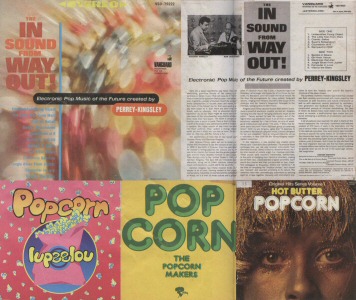
Next, they had session musicians play guitar lines and percussion over this electronic music. The result was two unique records — The In Sound From Way Out! and Kaleidoscopic Vibrations: records full of electronic soap bubbles and robotic bubblegum music.
Critics and record dealers didn't know what to do with the records; copies were sold for a dollar and categorised under: Instrumental Misc. But marketing people looted the two records like hungry lions. Almost every song from both records was used in a television commercial. The song 'Baroque Hoedown' is still used in the Electrical Parade at Disneyworld.
They were also discovered by hip-hop producers who sampled sounds from the records with great enthusiasm. In 1996, the Beastie Boys released a record with the same name — The In Sound From Way Out! — as a homage. The fact that Perrey and Kingsley were being sampled shows the strange forces at work in the music industry. What Perrey did was nothing much more than literal sampling. His way of working has been caught up with by the times. A song that Perrey and Kingsley worked on for a week can now be made in fifteen minutes with current technology. And yet their cut-and-paste work still sounds fresh and very special. There is something magical about handwork. A 'Perrey & Kingsley' sound you can recognise immediately.
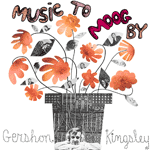
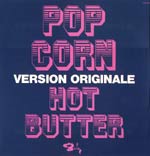
Kingsley made 'Popcorn' without Perrey. But Perrey's spirit is there. Half of the song consists of funny noises and the other half is melody. Gershon Kingsley put the song on the album Music To Moog By, but he didn't realise there was something special about it. Stan Free was the one who saw that the song had something unique. Free was a musician who performed in the First Moog Quartet, led by Kingsley — a quartet that wanted to introduce the Moog as a classical instrument. Stan Free noticed that the audience responded to 'Popcorn' and released it as a pop single under the name 'Hot Butter'. The little tune then spread across mankind like a virus.
Kingsley had sold the rights to the song before it became a hit, and he wanted to make some money — if only to send his daughter to a good university. He made some 'Popcorn'-ish songs such as 'Crackerjacks', 'Sauerkraut' and 'Cold Duck', but a second 'Popcorn' was not among them. A number is a prime number or it isn't.
Indirectly, his daughter could still enjoy a good university thanks to the song's rights. And maybe Kingsley selling the rights is even a kind of justice. You can say that the Moog with its funny noises made the song just as much as Kingsley did.
In that light, you can understand the title of Gershon Kingsley's then-new album: God Is A Moog.