


Our Verdict

Fire Emblem: Fortune's Weave is a true colossus of a game, almost always for the better, but occasionally for the worse. The core strategy gameplay is varied and engaging, most of the new ideas work, and the narrative is unprecedented in terms of scope. There's more admin than I like, and the lack of multiple save files and bird interactions can be frustrating, but outside of that, I doubt I'll play a better game in 2026.
In the last month, Fire Emblem: Fortune's Weave has completely taken over my life. Since receiving the code from Nintendo, it feels like I've done nothing but play it, think about it, or wish I could tell people how good it is. Well, now the time has finally come, and I can shout about this game from the rooftops. Fire Emblem: Fortune's Weave is an absolute tour de force. It's a generational game. It's the best thing I've played all year. And yet, I can't say it's perfect. Why, you ask? Well, let's get into it.
Usually, I'd start a review by detailing the story, but that, dear readers, is a bit complicated with Fortune's Weave. For one, it's massive. The main character is Eshmel, or the Herald of the Pale Raven, who, for this review, we'll occasionally refer to as the overarching protagonist. You start the game as Eshmel, get a blast of lore and a few tutorials before heading into the Obelisk Chamber, where the scale of this game becomes quickly apparent.
In this chamber, you get access to the stories of the four playable Heroic Games participants, Cai, Dietrich, Leda, and Theodora, also known as the faction-leading Flame Lords. That should sound a bit familiar if you played Three Houses, one of the very best Switch games, but rather than fulfilling each leader's quest one after the other, the Obelisk Chamber allows you to bounce between storylines at your own pace, at least for the first two parts of the game. I'm much keener on this gameplay design than Three Houses' one-at-a-time approach, but it does take a bit of getting used to, and it's easy to get lost in a single Flame Lord's quest.
With that said, I'll break it down a bit further, but with an important bit of context - the winner of the Heroic Games is granted one wish by the ruler of Dagda, Solel. First up, it's Cai, who's fighting to free his father from the prison under Dagsion's coliseum. Leda is also on a dad-adjacent quest, set on avenging her old man's death at the hands of another Heroic Games participant. Theodora, the queen of one Saramis, a Dagdan kingdom, enters the competition to prove her worth. Finally, there's Dietrich, a Fódlan native who ends up shipwrecked on Dagda and decides he wants to fight everyone, including the monstrous sea beast that put him there - no, really, that's the condensed version of his story.
What connects the four Flame Lord characters, outside of their connection with the Herald of the Pale Raven, participation in the Heroic Games, and some father-centric storytelling, is that each has a cursed power or weapon and an entourage. The cursed power bit is fun to find out for yourself, so I'll leave that for you to discover, but I have to touch on the entourages. The dynamics are just fantastic. They're each up there with the main parties of some of the best RPGs of all time, such as Final Fantasy IX, Mass Effect 2, and Chrono Trigger. No single character feels like a damp squib, and they all contribute something to the narrative and character growth of each Flame Lord.
As for the roster of playable characters outside of the overarching protagonist, the Flame Lords, and their entourages, the variety is fantastic. That's from every perspective: design, characterization, and, most importantly, combat styles. You've got gothic mages, plucky archers, serious swordfighters, and much, much more. You can also, in the latter stages of part one, recruit from other entourages, which means I didn't have to leave behind my favorite character, Fabio, after clearing his story as one of Dietrich's loyal followers - and I mean really loyal; Fabio is down bad for Dietrich.
The region Dagda itself is worth touching on before moving on to gameplay because, in the same year as Christopher Nolan's The Odyssey smashed the box office, it heavily leans into tropes, characters, and concepts from mythology, particularly from southern European countries such as Greece and Italy. In this part of Fire Emblem's world, gods live among humans. To say any more would encroach into spoiler-laden territory, so I won't, but the worldbuilding behind this game is something that even the most ardent high-fantasy lovers - hey, that's me! - would struggle to find an issue with.

Now, onto what you're really here for, or, at least, what I'm really here for. Yes, I'm talking about those sweet, sweet turn-based tactical battles. For the most part, it's a continuation of the mechanics in Three Houses. That means there's no weapon triangle, but instead, each weapon and class has distinct advantages - for example, mages deal massive damage to heavy units, while archers hit hardest against airborne enemies. Personally, I prefer this combat system to classic Fire Emblem, as it pushes you to develop a diverse battalion, and with over 20 recruitable characters outside of each Flame Lord and their entourage, diversity is not a problem.
This game's signature combat mechanic is the Blaze Arts system, and that's just a fancy way of saying "special move" - even more special than the traditional, weapon-specific Combat Arts moves. It's a simple but effective concept, with each Flame Lord, plus the Herald of the Pale Raven and a few more special characters, possessing unique Blaze Arts abilities.
Most of them are attacks, such as Cai's dark-magic blasts, but not all of them, with Leda using her musical powers to inspire status buffs in friendly units or Dietrich teleporting across the battlefield. If the developer's intent behind Blaze Arts was to offer the main characters a way to turn the tables of a battle, then it's a success, as in my 120 hours or so of gameplay, pulling out a Blaze Art has saved my skin several times.
As well as Blaze Arts, Fortune's Weave also introduces blessings. Right at the beginning of each character's story, they unlock Fortuna's Blessing, which is basically the same thing as Three Houses' Divine Pulse mechanic, undoing the events of a battle. You unlock more blessings by praying at specific temples. For example, by praying to Smyrnos, you can boost the potency of magic attacks at the first blessing level, or the range of magic attacks at level two, and so on.

The only drawbacks are that, outside of Fortuna's Blessing, each blessing requires using Divine Sand resources, limiting how many times you can buff your units, and the buff only applies for the turn you used it in. Blessings add yet another dynamic to the tactical mechanics, and while they're limited, you can think of them as a sort of get-out-of-jail-free card, similar to Blaze Arts, that can get you out of a corner without having to turn back the clock too far or start the battle all over again.
Outside of Blaze Arts and blessings, much of the gameplay mechanics should feel familiar. Your weapons degrade when using Combat Arts, which is Intelligent Systems' way of making sure you don't just cheese your most powerful attacks in every individual battlefield confrontation. You eventually unlock a way of repairing weapons, but it's a delicate balance in the early game. There's also plenty of variety in the type of battles you engage with. Most have a main goal that requires taking down an enemy leader, but some are a bit more inventive, involving dramatic escapes, giant-slaying competitions, and more.
Something else worth highlighting, especially given that this game feels more like a spiritual successor to Three Houses than it does Engage, is map variety. It's no secret that as good as Three Houses was, it could get a bit samey in terms of the battlefields themselves. That's not a problem in Fortune's Weave, at least, outside of skirmishes on the world map, and they're more like mini-battles. Every story battle feels elaborate and detailed, especially in the Heroic Games arc, which leans into the game's delicately detailed lore by reimagining a conflict from Dagda's storied history.
While we're on combat, it's worth touching on the difficulty and the permadeath factor. Fortune's Weave is much like Three Houses in that there are a couple of different ways to play it. You can opt for either normal or hard mode from the outset, and I'm not a glutton for punishment, so I went for normal.

Then, there's the choice between casual or classic mode, with the latter punishing you for losing units in battle by wiping them out for the rest of the game. I feel no shame in admitting that I went for casual mode, but in my next playthrough, I'll level up the challenge with classic. You can alter these options during the game, though, which is a nice touch for anyone who feels it's too hard, or perhaps even too easy.
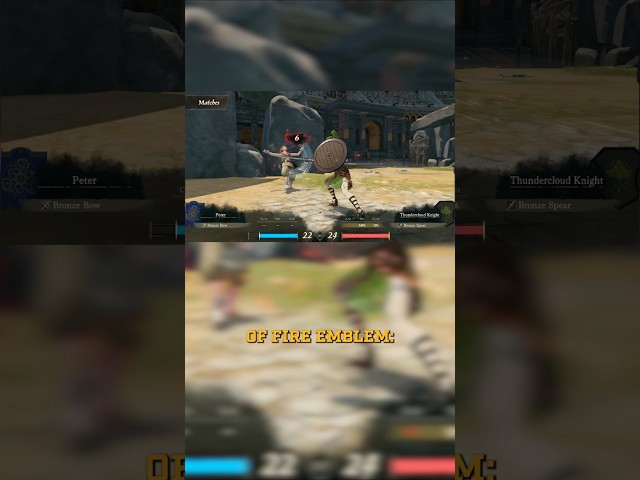
Now, we've covered tactical battles, but unlike previous Fire Emblem games, combat doesn't stop there. In Fortune's Weave, you've also got clashes, which are, effectively, old-school turn-based battles in the same sort of format as classic Final Fantasy or Pokémon games. The only difference is that you can only attack with one unit each turn, outside of link attacks, where two combatants combine to deliver a hard-hitting barrage at your opponent. Clashes, for the most part, are confined to dungeon crawling - don't worry, I'm getting there - but they also pop up in some story missions and side quests.
I can already see clashes being a potential dividing line in the Fire Emblem community, especially for the purists, but as for me, I'm a fan. These bouts add variety to the gameplay, and they're also fantastic for grinding underleveled characters. Whichever unit lands the final blow gets MVP status and more experience points, so you can use your stronger characters to whittle down enemy HP before using whichever unit you're trying to boost to deal the killing blow.
Traditionally, exploration hasn't been a core part of the Fire Emblem experience, but in Fortune's Weave, it's pretty central. You see, this game has a touch of the Persona series about it. Each main mission is separated by anything from a few days to a couple of weeks, and it's up to you what you want to use that time for. A single turn equates to six hours, so there are six turns in a day. Pretty frequently, you'll have over 100 turns to occupy your time, and that might sound like a lot, but it almost always flies by.

Like in Three Houses, you can use your time to develop relationships with recruitable characters by giving them gifts or taking them out for meals. Or, you can accept side missions from the residents of Dagda, which often require stepping outside of the capital to take on some bandits occupying a village, explore a dungeon packed with enemy clashes and resources for repairing weapons, or visit a town or port to speak with an NPC. There's plenty to keep you busy here, and it makes what is already a deep game feel even more nuanced and engaging.
On the world map, each of the four Flame Lords has their own abilities. Cai can farm vegetables and lure mounts for use in specific character classes, while Dietrich can use his sword to summon enemies before taking them on a skirmish battle - for reference, skirmishes are slimmed down, predominantly six-on-six battles you encounter on the world map. It's touches like this, outside of the narrative differences, that make each of the four Flame Lord arcs feel independent and fresh and not at all like a chore.
Every single playable character in Fire Emblem: Fortune's Weave has access to the class system, so you can cater their abilities to whichever class suits them best and upgrade once a character reaches a certain level. For example, a unit skilled with a bow and a sword is perfect for the rogue class, while the black-magic mages are a better fit for the shaman class. There's plenty of familiar options for Fire Emblem fans, including the two I just mentioned, but you've also got some new options to play with, and there's no better feeling than passing a class exam and taking your new, more powerful unit into battle.

All of this - the main missions, the map exploration, the clashes, and the classes - tie together to make Fortune's Weave feel like the most complete RPG from the Fire Emblem series to date. At first, I thought the core design and flow of the game felt a little too much like Persona or Metaphor: ReFantazio, but the more you play, the more it feels like a natural fit for Intelligent Systems' TRPG series.
While we're still on the highlight reel, it's worth touching on performance. Fortune's Weave runs like a dream on Nintendo Switch 2. I didn't experience any instances of lag or noticeable frame rate drops. Like a lot of triple-A games, it drains your battery pretty quickly if you're playing in handheld mode, but that's a hardware fault, and I can't blame Intelligent Systems for that.
Okay, so the bulk of this review has been pretty positive so far. Great battles, a compelling narrative, fresh mechanics that offer a nice change of pace, and solid performance. That's the shortened version, too - I've not even gotten into the fantastic visuals, voice acting, and soundtrack. There's a but coming, though. Remember earlier when I said I wish I could say this game is perfect? Well, I've got a couple of reasons I can't, but I can boil down my biggest issue to a single word: admin.

Fire Emblem: Fortune's Weave is heavy on the admin. To recruit new units, you need to offer them gifts or take them for a meal to boost their support level. To upgrade your blessings, you need to pray at temples. Those are just two examples, but more unlock as you go, such as taking in Dagsion's baths and theater performances, and if you're looking to optimize your playthrough, you've got to do all that once a week. Quite frankly, it's a lot, bordering on the overwhelming.
My main concern is that this in-game admin can detract from the game's overall momentum. You can be in the thick of it, following a particular character's narrative and progress in the Heroic Games, before finding yourself spending half an hour trying to boost your support with two recruitable characters, going all over the map to find gifts they might like. Not only that, but it also takes some of the fun out of exploring the world map, as you might be as far as you can get from Dagsion, and then it turns to a new week, and you feel like you've got to race back to get dinner with a healer and a brawler so they might join your ranks.
My secondary concern is that there's an alternative, but it doesn't feel good. I'll admit that I've had to rush a couple of sections to get this game completed before the review embargo, but knowing that I'm missing out on some narrative and gameplay depth made me feel like I wasn't getting the full experience. Admittedly, this problem is likely one that you won't experience, as you won't be playing on a deadline, but even still, the scope of this game can be intimidating at points.
My other gripe also ties into the admin side of things, but it's also just kind of silly. I'm talking about bird time. This mechanic is outright ridiculous. Effectively, to develop the relationship between the four Flame Lords and the game's true protagonist, the Herald of the Pale Raven, you need to feed the bird form of the protagonist. Then the perspective shifts into a sort of mini-game, and you are the bird, the Pale Raven, answering questions from the hero. You have three response options, and you're aiming to impress.

The problem here is your responses are limited to what a bird can do. You might be talking to Dietrich, who, as usual, is waxing lyrical about his desire to best every man and beast on the continent in battle, and your responses are limited to gazing intently at him, flapping your wings, or singing.
Frankly, it's as ridiculous as it sounds, and it's made more annoying by the fact that there's quite often no obvious response. It gets easier as the game progresses, but only because there's a limited pool of questions, and through trial and error you eventually learn what sort of responses each Flame Lord is looking for. Who knows, bird time could have some fans out there when the game launches, but I'm not one of them.
Outside of admin, I don't have much to complain about. The second act can get a bit repetitive, and I still need more time and playthroughs to know for sure, but it might be a bit redundant too. That's hard to explain without spoilers, but you'll know when you get there. Fortunately, the third act - which, again, I really can't talk about without ruining things, sorry - is where it all comes together and Fortune's Weave shines brightest and more than makes up for a slightly muddy middle.
The fact that there aren't multiple save files could also frustrate some as well, particularly Fire Emblem die-hards or the purists I mentioned earlier. It does feel necessary for the sort of story Intelligent Systems is trying to tell, and there's the option to revisit and replay individual chapters. However, it can still be grating if you go the wrong way on the world map and waste a few turns before accidentally auto-saving before a skirmish.
Despite these drawbacks, I honestly think Fortune's Weave might have dethroned Stardew Valley as my desert island game. A lot of my frustrations are tied to the fact that I played this game with a deadline - admittedly, a generous deadline, but a deadline nonetheless. If you've got 150-300 hours to sink into this game, it'll reward you for every minute spent. I could easily see myself replaying this game two or three times in the next year, and given its scale, that's a real commitment.

The best compliment I can pay Fire Emblem: Fortune's Weave is to say that it could be to TRPGs what The Legend of Zelda: Breath of the Wild was to the action RPG genre when it arrived back in 2017. It's revolutionary. It's all-encompassing. It's seminal. It's not perfect, but it's doing so much that not everything is going to stick. For me, though, the important bits do.
Yes, talking to the bird is silly, and the admin occasionally borders on egregious. However, the bulk of the experience - the combat, storytelling, voice acting, soundtrack, and visuals - is so rich and nuanced that it makes up for any grievances, for the most part. As I told my editor while writing this review, no game has ever demanded more of me, yet I already can't wait to play it again and again and again.
Fire Emblem: Fortune's Weave launches on September 17 and is available via the Nintendo Switch 2 eShop for $69.99. For more on the latest games, you can also check out our Orbitals review and Onimusha: Way of the Sword review.